Search
Search for projects by name or address
 CCTP v2
About
CCTP v2 is the second version of the Cross-Chain Transfer Protocol by Circle. Mainly used for USDC burn-mint transfers, it coexists with the v1 protocol but improves on its transfer speed.

About
CCTP v2 is the second version of the Cross-Chain Transfer Protocol by Circle. Mainly used for USDC burn-mint transfers, it coexists with the v1 protocol but improves on its transfer speed.





CCTP v2 is the second version of the Cross-Chain Transfer Protocol by Circle. Mainly used for USDC burn-mint transfers, it coexists with the v1 protocol but improves on its transfer speed.
Architecture
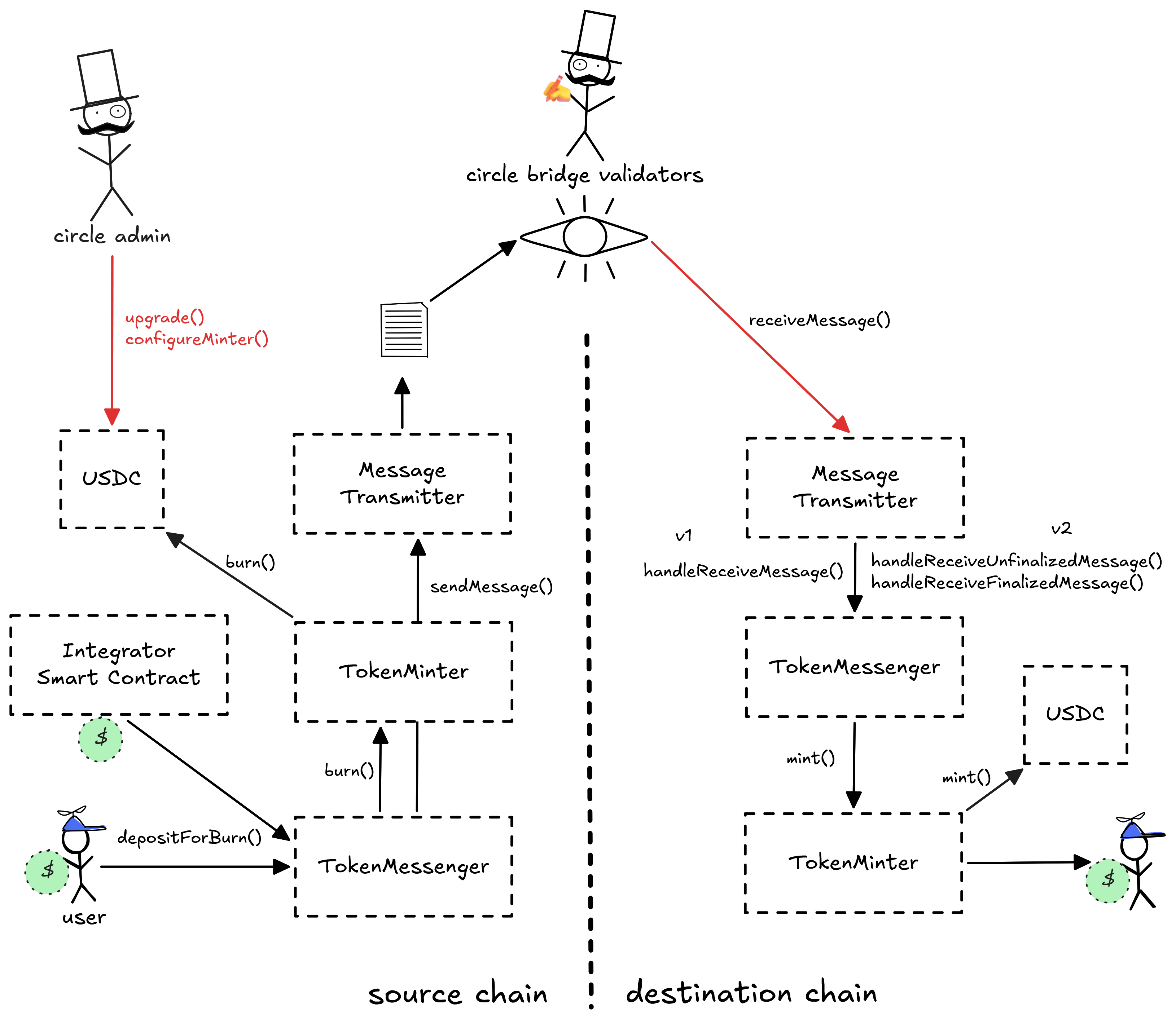
Circle’s Cross-Chain Transfer Protocol (CCTP) is a centralized burn-and-mint bridgeA message-passing protocol between two blockchains. At its most basic, a token bridge consists of a smart contract which can escrow funds on one side of the bridge, and instruct the release or minting of corresponding assets on the other side, but bridges could also support arbitrary messages. How these instructions are validated is a critical factor in assessing the trust assumptions of a bridge. for USDC and, underneath it, a generalized message-passing protocol. A source-chain TokenMessenger burns USDC through the local TokenMinter and asks the MessageTransmitter to emit a message for the destination domain. Circle’s offchain Iris attestation service observes the source transaction and acts as the oracle / attester at the destination. Anyone with the message and attestation can call receiveMessage on the destination MessageTransmitter; the contract verifies the attester signatures, prevents nonce replay, dispatches the message to the destination TokenMessenger, and mints the same amount of native USDC to the requested recipient.
CCTP v1 and v2
CCTP v1 and v2 use the same high-level flow and both can carry arbitrary message bodies. In the Ethereum discovery, v1’s MessageTransmitter and TokenMessenger are immutable contracts. CCTP v1 only supports ‘Standard Transfer’: Circle waits for a certain amount of blockAn ordered list of transactions and chain-related metadata that gets bundled together and published to the L1/DA layer. Nodes execute the transactions contained within blocks to change the rollup chain’s state. Protocol rules dictate what constitutes a valid block, and invalid blocks are skipped over. confirmations on the source chain before attesting.
CCTP v2 uses MessageTransmitterV2 and TokenMessengerV2, adds finalityStrongest confirmation rule that can be given on the ordering of transactions. On Ethereum, a transaction is finalized when the corresponding epoch becomes final, which currently takes around 15 mins from transaction inclusion. A rollup transaction can be said to be final when the corresponding data is published to L1 and its ordering cannot be reverted. If outputs, i.e. state diffs are published, then also a proof proving their correctness must be verified to consider the transaction final. thresholds, destination mint fees, and optional hook data. The new ‘Fast Transfer’ feature lets Iris attest much faster as long as Circle’s global ‘Fast Transfer’ allowance is available. Hooks are metadata passed with the burn message and are interpreted by app-level integrators rather than executed by CCTP core.
Crosschain oracle and validation
CCTP does not validate source-chain state on the destination chain. The destination MessageTransmitter verifies signatures from Circle-controlled attesters, so security depends on Circle’s offchain attestation service signing only valid source messages and protecting its signing keys. CCTP v1 is configured with a 2/2 attester threshold, while v2 is configured with a 2/2 threshold. The attester manager can change enabled attesters and thresholds, and the owner can change the attester manager.
UpgradeabilityThe ability for rollup smart contracts and parameters used in a rollup to be updated by holders of an admin key. Upgradeability represents a vector of risk for users, and should be decentralized and combined with time delays for greater security guarantees.
The v1 Ethereum contracts in discovery are immutable, but critical permissions like ownership, minters, pausing, rescuer, token-controller, and attester-manager roles govern protocol operation. V2 introduces proxied contracts; their proxy admins can replace implementations with no onchain delay. CCTP is deployed per Circle domain, so a complete risk assessment must include the corresponding contracts, signer configuration, and permissions on every supported source and destination chain.
Symbol | Last 24h
Volume | Last 24h
transfer count | Last 24h avg.
transfer time | Last 24h avg.
transfer value | |||||||||||||||||||||||||||||||||||||||||||||||||||||||||||||||||||||||||||||||||||||||||||||||
|---|---|---|---|---|---|---|---|---|---|---|---|---|---|---|---|---|---|---|---|---|---|---|---|---|---|---|---|---|---|---|---|---|---|---|---|---|---|---|---|---|---|---|---|---|---|---|---|---|---|---|---|---|---|---|---|---|---|---|---|---|---|---|---|---|---|---|---|---|---|---|---|---|---|---|---|---|---|---|---|---|---|---|---|---|---|---|---|---|---|---|---|---|---|---|---|---|---|---|---|
Symbol | Last 24h
Volume | Last 24h
transfer count | Last 24h avg.
transfer time | Last 24h avg.
transfer value | |||||||||||||||||||||||||||||||||||||||||||||||||||||||||||||||||||||||||||||||||||||||||||||||
|---|---|---|---|---|---|---|---|---|---|---|---|---|---|---|---|---|---|---|---|---|---|---|---|---|---|---|---|---|---|---|---|---|---|---|---|---|---|---|---|---|---|---|---|---|---|---|---|---|---|---|---|---|---|---|---|---|---|---|---|---|---|---|---|---|---|---|---|---|---|---|---|---|---|---|---|---|---|---|---|---|---|---|---|---|---|---|---|---|---|---|---|---|---|---|---|---|---|---|---|
Symbol | Last 24h
Volume | Last 24h
transfer count | Last 24h avg.
transfer time | Last 24h avg.
transfer value | |||||||||||||||||||||||||||||||||||||||||||||||||||||||||||||||||||||||||||||||||||||||||||||||
|---|---|---|---|---|---|---|---|---|---|---|---|---|---|---|---|---|---|---|---|---|---|---|---|---|---|---|---|---|---|---|---|---|---|---|---|---|---|---|---|---|---|---|---|---|---|---|---|---|---|---|---|---|---|---|---|---|---|---|---|---|---|---|---|---|---|---|---|---|---|---|---|---|---|---|---|---|---|---|---|---|---|---|---|---|---|---|---|---|---|---|---|---|---|---|---|---|---|---|---|
Timestamp | Tokens | Value | Bridge | Transfer time | Chains | ||||||||||||||||||||||||||||||||||||||||||||||||||||||||||||||||||||||||||||||||||||||||||||||
|---|---|---|---|---|---|---|---|---|---|---|---|---|---|---|---|---|---|---|---|---|---|---|---|---|---|---|---|---|---|---|---|---|---|---|---|---|---|---|---|---|---|---|---|---|---|---|---|---|---|---|---|---|---|---|---|---|---|---|---|---|---|---|---|---|---|---|---|---|---|---|---|---|---|---|---|---|---|---|---|---|---|---|---|---|---|---|---|---|---|---|---|---|---|---|---|---|---|---|---|
Timestamp | Tokens | Value | Bridge | Transfer time | Chains | ||||||||||||||||||||||||||||||||||||||||||||||||||||||||||||||||||||||||||||||||||||||||||||||
|---|---|---|---|---|---|---|---|---|---|---|---|---|---|---|---|---|---|---|---|---|---|---|---|---|---|---|---|---|---|---|---|---|---|---|---|---|---|---|---|---|---|---|---|---|---|---|---|---|---|---|---|---|---|---|---|---|---|---|---|---|---|---|---|---|---|---|---|---|---|---|---|---|---|---|---|---|---|---|---|---|---|---|---|---|---|---|---|---|---|---|---|---|---|---|---|---|---|---|---|
Timestamp | Tokens | Value | Bridge | Transfer time | Chains | ||||||||||||||||||||||||||||||||||||||||||||||||||||||||||||||||||||||||||||||||||||||||||||||
|---|---|---|---|---|---|---|---|---|---|---|---|---|---|---|---|---|---|---|---|---|---|---|---|---|---|---|---|---|---|---|---|---|---|---|---|---|---|---|---|---|---|---|---|---|---|---|---|---|---|---|---|---|---|---|---|---|---|---|---|---|---|---|---|---|---|---|---|---|---|---|---|---|---|---|---|---|---|---|---|---|---|---|---|---|---|---|---|---|---|---|---|---|---|---|---|---|---|---|---|
Ethereum
Actors:
Upgradeable contract with an unverified implementation that is registered as a USDC minter in the USDC token contract. Its minting allowance is set by its MasterMinter controllers.
- Can interact with USD Coin Token
- mint the token in the bounds of a preset minting allowance
- Can interact with TokenMinter
- set the local TokenMessenger, token controller, pauser, rescuer, and transfer ownership
- Can interact with TokenMessengerV2
- transfer any ERC-20 tokens out of the contract
- Can interact with USD Coin Token
- manage minter addresses MasterMinter
- Can interact with USD Coin Token
- blacklist addresses, freezing any interactions with the USDC token for them
- Can interact with GatewayWallet
- allowlist or disallowlist contract signers for Gateway burn intents
- Can upgrade with no delay
- UnverifiedUSDCMinter
- Can interact with TokenMessengerV2
- configure remote TokenMessengers, the local minter, V2 fee recipient and denylister, rescuer, and transfer ownership
- Can upgrade with no delay
- GatewayWallet
- Can interact with GatewayWallet
- configure supported tokens, withdrawal delay, burn signers, batch signers, fee recipient, pauser, denylister, contract signer allowlister, and transfer ownership
- Can interact with USD Coin Token
- mint the token in the bounds of a preset minting allowance GatewayMinter
- Can interact with MessageTransmitter
- enable or disable attesters and set the attestation signature threshold
- Can interact with MessageTransmitterV2
- pause and unpause message transmission and receiving
- Can upgrade with no delay
- GatewayMinter
- Can interact with GatewayMinter
- configure supported tokens, mint authorities, attestation signers, pauser, denylister, and transfer ownership
- Can interact with USD Coin Token
- pause the USDC token (no transfers, mints, burns)
- Can interact with MessageTransmitter
- set the attester manager, pauser, rescuer, maximum message body size, and transfer ownership
- Can interact with TokenMinterV2
- pause and unpause minting and burning through this TokenMinter
- Can interact with MessageTransmitterV2
- transfer any ERC-20 tokens out of the contract
- Can interact with TokenMessenger
- transfer any ERC-20 tokens out of the contract
- Can interact with TokenMessenger
- configure remote TokenMessengers, the local minter, V2 fee recipient and denylister, rescuer, and transfer ownership
- Can interact with GatewayMinter
- pause and unpause Gateway minting
- Can interact with MessageTransmitter
- transfer any ERC-20 tokens out of the contract
- Can interact with GatewayWallet
- denylist addresses, preventing them from interacting with the GatewayWallet
- Can interact with TokenMinterV2
- link or unlink remote tokens and configure per-message burn limits
- Can interact with TokenMinterV2
- set the local TokenMessenger, token controller, pauser, rescuer, and transfer ownership
- Can interact with GatewayMinter
- denylist addresses, preventing them from interacting with the GatewayMinter
- Can upgrade with no delay
- USD Coin Token
- Can interact with TokenMinter
- pause and unpause minting and burning through this TokenMinter
- Can interact with TokenMinter
- link or unlink remote tokens and configure per-message burn limits
- Can interact with TokenMinter
- transfer any ERC-20 tokens out of the contract
- Can interact with GatewayWallet
- pause and unpause deposits, burns, and withdrawals
- Can upgrade with no delay
- TokenMessengerV2
- Can interact with MessageTransmitterV2
- set the attester manager, pauser, rescuer, maximum message body size, and transfer ownership
- Can interact with USD Coin Token
- mint the token in the bounds of a preset minting allowance GatewayWallet
- Can upgrade with no delay
- MessageTransmitterV2
- Can interact with TokenMessengerV2
- denylist addresses, preventing them from interacting with this TokenMessenger
- Can interact with MessageTransmitterV2
- enable or disable attesters and set the attestation signature threshold
- Can interact with MessageTransmitter
- pause and unpause message transmission and receiving
- Can interact with TokenMinterV2
- transfer any ERC-20 tokens out of the contract
- Can interact with USD Coin Token
- manage all critical roles like pausers, blacklisters, minters, rescuer
Ethereum
Part of CCTP
- Roles:
- attesterManager: EOA 26
- getEnabledAttester: EOA 83, EOA 99
- owner: EOA 37
- pauser: EOA 91
- rescuer: EOA 48
Entrypoint or minter of USDC on this chain for the Gateway protocol.
- Roles:
- admin: EOA 30
- attestationSigners: EOA 24
- denylister: EOA 59
- owner: EOA 30
- pauser: EOA 47
Part of CCTP
- Roles:
- admin: EOA 80
- denylister: EOA 87
- localMessageTransmitter: MessageTransmitterV2
- owner: EOA 19
- rescuer: EOA 3
Exit point or burner of USDC on this chain for the Gateway protocol.
- Roles:
- admin: EOA 21
- attestationSigners: EOA 85
- contractSignersAllowlister: EOA 10
- denylister: EOA 50
- owner: EOA 21
- pauser: EOA 76
Part of CCTP
- Roles:
- admin: EOA 86
- attesterManager: EOA 88
- getEnabledAttester: EOA 39, EOA 49
- owner: EOA 84
- pauser: EOA 27
- rescuer: EOA 40
- Roles:
- admin: EOA 61
- blacklister: EOA 6
- masterMinter: MasterMinter; ultimately EOA 100, EOA 103, EOA 104, EOA 106, EOA 108, EOA 11, EOA 110, EOA 111, EOA 112, EOA 13, EOA 15, EOA 25, EOA 28, EOA 29, EOA 31, EOA 32, EOA 34, EOA 43, EOA 46, EOA 5, EOA 52, EOA 53, EOA 55, EOA 56, EOA 60, EOA 63, EOA 68, EOA 7, EOA 70, EOA 71, EOA 72, EOA 73, EOA 77, EOA 81, EOA 82, EOA 89, EOA 9, EOA 90, EOA 92, EOA 93, EOA 94, EOA 95, EOA 96, EOA 97
- minters: EOA 1, EOA 101, EOA 102, EOA 105, EOA 107, EOA 12, EOA 16, EOA 17, EOA 18, EOA 20, EOA 22, EOA 23, EOA 33, EOA 35, EOA 4, EOA 41, EOA 42, EOA 54, EOA 57, EOA 64, EOA 65, EOA 66, EOA 69, EOA 74, EOA 78, EOA 79, EOA 8, GatewayMinter, GatewayWallet, TokenMinter, TokenMinterV2, UnverifiedUSDCMinter; ultimately EOA 24, EOA 39, EOA 49, EOA 83, EOA 85, EOA 99
- owner: EOA 109
- pauser: EOA 36
Part of CCTP
- Roles:
- localMessageTransmitter: MessageTransmitter
- owner: EOA 45
- rescuer: EOA 44
Part of CCTP: Used for automated access control for minting.
- Roles:
- localTokenMessenger: TokenMessenger
- owner: EOA 2
- pauser: EOA 62
- rescuer: EOA 75
- tokenController: EOA 67
- Roles:
- controllers: EOA 100, EOA 103, EOA 104, EOA 106, EOA 108, EOA 11, EOA 110, EOA 111, EOA 112, EOA 13, EOA 15, EOA 25, EOA 28, EOA 29, EOA 31, EOA 32, EOA 34, EOA 43, EOA 46, EOA 5, EOA 52, EOA 53, EOA 55, EOA 56, EOA 60, EOA 63, EOA 68, EOA 7, EOA 70, EOA 71, EOA 72, EOA 73, EOA 77, EOA 81, EOA 82, EOA 9, EOA 90, EOA 92, EOA 93, EOA 94, EOA 95, EOA 96, EOA 97
- owner: EOA 89
Part of CCTP: Used for automated access control for minting.
- Roles:
- localTokenMessenger: TokenMessengerV2
- owner: EOA 58
- pauser: EOA 38
- rescuer: EOA 98
- tokenController: EOA 51
The current deployment carries some associated risks:
Funds can be stolen if a contract receives a malicious code upgrade. There is no delay on code upgrades (CRITICAL).