Search
Search for projects and tokens by name or address
 Form
FormForm
Badges
About
Form is an Optimium utilizing the OP Stack. The Form L2 is focused on bringing mass adoption and interoperability to the SocialFi category.
Badges
About
Form is an Optimium utilizing the OP Stack. The Form L2 is focused on bringing mass adoption and interoperability to the SocialFi category.
Why is the project listed in others?
Consequence: projects without a proper proof system fully rely on single entities to safely update the state. A malicious proposer can finalize an invalid state, which can cause loss of funds.
Consequence: projects without a data availability bridge fully rely on single entities (the sequencer) to honestly rely available data roots on Ethereum. A malicious sequencer can collude with the proposer to finalize an unavailable state, which can cause loss of funds.
Learn more about the recategorisation here.
The section shows the operating costs that L2s pay to Ethereum.
This section shows how "live" the project's operators are by displaying how frequently they submit transactions of the selected type. It also highlights anomalies - significant deviations from their typical schedule.
Funds can be stolen if
Funds can be lost if
Funds can be frozen if
MEV can be extracted if
In the event of a sequencerA party responsible for ordering and executing transactions on the rollup. The sequencer verifies transactions, compresses the data into a block, and submits the data related to it to enable state reconstruction to Ethereum L1 as a single transaction. The data can be either transaction data or state diffs. failure, users can force transactions to be included in the project’s chain by sending them to L1Layer 1 (L1) is a blockchain that is self-reliant on its validator set for its security and consensus properties. Ethereum is an example of a layer 1. Blockchains started receiving the moniker of layer 1 once layer 2 became a meaningful area of development.. There can be up to a 12h delay on this operation.
Currently the system permits invalid state rootsA cryptographic hash succinctly representing a state using a Merkle tree.. More details in project overview.
Proof construction and state derivation fully rely on data that is posted on Celestia. SequencerA party responsible for ordering and executing transactions on the rollup. The sequencer verifies transactions, compresses the data into a block, and submits the data related to it to enable state reconstruction to Ethereum L1 as a single transaction. The data can be either transaction data or state diffs. tx roots are not checked against the Blobstream bridgeA message-passing protocol between two blockchains. At its most basic, a token bridge consists of a smart contract which can escrow funds on one side of the bridge, and instruct the release or minting of corresponding assets on the other side, but bridges could also support arbitrary messages. How these instructions are validated is a critical factor in assessing the trust assumptions of a bridge. data roots onchain, but L2Layer 2 (L2) is a category of technical solutions aimed to scale the base layer in a trust minimized way. This category includes solutions like rollups as well as state channels and plasma. Other solutions are able to scale further, but with the introduction of additional trust assumptions, which are therefore not trust minimized. Sometimes the term Layer 2 is used to refer to include these solutions too, like validiums and optimiums, but to distinguish between trust minimized and non trust minimized solutions they are often referred to as "light" L2s, opposed to "strong" L2s like rollups. nodes can verify data availabilityThe property of a rollup's data being reachable by any node retrieving the data that were rolled up and executed to reach the proposed state. Data availability (DA), specifically decoupling it from the rollup nodes themselves, is one of the preeminent factors which allows a rollup to scale securely. A rollup is faced with a decision of what to use as a DA layer to guarantee that any node can retrieve this data--permissionlessly under any circumstance. For this reason, using Ethereum for DA currently provides the strongest security guarantees. If data is stored somewhere other than a permissionless L1, then the project is not a rollup, but rather a validium or an optimium. by running a Celestia light clientSometimes labelled interchangeably as a “node”, they are tasked with processing transactions and managing the blockchains's state. They run the computations for each transaction according to the rollup's virtual machine and protocol rules. If comparing to Ethereum clients, these would be execution clients such as Geth, as opposed to consensus clients..
There is no window for users to exit in case of an unwanted upgrade since contracts are instantly upgradable.
Only the whitelisted proposers can publish state rootsA cryptographic hash succinctly representing a state using a Merkle tree. on L1Layer 1 (L1) is a blockchain that is self-reliant on its validator set for its security and consensus properties. Ethereum is an example of a layer 1. Blockchains started receiving the moniker of layer 1 once layer 2 became a meaningful area of development., so in the event of failure the withdrawals are frozen.
Data is posted to Celestia
Transactions roots are posted onchain and the full data is posted on Celestia. Since the Blobstream bridgeA message-passing protocol between two blockchains. At its most basic, a token bridge consists of a smart contract which can escrow funds on one side of the bridge, and instruct the release or minting of corresponding assets on the other side, but bridges could also support arbitrary messages. How these instructions are validated is a critical factor in assessing the trust assumptions of a bridge. is not used, availability of the data is not verified against Celestia validatorsIn the context of L2s, a Validator is an actor that validates the correctness of state transitions. For optimistic rollups this corresponds to challengers, and for ZK rollups this corresponds to the onchain verifier, meaning that the SequencerA party responsible for ordering and executing transactions on the rollup. The sequencer verifies transactions, compresses the data into a block, and submits the data related to it to enable state reconstruction to Ethereum L1 as a single transaction. The data can be either transaction data or state diffs. can single-handedly publish unavailable roots. If Celestia becomes unavailable, the sequencer falls back to Ethereum.
Funds can be lost if the sequencer posts an unavailable transaction root (CRITICAL).
Funds can be lost if the data is not available on the external provider (CRITICAL).
OP Stack projects can use the OP fault proof systemThe infrastructure that allows projects to verify their state transitions. It is composed by onchain verifiers and offchain provers. The main two flavors are optimistic and ZK proof systems, but they can be combined in a hybrid model. In general though, if a system is able to accept state roots optimistically, even if it has a ZK component, it is considered an optimistic proof system., already being deployed on some. This project though is not using fault proofs yet and is relying on the honesty of the permissioned ProposerIn the context of L2s, the actor that proposes a claimed state root on L1. The term is also used in the context of Ethereum to refer to the actor that proposes a new block. and Challengers to ensure state correctness. The smart contract system permits invalid state rootsA cryptographic hash succinctly representing a state using a Merkle tree..
Funds can be stolen if an invalid state root is submitted to the system (CRITICAL).
Past upgrades
The metrics include upgrades on the currently used proxy contracts. Historical proxy contracts and changes of such are not included.
2025 October 07, 09:45 UTC3changesTwo members removed from multisig.
Two members removed from multisig.
| contract Caldera Multisig 3 (eth:0x2bf43034b9559643e986A2fE3cE015a18247b904) { | |
| +++ description: None | |
| values.$members.5: | |
| - | "eth:0x2F2d46D3dD36c8d1ae2Cb81c0cD2c05C68DBA675" |
| values.$members.7: | |
| - | "eth:0x12ee26aD74d50a1f6BDD90811387d1e0f3e7C76A" |
| values.multisigThreshold: | |
| - | "4 of 9 (44%)" |
| + | "4 of 7 (57%)" |
| } | |
2025 October 02, 07:08 UTC3changesCaldera multisig members decrease.
Caldera multisig members decrease.
| contract Caldera Multisig 3 (eth:0x2bf43034b9559643e986A2fE3cE015a18247b904) { | |
| +++ description: None | |
| values.$members.9: | |
| - | "eth:0xbf853295743511e8DC5F03809d209C33fC136d24" |
| values.$members.10: | |
| - | "eth:0x15D5fF2dEc328a1cF3D64413caaBdcE29bff050A" |
| values.multisigThreshold: | |
| - | "4 of 11 (36%)" |
| + | "4 of 9 (44%)" |
| } | |
2025 September 30, 16:42 UTC4changesCaldera multisig threshold increase.
Caldera multisig threshold increase.
| contract Caldera Multisig 3 (eth:0x2bf43034b9559643e986A2fE3cE015a18247b904) { | |
| +++ description: None | |
| values.$members.0: | |
| + | "eth:0x62ea938a30826c8794C8B8BbA775B91cAE3B849A" |
| values.$members.1: | |
| + | "eth:0xe5219fe14E2FD520Ff80be036790913053d1575d" |
| values.$members.2: | |
| + | "eth:0xEC114946E7213d113c9B9481028271B5E9e09371" |
| values.multisigThreshold: | |
| - | "4 of 8 (50%)" |
| + | "4 of 11 (36%)" |
| } | |
2025 September 26, 08:38 UTC2changesCaldera multisig threshold change.
Caldera multisig threshold change.
| contract Caldera Multisig 3 (eth:0x2bf43034b9559643e986A2fE3cE015a18247b904) { | |
| +++ description: None | |
| values.$members.0: | |
| + | "eth:0x9e14B1baFCEB80B67934aBE4fB00a7291aCfBcD0" |
| values.multisigThreshold: | |
| - | "4 of 7 (57%)" |
| + | "4 of 8 (50%)" |
| } | |
2025 August 12, 14:46 UTC3changescaldera multisig: 2 signers removed.
caldera multisig: 2 signers removed.
| contract Caldera Multisig 3 (0x2bf43034b9559643e986A2fE3cE015a18247b904) { | |
| +++ description: None | |
| values.$members.6: | |
| - | "eth:0xD61640d06dC7A61C46d9515680b4DDd2AC51E9A9" |
| values.$members.7: | |
| - | "eth:0xb004d94314a34627C09E4b8f83D9E7420d99BbFC" |
| values.multisigThreshold: | |
| - | "4 of 9 (44%)" |
| + | "4 of 7 (57%)" |
| } | |
The system has a centralized operator
The operatorAn operator is the entity charged with managing a rollup and progressing its state. A rollup operator can be a centralized sequencer, proposer, prover, challenger, pauser of admin that is able to perform upgrades. is the only entity that can propose blocksAn ordered list of transactions and chain-related metadata that gets bundled together and published to the L1/DA layer. Nodes execute the transactions contained within blocks to change the rollup chain’s state. Protocol rules dictate what constitutes a valid block, and invalid blocks are skipped over.. A live and trustworthy operator is vital to the health of the system.
MEV can be extracted if the operator exploits their centralized position and frontruns user transactions.
Users can force any transaction
Because the state of the system is based on transactions submitted on the underlying host chain and anyone can submit their transactions there it allows the users to circumvent censorship by interacting with the smart contract on the host chain directly.
Regular messaging
The user initiates L2Layer 2 (L2) is a category of technical solutions aimed to scale the base layer in a trust minimized way. This category includes solutions like rollups as well as state channels and plasma. Other solutions are able to scale further, but with the introduction of additional trust assumptions, which are therefore not trust minimized. Sometimes the term Layer 2 is used to refer to include these solutions too, like validiums and optimiums, but to distinguish between trust minimized and non trust minimized solutions they are often referred to as "light" L2s, opposed to "strong" L2s like rollups.->L1Layer 1 (L1) is a blockchain that is self-reliant on its validator set for its security and consensus properties. Ethereum is an example of a layer 1. Blockchains started receiving the moniker of layer 1 once layer 2 became a meaningful area of development. messages by submitting a regular transaction on this chain. When the blockAn ordered list of transactions and chain-related metadata that gets bundled together and published to the L1/DA layer. Nodes execute the transactions contained within blocks to change the rollup chain’s state. Protocol rules dictate what constitutes a valid block, and invalid blocks are skipped over. containing that transaction is settled, the message becomes available for processing on L1. The process of block finalization takes a challenge periodIn optimistic rollups, the window of time wherein network participants can assert that some fraud was included in a prior block. Most optimistic rollups currently specify a challenge window of 7 days. By extending the period, there is more time for participants to guard against fraud (invalid state transitions), but also more time until withdrawals gets enabled. of 7d to complete.
Funds can be frozen if the centralized validator goes down. Users cannot produce blocks themselves and exiting the system requires new block production (CRITICAL).
Forced messaging
If the user experiences censorship from the operatorAn operator is the entity charged with managing a rollup and progressing its state. A rollup operator can be a centralized sequencer, proposer, prover, challenger, pauser of admin that is able to perform upgrades. with regular L2Layer 2 (L2) is a category of technical solutions aimed to scale the base layer in a trust minimized way. This category includes solutions like rollups as well as state channels and plasma. Other solutions are able to scale further, but with the introduction of additional trust assumptions, which are therefore not trust minimized. Sometimes the term Layer 2 is used to refer to include these solutions too, like validiums and optimiums, but to distinguish between trust minimized and non trust minimized solutions they are often referred to as "light" L2s, opposed to "strong" L2s like rollups.->L1Layer 1 (L1) is a blockchain that is self-reliant on its validator set for its security and consensus properties. Ethereum is an example of a layer 1. Blockchains started receiving the moniker of layer 1 once layer 2 became a meaningful area of development. messaging they can submit their messages directly on L1. The system is then obliged to service this request or halt all messages, including forced withdrawals from L1 and regular messages initiated on L2. Once the force operation is submitted and if the request is serviced, the operation follows the flow of a regular message.
EVM compatible smart contracts are supported
OP stack chains are pursuing the EVM EquivalenceA perfect degree of compatibility; where one system or concept is indistinguishable from another in the domain being compared. In the context of rollups, it generally refers to the proximity to the EVM and to Ethereum architecture. model. No changes to smart contracts are required regardless of the language they are written in, i.e. anything deployed on L1Layer 1 (L1) is a blockchain that is self-reliant on its validator set for its security and consensus properties. Ethereum is an example of a layer 1. Blockchains started receiving the moniker of layer 1 once layer 2 became a meaningful area of development. can be deployed on L2Layer 2 (L2) is a category of technical solutions aimed to scale the base layer in a trust minimized way. This category includes solutions like rollups as well as state channels and plasma. Other solutions are able to scale further, but with the introduction of additional trust assumptions, which are therefore not trust minimized. Sometimes the term Layer 2 is used to refer to include these solutions too, like validiums and optimiums, but to distinguish between trust minimized and non trust minimized solutions they are often referred to as "light" L2s, opposed to "strong" L2s like rollups..
Ethereum
Actors:
A Multisig with 4/7 threshold.
- Can upgrade with no delay
- L2OutputOracle ProxyAdmin
- OptimismPortal ProxyAdmin
- L1ERC721Bridge ProxyAdmin
- OptimismMintableERC20Factory ProxyAdmin
- SuperchainConfig ProxyAdmin
- SystemConfig ProxyAdmin
- L1StandardBridge ProxyAdmin
- L1CrossDomainMessenger ProxyAdmin
- Can interact with AddressManager
- set and change address mappings ProxyAdmin
- Can interact with OptimismPortal
- Allowed to pause withdrawals. In op stack systems with a proof systemThe infrastructure that allows projects to verify their state transitions. It is composed by onchain verifiers and offchain provers. The main two flavors are optimistic and ZK proof systems, but they can be combined in a hybrid model. In general though, if a system is able to accept state roots optimistically, even if it has a ZK component, it is considered an optimistic proof system., the Guardian can also blacklist dispute games and set the respected game type (permissioned / permissionlessAnyone willing should be able to join and leave the network at any time, without causing significant disturbance to the network or being detrimental to the party in question. No single entity should have the power to allowlist or blocklist participants.)
- Can interact with SuperchainConfig
- Allowed to pause withdrawals. In op stack systems with a proof system, the Guardian can also blacklist dispute games and set the respected game type (permissioned / permissionless)
- Can interact with SystemConfig
- it can update the preconfer address, the batch submitter (SequencerA party responsible for ordering and executing transactions on the rollup. The sequencer verifies transactions, compresses the data into a block, and submits the data related to it to enable state reconstruction to Ethereum L1 as a single transaction. The data can be either transaction data or state diffs.) address and the gasA virtual fuel used to execute smart contracts on a rollup. The EVM (or other VM within the rollup) uses an accounting mechanism to correspond the consumption of gas to the consumption of computing resources, and to limit the consumption of computing resources. configuration of the system
- Can interact with L2OutputOracle
- Allowed to challenge or delete state rootsA cryptographic hash succinctly representing a state using a Merkle tree. proposed by a ProposerIn the context of L2s, the actor that proposes a claimed state root on L1. The term is also used in the context of Ethereum to refer to the actor that proposes a new block.
- Can interact with L2OutputOracle
- Allowed to post new state rootsA cryptographic hash succinctly representing a state using a Merkle tree. of the current layer to the host chain
- Can interact with SystemConfig
- Allowed to commit transactions from the current layer to the host chain
Ethereum
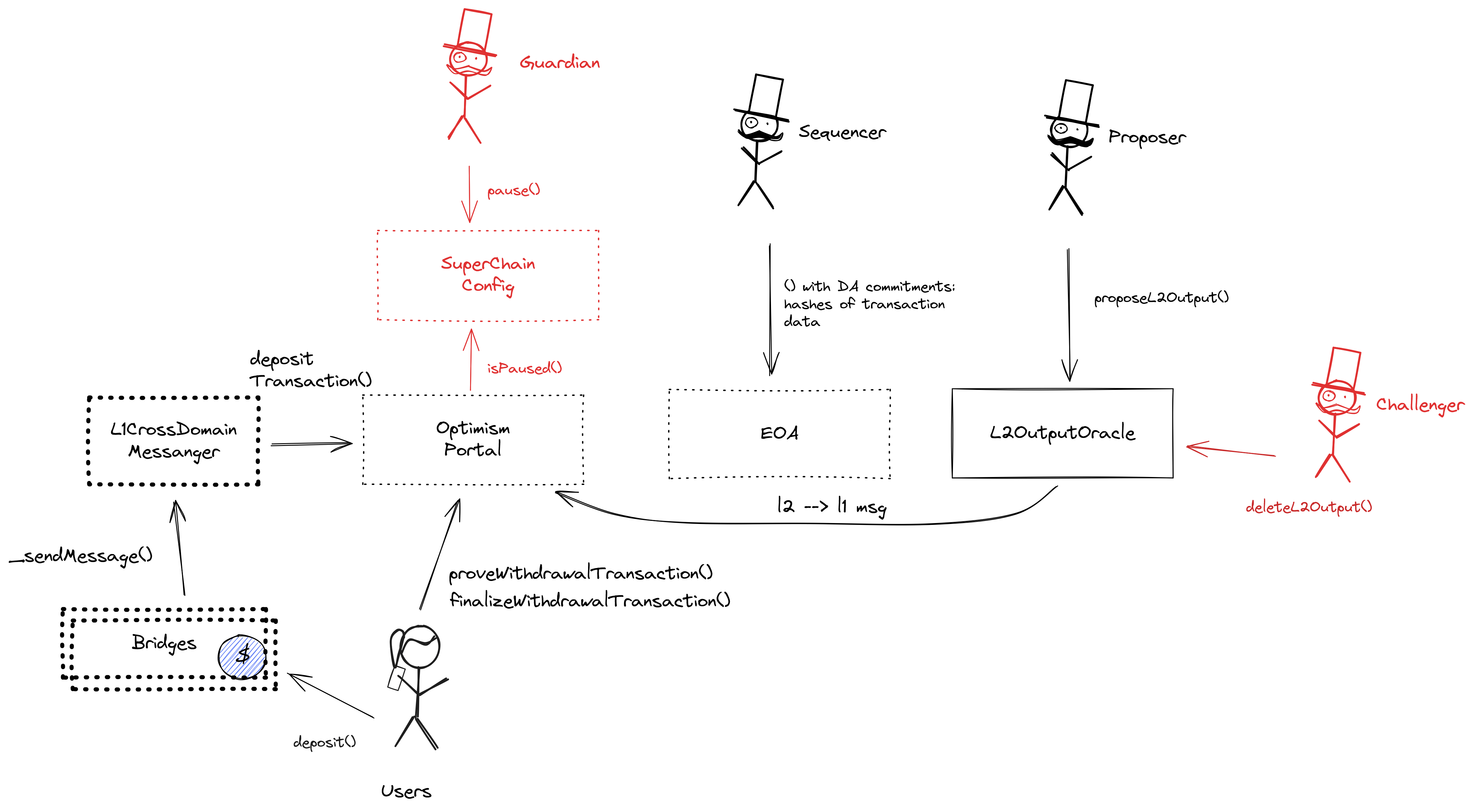
Contains a list of proposed state rootsA cryptographic hash succinctly representing a state using a Merkle tree. which Proposers assert to be a result of blockAn ordered list of transactions and chain-related metadata that gets bundled together and published to the L1/DA layer. Nodes execute the transactions contained within blocks to change the rollup chain’s state. Protocol rules dictate what constitutes a valid block, and invalid blocks are skipped over. execution. Currently only the PROPOSERIn the context of L2s, the actor that proposes a claimed state root on L1. The term is also used in the context of Ethereum to refer to the actor that proposes a new block. address can submit new state roots.
- Roles:
- admin: ProxyAdmin; ultimately Caldera Multisig 3
- challenger: EOA 1
- proposer: EOA 2
The main entry point to deposit funds from host chain to this chain. It also allows to prove and finalize withdrawals.
- Roles:
- admin: ProxyAdmin; ultimately Caldera Multisig 3
- guardian: Caldera Multisig 3
Contains configuration parameters such as the SequencerA party responsible for ordering and executing transactions on the rollup. The sequencer verifies transactions, compresses the data into a block, and submits the data related to it to enable state reconstruction to Ethereum L1 as a single transaction. The data can be either transaction data or state diffs. address, gas limitThe maximum amount of gas a transaction or block may consume. on this chain and the unsafe blockAn ordered list of transactions and chain-related metadata that gets bundled together and published to the L1/DA layer. Nodes execute the transactions contained within blocks to change the rollup chain’s state. Protocol rules dictate what constitutes a valid block, and invalid blocks are skipped over. signer address.
- Roles:
- admin: ProxyAdmin; ultimately Caldera Multisig 3
- batcherHash: EOA 3
- owner: Caldera Multisig 3
This is NOT the shared SuperchainConfig contract of the OP stack Superchain but rather a local fork. It manages the PAUSED_SLOT, a boolean value indicating whether the local chain is paused, and GUARDIAN_SLOT, the address of the guardian which can pause and unpause the system.
- Roles:
- admin: ProxyAdmin; ultimately Caldera Multisig 3
- guardian: Caldera Multisig 3
Used to bridgeA message-passing protocol between two blockchains. At its most basic, a token bridge consists of a smart contract which can escrow funds on one side of the bridge, and instruct the release or minting of corresponding assets on the other side, but bridges could also support arbitrary messages. How these instructions are validated is a critical factor in assessing the trust assumptions of a bridge. ERC-721 tokens from host chain to this chain.
- Roles:
- admin: ProxyAdmin; ultimately Caldera Multisig 3
The main entry point to deposit ERC20 tokens from host chain to this chain.
- Roles:
- admin: ProxyAdmin; ultimately Caldera Multisig 3
All supported tokens in this escrow are included in the value secured calculation.
Sends messages from host chain to this chain, and relays messages back onto host chain. In the event that a message sent from host chain to this chain is rejected for exceeding this chain’s epoch gas limitThe maximum amount of gas a transaction or block may consume., it can be resubmitted via this contract’s replay function.
- Roles:
- admin: ProxyAdmin; ultimately Caldera Multisig 3
A helper contract that generates OptimismMintableERC20 contracts on the networkA constellation of nodes (peers) that communicate via a peer-to-peer protocol, for example, in propagating transactions and blocks to other nodes. it’s deployed to. OptimismMintableERC20 is a standard extension of the base ERC20 token contract designed to allow the L1StandardBridge contracts to mint and burn tokens. This makes it possible to use an OptimismMintableERC20 as this chain’s representation of a token on the host chain, or vice-versa.
- Roles:
- admin: ProxyAdmin; ultimately Caldera Multisig 3
- Roles:
- owner: Caldera Multisig 3
The current deployment carries some associated risks:
Funds can be stolen if a contract receives a malicious code upgrade. There is no delay on code upgrades (CRITICAL).