Search
Search for projects by name or address
 Fuel Ignition
Fuel Ignition
Badges
About
Fuel Ignition is a high-performance Ethereum L2 built on FuelVM and the Sway language.
Badges
About
Fuel Ignition is a high-performance Ethereum L2 built on FuelVM and the Sway language.
Why is the project listed in others?
Consequence: projects without a proper proof system fully rely on single entities to safely update the state. A malicious proposer can finalize an invalid state, which can cause loss of funds.
Consequence: projects without a data availability bridge fully rely on single entities (the sequencer) to honestly rely available data roots on Ethereum. A malicious sequencer can collude with the proposer to finalize an unavailable state, which can cause loss of funds.
Learn more about the recategorisation here.
The section shows the operating costs that L2s pay to Ethereum.
Fuel bridge unpaused
2026 Jul 10th
Fuel unpauses the bridgeA message-passing protocol between two blockchains. At its most basic, a token bridge consists of a smart contract which can escrow funds on one side of the bridge, and instruct the release or minting of corresponding assets on the other side, but bridges could also support arbitrary messages. How these instructions are validated is a critical factor in assessing the trust assumptions of a bridge. after an eight-day pause.
Fuel bridge paused
2026 Jul 2nd
Fuel pauses the bridgeA message-passing protocol between two blockchains. At its most basic, a token bridge consists of a smart contract which can escrow funds on one side of the bridge, and instruct the release or minting of corresponding assets on the other side, but bridges could also support arbitrary messages. How these instructions are validated is a critical factor in assessing the trust assumptions of a bridge., stopping deposits and withdrawal messages.
Funds can be stolen if
Funds can be lost if
Funds can be frozen if
MEV can be extracted if
In the event of a sequencerA party responsible for ordering and executing transactions on the rollup. The sequencer verifies transactions, compresses the data into a block, and submits the data related to it to enable state reconstruction to Ethereum L1 as a single transaction. The data can be either transaction data or state diffs. failure, users can force transactions to be included in the project’s chain by sending them to L1Layer 1 (L1) is a blockchain that is self-reliant on its validator set for its security and consensus properties. Ethereum is an example of a layer 1. Blockchains started receiving the moniker of layer 1 once layer 2 became a meaningful area of development..
Currently the system permits invalid state rootsA cryptographic hash succinctly representing a state using a Merkle tree.. More details in project overview.
Proof construction and state derivation fully rely on data that is posted on EigenDA. The sequencerA party responsible for ordering and executing transactions on the rollup. The sequencer verifies transactions, compresses the data into a block, and submits the data related to it to enable state reconstruction to Ethereum L1 as a single transaction. The data can be either transaction data or state diffs. is publishing data to EigenDA v2. Sequencer transaction data roots are not checked against the DACert VerifierAn entity in a ZK-Rollup, often a smart contract, that verifies zero-knowledge proofs submitted by a prover. onchain.
There is no window for users to exit in case of an unwanted upgrade since contracts are instantly upgradable.
Only the whitelisted proposers can publish state rootsA cryptographic hash succinctly representing a state using a Merkle tree. on L1Layer 1 (L1) is a blockchain that is self-reliant on its validator set for its security and consensus properties. Ethereum is an example of a layer 1. Blockchains started receiving the moniker of layer 1 once layer 2 became a meaningful area of development., so in the event of failure the withdrawals are frozen.
Data is posted to EigenDA
No transactions roots are posted onchain and the full data is posted on EigenDA. Since the ServiceManager bridgeA message-passing protocol between two blockchains. At its most basic, a token bridge consists of a smart contract which can escrow funds on one side of the bridge, and instruct the release or minting of corresponding assets on the other side, but bridges could also support arbitrary messages. How these instructions are validated is a critical factor in assessing the trust assumptions of a bridge. is not used, availability of the data is not verified against EigenDA operators, meaning that data is not guaranteed to be available.
Funds can be lost if the data is not available on the external provider (CRITICAL).
Ultimately, Fuel will use one round fraud proofs with single round performed via a RISC-VA free and open-source instruction set architecure (ISA) used in hardware and software. It is simple and well specified, for this reason it is chosen as an ISA for several zkVMs (usually 32-bit version with base integer instructions and multiplication extension RV32IM).-based zkVMA special type of zk proving system that proves the correctness of state transitions of a virtual machine. Computation is represented by a program in a specific instruction language, it can have private and public inputs and public outputs. Most of zkVMs are STARKs.. Currently, there is a 1d challenge periodIn optimistic rollups, the window of time wherein network participants can assert that some fraud was included in a prior block. Most optimistic rollups currently specify a challenge window of 7 days. By extending the period, there is more time for participants to guard against fraud (invalid state transitions), but also more time until withdrawals gets enabled..
Funds can be stolen if an invalid state root is submitted to the system by the proposer (CRITICAL).
Past upgrades
The metrics include upgrades on the currently used proxy contracts. Historical proxy contracts and changes of such are not included.
2026 July 15, 13:59 UTC1changeFuelMessagePortal is no longer paused.
FuelMessagePortal is no longer paused.
| contract FuelMessagePortal (eth:0xAEB0c00D0125A8a788956ade4f4F12Ead9f65DDf) [N/A] { | |
| +++ description: None | |
| values.paused: | |
| - | true |
| + | false |
| } | |
2026 July 06, 11:02 UTC8changesPaused the bridge: no deposits and withdrawals messages could be processed now. I haven't found any public communication about it. Also reduced sc from 7 out of 10 to 4 out of 6 by removing 4 members.
Paused the bridge: no deposits and withdrawals messages could be processed now. I haven’t found any public communication about it.
Also reduced sc from 7 out of 10 to 4 out of 6 by removing 4 members.
| contract Fuel Security Council (eth:0x32da601374b38154f05904B16F44A1911Aa6f314) [GnosisSafe] { | |
| +++ description: None | |
| values.$members.0: | |
| - | "eth:0x7cdbF64f57f0D623D924d2b4c17664c1Cd9f93d4" |
| values.$members.1: | |
| - | "eth:0x8a34B78Feb23b97b5ccDf83D9aDC7669C34D346F" |
| values.$members.3: | |
| - | "eth:0xd4c29D8ddC7D3E326030270f35d9FD4973AbBE09" |
| values.$members.4: | |
| - | "eth:0x446f9d40cA491cf0788dacCAc4D16d5d8B4015Cc" |
| values.$threshold: | |
| - | 7 |
| + | 4 |
| values.multisigThreshold: | |
| - | "7 of 10 (70%)" |
| + | "4 of 6 (67%)" |
| } | |
| - | Status: DELETED |
| contract Safe (eth:0x446f9d40cA491cf0788dacCAc4D16d5d8B4015Cc) [GnosisSafe] | |
| +++ description: None | |
| contract FuelMessagePortal (eth:0xAEB0c00D0125A8a788956ade4f4F12Ead9f65DDf) [N/A] { | |
| +++ description: None | |
| values.paused: | |
| - | false |
| + | true |
| } | |
2026 March 12, 12:43 UTC2changesFuelChainState contract unpaused (bridge maintenance complete). New COMMITTER ROLE member added (0x32da601374b38154f05904B16F44A1911Aa6f314), which is the Fuel Security Council multisig.
FuelChainState contract unpaused (bridge maintenance complete). New COMMITTER_ROLE member added (0x32da601374b38154f05904B16F44A1911Aa6f314), which is the Fuel Security Council multisig.
| contract FuelChainState (eth:0xf3D20Db1D16A4D0ad2f280A5e594FF3c7790f130) { | |
| +++ description: None | |
| values.paused: | |
| - | true |
| + | false |
| values.accessControl.COMMITTER_ROLE.members.1: | |
| + | "eth:0x32da601374b38154f05904B16F44A1911Aa6f314" |
| } | |
2026 January 09, 15:10 UTC3changesSecurity Council member removed (0x81ACA96D4Ae0932d2F3463a043392efcCB1F05b6), threshold reduced from 8/11 (73%) to 7/10 (70%).
Security Council member removed (0x81ACA96D4Ae0932d2F3463a043392efcCB1F05b6), threshold reduced from 8/11 (73%) to 7/10 (70%).
| contract Fuel Security Council (eth:0x32da601374b38154f05904B16F44A1911Aa6f314) { | |
| +++ description: None | |
| values.$members.9: | |
| - | "eth:0x81ACA96D4Ae0932d2F3463a043392efcCB1F05b6" |
| values.$threshold: | |
| - | 8 |
| + | 7 |
| values.multisigThreshold: | |
| - | "8 of 11 (73%)" |
| + | "7 of 10 (70%)" |
| } | |
2025 October 21, 13:02 UTC3changesMultisig member removed and threshold decreased.
Multisig member removed and threshold decreased.
| contract Fuel Security Council (eth:0x32da601374b38154f05904B16F44A1911Aa6f314) { | |
| +++ description: None | |
| values.$members.3: | |
| - | "eth:0x76707a7F4b40ecFCc7431A3D7345Ef597ee7e306" |
| values.$threshold: | |
| - | 9 |
| + | 8 |
| values.multisigThreshold: | |
| - | "9 of 12 (75%)" |
| + | "8 of 11 (73%)" |
| } | |
The system has a centralized sequencer
While forcing transaction is open to anyone the system employs a privileged sequencerA party responsible for ordering and executing transactions on the rollup. The sequencer verifies transactions, compresses the data into a block, and submits the data related to it to enable state reconstruction to Ethereum L1 as a single transaction. The data can be either transaction data or state diffs. that has priority for submitting transaction batches and ordering transactions.
MEV can be extracted if the operator exploits their centralized position and frontruns user transactions.
Users can force any transaction
Because the state of the system is based on transactions submitted on the underlying host chain and anyone can submit their transactions there it allows the users to circumvent censorship by interacting with the smart contract on the host chain directly.
Regular messaging
The user initiates L2Layer 2 (L2) is a category of technical solutions aimed to scale the base layer in a trust minimized way. This category includes solutions like rollups as well as state channels and plasma. Other solutions are able to scale further, but with the introduction of additional trust assumptions, which are therefore not trust minimized. Sometimes the term Layer 2 is used to refer to include these solutions too, like validiums and optimiums, but to distinguish between trust minimized and non trust minimized solutions they are often referred to as "light" L2s, opposed to "strong" L2s like rollups.->L1Layer 1 (L1) is a blockchain that is self-reliant on its validator set for its security and consensus properties. Ethereum is an example of a layer 1. Blockchains started receiving the moniker of layer 1 once layer 2 became a meaningful area of development. messages by submitting a regular transaction on this chain. When the blockAn ordered list of transactions and chain-related metadata that gets bundled together and published to the L1/DA layer. Nodes execute the transactions contained within blocks to change the rollup chain’s state. Protocol rules dictate what constitutes a valid block, and invalid blocks are skipped over. containing that transaction is settled, the message becomes available for processing on L1. The process of block finalization usually takes several days to complete.
Forced messaging
If the user experiences censorship from the operatorAn operator is the entity charged with managing a rollup and progressing its state. A rollup operator can be a centralized sequencer, proposer, prover, challenger, pauser of admin that is able to perform upgrades. with regular L2Layer 2 (L2) is a category of technical solutions aimed to scale the base layer in a trust minimized way. This category includes solutions like rollups as well as state channels and plasma. Other solutions are able to scale further, but with the introduction of additional trust assumptions, which are therefore not trust minimized. Sometimes the term Layer 2 is used to refer to include these solutions too, like validiums and optimiums, but to distinguish between trust minimized and non trust minimized solutions they are often referred to as "light" L2s, opposed to "strong" L2s like rollups.->L1Layer 1 (L1) is a blockchain that is self-reliant on its validator set for its security and consensus properties. Ethereum is an example of a layer 1. Blockchains started receiving the moniker of layer 1 once layer 2 became a meaningful area of development. messaging they can submit their messages directly on L1. The system is then obliged to service this request or halt all messages, including forced withdrawals from L1 and regular messages initiated on L2. Once the force operation is submitted and if the request is serviced, the operation follows the flow of a regular message.
Fuel operates via the FuelVM and the Sway language
The FuelVM makes use of the UTXO model and a register-based design to enable parallel transaction processing. The language used is Sway and it does not support Solidity contracts.
Ethereum
Actors:
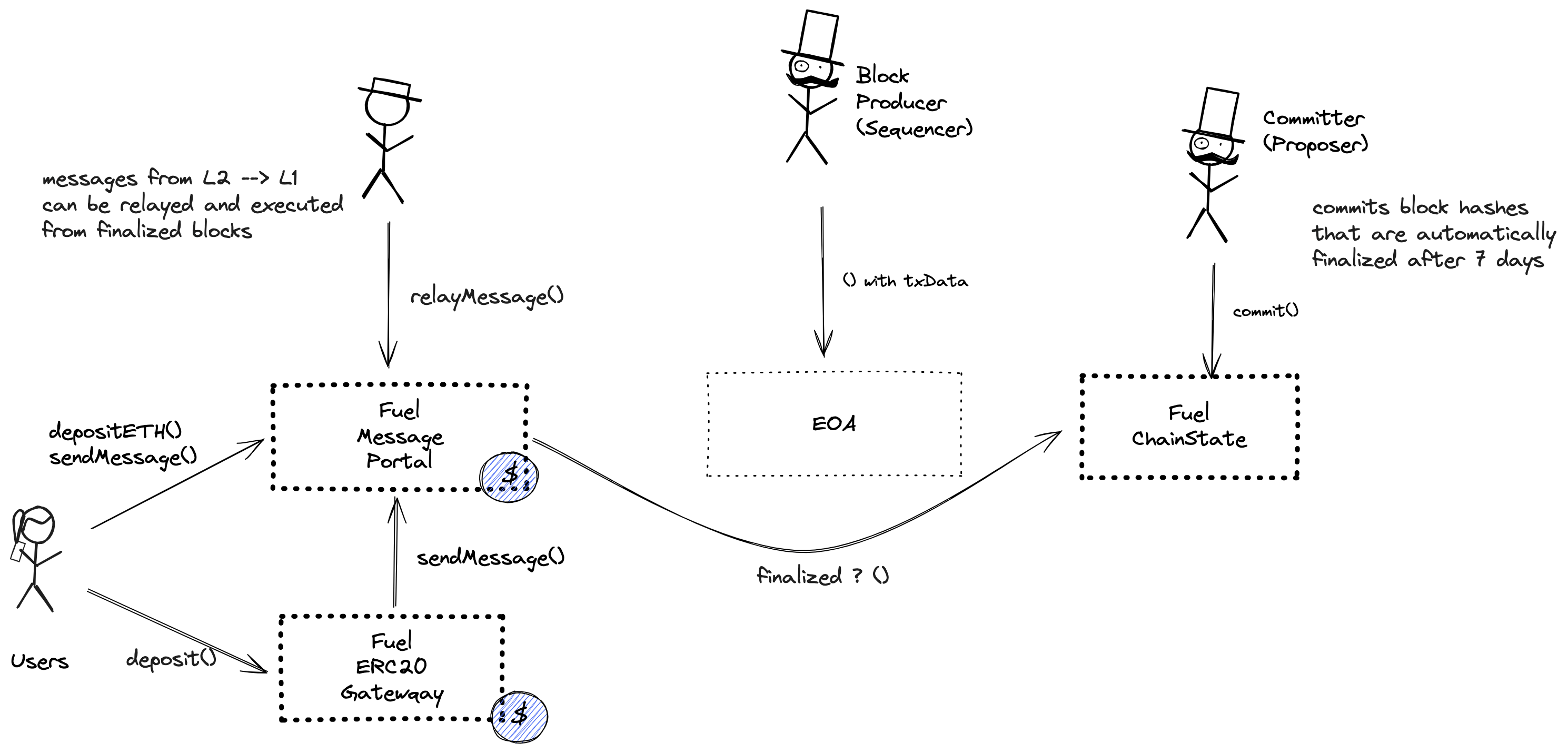
Whitelisted addresses that can pause the ERC20Gateway.
Whitelisted addresses that can pause the FuelMessagePortal and blacklist L2Layer 2 (L2) is a category of technical solutions aimed to scale the base layer in a trust minimized way. This category includes solutions like rollups as well as state channels and plasma. Other solutions are able to scale further, but with the introduction of additional trust assumptions, which are therefore not trust minimized. Sometimes the term Layer 2 is used to refer to include these solutions too, like validiums and optimiums, but to distinguish between trust minimized and non trust minimized solutions they are often referred to as "light" L2s, opposed to "strong" L2s like rollups.->L1Layer 1 (L1) is a blockchain that is self-reliant on its validator set for its security and consensus properties. Ethereum is an example of a layer 1. Blockchains started receiving the moniker of layer 1 once layer 2 became a meaningful area of development. messages.
Whitelisted addresses that can pause the FuelChainState.
Permissioned address that can propose new state rootsA cryptographic hash succinctly representing a state using a Merkle tree..
A Multisig with 4/6 threshold. Can upgrade the FuelERC20Gateway, FuelMessagePortal and FuelChainState contracts, potentially gaining access to all funds. It can unpause contracts and remove L2Layer 2 (L2) is a category of technical solutions aimed to scale the base layer in a trust minimized way. This category includes solutions like rollups as well as state channels and plasma. Other solutions are able to scale further, but with the introduction of additional trust assumptions, which are therefore not trust minimized. Sometimes the term Layer 2 is used to refer to include these solutions too, like validiums and optimiums, but to distinguish between trust minimized and non trust minimized solutions they are often referred to as "light" L2s, opposed to "strong" L2s like rollups.->L1Layer 1 (L1) is a blockchain that is self-reliant on its validator set for its security and consensus properties. Ethereum is an example of a layer 1. Blockchains started receiving the moniker of layer 1 once layer 2 became a meaningful area of development. messages from the blacklist. It can also limit the tokens that can be bridged to L2.
Ethereum
Standard gateway to deposit and withdraw ERC20 tokens. It implements rate limits and a whitelist for tokens. The whitelist is currently active.
Contract that allows to send and receive arbitrary messages to and from L2Layer 2 (L2) is a category of technical solutions aimed to scale the base layer in a trust minimized way. This category includes solutions like rollups as well as state channels and plasma. Other solutions are able to scale further, but with the introduction of additional trust assumptions, which are therefore not trust minimized. Sometimes the term Layer 2 is used to refer to include these solutions too, like validiums and optimiums, but to distinguish between trust minimized and non trust minimized solutions they are often referred to as "light" L2s, opposed to "strong" L2s like rollups.. Pausers are allowed to blacklist L2->L1Layer 1 (L1) is a blockchain that is self-reliant on its validator set for its security and consensus properties. Ethereum is an example of a layer 1. Blockchains started receiving the moniker of layer 1 once layer 2 became a meaningful area of development. messages.
Contract that allows state rootA cryptographic hash succinctly representing a state using a Merkle tree. submissions and settlementThe mechanism with which the execution of rollup blocks and the resultant state is verified and possible disputes are resolved. In the context of rollups or other modular blockchains, it often refers to the proof system used--validity (ZK) or fraud proofs, or a combination thereof. Sometimes it will refer to this mechanism along with where the mechanism's outputs are ultimately published and verified, as in Ethereum being a settlement layer by verifying the proofs and allowing for withdrawals..
The current deployment carries some associated risks:
Funds can be stolen if a contract receives a malicious code upgrade. There is no delay on upgrades (CRITICAL).
Funds can be frozen if pausers blacklist L2->L1 messages (CRITICAL).
Funds can be frozen if the limit of tokens that can be withdrawn is set too low.