Search
Search for projects and tokens by name or address
 Immutable zkEVM
Immutable zkEVM
Badges
About
Immutable zkEVM is a sidechain focused on gaming and powered by the Polygon stack. It plans to eventually transition to a ZK Rollup.
Badges
About
Immutable zkEVM is a sidechain focused on gaming and powered by the Polygon stack. It plans to eventually transition to a ZK Rollup.
Why is the project listed in others?
Consequence: projects without a proper proof system fully rely on single entities to safely update the state. A malicious proposer can finalize an invalid state, which can cause loss of funds.
Consequence: projects without a data availability bridge fully rely on single entities (the sequencer) to honestly rely available data roots on Ethereum. A malicious sequencer can collude with the proposer to finalize an unavailable state, which can cause loss of funds.
Learn more about the recategorisation here.
Funds can be stolen if
- a contract receives a malicious code upgrade. There is no delay on code upgrades (CRITICAL),
- validators decide to mint more tokens than there are locked on Ethereum thus preventing some existing holders from being able to bring their funds back to Ethereum,
- validators relay a withdraw request that wasn't originated on the source chain.
Users can be censored if
There is no mechanism to have transactions be included if the sequencerA party responsible for ordering and executing transactions on the rollup. The sequencer verifies transactions, compresses the data into a block, and submits the data related to it to enable state reconstruction to Ethereum L1 as a single transaction. The data can be either transaction data or state diffs. is down or censoring.
Currently the system permits invalid state rootsA cryptographic hash succinctly representing a state using a Merkle tree.. More details in project overview.
Proof construction and state derivation rely fully on data that is NOT published onchain.
There is no window for users to exit in case of an unwanted upgrade since contracts are instantly upgradable.
Only the whitelisted proposers can publish state rootsA cryptographic hash succinctly representing a state using a Merkle tree. on L1Layer 1 (L1) is a blockchain that is self-reliant on its validator set for its security and consensus properties. Ethereum is an example of a layer 1. Blockchains started receiving the moniker of layer 1 once layer 2 became a meaningful area of development., so in the event of failure the withdrawals are frozen.
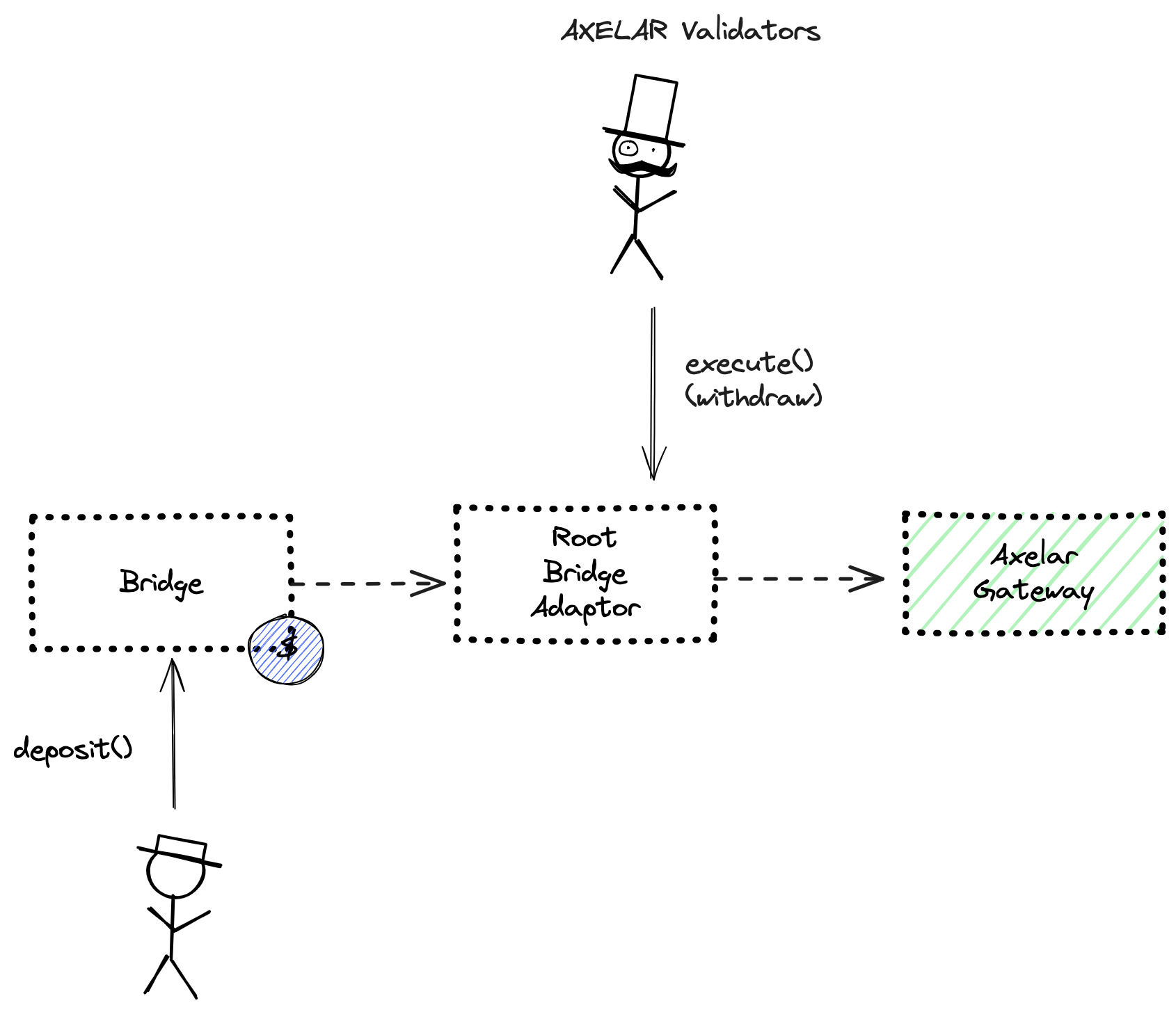
Immutable zkEVM bridgeA message-passing protocol between two blockchains. At its most basic, a token bridge consists of a smart contract which can escrow funds on one side of the bridge, and instruct the release or minting of corresponding assets on the other side, but bridges could also support arbitrary messages. How these instructions are validated is a critical factor in assessing the trust assumptions of a bridge. makes use of Axelar networkA constellation of nodes (peers) that communicate via a peer-to-peer protocol, for example, in propagating transactions and blocks to other nodes. (a Cosmos chain) to transfer assets between Ethereum and Immutable zkEVM. As in any standard Cosmos chain, validatorsIn the context of L2s, a Validator is an actor that validates the correctness of state transitions. For optimistic rollups this corresponds to challengers, and for ZK rollups this corresponds to the onchain verifier are bonded by staking tokens and can be slashed by social consensusAn agreement on the latest and correct state of a blockchain. Unlike L1 blockchains which coordinate participating nodes with consensus rules, rollups rely on L1s for reaching consensus by checking the state of the rollup smart contract deployed thereon. for misbehaviour.
A deposit starts by a user depositing tokens on the Bridge contract and then the tokens are minted on the destination chain.
Withdrawals to Ethereum can be delayed by a predefined time with a flow rate mechanism that controls outflows of the bridge escrow. The ProxyAdmin or an address with the rate_control role can define so-called buckets for each token: Each bucket has a capacity and a refill rate. All withdrawals that exceed the tokens bucket capacity trigger the withdrawal queue, which delays subsequent withdrawals of any of the bridges’ assets for a time defined in withdrawalDelay (currently 1d).
Users can be censored if validators on Axelar decide to not mint tokens after observing an event on Ethereum.
Funds can be stolen if validators decide to mint more tokens than there are locked on Ethereum thus preventing some existing holders from being able to bring their funds back to Ethereum.
Funds can be stolen if validators relay a withdraw request that wasn't originated on the source chain.
Past upgrades
The metrics include upgrades on the currently used proxy contracts. Historical proxy contracts and changes of such are not included.
2026 March 04, 09:00 UTC1changems member change.
ms member change.
| contract OwnerMultisig (eth:0xD2C37fC6fD89563187f3679304975655e448D192) { | |
| +++ description: None | |
| values.$members.5: | |
| - | "eth:0xb3538EDB1cD74AE43e0aD25eac6F03553657E3fB" |
| + | "eth:0x94e97260182B9537822687Dd3c301225c6f87a5e" |
| } | |
2025 July 14, 12:45 UTC6changesDiscovery rerun on the same block number with only config-related changes.
Discovery rerun on the same block number with only config-related changes.
New and verified contracts
| + | Status: CREATED |
| contract AxelarGatewayProxyMultisig (0x4F4495243837681061C4743b74B3eEdf548D56A5) | |
| +++ description: None | |
| + | Status: CREATED |
| contract RootAxelarBridgeAdaptor (0x4f49B53928A71E553bB1B0F66a5BcB54Fd4E8932) | |
| +++ description: None | |
| + | Status: CREATED |
| contract ChildERC20 (0x8804A8aA1F18f23aE8A456dD73806FdA3219FaD1) | |
| +++ description: None | |
| + | Status: CREATED |
| contract Bridge (0xBa5E35E26Ae59c7aea6F029B68c6460De2d13eB6) | |
| +++ description: None | |
| + | Status: CREATED |
| contract OwnerMultisig (0xD2C37fC6fD89563187f3679304975655e448D192) | |
| +++ description: None | |
| + | Status: CREATED |
| contract ProxyAdmin (0xdE2BCd3F0297d29c25e83228E5A33C0b43b51Ec8) | |
| +++ description: None | |
2025 March 07, 13:49 UTC1changeMS: single member change.
MS: single member change.
| contract OwnerMultisig (0xD2C37fC6fD89563187f3679304975655e448D192) { | |
| +++ description: None | |
| values.$members.5: | |
| - | "0xbD8Dc294478ec4dAd9f1b4596bf275f4d0309817" |
| + | "0xb3538EDB1cD74AE43e0aD25eac6F03553657E3fB" |
| } | |
2024 October 16, 09:51 UTC1changeSigner change.
Signer change.
| contract OwnerMultisig (0xD2C37fC6fD89563187f3679304975655e448D192) { | |
| +++ description: None | |
| values.$members.3: | |
| - | "0xB3669C058ddF26171Fd131D80C801AaEeb1519b8" |
| + | "0xA28A84676E3Cec39e6F1D06CD0EEF6cAAa2F7f7b" |
| } | |
2024 September 06, 11:30 UTC6changesOne signer removed.
One signer removed.
| contract OwnerMultisig (0xD2C37fC6fD89563187f3679304975655e448D192) { | |
| +++ description: None | |
| values.$members.6: | |
| - | "0xbD8Dc294478ec4dAd9f1b4596bf275f4d0309817" |
| values.$members.5: | |
| - | "0x296A19A4e87F5824DBE8DEd53415A4704538bB30" |
| + | "0xbD8Dc294478ec4dAd9f1b4596bf275f4d0309817" |
| values.$members.4: | |
| - | "0xB3669C058ddF26171Fd131D80C801AaEeb1519b8" |
| + | "0x296A19A4e87F5824DBE8DEd53415A4704538bB30" |
| values.$members.3: | |
| - | "0xdb6c271060571A96A62E3947E373395C89f765Ba" |
| + | "0xB3669C058ddF26171Fd131D80C801AaEeb1519b8" |
| values.$members.2: | |
| - | "0x5F1A23A3baB949D7264AfA4E6fbfEB245685E6B5" |
| + | "0xdb6c271060571A96A62E3947E373395C89f765Ba" |
| values.multisigThreshold: | |
| - | "4 of 7 (57%)" |
| + | "4 of 6 (67%)" |
| } | |
Ethereum
Actors:
A Multisig with 4/6 threshold. Multisig controlling the ProxyAdmin, potentially stealing all locked funds.
Contract allowed to upgrade the BridgeA message-passing protocol between two blockchains. At its most basic, a token bridge consists of a smart contract which can escrow funds on one side of the bridge, and instruct the release or minting of corresponding assets on the other side, but bridges could also support arbitrary messages. How these instructions are validated is a critical factor in assessing the trust assumptions of a bridge., its flow rate control and the Axelar adaptor.
Ethereum
Main escrow for tokens.
Axelar adaptor contract used by the bridgeA message-passing protocol between two blockchains. At its most basic, a token bridge consists of a smart contract which can escrow funds on one side of the bridge, and instruct the release or minting of corresponding assets on the other side, but bridges could also support arbitrary messages. How these instructions are validated is a critical factor in assessing the trust assumptions of a bridge..
The current deployment carries some associated risks:
Funds can be stolen if a contract receives a malicious code upgrade. There is no delay on code upgrades (CRITICAL).