Search
Search for projects and tokens by name or address
 Cloaked
Cloaked
About
A stealth-address wallet that receives every payment on a fresh address, with passkey login and an Incognito balance in Privacy Pools.

About
A stealth-address wallet that receives every payment on a fresh address, with passkey login and an Incognito balance in Privacy Pools.
Cloaked is a wallet that gives the user a fresh receiving address for every payment and shows them all as one account. Payers use the user’s name, like ltwobeat.clkd.eth, and each lookup returns a new address. Outsiders see separate payments, while Cloaked sees all of them.
The user trusts Cloaked, which holds a key that sees all their addresses, runs the closed-source app and submits every send. The user’s funds sit in addresses that only they control, and an open recovery tool exports their keys without Cloaked.
Keys
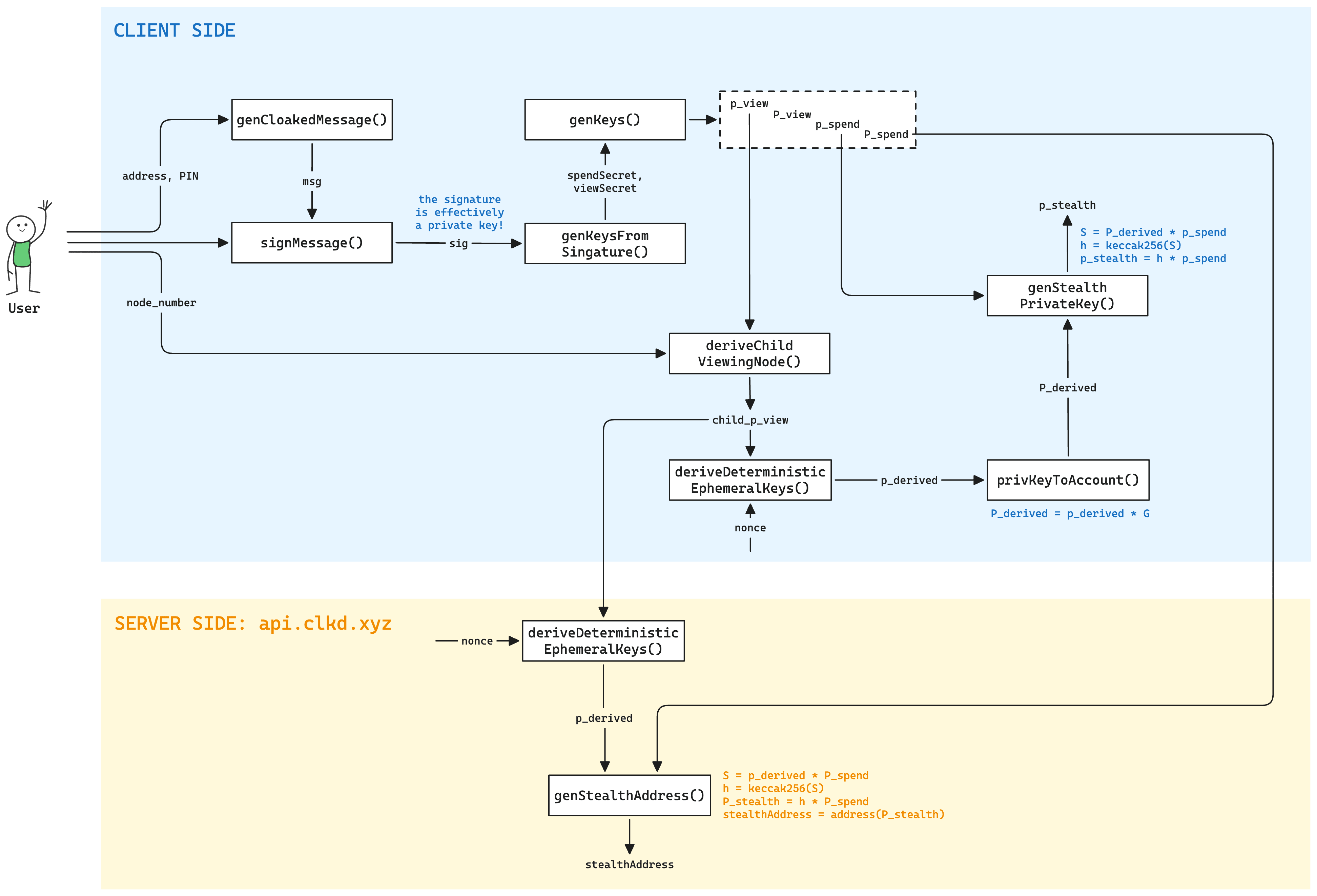
The app creates the user’s keys in their browser, from a passkey, a wallet signature and a four-digit PIN, or an email login through Web3Auth. Cloaked gets a viewing key that shows all the user’s addresses, while only the user can spend.
Flow
- Request an address. The app, the API or a lookup of your name asks Cloaked for a new address. For name lookups, Cloaked’s server signs the answer, so a payer has to trust that the address is yours.
- Receive. Each address is a plain account that only your spending key can control.
- Send. Cloaked picks addresses with enough balance and prepares the transaction, your app signs it, and Cloaked submits it. Change goes to a fresh address in the same transaction, and a send that uses several addresses shows onchain that they belong together.
App
The web app at app.clkd.xyz and the browser extension are closed source. They read balances through Cloaked’s servers, and a linked ENS name through Alchemy under Cloaked’s key. The open recovery tool recreates the user’s address keys offline.
Incognito
The Incognito balance moves funds through Privacy Pools. Cloaked submits both the deposit and the withdrawal, so it knows which belong together, and it keeps that record.
Compliance
Cloaked uses the user’s IP address for sanctions and geographic checks and can refuse quotes or relays, for example for tokenized stocks.
Fees
GasA virtual fuel used to execute smart contracts on a rollup. The EVM (or other VM within the rollup) uses an accounting mechanism to correspond the consumption of gas to the consumption of computing resources, and to limit the consumption of computing resources. for each send comes out of the sent token, so no native balance is needed. Incognito withdrawals pay Cloaked’s relay 0.1% for USDC, per its relayer API.
What the protocol promises: Hides which account a receiving address belongs to. The payer knows the address it was given; sender, asset, amount and where the funds go next are public.
Ethereum is public by default. Each protocol is rated on its main privacy promise, like hiding who paid, who received, how much, or which deposit became which withdrawal. Against each adversary, the colour says whether it holds for a careful user with the app's own settings: green yes, yellow only with significant extra work, red no. Fields marked at risk stay private only under the condition in their note.
Each payment reaches a fresh address, and nothing onchain names the account behind it. A send draws from several addresses in one transaction unless the user picks one with Advanced Control. Its change goes to a fresh address in the same transaction, which links the two.
Advice: Generate a fresh address for each receive, spend one address at a time with Advanced Control, and send to destinations with no public link to the user.
Cloaked’s relayers and fee Safe mark every spend as a Cloaked user’s, so an address hides among all stealth addresses Cloaked has ever spent from. Timing, distinctive amounts, recurring counterparties and change outputs cluster recipients further. Incognito withdrawals from Privacy Pools carry the same relayer and fee marks.
Advice: Space out related payments, avoid distinctive amounts and follow the user's own change outputs to see what a counterparty can trace.
No third party sees both the user’s account and a receiving address, except the RPC of a payer who looks up the user’s name. Alchemy, under Cloaked’s key, receives the user’s own ENS name when one is linked. The app contacts Reown, WalletConnect’s maker, on every load with Cloaked’s project id only. An email login hands the email to Web3Auth, whose key then derives the user’s secrets.
Advice: Share a payment link or a fresh address instead of the name, and log in with a passkey rather than email.
Cloaked holds the viewing key, so it can regenerate every address and tie its activity to the user’s account. It also serves the closed-source app that handles the user’s keys. Its relay submits both sides of every Incognito round trip through Privacy Pools and keeps the association.
No announcement is published, so address derivations cannot be replayed from the chain alone. Accounts created from a wallet signature reduce to that wallet’s key plus a four-digit PIN. Passkey secrets do not follow from breaking the passkey.
Advice: Create the user's account with a passkey, not from a wallet signature. Keep the backup file from setup, since the passkey works only on Cloaked's domain.
Funds can be stolen if
- the closed-source app is malicious or compromised and exfiltrates spending keys.
- the accepted ENS signer returns an attacker-controlled payment address for a Cloaked name.
Funds can be lost if
- a user loses the passkey and encrypted backup, or the wallet and PIN, needed to re-derive the spending key.
- the service and the app derive different address data and a payment reaches an address whose key the user cannot recreate.
Privacy can be lost if
- Cloaked, or anyone who obtains its records now or later, uses the viewing keys to link every account’s addresses (see privileged insider).
- Cloaked’s relayers and fee Safe mark every spend as a Cloaked user’s (see chain analyst).
- Cloaked changes its closed-source app to send account data to third parties (see privileged insider).
- a payer looks up the user’s name through a public RPC, which then sees the name and the new address (see networkA constellation of nodes (peers) that communicate via a peer-to-peer protocol, for example, in propagating transactions and blocks to other nodes. observer).
- a user relies on the Incognito balance, whose relay keeps the link between deposit and withdrawal (see privileged insider).
Cloaked changes its hosted app, API, ENS gateway, indexer and relay at will, without notice onchain.
The OffchainResolver is immutable. Its owner can replace the gateway URLs and the accepted signer instantly, and the signer can authenticate any answer, including a payment address. Owner and signer are the same EOA. This affects new lookups only, since existing addresses stay under their owners’ keys.
2026 August 21, 11:41 UTC1changeInitial discovery of Cloaked's ENS CCIP-Read OffchainResolver and the EOA that controls its gateway and signer.
Initial discovery of Cloaked’s ENS CCIP-Read OffchainResolver and the EOA that controls its gateway and signer.
Initial discovery
| + | Status: CREATED |
| contract OffchainResolver (eth:0x77fEF66b77d6a44AeCcCCf911f9864c7b7ca392C) [N/A] | |
| +++ description: Immutable ENS CCIP-Read resolver used by Cloaked. Every query redirects to a configurable API gateway and accepts the returned ENS record if it is unexpired and signed by the configurable signer. It does not verify that a returned payment address was derived for the named recipient. | |
Ethereum
Actors:
- Can interact with OffchainResolver
- change the accepted signer and gateway URLs immediately, or transfer resolver ownership
- sign arbitrary offchain ENS answers, including payment addresses accepted by the resolver
Ethereum
Immutable ENS CCIP-Read resolver used by Cloaked. Every query redirects to a configurable API gateway and accepts the returned ENS record if it is unexpired and signed by the configurable signer. It does not verify that a returned payment address was derived for the named recipient.
- Roles:
- owner: Cloaked Resolver Owner
- signer: Cloaked Resolver Owner