Search
Search for projects by name or address
 K2
K2
Badges
About
K2 is a general-purpose L2, which rebranded to the OpenGDP Network to soon become an asset tokenization-focused L1.
Badges
About
K2 is a general-purpose L2, which rebranded to the OpenGDP Network to soon become an asset tokenization-focused L1.
Why is the project listed in others?
Consequence: projects without a proper proof system fully rely on single entities to safely update the state. A malicious proposer can finalize an invalid state, which can cause loss of funds.
Consequence: projects without a data availability bridge fully rely on single entities (the sequencer) to honestly rely available data roots on Ethereum. A malicious sequencer can collude with the proposer to finalize an unavailable state, which can cause loss of funds.
Learn more about the recategorisation here.
2025 Aug 19 — 2026 Aug 19
The section shows the operating costs that L2s pay to Ethereum.
2025 Aug 19 — 2026 Aug 19
This section shows how much data the project publishes to its data-availability (DA) layer over time. The project currently posts data to Celestia.
2025 Aug 19 — 2026 Aug 19
This section shows how "live" the project's operators are by displaying how frequently they submit transactions of the selected type. It also highlights anomalies - significant deviations from their typical schedule.
2026 Jul 20 — Aug 19
Last 30 day anomalies
All liveness anomalies detected for this project in the last 30 days, helping you review recent downtime and availability issues.
No State updates were performed for 14h 3m (from 2026 Aug 06, 01:52 UTC until 2026 Aug 06, 15:55 UTC). These typically occur every 3h 59m on average.
No Tx data submissions were performed for 12h 11m (from 2026 Aug 06, 02:09 UTC until 2026 Aug 06, 14:20 UTC). These typically occur every 20m 37s on average.
No Tx data submissions were performed for 6d 10h (from 2026 Mar 04, 06:07 UTC until 2026 Mar 10, 16:51 UTC). These typically occur every 20m 37s on average.
Funds can be stolen if
Funds can be lost if
Funds can be frozen if
MEV can be extracted if
Currently the system permits invalid state roots. More details in project overview.
Proof construction and state derivation fully rely on data that is posted on Celestia. Sequencer tx roots are not checked against the Blobstream bridge data roots onchain, but L2 nodes can verify data availability by running a Celestia light client.
There is no window for users to exit in case of an unwanted upgrade since contracts are instantly upgradable.
Only the whitelisted proposers can publish state roots on L1, so in the event of failure the withdrawals are frozen.
Data is posted to Celestia
Transactions roots are posted onchain and the full data is posted on Celestia. Since the Blobstream bridge is not used, availability of the data is not verified against Celestia validators, meaning that the Sequencer can single-handedly publish unavailable roots.
Funds can be lost if the sequencer posts an unavailable transaction root (CRITICAL).
Funds can be lost if the data is not available on the external provider (CRITICAL).
- Introducing Blobstream: streaming modular DA to Ethereum
- Derivation: Batch submission - OP Mainnet specs
- BatchInbox - address
- OptimismPortal.sol - source code, depositTransaction function
CelestiaOP Stack projects can use the OP fault proof system, already being deployed on some. This project though is not using fault proofs yet and is relying on the honesty of the permissioned Proposer and Challengers to ensure state correctness. The smart contract system permits invalid state roots.
Funds can be stolen if an invalid state root is submitted to the system (CRITICAL).
Past upgrades
The metrics include upgrades on the currently used proxy contracts. Historical proxy contracts and changes of such are not included.
2026 July 09, 09:57 UTC2changesSystemConfig opStackDA.isUsingCelestia: false → true . K2 is posting to Celestia again after the brief switch to Ethereum calldata on 2026-07-01; that switch was transient and has been removed from the config.
SystemConfig opStackDA.isUsingCelestia: false → true. K2 is posting to Celestia again after the brief switch to Ethereum calldata on 2026-07-01; that switch was transient and has been removed from the config.
| contract SystemConfig (eth:0x622333688CC1878C7ff4205c89bDe051798788A7) [opstack/SystemConfig] { | |
| +++ description: Contains configuration parameters such as the Sequencer address, gas limit on this chain and the unsafe block signer address. | |
| values.opStackDA.isUsingCelestia: | |
| - | false |
| + | true |
| } |
2026 July 01, 16:32 UTC2changesSystemConfig opStackDA.isUsingCelestia : true → false . Karak no longer uses Celestia DA.
SystemConfig opStackDA.isUsingCelestia: true → false. Karak no longer uses Celestia DA.
| contract SystemConfig (eth:0x622333688CC1878C7ff4205c89bDe051798788A7) [opstack/SystemConfig] { | |
| +++ description: Contains configuration parameters such as the Sequencer address, gas limit on this chain and the unsafe block signer address. | |
| values.opStackDA.isUsingCelestia: | |
| - | true |
| + | false |
| } |
2025 December 12, 10:25 UTC2changesK2 is posting to Celestia.
K2 is posting to Celestia.
| contract SystemConfig (eth:0x622333688CC1878C7ff4205c89bDe051798788A7) { | |
| +++ description: Contains configuration parameters such as the Sequencer address, gas limit on this chain and the unsafe block signer address. | |
| values.opStackDA.isUsingCelestia: | |
| - | false |
| + | true |
| } |
2025 November 28, 12:50 UTC2changesPosts calldata instead of Celestia blobs.
Posts calldata instead of Celestia blobs.
| contract SystemConfig (eth:0x622333688CC1878C7ff4205c89bDe051798788A7) { | |
| +++ description: Contains configuration parameters such as the Sequencer address, gas limit on this chain and the unsafe block signer address. | |
| values.opStackDA.isUsingCelestia: | |
| - | true |
| + | false |
| } |
2025 July 14, 12:45 UTC10changesDiscovery rerun on the same block number with only config-related changes.
Discovery rerun on the same block number with only config-related changes.
New and verified contracts
| + | Status: CREATED |
| contract L2OutputOracle (0x0a23342520Aa8Ca963c4201801F4D3E95e731637) | |
| +++ description: Contains a list of proposed state roots which Proposers assert to be a result of block execution. Currently only the PROPOSER address can submit new state roots. |
| + | Status: CREATED |
| contract ProxyAdmin (0x1612F868EbA1cea65ee66bF4A7C75001b0D4065C) | |
| +++ description: None |
| + | Status: CREATED |
| contract KarakMultisig (0x28A227d4faF0f4f75897438E24C43EF1CDABb920) | |
| +++ description: None |
| + | Status: CREATED |
| contract SystemConfig (0x622333688CC1878C7ff4205c89bDe051798788A7) | |
| +++ description: Contains configuration parameters such as the Sequencer address, gas limit on this chain and the unsafe block signer address. |
| + | Status: CREATED |
| contract L1ERC721Bridge (0x952851CecB07705A5bb483C1CE080F97e1E7491E) | |
| +++ description: Used to bridge ERC-721 tokens from host chain to this chain. |
| + | Status: CREATED |
| contract L1CrossDomainMessenger (0x9BFfA66a8FcAAd7AC9ea7c7d4b9a6fc46777022d) | |
| +++ description: Sends messages from host chain to this chain, and relays messages back onto host chain. In the event that a message sent from host chain to this chain is rejected for exceeding this chain's epoch gas limit, it can be resubmitted via this contract's replay function. |
| + | Status: CREATED |
| contract L1StandardBridge (0xBA61F25dd9f2d5f02D01B1C2c1c5F0B14c4B48A3) | |
| +++ description: The main entry point to deposit ERC20 tokens from host chain to this chain. |
| + | Status: CREATED |
| contract OptimismPortal (0xeeCE9CD7Abd1CC84d9dfc7493e7e68079E47eA73) | |
| +++ description: The main entry point to deposit funds from host chain to this chain. It also allows to prove and finalize withdrawals. |
| + | Status: CREATED |
| contract OptimismMintableERC20Factory (0xF04a74899FF4c4410fAF3B5faa29B8Fd199C13DB) | |
| +++ description: A helper contract that generates OptimismMintableERC20 contracts on the network it's deployed to. OptimismMintableERC20 is a standard extension of the base ERC20 token contract designed to allow the L1StandardBridge contracts to mint and burn tokens. This makes it possible to use an OptimismMintableERC20 as this chain's representation of a token on the host chain, or vice-versa. |
| + | Status: CREATED |
| contract AddressManager (0xF2C89960B6D63eC6c61dF3EA8BaFa0a02c26e8C9) | |
| +++ description: Legacy contract used to manage a mapping of string names to addresses. Modern OP stack uses a different standard proxy system instead, but this contract is still necessary for backwards compatibility with several older contracts. |
The system has a centralized operator
MEV can be extracted if the operator exploits their centralized position and frontruns user transactions.
Users can force any transaction
Because the state of the system is based on transactions submitted on the underlying host chain and anyone can submit their transactions there it allows the users to circumvent censorship by interacting with the smart contract on the host chain directly.
Regular messaging
Funds can be frozen if the centralized validator goes down. Users cannot produce blocks themselves and exiting the system requires new block production (CRITICAL).
Forced messaging
If the user experiences censorship from the operator with regular L2->L1 messaging they can submit their messages directly on L1. The system is then obliged to service this request or halt all messages, including forced withdrawals from L1 and regular messages initiated on L2. Once the force operation is submitted and if the request is serviced, the operation follows the flow of a regular message.
EVM compatible smart contracts are supported
OP stack chains are pursuing the EVM Equivalence model. No changes to smart contracts are required regardless of the language they are written in, i.e. anything deployed on L1 can be deployed on L2.
Ethereum
Actors:
A Multisig with 3/5 threshold.
- Can upgrade with no delay
- L2OutputOracle ProxyAdmin
- SystemConfig ProxyAdmin
- L1ERC721Bridge ProxyAdmin
- L1CrossDomainMessenger ProxyAdmin
- L1StandardBridge ProxyAdmin
- OptimismPortal ProxyAdmin
- OptimismMintableERC20Factory ProxyAdmin
- Can interact with L2OutputOracle
- Allowed to challenge or delete state roots proposed by a Proposer
- Can interact with SystemConfig
- Can interact with OptimismPortal
- Allowed to pause withdrawals. In op stack systems with a proof system, the Guardian can also blacklist dispute games and set the respected game type (permissioned / permissionless)
- Can interact with AddressManager
- set and change address mappings ProxyAdmin
- Can interact with L2OutputOracle
- Allowed to post new state roots of the current layer to the host chain
- Can interact with SystemConfig
- Allowed to commit transactions from the current layer to the host chain
Ethereum
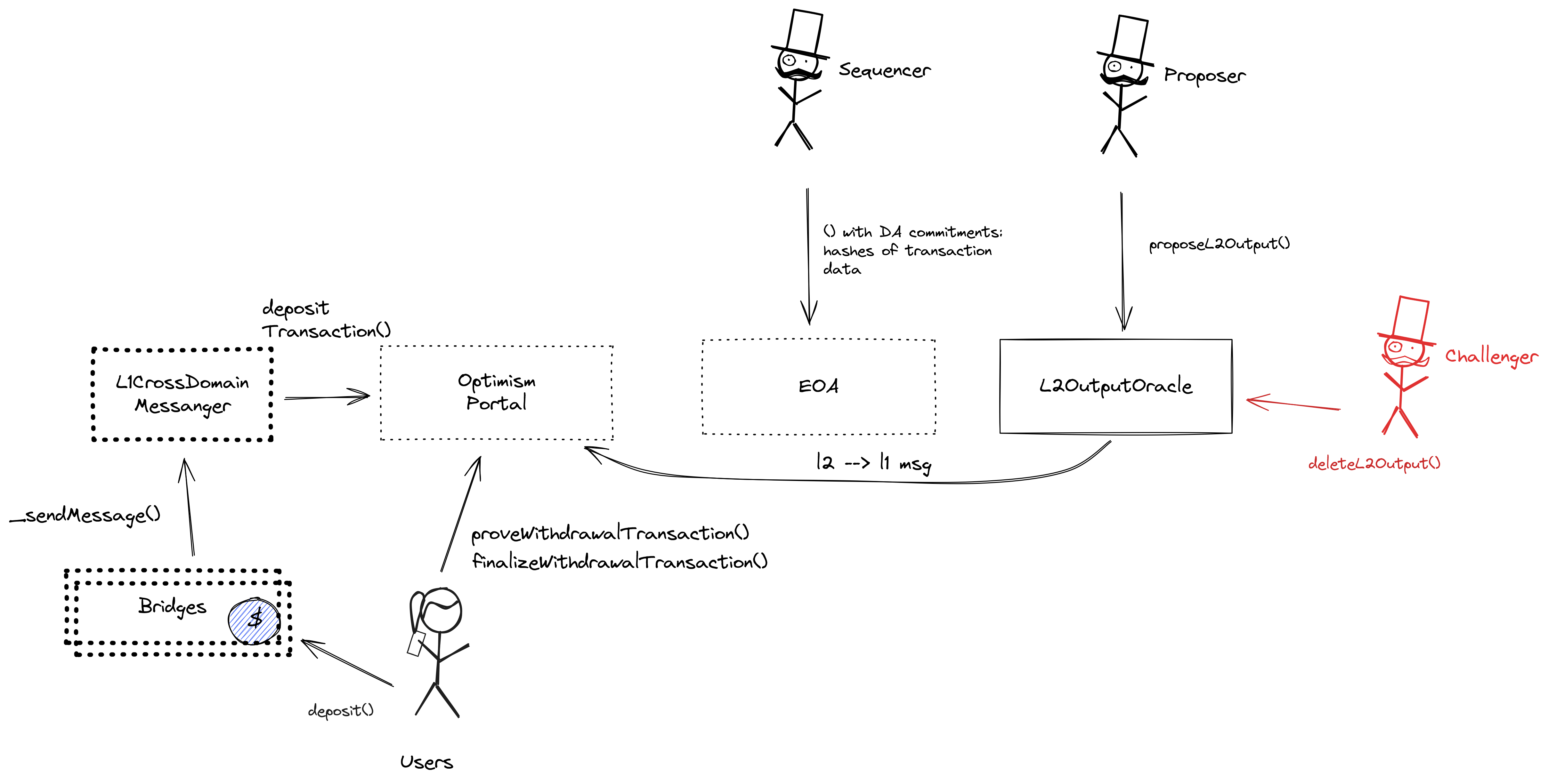
Contains a list of proposed state roots which Proposers assert to be a result of block execution. Currently only the PROPOSER address can submit new state roots.
- Roles:
- admin: ProxyAdmin; ultimately KarakMultisig
- challenger: KarakMultisig
- proposer: EOA 1
The main entry point to deposit funds from host chain to this chain. It also allows to prove and finalize withdrawals.
- Roles:
- admin: ProxyAdmin; ultimately KarakMultisig
- guardian: KarakMultisig

Used to bridge ERC-721 tokens from host chain to this chain.
- Roles:
- admin: ProxyAdmin; ultimately KarakMultisig
Sends messages from host chain to this chain, and relays messages back onto host chain. In the event that a message sent from host chain to this chain is rejected for exceeding this chain’s epoch gas limit, it can be resubmitted via this contract’s replay function.
- Roles:
- admin: ProxyAdmin; ultimately KarakMultisig
The main entry point to deposit ERC20 tokens from host chain to this chain.
- Roles:
- admin: ProxyAdmin; ultimately KarakMultisig
All supported tokens in this escrow are included in the value secured calculation.
- Roles:
- owner: KarakMultisig
A helper contract that generates OptimismMintableERC20 contracts on the network it’s deployed to. OptimismMintableERC20 is a standard extension of the base ERC20 token contract designed to allow the L1StandardBridge contracts to mint and burn tokens. This makes it possible to use an OptimismMintableERC20 as this chain’s representation of a token on the host chain, or vice-versa.
- Roles:
- admin: ProxyAdmin; ultimately KarakMultisig
The current deployment carries some associated risks:
Funds can be stolen if a contract receives a malicious code upgrade. There is no delay on code upgrades (CRITICAL).