Search
Search for projects and tokens by name or address
 Zk.Money v1
Zk.Money v1 (Aztec v1)
Badges
About
Zk.Money v1 (Aztec v1, or sometimes called Aztec 2.0) is an open source layer 2 network that aims to enable affordable, private crypto payments via zero-knowledge proofs.
About
Zk.Money v1 (Aztec v1, or sometimes called Aztec 2.0) is an open source layer 2 network that aims to enable affordable, private crypto payments via zero-knowledge proofs.
The section shows the operating costs that L2s pay to Ethereum.
This section shows how "live" the project's operators are by displaying how frequently they submit transactions of the selected type. It also highlights anomalies - significant deviations from their typical schedule.
Escape-hatch verifier exploit
2026 Jun 17th
$2.2M of assets are drained by exploiting an unsound verification key.
Aztec operator sunset
2023 Jul 8th
Aztec stops their rollupA blockchain that inherits consensus and data availability from another blockchain called L1. Rollups enable trust minimized bridges with the base layer via proof systems, either optimistic or zero-knowledge. A rollup without a bridge, or without considering the bridge, is called a sovereign rollup. operators. Users now have to run the Rollup manually.
In the event of a sequencerA party responsible for ordering and executing transactions on the rollup. The sequencer verifies transactions, compresses the data into a block, and submits the data related to it to enable state reconstruction to Ethereum L1 as a single transaction. The data can be either transaction data or state diffs. failure, users can force transactions to be included in the project’s chain by sending them to L1Layer 1 (L1) is a blockchain that is self-reliant on its validator set for its security and consensus properties. Ethereum is an example of a layer 1. Blockchains started receiving the moniker of layer 1 once layer 2 became a meaningful area of development.. Proposing new blocksAn ordered list of transactions and chain-related metadata that gets bundled together and published to the L1/DA layer. Nodes execute the transactions contained within blocks to change the rollup chain’s state. Protocol rules dictate what constitutes a valid block, and invalid blocks are skipped over. requires creating ZK proofs.
SNARKs are succinct zero knowledge proofs that ensure state correctness, but require trusted setupGeneration of a piece of data that must then be used for some cryptographic protocol to run. Generating this data requires some secret information. The "trust" comes from the fact the secret must be destroyed after the ceremony, otherwise cryptographic properties of the protocol could be broken. Once the data is generated, and the secrets are forgotten, no further participation from the creators of the ceremony is required. There are two types of trusted setups for SNARKs: (i) trusted setup per circuit where it is generated from scratch for each circuit, (ii) trusted universal setup per proving system where it can be used for several circuits..
All of the data needed for proof construction is published on Ethereum L1Layer 1 (L1) is a blockchain that is self-reliant on its validator set for its security and consensus properties. Ethereum is an example of a layer 1. Blockchains started receiving the moniker of layer 1 once layer 2 became a meaningful area of development..
Users can exit funds at any time because contracts are not upgradeable.
If the ProposerIn the context of L2s, the actor that proposes a claimed state root on L1. The term is also used in the context of Ethereum to refer to the actor that proposes a new block. fails, users can leverage the source available proverAn entity that generates the cryptographic proof to convince the verifier that the statement is true. In a ZK-Rollup, the prover generates the ZK (validity) proof to submit to the verifier contract. to submit proofs to the L1Layer 1 (L1) is a blockchain that is self-reliant on its validator set for its security and consensus properties. Ethereum is an example of a layer 1. Blockchains started receiving the moniker of layer 1 once layer 2 became a meaningful area of development. bridgeA message-passing protocol between two blockchains. At its most basic, a token bridge consists of a smart contract which can escrow funds on one side of the bridge, and instruct the release or minting of corresponding assets on the other side, but bridges could also support arbitrary messages. How these instructions are validated is a critical factor in assessing the trust assumptions of a bridge..
Rollup operators cannot compromise the system, but being application-specific might bring additional risk.
Aztec v2 is a private rollup that allows users to transfer assets privately. Arbitrary smart contracts are not supported.
All data required for proofs is published onchain
All the data that is used to construct the system state is published onchain in the form of cheap calldata. This ensures that it will always be available when needed.
 Ethereum
There are three ways to run a nodeA software client that participates in the network. and use the escape hatchThe facility for any user of a rollup to exit the system with their assets under any circumstance. Most relevant in rollups with a centralized proposer, wherein users do not have the ability to propose blocks, but can nonetheless exit the rollup by interacting with a smart contract on L1.: By running the Aztec v2 Ejector during the escape hatch window, 2) by running falafel, 3) by running the SDK in escape hatch mode and connecting to an escape hatch server. The two latter methods are no longer recommended by the Aztec team.
No compression scheme is used.
No genesis state is used.
The data format used can be found here.
Each update to the system state must be accompanied by a ZK proof that ensures that the new state was derived by correctly applying a series of valid user transactions to the previous state. These proofs are then verified on Ethereum by a smart contract.
2025 May 12, 09:49 UTC1changeDiscovery rerun on the same block number with only config-related changes.
Discovery rerun on the same block number with only config-related changes.
New and verified contracts
| + | Status: CREATED |
| contract VerificationKeysLibrary (eth:0xF3761B450571a49Fa8e2aF6e37e1Eb3516209d56) | |
| +++ description: None | |
2025 July 14, 12:44 UTC4changesDiscovery rerun on the same block number with only config-related changes.
Discovery rerun on the same block number with only config-related changes.
New and verified contracts
| + | Status: CREATED |
| contract AztecFeeDistributor (0x41A57F5581aDf11b25F3eDb7C1DB19f18bb76734) | |
| +++ description: Contract responsible for collecting transaction fees and reimbursing gas to whitelisted Rollup Providers. | |
| + | Status: CREATED |
| contract TurboVerifier (0x48Cb7BA00D087541dC8E2B3738f80fDd1FEe8Ce8) | |
| +++ description: Turbo Plonk ZK verifier. | |
| + | Status: CREATED |
| contract RollupProcessor (0x737901bea3eeb88459df9ef1BE8fF3Ae1B42A2ba) | |
| +++ description: None | |
| + | Status: CREATED |
| contract Aztec Multisig (0xE298a76986336686CC3566469e3520d23D1a8aaD) | |
| +++ description: None | |
2025 May 09, 10:53 UTCHigh severity3changesThe public address (private key was made public so anyone can operate the chain) set a 7702-authorization to a drainer because there were some minor tokens in the EOA.
The public address (private key was made public so anyone can operate the chain) set a 7702-authorization to a drainer because there were some minor tokens in the EOA.
| EOA FirstAnvilAddress (0xf39Fd6e51aad88F6F4ce6aB8827279cffFb92266) { | |
| +++ description: None | |
| proxyType: | |
| - | "EOA" |
| + | "EIP7702 EOA" |
| unverified: | |
| + | true |
| values: | |
| + | {"$implementation":"0x698Cd6D2618bAa3E35ECb7322919C5fce95886Cf"} |
| } | |
2024 May 06, 14:22 UTC1changeOwnership of the rollup contract is renounced.
Ownership of the rollup contract is renounced.
| contract RollupProcessor (0x737901bea3eeb88459df9ef1BE8fF3Ae1B42A2ba) { | |
| +++ description: None | |
| values.owner: | |
| - | "0xE298a76986336686CC3566469e3520d23D1a8aaD" |
| + | "0x0000000000000000000000000000000000000000" |
| } | |
2024 March 25, 10:52 UTC1changeRollup processors receive gas reimbursements from the AztecFeeDistributor for having called the processRollup() function. The reimburseConstant, which is a constant added to each dynamically calculated gas reimbursement is now set to 0. Context: Zk.money V1 (this project) is sunset for a long time now. Users can only exit by running a local docker container that runs the rollup. They have to pay the processRollup() transaction fee but get refunded by the AztecFeeDistributor.
Rollup processors receive gas reimbursements from the AztecFeeDistributor for having called the processRollup() function. The reimburseConstant, which is a constant added to each dynamically calculated gas reimbursement is now set to 0. Context: Zk.money V1 (this project) is sunset for a long time now. Users can only exit by running a local docker container that runs the rollup. They have to pay the processRollup() transaction fee but get refunded by the AztecFeeDistributor.
| contract AztecFeeDistributor (0x41A57F5581aDf11b25F3eDb7C1DB19f18bb76734) { | |
| +++ description: None | |
| +++ description: Tip that gets added to a gas reimbursement for processing the rollup. | |
| +++ severity: LOW | |
| values.reimburseConstant: | |
| - | 678600 |
| + | 0 |
| } | |
No regular operators
Only specific addresses appointed by the owner are permitted to propose new blocksAn ordered list of transactions and chain-related metadata that gets bundled together and published to the L1/DA layer. Nodes execute the transactions contained within blocks to change the rollup chain’s state. Protocol rules dictate what constitutes a valid block, and invalid blocks are skipped over. during regular rollupA blockchain that inherits consensus and data availability from another blockchain called L1. Rollups enable trust minimized bridges with the base layer via proof systems, either optimistic or zero-knowledge. A rollup without a bridge, or without considering the bridge, is called a sovereign rollup. operations. Since EOL, these operators are not regularly processing the rollup anymore.
Users can force any transaction
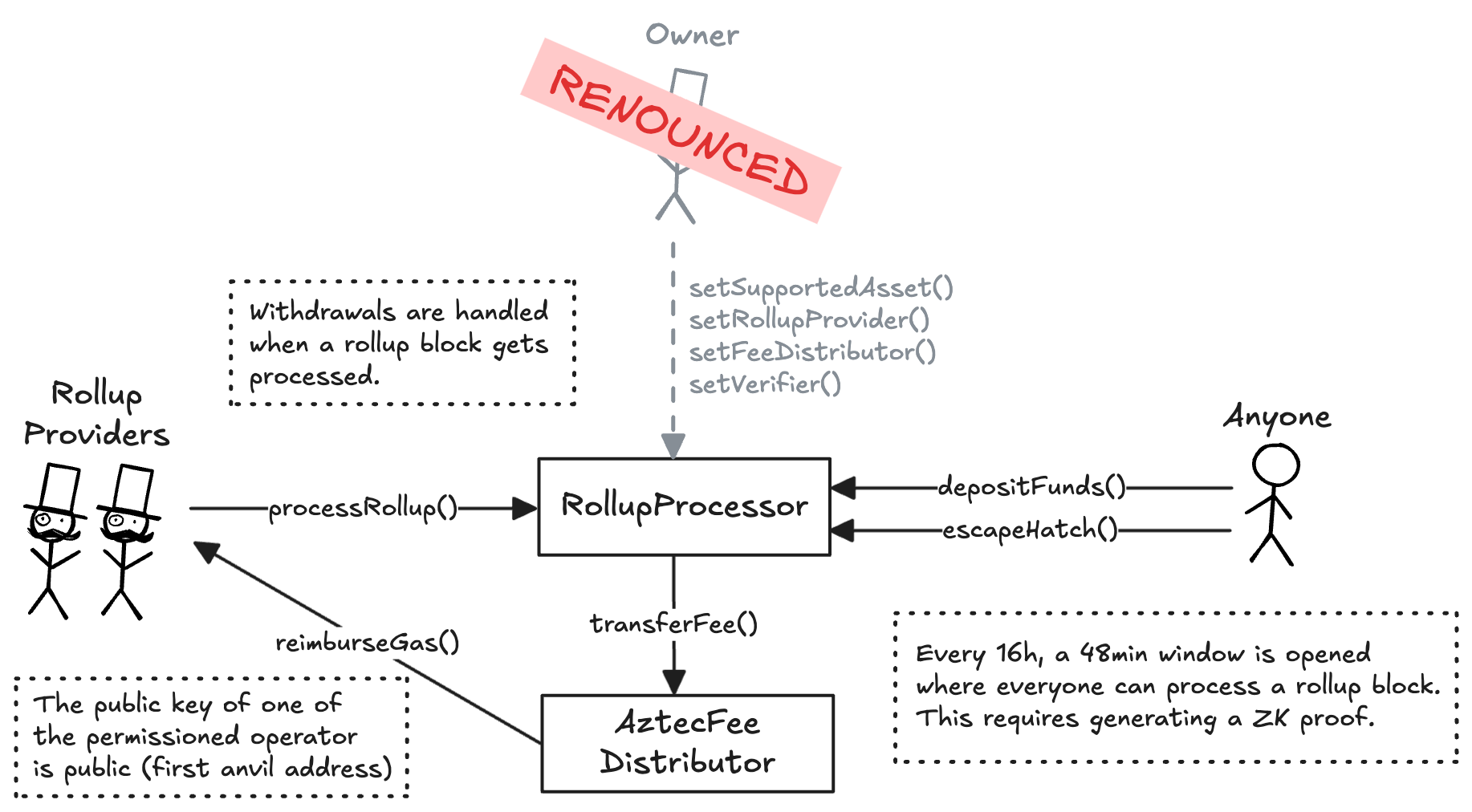
Because the blockAn ordered list of transactions and chain-related metadata that gets bundled together and published to the L1/DA layer. Nodes execute the transactions contained within blocks to change the rollup chain’s state. Protocol rules dictate what constitutes a valid block, and invalid blocks are skipped over. production is open to anyone if users experience censorship from the operatorAn operator is the entity charged with managing a rollup and progressing its state. A rollup operator can be a centralized sequencer, proposer, prover, challenger, pauser of admin that is able to perform upgrades. they can propose their own blocks which would include their transactions.The private key of one of the permissioned operators is public (first Anvil address), therefore anyone can in principle resume regular operations. No funds need to be deposited to that address since submitting signatures is enough. Every 16h a special 48m window (escape hatchThe facility for any user of a rollup to exit the system with their assets under any circumstance. Most relevant in rollups with a centralized proposer, wherein users do not have the ability to propose blocks, but can nonetheless exit the rollup by interacting with a smart contract on L1.) is open during which any address can propose new blocks.
Funds can be frozen if the operator refuses to include their transactions and users lack resources to propose blocks themselves.
Regular withdraw (deprecated)
The user initiates the withdrawal by submitting a transaction on L2Layer 2 (L2) is a category of technical solutions aimed to scale the base layer in a trust minimized way. This category includes solutions like rollups as well as state channels and plasma. Other solutions are able to scale further, but with the introduction of additional trust assumptions, which are therefore not trust minimized. Sometimes the term Layer 2 is used to refer to include these solutions too, like validiums and optimiums, but to distinguish between trust minimized and non trust minimized solutions they are often referred to as "light" L2s, opposed to "strong" L2s like rollups.. When the blockAn ordered list of transactions and chain-related metadata that gets bundled together and published to the L1/DA layer. Nodes execute the transactions contained within blocks to change the rollup chain’s state. Protocol rules dictate what constitutes a valid block, and invalid blocks are skipped over. containing that transaction is proven on L1Layer 1 (L1) is a blockchain that is self-reliant on its validator set for its security and consensus properties. Ethereum is an example of a layer 1. Blockchains started receiving the moniker of layer 1 once layer 2 became a meaningful area of development. the assets are automatically withdrawn to the user.
EOL: Manual withdrawal using Aztec v2 Ejector
EOL: Ownership of the rollupA blockchain that inherits consensus and data availability from another blockchain called L1. Rollups enable trust minimized bridges with the base layer via proof systems, either optimistic or zero-knowledge. A rollup without a bridge, or without considering the bridge, is called a sovereign rollup. contract is irrevocably renounced and operators are not processing the rollup. Assets in the escrow can be manually withdrawn with the Aztec v2 Ejector.
Payments are private
Balances and identities for all tokens on the Aztec rollupA blockchain that inherits consensus and data availability from another blockchain called L1. Rollups enable trust minimized bridges with the base layer via proof systems, either optimistic or zero-knowledge. A rollup without a bridge, or without considering the bridge, is called a sovereign rollup. are encrypted. Each transaction is encoded as a zkSNARK, protecting user data.
Ethereum
Actors:
Addresses that can propose new blocksAn ordered list of transactions and chain-related metadata that gets bundled together and published to the L1/DA layer. Nodes execute the transactions contained within blocks to change the rollup chain’s state. Protocol rules dictate what constitutes a valid block, and invalid blocks are skipped over. during regular rollupA blockchain that inherits consensus and data availability from another blockchain called L1. Rollups enable trust minimized bridges with the base layer via proof systems, either optimistic or zero-knowledge. A rollup without a bridge, or without considering the bridge, is called a sovereign rollup. operation. Since the private key of one of them is public (first Anvil address), anyone can in principle resume regular operations. Every 16h a special 48m window (escape hatchThe facility for any user of a rollup to exit the system with their assets under any circumstance. Most relevant in rollups with a centralized proposer, wherein users do not have the ability to propose blocks, but can nonetheless exit the rollup by interacting with a smart contract on L1.) is open during which anyone can propose new blocks.
A Multisig with 1/2 threshold. Can update parameters related to the reimbursement of gasA virtual fuel used to execute smart contracts on a rollup. The EVM (or other VM within the rollup) uses an accounting mechanism to correspond the consumption of gas to the consumption of computing resources, and to limit the consumption of computing resources. to permissioned rollupA blockchain that inherits consensus and data availability from another blockchain called L1. Rollups enable trust minimized bridges with the base layer via proof systems, either optimistic or zero-knowledge. A rollup without a bridge, or without considering the bridge, is called a sovereign rollup. providers. It doesn’t affect the escape hatchThe facility for any user of a rollup to exit the system with their assets under any circumstance. Most relevant in rollups with a centralized proposer, wherein users do not have the ability to propose blocks, but can nonetheless exit the rollup by interacting with a smart contract on L1. mechanism, but it can halt regular operations by setting a reimbursement constant that is too high.
Ethereum
Contract responsible for collecting transaction fees and reimbursing gasA virtual fuel used to execute smart contracts on a rollup. The EVM (or other VM within the rollup) uses an accounting mechanism to correspond the consumption of gas to the consumption of computing resources, and to limit the consumption of computing resources. to whitelisted RollupA blockchain that inherits consensus and data availability from another blockchain called L1. Rollups enable trust minimized bridges with the base layer via proof systems, either optimistic or zero-knowledge. A rollup without a bridge, or without considering the bridge, is called a sovereign rollup. Providers.
Turbo PlonkA zk-SNARK proving system introduced by Gabizon, Williamson and Ciobotaru in 2019 that allows proving custom circuits. Plonk is based on KZG polynomial commitments and thus requires a universal trusted setup. ZK verifierAn entity in a ZK-Rollup, often a smart contract, that verifies zero-knowledge proofs submitted by a prover..