Search
Search for projects by name or address
 Scroll
Scroll
Badges
About
Scroll is a ZK Rollup that extends Ethereum’s capabilities through ZK tech and EVM compatibility.
- Compromising ≥75% of the Security Council should be the only way (other than bugs) for a rollup to indefinitely block an L2→L1 message (e.g. a withdrawal) or push an invalid L2→L1 message (e.g. an invalid withdrawal) with a <7d exit window.
Badges
About
Scroll is a ZK Rollup that extends Ethereum’s capabilities through ZK tech and EVM compatibility.
The section shows the operating costs that L2s pay to Ethereum.
This section shows how much data the project publishes to Ethereum over time. It leaves out data posted to other data-availability (DA) layers. The project currently posts data to Ethereum.
This section shows how "live" the project's operators are by displaying how frequently they submit transactions of the selected type. It also highlights anomalies - significant deviations from their typical schedule.
Security Council removal
2026 Jun 1st
Independent 9-of-12 Security CouncilA Security Council is a sufficiently decentralized set of members that is able to upgrade a system. A properly set up Security Council consists of at least 8 members with a threshold greater than 75%. What 'sufficiently decentralized' means is fundamentally subjective and L2BEAT evaluates each case individually. A Security Council is allowed to instantly upgrade Stage 1 rollups. replaced by a 3-of-4 team admin multisig; drops to Stage 0.
Emergency verifier upgrade
2026 Feb 23rd
Emergency verifierAn entity in a ZK-Rollup, often a smart contract, that verifies zero-knowledge proofs submitted by a prover. replacement due to a bug in the guest proverAn entity that generates the cryptographic proof to convince the verifier that the statement is true. In a ZK-Rollup, the prover generates the ZK (validity) proof to submit to the verifier contract. program.
Funds can be stolen if
MEV can be extracted if
In the event of a sequencerA party responsible for ordering and executing transactions on the rollup. The sequencer verifies transactions, compresses the data into a block, and submits the data related to it to enable state reconstruction to Ethereum L1 as a single transaction. The data can be either transaction data or state diffs. failure, users can force transactions to be included in the project’s chain by sending them to L1Layer 1 (L1) is a blockchain that is self-reliant on its validator set for its security and consensus properties. Ethereum is an example of a layer 1. Blockchains started receiving the moniker of layer 1 once layer 2 became a meaningful area of development.. There can be up to a 7d delay on this operation. Proposing new blocksAn ordered list of transactions and chain-related metadata that gets bundled together and published to the L1/DA layer. Nodes execute the transactions contained within blocks to change the rollup chain’s state. Protocol rules dictate what constitutes a valid block, and invalid blocks are skipped over. requires creating ZK proofs.
STARKs and SNARKs are zero knowledge proofs that ensure state correctness. STARKs proofs are wrapped in SNARKs proofs for efficiency. SNARKs require a trusted setupGeneration of a piece of data that must then be used for some cryptographic protocol to run. Generating this data requires some secret information. The "trust" comes from the fact the secret must be destroyed after the ceremony, otherwise cryptographic properties of the protocol could be broken. Once the data is generated, and the secrets are forgotten, no further participation from the creators of the ceremony is required. There are two types of trusted setups for SNARKs: (i) trusted setup per circuit where it is generated from scratch for each circuit, (ii) trusted universal setup per proving system where it can be used for several circuits..
All of the data needed for proof construction is published on Ethereum L1Layer 1 (L1) is a blockchain that is self-reliant on its validator set for its security and consensus properties. Ethereum is an example of a layer 1. Blockchains started receiving the moniker of layer 1 once layer 2 became a meaningful area of development..
There is no window for users to exit in case of an unwanted upgrade since contracts are instantly upgradable.
If the ProposerIn the context of L2s, the actor that proposes a claimed state root on L1. The term is also used in the context of Ethereum to refer to the actor that proposes a new block. fails, users can leverage the source available proverAn entity that generates the cryptographic proof to convince the verifier that the statement is true. In a ZK-Rollup, the prover generates the ZK (validity) proof to submit to the verifier contract. to submit proofs to the L1Layer 1 (L1) is a blockchain that is self-reliant on its validator set for its security and consensus properties. Ethereum is an example of a layer 1. Blockchains started receiving the moniker of layer 1 once layer 2 became a meaningful area of development. bridgeA message-passing protocol between two blockchains. At its most basic, a token bridge consists of a smart contract which can escrow funds on one side of the bridge, and instruct the release or minting of corresponding assets on the other side, but bridges could also support arbitrary messages. How these instructions are validated is a critical factor in assessing the trust assumptions of a bridge..
All data required for proofs is published on chain
All the data that is used to construct the system state is published on chain in the form of cheap blobsThe data that a rollup publishes to its L1/data availability (DA) layer. They consist of the L2 transactions that are rolled up, along with some metadata. Blobs are introduced as a new transaction type within Ethereum with EIP-4844, and has rollup scaling specifically in mind. Blobs persist on Ethereum’s Beacon Chain ephemerally. or calldata. This ensures that it will be available for enough time.
EthereumThe nodeA software client that participates in the network. software to reconstruct the state is available here. Note that it uses the L2Layer 2 (L2) is a category of technical solutions aimed to scale the base layer in a trust minimized way. This category includes solutions like rollups as well as state channels and plasma. Other solutions are able to scale further, but with the introduction of additional trust assumptions, which are therefore not trust minimized. Sometimes the term Layer 2 is used to refer to include these solutions too, like validiums and optimiums, but to distinguish between trust minimized and non trust minimized solutions they are often referred to as "light" L2s, opposed to "strong" L2s like rollups. p2p networkA constellation of nodes (peers) that communicate via a peer-to-peer protocol, for example, in propagating transactions and blocks to other nodes. to fetch blocksAn ordered list of transactions and chain-related metadata that gets bundled together and published to the L1/DA layer. Nodes execute the transactions contained within blocks to change the rollup chain’s state. Protocol rules dictate what constitutes a valid block, and invalid blocks are skipped over., and not the L1Layer 1 (L1) is a blockchain that is self-reliant on its validator set for its security and consensus properties. Ethereum is an example of a layer 1. Blockchains started receiving the moniker of layer 1 once layer 2 became a meaningful area of development. network. The consistency with L1 data can be checked by running the scroll-geth node with the --rollup.verify flag.
Data batches are compressed using the zstd algorithm.
The genesis file can be found here, which contains two prefunded addresses and five predeployed contracts.
BlocksAn ordered list of transactions and chain-related metadata that gets bundled together and published to the L1/DA layer. Nodes execute the transactions contained within blocks to change the rollup chain’s state. Protocol rules dictate what constitutes a valid block, and invalid blocks are skipped over. are grouped into chunks, chunks are grouped into batches, and batches are grouped into bundles. Chunk encoding format can be found here, and batch encoding format can be found here.
Each update to the system state must be accompanied by a ZK proof that ensures that the new state was derived by correctly applying a series of valid user transactions to the previous state. These proofs are then verified on Ethereum by a smart contract.
Scroll circuits are OpenVM-based Guest Programs that use the OpenVM proverAn entity that generates the cryptographic proof to convince the verifier that the statement is true. In a ZK-Rollup, the prover generates the ZK (validity) proof to submit to the verifier contract.. The source code of the base circuits can be found here.
SNARKShort for "succinct non-interactive argument of knowledge", a SNARK is a widely used type of zero-knowledge proof that is short and fast to verify. Different kinds of SNARKs are usually systematized by proof size, verification time, and type of setup. The most famous SNARKs are Groth16, PLONK/Marlin, Bulletproofs, and STARKs. verification keys can be generated and checked against Ethereum verifierAn entity in a ZK-Rollup, often a smart contract, that verifies zero-knowledge proofs submitted by a prover. contract using this guide. The system requires a trusted setupGeneration of a piece of data that must then be used for some cryptographic protocol to run. Generating this data requires some secret information. The "trust" comes from the fact the secret must be destroyed after the ceremony, otherwise cryptographic properties of the protocol could be broken. Once the data is generated, and the secrets are forgotten, no further participation from the creators of the ceremony is required. There are two types of trusted setups for SNARKs: (i) trusted setup per circuit where it is generated from scratch for each circuit, (ii) trusted universal setup per proving system where it can be used for several circuits..
Each update to the system state must be accompanied by a ZK proof that ensures that the new state was derived by correctly applying a series of valid user transactions to the previous state. These proofs are then verified on Ethereum by a smart contract.

Trusted Setups
Onchain verifier
Used in
Onchain verifier | Used in |
All core contracts in the Scroll protocol are upgradable by the ProxyAdmin, which is controlled by the ScrollAdminMultisig through the ScrollOwner contract. The ScrollOwner is a central governance contract controlled by four distinct Timelocks: two governed by the ScrollAdminMultisig and two by the Scroll team multisigs. Each multisig can initiate specific types of changes with differing delay guarantees. On 2026-06-01, Scroll removed its independent 9-of-12 Security CouncilA Security Council is a sufficiently decentralized set of members that is able to upgrade a system. A properly set up Security Council consists of at least 8 members with a threshold greater than 75%. What 'sufficiently decentralized' means is fundamentally subjective and L2BEAT evaluates each case individually. A Security Council is allowed to instantly upgrade Stage 1 rollups. and transferred its roles on the TimelockSCSlow (3d execution delay) and TimelockSCEmergency (No execution delay) on both chains to the ScrollAdminMultisig, along with admin of the L2Layer 2 (L2) is a category of technical solutions aimed to scale the base layer in a trust minimized way. This category includes solutions like rollups as well as state channels and plasma. Other solutions are able to scale further, but with the introduction of additional trust assumptions, which are therefore not trust minimized. Sometimes the term Layer 2 is used to refer to include these solutions too, like validiums and optimiums, but to distinguish between trust minimized and non trust minimized solutions they are often referred to as "light" L2s, opposed to "strong" L2s like rollups. AgoraGovernor. Emergency pause of core contracts is managed through the PauseController, which allows the team to pause batch commitment and finalization in permissioned mode, as well as L1Layer 1 (L1) is a blockchain that is self-reliant on its validator set for its security and consensus properties. Ethereum is an example of a layer 1. Blockchains started receiving the moniker of layer 1 once layer 2 became a meaningful area of development.->L2 messaging. Each pause is subject to a cooldown period of 1mo execution delay, during which the ScrollAdminMultisig can unpause. SCR token holders perform onchain voting on governance proposals through the AgoraGovernor contract on L2. However, onchain governance proposals do not contain transaction payloads, so onchain voting only acts as an onchain temperature check.
Past upgrades
The metrics include upgrades on the currently used proxy contracts. Historical proxy contracts and changes of such are not included.
Ossification
Contracts our research team classifies as critical form the project's critical perimeter. Its clock starts at the ossification genesis, and every critical change resets it (changes within 24 hours count as one). The ossification score is the share of recorded code-bug exploits whose exploited code was younger than this perimeter is today. Battle-tested exposure is the value secured, summed over that unchanged period.
Discovery updates
2026 October 08, 10:24 UTC1changeOssification review: perimeter and severity changes in config, template severities (role holders MEDIUM).
Ossification review: perimeter and severity changes in config, template severities (role holders MEDIUM).
New and verified contracts
| + | Status: CREATED |
| contract L2DaiGateway (scr:0xaC78dff3A87b5b534e366A93E785a0ce8fA6Cc62) [N/A] | |
| +++ description: None | |
2026 October 08, 10:24 UTC18changesSome safes and verifier sources were verified on Etherscan.
Some safes and verifier sources were verified on Etherscan.
New and verified contracts
| contract PlonkVerifierPostEuclid (eth:0xd1638c0C7Bd6bf49D655D855d353aC8b4f949582) [N/A] { | |
| +++ description: None | |
| unverified: | |
| - | true |
| implementationNames.eth:0xd1638c0C7Bd6bf49D655D855d353aC8b4f949582: | |
| - | "" |
| + | "Halo2Verifier" |
| sourceHashes: | |
| + | ["0xf1304144e7e31f4b3006633baf6786a35f34e00eec7b2a387c4bb9cb35164fce"] |
| } | |
| contract GnosisSafeL2 (scr:0x11cd09a0c5B1dc674615783b0772a9bFD53e3A8F) [GnosisSafe] { | |
| +++ description: None | |
| unverified: | |
| - | true |
| sourceHashes.0: | |
| - | null |
| + | "0x81a7349eebb98ac33b0bc6842e3cb258034a8f2a4ba004570bb8e2e25947f9ff" |
| implementationNames.scr:0x11cd09a0c5B1dc674615783b0772a9bFD53e3A8F: | |
| - | "" |
| + | "GnosisSafeProxy" |
| } | |
| contract SafeL2 (scr:0x69C2eD64171bF5737c2B78bdF722e68a032B2825) [GnosisSafe] { | |
| +++ description: None | |
| unverified: | |
| - | true |
| sourceHashes.0: | |
| - | null |
| + | "0xfe0725afd3cf2e5fb7627005a6bcf13ef7e35f78034eed2211edbffdb6a9aab5" |
| implementationNames.scr:0x69C2eD64171bF5737c2B78bdF722e68a032B2825: | |
| - | "" |
| + | "SafeProxy" |
| } | |
| contract SafeL2 (scr:0x8edC4EADEE120d4C51923c515e7C3241c815C2BC) [GnosisSafe] { | |
| +++ description: None | |
| unverified: | |
| - | true |
| sourceHashes.0: | |
| - | null |
| + | "0xfe0725afd3cf2e5fb7627005a6bcf13ef7e35f78034eed2211edbffdb6a9aab5" |
| implementationNames.scr:0x8edC4EADEE120d4C51923c515e7C3241c815C2BC: | |
| - | "" |
| + | "SafeProxy" |
| } | |
| contract SafeL2 (scr:0x9479ABfebefEea3c846163012a472b44F305b3d7) [GnosisSafe] { | |
| +++ description: None | |
| unverified: | |
| - | true |
| sourceHashes.0: | |
| - | null |
| + | "0xfe0725afd3cf2e5fb7627005a6bcf13ef7e35f78034eed2211edbffdb6a9aab5" |
| implementationNames.scr:0x9479ABfebefEea3c846163012a472b44F305b3d7: | |
| - | "" |
| + | "SafeProxy" |
| } | |
| contract SafeL2 (scr:0xC3eA7C657884BB380B66D79C36aDCb5658b01896) [GnosisSafe] { | |
| +++ description: None | |
| unverified: | |
| - | true |
| sourceHashes.0: | |
| - | null |
| + | "0xfe0725afd3cf2e5fb7627005a6bcf13ef7e35f78034eed2211edbffdb6a9aab5" |
| implementationNames.scr:0xC3eA7C657884BB380B66D79C36aDCb5658b01896: | |
| - | "" |
| + | "SafeProxy" |
| } | |
2026 September 28, 13:11 UTCCritical state change5changesOpenVM verifier upgraded to v2.0.0 on Scroll: https://forum.scroll.io/t/announcement-openvm-v2-0-0-upgrade-on-scroll/1495. ZK programs and verifiers are successfully reproduced.
OpenVM verifier upgraded to v2.0.0 on Scroll: https://forum.scroll.io/t/announcement-openvm-v2-0-0-upgrade-on-scroll/1495. ZK programs and verifiers are successfully reproduced.
| contract MultipleVersionRollupVerifier (eth:0x4CEA3E866e7c57fD75CB0CA3E9F5f1151D4Ead3F) [scroll/MultipleVersionRollupVerifier] { | |
| +++ description: Contract used to update the verifier and keep track of current and old versions. | |
| values.latestVerifier.9.verifier: | |
| - | "eth:0x808297224e86b1a6055B5F790a2cE07Ed611f955" |
| + | "eth:0x7966FE0De13e3B81533470640Ac489223476B254" |
| } | |
| - | Status: DELETED |
| contract ZkEvmVerifierPostFeynman (eth:0x808297224e86b1a6055B5F790a2cE07Ed611f955) [N/A] | |
| +++ description: None | |
| - | Status: DELETED |
| contract PlonkVerifierFeynmanV2 (eth:0x96cbcC4333E172927fDa8B631C716d43E2FBA01C) [N/A] | |
| +++ description: None | |
| + | Status: CREATED |
| contract PlonkVerifierOpenVMv2 (eth:0x0d2A59fd7060460F07c30C2817b4E79576da01C6) [N/A] | |
| +++ description: None | |
| + | Status: CREATED |
| contract ZkEvmVerifierPostFeynman (eth:0x7966FE0De13e3B81533470640Ac489223476B254) [N/A] | |
| +++ description: None | |
2026 September 18, 09:30 UTC14changesReview active Scroll v10 verifier at the main-branch block.
Review active Scroll v10 verifier at the main-branch block.
New and verified contracts
| + | Status: CREATED |
| contract GnosisSafeL2 (eth:0x11cd09a0c5B1dc674615783b0772a9bFD53e3A8F) [GnosisSafe] | |
| +++ description: None | |
| + | Status: CREATED |
| contract Safe (eth:0x1a37bF1Ccbf570C92FE2239FefaaAF861c2924DD) [GnosisSafe] | |
| +++ description: None | |
| + | Status: CREATED |
| contract Scroll Security Council Minority (eth:0x40bD67b02EBf1CFB4AdA7F60CabAc94d6aafc6eE) [GnosisSafe] | |
| +++ description: None | |
| + | Status: CREATED |
| contract Safe (eth:0x69C2eD64171bF5737c2B78bdF722e68a032B2825) [GnosisSafe] | |
| +++ description: None | |
| + | Status: CREATED |
| contract Safe (eth:0x8edC4EADEE120d4C51923c515e7C3241c815C2BC) [GnosisSafe] | |
| +++ description: None | |
| + | Status: CREATED |
| contract Safe (eth:0x9479ABfebefEea3c846163012a472b44F305b3d7) [GnosisSafe] | |
| +++ description: None | |
| + | Status: CREATED |
| contract Safe (eth:0xC3eA7C657884BB380B66D79C36aDCb5658b01896) [GnosisSafe] | |
| +++ description: None | |
| + | Status: CREATED |
| contract GnosisSafeL2 (scr:0x11cd09a0c5B1dc674615783b0772a9bFD53e3A8F) [GnosisSafe] | |
| +++ description: None | |
| + | Status: CREATED |
| contract SafeL2 (scr:0x1a37bF1Ccbf570C92FE2239FefaaAF861c2924DD) [GnosisSafe] | |
| +++ description: None | |
| + | Status: CREATED |
| contract Scroll Security Council Minority (scr:0x40bD67b02EBf1CFB4AdA7F60CabAc94d6aafc6eE) [GnosisSafe] | |
| +++ description: None | |
| + | Status: CREATED |
| contract SafeL2 (scr:0x69C2eD64171bF5737c2B78bdF722e68a032B2825) [GnosisSafe] | |
| +++ description: None | |
| + | Status: CREATED |
| contract SafeL2 (scr:0x8edC4EADEE120d4C51923c515e7C3241c815C2BC) [GnosisSafe] | |
| +++ description: None | |
| + | Status: CREATED |
| contract SafeL2 (scr:0x9479ABfebefEea3c846163012a472b44F305b3d7) [GnosisSafe] | |
| +++ description: None | |
| + | Status: CREATED |
| contract SafeL2 (scr:0xC3eA7C657884BB380B66D79C36aDCb5658b01896) [GnosisSafe] | |
| +++ description: None | |
2026 June 26, 10:26 UTC3changesMarked verifier contract as source-verified since its bytecode was successfully reproduced in zk catalog.
Marked verifier contract as source-verified since its bytecode was successfully reproduced in zk catalog.
New and verified contracts
| contract PlonkVerifierFeynmanV2 (eth:0x96cbcC4333E172927fDa8B631C716d43E2FBA01C) [N/A] { | |
| +++ description: None | |
| unverified: | |
| - | true |
| sourceHashes: | |
| + | ["0x0ffd802e46395eb0f9e68316cd3afa259549980515f4922777333fc64f675834"] |
| references: | |
| + | [{"text":"Source Code","href":"https://l2beat.com/zk-catalog/openvmprover#verifiers"}] |
| } | |
The system has a centralized sequencer
While forcing transaction is open to anyone the system employs a privileged sequencerA party responsible for ordering and executing transactions on the rollup. The sequencer verifies transactions, compresses the data into a block, and submits the data related to it to enable state reconstruction to Ethereum L1 as a single transaction. The data can be either transaction data or state diffs. that has priority for submitting transaction batches and ordering transactions.
MEV can be extracted if the operator exploits their centralized position and frontruns user transactions.
Users can force any transaction
Because the state of the system is based on transactions submitted on the underlying host chain and anyone can submit their transactions there it allows the users to circumvent censorship by interacting with the smart contract on the host chain directly. The enforced livenessLiveness refers to the ability of a system to respond to requests and to process them in a timely manner. In the context of L2s, it refers to the ability of settling transactions, proofs and state roots to the base layer. mechanism is activated if either an L1Layer 1 (L1) is a blockchain that is self-reliant on its validator set for its security and consensus properties. Ethereum is an example of a layer 1. Blockchains started receiving the moniker of layer 1 once layer 2 became a meaningful area of development. message has not been finalized for more than 7d or a batch has not been finalized for more than 7d. When activated, transactions that were directly posted to the smart contract can be forcefully included by anyone on the host chain, which finalizes their ordering.
Regular messaging
The user initiates L2Layer 2 (L2) is a category of technical solutions aimed to scale the base layer in a trust minimized way. This category includes solutions like rollups as well as state channels and plasma. Other solutions are able to scale further, but with the introduction of additional trust assumptions, which are therefore not trust minimized. Sometimes the term Layer 2 is used to refer to include these solutions too, like validiums and optimiums, but to distinguish between trust minimized and non trust minimized solutions they are often referred to as "light" L2s, opposed to "strong" L2s like rollups.->L1Layer 1 (L1) is a blockchain that is self-reliant on its validator set for its security and consensus properties. Ethereum is an example of a layer 1. Blockchains started receiving the moniker of layer 1 once layer 2 became a meaningful area of development. messages by submitting a regular transaction on this chain. When the blockAn ordered list of transactions and chain-related metadata that gets bundled together and published to the L1/DA layer. Nodes execute the transactions contained within blocks to change the rollup chain’s state. Protocol rules dictate what constitutes a valid block, and invalid blocks are skipped over. containing that transaction is settled, the message becomes available for processing on L1. ZK proofs are required to settle blocks.
Ethereum
Actors:
A Multisig with 3/4 threshold. Multisig of Scroll team operators that controls the rollupA blockchain that inherits consensus and data availability from another blockchain called L1. Rollups enable trust minimized bridges with the base layer via proof systems, either optimistic or zero-knowledge. A rollup without a bridge, or without considering the bridge, is called a sovereign rollup.’s upgrade and proof-system parameter paths.
- Can interact with TimelockSCEmergency
- cancel queued transactions
- execute transactions that are ready
- propose transactions
- update the minimum delay and manage all access control roles of the timelock TimelockSCEmergency - or - acting directly
- Can interact with TimelockSCSlow
- cancel queued transactions
- execute transactions that are ready
- propose transactions
- update the minimum delay and manage all access control roles of the timelock with 3d delay or with no delay TimelockSCSlow with 3d delay - or - acting directly
- Can interact with ScrollOwner
- disable enforced batch mode TimelockSCEmergency
- unpause core contracts via the PauseController
- update and reset the PauseController cooldown period TimelockSCEmergency
- update ScrollChain zk proof verifierAn entity in a ZK-Rollup, often a smart contract, that verifies zero-knowledge proofs submitted by a prover. TimelockSCEmergency
- update the L1ScrollMessenger fee vault address TimelockSCEmergency
- update the minimum delay message queue parameters and enforced mode parameters TimelockSCEmergency
- upgrade all core contracts of the system TimelockSCEmergency
A Multisig with 2/4 threshold.
- Can interact with ScrollOwner
- pause the ScrollChain in permissioned mode and the L1Layer 1 (L1) is a blockchain that is self-reliant on its validator set for its security and consensus properties. Ethereum is an example of a layer 1. Blockchains started receiving the moniker of layer 1 once layer 2 became a meaningful area of development. -> L2Layer 2 (L2) is a category of technical solutions aimed to scale the base layer in a trust minimized way. This category includes solutions like rollups as well as state channels and plasma. Other solutions are able to scale further, but with the introduction of additional trust assumptions, which are therefore not trust minimized. Sometimes the term Layer 2 is used to refer to include these solutions too, like validiums and optimiums, but to distinguish between trust minimized and non trust minimized solutions they are often referred to as "light" L2s, opposed to "strong" L2s like rollups. message queue TimelockEmergency
- remove permissioned batchers and provers to the whitelist, and update the sequencerA party responsible for ordering and executing transactions on the rollup. The sequencer verifies transactions, compresses the data into a block, and submits the data related to it to enable state reconstruction to Ethereum L1 as a single transaction. The data can be either transaction data or state diffs. address TimelockEmergency
- revert unfinalized batches TimelockEmergency
- Can interact with TimelockEmergency
- cancel queued transactions
- propose transactions
- update the minimum delay and manage all access control roles of the timelock TimelockEmergency - or - acting directly
A Multisig with 2/4 threshold.
- Can interact with TimelockFast
- cancel queued transactions
- propose transactions
- update the minimum delay and manage all access control roles of the timelock with 1d delay or with no delay TimelockFast with 1d delay - or - acting directly
- Can interact with ScrollOwner
- add permissioned batchers and provers to the whitelist with 1d delay TimelockFast with 1d delay
- set ERC20 gateways in the L1GatewayRouter with 1d delay TimelockFast with 1d delay
A Multisig with 9/12 threshold.
A Multisig with 3/12 threshold.
Member of Scroll Multisig 1, Scroll Multisig 4, Scroll Multisig 2.
- Can interact with TimelockSCEmergency
- execute transactions that are ready Scroll Multisig 1
- Can interact with TimelockFast
- execute transactions that are ready Scroll Multisig 1
- Can interact with TimelockSCSlow
- execute transactions that are ready Scroll Multisig 1
- Can interact with TimelockEmergency
- execute transactions that are ready Scroll Multisig 1
Member of Scroll Multisig 1, Scroll Multisig 4, Scroll Multisig 2, ScrollAdminMultisig, Scroll Multisig 3.
- Can interact with TimelockSCEmergency
- execute transactions that are ready Scroll Multisig 1
- Can interact with TimelockFast
- execute transactions that are ready Scroll Multisig 1
- Can interact with TimelockSCSlow
- execute transactions that are ready Scroll Multisig 1
- Can interact with TimelockEmergency
- execute transactions that are ready Scroll Multisig 1
Member of Scroll Multisig 1, Scroll Multisig 2, ScrollAdminMultisig, Scroll Multisig 3.
- Can interact with TimelockSCEmergency
- execute transactions that are ready Scroll Multisig 1
- Can interact with TimelockFast
- execute transactions that are ready Scroll Multisig 1
- Can interact with TimelockSCSlow
- execute transactions that are ready Scroll Multisig 1
- Can interact with TimelockEmergency
- execute transactions that are ready Scroll Multisig 1
Scroll
Actors:
A Multisig with 3/4 threshold. L2Layer 2 (L2) is a category of technical solutions aimed to scale the base layer in a trust minimized way. This category includes solutions like rollups as well as state channels and plasma. Other solutions are able to scale further, but with the introduction of additional trust assumptions, which are therefore not trust minimized. Sometimes the term Layer 2 is used to refer to include these solutions too, like validiums and optimiums, but to distinguish between trust minimized and non trust minimized solutions they are often referred to as "light" L2s, opposed to "strong" L2s like rollups. counterpart of ScrollAdminMultisig.
- Can interact with ScrollOwner
- disable enforced batch mode TimelockSCEmergencyScroll
- update ScrollChain zk proof verifierAn entity in a ZK-Rollup, often a smart contract, that verifies zero-knowledge proofs submitted by a prover. TimelockSCEmergencyScroll
- upgrade all core contracts of the system TimelockSCEmergencyScroll
- Can interact with TimelockSCEmergencyScroll
- cancel queued transactions
- execute transactions that are ready
- propose transactions
- update the minimum delay and manage all access control roles of the timelock TimelockSCEmergencyScroll - or - acting directly
- Can interact with AgoraGovernor
- can configure contract settings such as voting delay, quorum, contract manager with no delay or with 3d delay - acting directly - or TimelockSCSlow with 3d delay
- Can interact with TimelockSCSlow
- cancel queued transactions
- execute transactions that are ready
- propose transactions
- update the minimum delay and manage all access control roles of the timelock with 3d delay or with no delay TimelockSCSlow with 3d delay - or - acting directly
Used to propose and manage onchain governance proposals.
- Can interact with AgoraGovernor
- can configure contract settings such as voting delay, quorum, contract manager with 3d delay TimelockSCSlow with 3d delay
- Can interact with TimelockSCSlow
- cancel queued transactions
- execute transactions that are ready
- propose transactions
- update the minimum delay and manage all access control roles of the timelock with 3d delay TimelockSCSlow with 3d delay
A Multisig with 2/4 threshold.
- Can interact with TimelockEmergency
- cancel queued transactions
- propose transactions
- update the minimum delay and manage all access control roles of the timelock TimelockEmergency - or - acting directly
A Multisig with 2/4 threshold.
- Can interact with TimelockFast
- cancel queued transactions
- propose transactions
- update the minimum delay and manage all access control roles of the timelock with 1d delay or with no delay TimelockFast with 1d delay - or - acting directly
A Multisig with 2/2 threshold.
- Can interact with AgoraGovernor
- can propose new onchain governance proposals without the required threshold of votes
- Can upgrade with no delay
- L2LidoGateway
A Multisig with 9/12 threshold.
A Multisig with 3/12 threshold.
Member of Scroll Multisig 1, Scroll Multisig 2.
- Can interact with TimelockSCEmergencyScroll
- execute transactions that are ready Scroll Multisig 1
- Can interact with TimelockFast
- execute transactions that are ready Scroll Multisig 1
- Can interact with TimelockSCSlow
- execute transactions that are ready Scroll Multisig 1
- Can interact with TimelockEmergency
- execute transactions that are ready Scroll Multisig 1
Member of Scroll Multisig 1, Scroll Multisig 2, ScrollAdminMultisig, Scroll Multisig 3.
- Can interact with TimelockSCEmergencyScroll
- execute transactions that are ready Scroll Multisig 1
- Can interact with TimelockFast
- execute transactions that are ready Scroll Multisig 1
- Can interact with TimelockSCSlow
- execute transactions that are ready Scroll Multisig 1
- Can interact with TimelockEmergency
- execute transactions that are ready Scroll Multisig 1
Ethereum
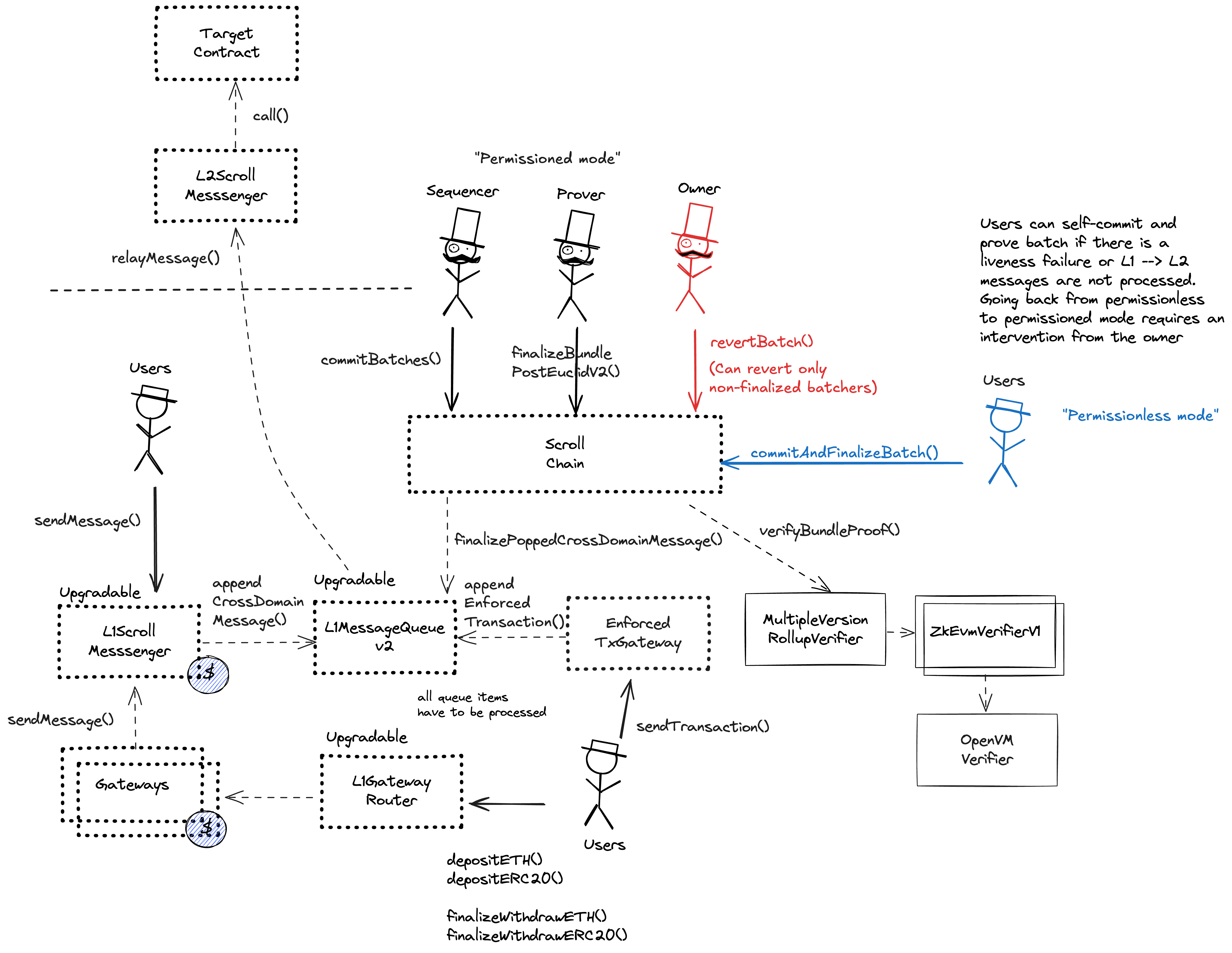
Contract used to update the verifierAn entity in a ZK-Rollup, often a smart contract, that verifies zero-knowledge proofs submitted by a prover. and keep track of current and old versions.
Contains the array of queued L1Layer 1 (L1) is a blockchain that is self-reliant on its validator set for its security and consensus properties. Ethereum is an example of a layer 1. Blockchains started receiving the moniker of layer 1 once layer 2 became a meaningful area of development. -> L2Layer 2 (L2) is a category of technical solutions aimed to scale the base layer in a trust minimized way. This category includes solutions like rollups as well as state channels and plasma. Other solutions are able to scale further, but with the introduction of additional trust assumptions, which are therefore not trust minimized. Sometimes the term Layer 2 is used to refer to include these solutions too, like validiums and optimiums, but to distinguish between trust minimized and non trust minimized solutions they are often referred to as "light" L2s, opposed to "strong" L2s like rollups. messages, either appended using the L1ScrollMessenger or the EnforcedTxGateway.
- Roles:
- admin: ProxyAdmin
Contract used to send L1Layer 1 (L1) is a blockchain that is self-reliant on its validator set for its security and consensus properties. Ethereum is an example of a layer 1. Blockchains started receiving the moniker of layer 1 once layer 2 became a meaningful area of development. -> L2Layer 2 (L2) is a category of technical solutions aimed to scale the base layer in a trust minimized way. This category includes solutions like rollups as well as state channels and plasma. Other solutions are able to scale further, but with the introduction of additional trust assumptions, which are therefore not trust minimized. Sometimes the term Layer 2 is used to refer to include these solutions too, like validiums and optimiums, but to distinguish between trust minimized and non trust minimized solutions they are often referred to as "light" L2s, opposed to "strong" L2s like rollups. and relay messages from L2. It allows to replay failed messages and to drop skipped messages. L1 -> L2 messages sent using this contract pay for L2 gasA virtual fuel used to execute smart contracts on a rollup. The EVM (or other VM within the rollup) uses an accounting mechanism to correspond the consumption of gas to the consumption of computing resources, and to limit the consumption of computing resources. on L1 and will have the aliased address of this contract as the sender.
- Roles:
- admin: ProxyAdmin
Contracts to force L1Layer 1 (L1) is a blockchain that is self-reliant on its validator set for its security and consensus properties. Ethereum is an example of a layer 1. Blockchains started receiving the moniker of layer 1 once layer 2 became a meaningful area of development. -> L2Layer 2 (L2) is a category of technical solutions aimed to scale the base layer in a trust minimized way. This category includes solutions like rollups as well as state channels and plasma. Other solutions are able to scale further, but with the introduction of additional trust assumptions, which are therefore not trust minimized. Sometimes the term Layer 2 is used to refer to include these solutions too, like validiums and optimiums, but to distinguish between trust minimized and non trust minimized solutions they are often referred to as "light" L2s, opposed to "strong" L2s like rollups. messages with the proper sender.
- Roles:
- admin: ProxyAdmin
Owner of all contracts in the system. It implements an extension of AccessControl that manages roles and functions allowed to be called by each role.
- Roles:
- opsFast: TimelockFast; ultimately Scroll Multisig 3
- opsNoDelay: TimelockEmergency; ultimately Scroll Multisig 2
- scMinorityNoDelay: ScrollAdminMultisig
- scNoDelay: TimelockSCEmergency; ultimately ScrollAdminMultisig
System configuration contract for Scroll, contains enforcedBatchParameters and messageQueueParameters determining permissionlessAnyone willing should be able to join and leave the network at any time, without causing significant disturbance to the network or being detrimental to the party in question. No single entity should have the power to allowlist or blocklist participants. mode.
- Roles:
- admin: ProxyAdmin
- owner: ScrollOwner
The main contract of the Scroll chain. Allows to post transaction data and state rootsA cryptographic hash succinctly representing a state using a Merkle tree., along with proofs. Sequencing and proposing are behind a whitelist unless enforcedBatchMode is activated.
- Roles:
- admin: ProxyAdmin
A timelock with access control. The current minimum delay is 0s. Proposals that passed their minimum delay can be executed by anyone.
- Roles:
- canceller: ScrollAdminMultisig
- executor: Scroll Multisig 1, ScrollAdminMultisig; ultimately EOA 1, EOA 2, EOA 3, EOA 4
- proposerIn the context of L2s, the actor that proposes a claimed state root on L1. The term is also used in the context of Ethereum to refer to the actor that proposes a new block.: ScrollAdminMultisig
- timelockAdmin: ScrollAdminMultisig, TimelockSCEmergency; ultimately ScrollAdminMultisig
A timelock with access control. The current minimum delay is 1d. Proposals that passed their minimum delay can be executed by anyone.
- Roles:
- canceller: Scroll Multisig 3
- executor: Scroll Multisig 1; ultimately EOA 1, EOA 2, EOA 3, EOA 4
- proposerIn the context of L2s, the actor that proposes a claimed state root on L1. The term is also used in the context of Ethereum to refer to the actor that proposes a new block.: Scroll Multisig 3
- timelockAdmin: Scroll Multisig 3, TimelockFast; ultimately Scroll Multisig 3
A timelock with access control. The current minimum delay is 3d. Proposals that passed their minimum delay can be executed by anyone.
- Roles:
- canceller: ScrollAdminMultisig
- executor: Scroll Multisig 1, ScrollAdminMultisig; ultimately EOA 1, EOA 2, EOA 3, EOA 4
- proposerIn the context of L2s, the actor that proposes a claimed state root on L1. The term is also used in the context of Ethereum to refer to the actor that proposes a new block.: ScrollAdminMultisig
- timelockAdmin: ScrollAdminMultisig, TimelockSCSlow; ultimately ScrollAdminMultisig
A timelock with access control. The current minimum delay is 0s. Proposals that passed their minimum delay can be executed by anyone.
- Roles:
- canceller: Scroll Multisig 2
- executor: Scroll Multisig 1; ultimately EOA 1, EOA 2, EOA 3, EOA 4
- proposerIn the context of L2s, the actor that proposes a claimed state root on L1. The term is also used in the context of Ethereum to refer to the actor that proposes a new block.: Scroll Multisig 2
- timelockAdmin: Scroll Multisig 2, TimelockEmergency; ultimately Scroll Multisig 2
Contract used to bridgeA message-passing protocol between two blockchains. At its most basic, a token bridge consists of a smart contract which can escrow funds on one side of the bridge, and instruct the release or minting of corresponding assets on the other side, but bridges could also support arbitrary messages. How these instructions are validated is a critical factor in assessing the trust assumptions of a bridge. ERC721 tokens from L1Layer 1 (L1) is a blockchain that is self-reliant on its validator set for its security and consensus properties. Ethereum is an example of a layer 1. Blockchains started receiving the moniker of layer 1 once layer 2 became a meaningful area of development. to L2Layer 2 (L2) is a category of technical solutions aimed to scale the base layer in a trust minimized way. This category includes solutions like rollups as well as state channels and plasma. Other solutions are able to scale further, but with the introduction of additional trust assumptions, which are therefore not trust minimized. Sometimes the term Layer 2 is used to refer to include these solutions too, like validiums and optimiums, but to distinguish between trust minimized and non trust minimized solutions they are often referred to as "light" L2s, opposed to "strong" L2s like rollups..
- Roles:
- admin: ProxyAdmin
- Roles:
- admin: ProxyAdmin
Contract used to bridgeA message-passing protocol between two blockchains. At its most basic, a token bridge consists of a smart contract which can escrow funds on one side of the bridge, and instruct the release or minting of corresponding assets on the other side, but bridges could also support arbitrary messages. How these instructions are validated is a critical factor in assessing the trust assumptions of a bridge. ETH from L1Layer 1 (L1) is a blockchain that is self-reliant on its validator set for its security and consensus properties. Ethereum is an example of a layer 1. Blockchains started receiving the moniker of layer 1 once layer 2 became a meaningful area of development. to L2Layer 2 (L2) is a category of technical solutions aimed to scale the base layer in a trust minimized way. This category includes solutions like rollups as well as state channels and plasma. Other solutions are able to scale further, but with the introduction of additional trust assumptions, which are therefore not trust minimized. Sometimes the term Layer 2 is used to refer to include these solutions too, like validiums and optimiums, but to distinguish between trust minimized and non trust minimized solutions they are often referred to as "light" L2s, opposed to "strong" L2s like rollups..
- Roles:
- admin: ProxyAdmin
Contract used to bridgeA message-passing protocol between two blockchains. At its most basic, a token bridge consists of a smart contract which can escrow funds on one side of the bridge, and instruct the release or minting of corresponding assets on the other side, but bridges could also support arbitrary messages. How these instructions are validated is a critical factor in assessing the trust assumptions of a bridge. ERC20 tokens from L1Layer 1 (L1) is a blockchain that is self-reliant on its validator set for its security and consensus properties. Ethereum is an example of a layer 1. Blockchains started receiving the moniker of layer 1 once layer 2 became a meaningful area of development. to L2Layer 2 (L2) is a category of technical solutions aimed to scale the base layer in a trust minimized way. This category includes solutions like rollups as well as state channels and plasma. Other solutions are able to scale further, but with the introduction of additional trust assumptions, which are therefore not trust minimized. Sometimes the term Layer 2 is used to refer to include these solutions too, like validiums and optimiums, but to distinguish between trust minimized and non trust minimized solutions they are often referred to as "light" L2s, opposed to "strong" L2s like rollups.. It allows to change the token mappings.
- Roles:
- admin: ProxyAdmin
All supported tokens in this escrow are included in the value secured calculation.
Contract used to bridgeA message-passing protocol between two blockchains. At its most basic, a token bridge consists of a smart contract which can escrow funds on one side of the bridge, and instruct the release or minting of corresponding assets on the other side, but bridges could also support arbitrary messages. How these instructions are validated is a critical factor in assessing the trust assumptions of a bridge. ERC1155 tokens from L1Layer 1 (L1) is a blockchain that is self-reliant on its validator set for its security and consensus properties. Ethereum is an example of a layer 1. Blockchains started receiving the moniker of layer 1 once layer 2 became a meaningful area of development. to L2Layer 2 (L2) is a category of technical solutions aimed to scale the base layer in a trust minimized way. This category includes solutions like rollups as well as state channels and plasma. Other solutions are able to scale further, but with the introduction of additional trust assumptions, which are therefore not trust minimized. Sometimes the term Layer 2 is used to refer to include these solutions too, like validiums and optimiums, but to distinguish between trust minimized and non trust minimized solutions they are often referred to as "light" L2s, opposed to "strong" L2s like rollups..
- Roles:
- admin: ProxyAdmin
Contract used to bridgeA message-passing protocol between two blockchains. At its most basic, a token bridge consists of a smart contract which can escrow funds on one side of the bridge, and instruct the release or minting of corresponding assets on the other side, but bridges could also support arbitrary messages. How these instructions are validated is a critical factor in assessing the trust assumptions of a bridge. ERC20 tokens from L1Layer 1 (L1) is a blockchain that is self-reliant on its validator set for its security and consensus properties. Ethereum is an example of a layer 1. Blockchains started receiving the moniker of layer 1 once layer 2 became a meaningful area of development. to L2Layer 2 (L2) is a category of technical solutions aimed to scale the base layer in a trust minimized way. This category includes solutions like rollups as well as state channels and plasma. Other solutions are able to scale further, but with the introduction of additional trust assumptions, which are therefore not trust minimized. Sometimes the term Layer 2 is used to refer to include these solutions too, like validiums and optimiums, but to distinguish between trust minimized and non trust minimized solutions they are often referred to as "light" L2s, opposed to "strong" L2s like rollups.. It uses a fixed token list.
- Roles:
- admin: ProxyAdmin
All supported tokens in this escrow are included in the value secured calculation.
Main entry point for depositing ETH and ERC20 tokens, which are then forwarded to the correct gateway.
- Roles:
- admin: ProxyAdmin

Contract used to bridgeA message-passing protocol between two blockchains. At its most basic, a token bridge consists of a smart contract which can escrow funds on one side of the bridge, and instruct the release or minting of corresponding assets on the other side, but bridges could also support arbitrary messages. How these instructions are validated is a critical factor in assessing the trust assumptions of a bridge. WETH from L1Layer 1 (L1) is a blockchain that is self-reliant on its validator set for its security and consensus properties. Ethereum is an example of a layer 1. Blockchains started receiving the moniker of layer 1 once layer 2 became a meaningful area of development. to L2Layer 2 (L2) is a category of technical solutions aimed to scale the base layer in a trust minimized way. This category includes solutions like rollups as well as state channels and plasma. Other solutions are able to scale further, but with the introduction of additional trust assumptions, which are therefore not trust minimized. Sometimes the term Layer 2 is used to refer to include these solutions too, like validiums and optimiums, but to distinguish between trust minimized and non trust minimized solutions they are often referred to as "light" L2s, opposed to "strong" L2s like rollups..
- Roles:
- admin: ProxyAdmin
Contract used to bridgeA message-passing protocol between two blockchains. At its most basic, a token bridge consists of a smart contract which can escrow funds on one side of the bridge, and instruct the release or minting of corresponding assets on the other side, but bridges could also support arbitrary messages. How these instructions are validated is a critical factor in assessing the trust assumptions of a bridge. ERC20 tokens from L1Layer 1 (L1) is a blockchain that is self-reliant on its validator set for its security and consensus properties. Ethereum is an example of a layer 1. Blockchains started receiving the moniker of layer 1 once layer 2 became a meaningful area of development. to L2Layer 2 (L2) is a category of technical solutions aimed to scale the base layer in a trust minimized way. This category includes solutions like rollups as well as state channels and plasma. Other solutions are able to scale further, but with the introduction of additional trust assumptions, which are therefore not trust minimized. Sometimes the term Layer 2 is used to refer to include these solutions too, like validiums and optimiums, but to distinguish between trust minimized and non trust minimized solutions they are often referred to as "light" L2s, opposed to "strong" L2s like rollups.. It allows to change the token mappings.
Contract used to bridgeA message-passing protocol between two blockchains. At its most basic, a token bridge consists of a smart contract which can escrow funds on one side of the bridge, and instruct the release or minting of corresponding assets on the other side, but bridges could also support arbitrary messages. How these instructions are validated is a critical factor in assessing the trust assumptions of a bridge. USDC tokens from L1Layer 1 (L1) is a blockchain that is self-reliant on its validator set for its security and consensus properties. Ethereum is an example of a layer 1. Blockchains started receiving the moniker of layer 1 once layer 2 became a meaningful area of development. to L2Layer 2 (L2) is a category of technical solutions aimed to scale the base layer in a trust minimized way. This category includes solutions like rollups as well as state channels and plasma. Other solutions are able to scale further, but with the introduction of additional trust assumptions, which are therefore not trust minimized. Sometimes the term Layer 2 is used to refer to include these solutions too, like validiums and optimiums, but to distinguish between trust minimized and non trust minimized solutions they are often referred to as "light" L2s, opposed to "strong" L2s like rollups..
- Roles:
- admin: ProxyAdmin
- Roles:
- admin: ProxyAdmin
- Roles:
- admin: ProxyAdmin
- Roles:
- owner: ScrollOwner
Scroll
Owner of all contracts in the system. It implements an extension of AccessControl that manages roles and functions allowed to be called by each role.
- Roles:
- scNoDelay: TimelockSCEmergencyScroll; ultimately ScrollAdminMultisig
Contract used to withdraw ERC20 tokens on L2Layer 2 (L2) is a category of technical solutions aimed to scale the base layer in a trust minimized way. This category includes solutions like rollups as well as state channels and plasma. Other solutions are able to scale further, but with the introduction of additional trust assumptions, which are therefore not trust minimized. Sometimes the term Layer 2 is used to refer to include these solutions too, like validiums and optimiums, but to distinguish between trust minimized and non trust minimized solutions they are often referred to as "light" L2s, opposed to "strong" L2s like rollups. and finalize deposit the tokens from L1Layer 1 (L1) is a blockchain that is self-reliant on its validator set for its security and consensus properties. Ethereum is an example of a layer 1. Blockchains started receiving the moniker of layer 1 once layer 2 became a meaningful area of development..
- Roles:
- admin: ProxyAdmin
A timelock with access control. The current minimum delay is 0s. Proposals that passed their minimum delay can be executed by anyone.
- Roles:
- canceller: ScrollAdminMultisig
- executor: Scroll Multisig 1, ScrollAdminMultisig; ultimately EOA 5, EOA 6, EOA 7, EOA 8
- proposerIn the context of L2s, the actor that proposes a claimed state root on L1. The term is also used in the context of Ethereum to refer to the actor that proposes a new block.: ScrollAdminMultisig
- timelockAdmin: ScrollAdminMultisig, TimelockSCEmergencyScroll; ultimately ScrollAdminMultisig
A timelock with access control. The current minimum delay is 1d. Proposals that passed their minimum delay can be executed by anyone.
- Roles:
- canceller: Scroll Multisig 3
- executor: Scroll Multisig 1; ultimately EOA 5, EOA 6, EOA 7, EOA 8
- proposerIn the context of L2s, the actor that proposes a claimed state root on L1. The term is also used in the context of Ethereum to refer to the actor that proposes a new block.: Scroll Multisig 3
- timelockAdmin: Scroll Multisig 3, TimelockFast; ultimately Scroll Multisig 3
A timelock with access control. The current minimum delay is 3d. Proposals that passed their minimum delay can be executed by anyone.
- Roles:
- canceller: AgoraGovernor, ScrollAdminMultisig
- executor: AgoraGovernor, Scroll Multisig 1, ScrollAdminMultisig; ultimately EOA 5, EOA 6, EOA 7, EOA 8
- proposerIn the context of L2s, the actor that proposes a claimed state root on L1. The term is also used in the context of Ethereum to refer to the actor that proposes a new block.: AgoraGovernor, ScrollAdminMultisig
- timelockAdmin: ScrollAdminMultisig, TimelockSCSlow; ultimately AgoraGovernor, ScrollAdminMultisig
A timelock with access control. The current minimum delay is 0s. Proposals that passed their minimum delay can be executed by anyone.
- Roles:
- canceller: Scroll Multisig 2
- executor: Scroll Multisig 1; ultimately EOA 5, EOA 6, EOA 7, EOA 8
- proposerIn the context of L2s, the actor that proposes a claimed state root on L1. The term is also used in the context of Ethereum to refer to the actor that proposes a new block.: Scroll Multisig 2
- timelockAdmin: Scroll Multisig 2, TimelockEmergency; ultimately Scroll Multisig 2
Contract of the USDC token on Scroll.
- Roles:
- admin: ProxyAdmin
- Roles:
- admin: ProxyAdmin
Counterpart to the L1GatewayRouter contract.
- Roles:
- admin: ProxyAdmin
Used to append messages to the L2MessageQueue from the L2ScrollMessenger.
Counterpart to the L1ERC1155Gateway contract.
- Roles:
- admin: ProxyAdmin
Counterpart to the L1CustomERC20Gateway contract.
- Roles:
- admin: ProxyAdmin
Contract used to deploy ScrollStandardERC20 tokens for L2StandardERC20Gateway.
Contract of the L2ScrollMessenger contract.
- Roles:
- admin: ProxyAdmin
- Roles:
- admin: ProxyAdmin
ETH is pre-minted to this contract in the genesis blockAn ordered list of transactions and chain-related metadata that gets bundled together and published to the L1/DA layer. Nodes execute the transactions contained within blocks to change the rollup chain’s state. Protocol rules dictate what constitutes a valid block, and invalid blocks are skipped over. and released on Scroll whenever corresponding deposits are made on Ethereum.
- Roles:
- admin: ProxyAdmin
Counterpart to the L1ERC721Gateway contract.
- Roles:
- admin: ProxyAdmin
- Roles:
- owner: ScrollOwner
- Roles:
- admin: ProxyAdmin
- Roles:
- admin: ProxyAdmin
- Roles:
- admin: ProxyAdmin
Contract that uses controllers to manage minters for USDC on Scroll.
Contract of the ERC20 standard token used by the ERC20 factory.
- Roles:
- admin: ProxyAdmin
The current deployment carries some associated risks:
Funds can be stolen if a contract receives a malicious code upgrade. There is no delay on code upgrades (CRITICAL).