Search
Search for projects by name or address
 ApeX Omni
ApeX Omni
Badges
About
ApeX Omni is an application-specific ZK rollup for order book trading. It uses zkLink X to aggregate liquidity deposited across multiple chains.
Badges
About
ApeX Omni is an application-specific ZK rollup for order book trading. It uses zkLink X to aggregate liquidity deposited across multiple chains.
Why is the project listed in others?
ApeX's proof system does not authenticate deposits on external chains. Users must additionally trust the validator and the LayerZero bridges (including their governors and the LayerZero message verifiers) not to collude in forging non-existent deposits, which allows draining rollup escrows.
Consequence: projects without a proper proof system fully rely on single entities to safely update the state. A malicious proposer can finalize an invalid state, which can cause loss of funds.
Learn more about the recategorisation here.
ApeX Pro sunset
2025 Feb 27th
ApeX Pro StarkEx chain is discontinuied in favor of zkLink X stack chain.
ApeX Omni launched on zkLink X
2024 Jun 10th
A launch of ApeX Omni chain build on zkLink X stack is announced.
ApeX Omni is an application-specific ZK rollupA blockchain that inherits consensus and data availability from another blockchain called L1. Rollups enable trust minimized bridges with the base layer via proof systems, either optimistic or zero-knowledge. A rollup without a bridge, or without considering the bridge, is called a sovereign rollup. for order book trading. It uses zkLink X to aggregate liquidity deposited across multiple chains.
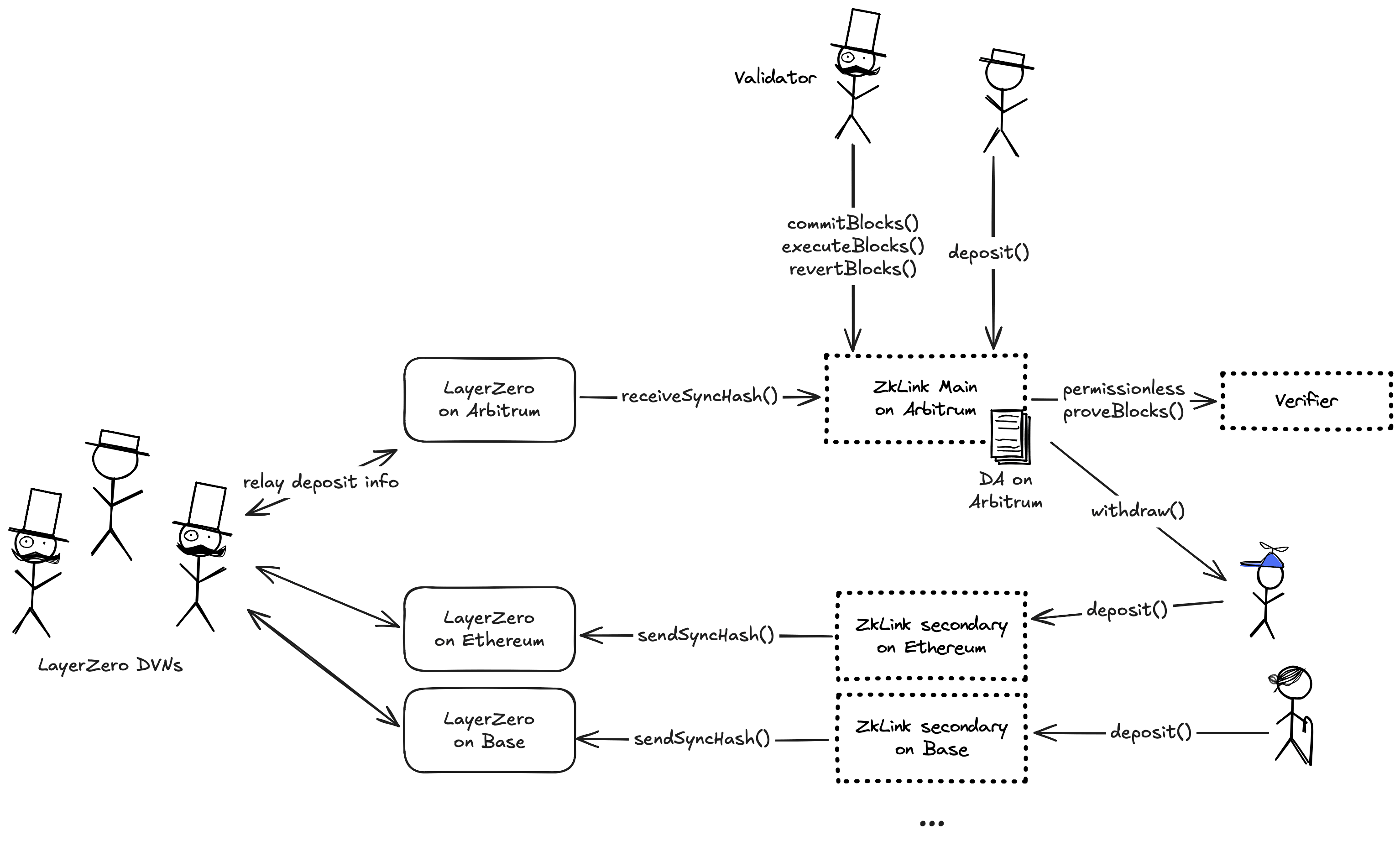
ApeX Omni is a non-EVM L3Intuitively, L3s are projects that follow a similar structure to the L2 <> L1 structure but with an L2 underneath. It's not entirely defined yet if this implies that the token escrow must be on the L2, or the proof system. Also, certain cases like projects using aggregation layers make the distinction between L2 and L3 fuzzy as certain components start to look less like a traditional blockchain. How to properly define what is a layer in the first place is still an open question. on Arbitrum One. Its primary zkLink deployment verifies state transition proofs and publishes state differences on Arbitrum, while secondary deployments escrow assets deposited on other chains and synchronize their local state with the primary deployment through LayerZero.
 Arbitrum One
Funds can be stolen if
Funds can be lost if
Funds can be frozen if
Users can be censored if
MEV can be extracted if
| SEQUENCER FAILURE | STATE VALIDATION | DATA AVAILABILITY | EXIT WINDOW | PROPOSER FAILURE | |
| Arbitrum One L2 | Self sequence | Fraud proofs (INT) | Onchain | None | Self propose |
| ApeX Omni L3 • Individual | No mechanism | Validity proofs (SN) | Onchain (SD) | None | Cannot withdraw |
| ApeX Omni L3 • Combined | No mechanism | Validity proofs | Onchain | None | Cannot withdraw |
There is no mechanism to have transactions be included if the sequencerA party responsible for ordering and executing transactions on the rollup. The sequencer verifies transactions, compresses the data into a block, and submits the data related to it to enable state reconstruction to Ethereum L1 as a single transaction. The data can be either transaction data or state diffs. is down or censoring.
Zero knowledge cryptography is used to ensure state correctness. Proofs are first verified on Arbitrum One and finally on Ethereum.
All of the data needed for proof construction is published on the base chain, which ultimately gets published on Ethereum.
There is no window for users to exit in case of an unwanted upgrade since contracts are instantly upgradable.
Only the whitelisted proposers can publish state rootsA cryptographic hash succinctly representing a state using a Merkle tree. on L1Layer 1 (L1) is a blockchain that is self-reliant on its validator set for its security and consensus properties. Ethereum is an example of a layer 1. Blockchains started receiving the moniker of layer 1 once layer 2 became a meaningful area of development., so in the event of failure the withdrawals are frozen.
State differences are published on Arbitrum One
The data needed to reconstruct the ApeX state is included in commitBlocks calldata on Arbitrum One. Secondary deployments additionally commit their local onchain operations and send synchronization hashes to the primary deployment.
Arbitrum OneEach update to the system state must be accompanied by a ZK proof that ensures that the new state was derived by correctly applying a series of valid user transactions to the previous state. These proofs are then verified on Arbitrum One by a smart contract. Deposits on secondary chains are not covered by these validity proofs and rely on LayerZero bridgeA message-passing protocol between two blockchains. At its most basic, a token bridge consists of a smart contract which can escrow funds on one side of the bridge, and instruct the release or minting of corresponding assets on the other side, but bridges could also support arbitrary messages. How these instructions are validated is a critical factor in assessing the trust assumptions of a bridge. contracts instead. Escrowed funds can be stolen if the validatorIn the context of L2s, a Validator is an actor that validates the correctness of state transitions. For optimistic rollups this corresponds to challengers, and for ZK rollups this corresponds to the onchain verifier colludes with a compromised bridge.

2026 October 01, 10:35 UTC23changesAll sync services (message bridges) were switched from the old LZSyncHashBridges to new immutable LayerZeroBridges. Reason: LayerZero retired the ULNv2 relayer on 2026-08-03 and its new executor rejects the empty adapterParams the old bridges sent. The new bridges send type-1 adapterParams with a governor-set per-destination minDstGas and have their own governor . Everything else is unchanged. Source was manually verified: zkLinkProtocol/zklink-contracts branch fix/lz-adapterparams (4228fe6), now verified on Etherscan and Sourcify. Code differs per chain only by chain constants. - https://disco.l2beat.com/diff/arb1:0xfC5c2b3E615cF12e86E6dA8eF6C76fAbae5F2B7D/arb1:0xf8A29C604eff6e4a3f7ad5f29ae11656bfD85453 - https://disco.l2beat.com/diff/eth:0x3D70dc86dC8099D8a4c86C18839C7e84a13a441E/eth:0xf8A29C604eff6e4a3f7ad5f29ae11656bfD85453 - https://disco.l2beat.com/diff/base:0xeD5D1e1320720CAe8Bb40275550A7D307A082AC3/base:0xf8A29C604eff6e4a3f7ad5f29ae11656bfD85453 - https://disco.l2beat.com/diff/bnb:0xc271a8e9eB2b10FCDe1709D76de6681249669D2e/bnb:0xf8A29C604eff6e4a3f7ad5f29ae11656bfD85453 - https://disco.l2beat.com/diff/mantle:0x04C6a52f3bf9F73618cD70F234AdB95a73325D1e/mantle:0xf8A29C604eff6e4a3f7ad5f29ae11656bfD85453
All sync services (message bridges) were switched from the old LZSyncHashBridges to new immutable LayerZeroBridges.
Reason: LayerZero retired the ULNv2 relayer on 2026-08-03 and its new executor rejects the empty adapterParams the old bridges sent. The new bridges send type-1 adapterParams with a governor-set per-destination minDstGas and have their own governor. Everything else is unchanged. Source was manually verified: zkLinkProtocol/zklink-contracts branch fix/lz-adapterparams (4228fe6), now verified on Etherscan and Sourcify. Code differs per chain only by chain constants.
- https://disco.l2beat.com/diff/arb1:0xfC5c2b3E615cF12e86E6dA8eF6C76fAbae5F2B7D/arb1:0xf8A29C604eff6e4a3f7ad5f29ae11656bfD85453
- https://disco.l2beat.com/diff/eth:0x3D70dc86dC8099D8a4c86C18839C7e84a13a441E/eth:0xf8A29C604eff6e4a3f7ad5f29ae11656bfD85453
- https://disco.l2beat.com/diff/base:0xeD5D1e1320720CAe8Bb40275550A7D307A082AC3/base:0xf8A29C604eff6e4a3f7ad5f29ae11656bfD85453
- https://disco.l2beat.com/diff/bnb:0xc271a8e9eB2b10FCDe1709D76de6681249669D2e/bnb:0xf8A29C604eff6e4a3f7ad5f29ae11656bfD85453
- https://disco.l2beat.com/diff/mantle:0x04C6a52f3bf9F73618cD70F234AdB95a73325D1e/mantle:0xf8A29C604eff6e4a3f7ad5f29ae11656bfD85453
| contract ZkLink Main (arb1:0x3169844a120C0f517B4eB4A750c08d8518C8466a) [apex-omni/ZkLink_main] { | |
| +++ description: The main rollup contract. It processes L3 blocks submitted by validators and settles L3 state, handles deposits and withdrawals, and synchronizes block data with other zkLink chains. | |
| +++ description: Cross-chain synchronization services relaying deposit info, indexed by zkLink chain ID. | |
| values.syncServices.3: | |
| - | "arb1:0xfC5c2b3E615cF12e86E6dA8eF6C76fAbae5F2B7D" |
| + | "arb1:0xf8A29C604eff6e4a3f7ad5f29ae11656bfD85453" |
| +++ description: Cross-chain synchronization services relaying deposit info, indexed by zkLink chain ID. | |
| values.syncServices.4: | |
| - | "arb1:0xfC5c2b3E615cF12e86E6dA8eF6C76fAbae5F2B7D" |
| + | "arb1:0xf8A29C604eff6e4a3f7ad5f29ae11656bfD85453" |
| +++ description: Cross-chain synchronization services relaying deposit info, indexed by zkLink chain ID. | |
| values.syncServices.11: | |
| - | "arb1:0xfC5c2b3E615cF12e86E6dA8eF6C76fAbae5F2B7D" |
| + | "arb1:0xf8A29C604eff6e4a3f7ad5f29ae11656bfD85453" |
| +++ description: Cross-chain synchronization services relaying deposit info, indexed by zkLink chain ID. | |
| values.syncServices.12: | |
| - | "arb1:0xfC5c2b3E615cF12e86E6dA8eF6C76fAbae5F2B7D" |
| + | "arb1:0xf8A29C604eff6e4a3f7ad5f29ae11656bfD85453" |
| } | |
| contract GnosisSafeL2 (arb1:0xba3852Ea9b72DE82AF343f7e3F09c86fdea912ED) [GnosisSafe] { | |
| +++ description: None | |
| receivedPermissions.2: | |
| + | {"permission":"interact","from":"arb1:0xf8A29C604eff6e4a3f7ad5f29ae11656bfD85453","description":"change the trusted remote bridges and the LayerZero messaging configuration (message libraries and verifiers), which together determine which synchronization hashes and block confirmations are accepted, set the minimum destination gas, force-resume blocked message delivery and change the bridge governor.","role":".governor"} |
| } | |
| - | Status: DELETED |
| contract LayerZeroBridge (arb1:0xfC5c2b3E615cF12e86E6dA8eF6C76fAbae5F2B7D) [apex-omni/LZSyncHashBridge] | |
| +++ description: A LayerZero bridge that relays synchronization hashes and block confirmations between zkLink chains. | |
| contract GnosisSafeL2 (base:0xba3852Ea9b72DE82AF343f7e3F09c86fdea912ED) [GnosisSafe] { | |
| +++ description: None | |
| receivedPermissions.2: | |
| + | {"permission":"interact","from":"base:0xf8A29C604eff6e4a3f7ad5f29ae11656bfD85453","description":"change the trusted remote bridges and the LayerZero messaging configuration (message libraries and verifiers), which together determine which synchronization hashes and block confirmations are accepted, set the minimum destination gas, force-resume blocked message delivery and change the bridge governor.","role":".governor"} |
| } | |
| - | Status: DELETED |
| contract LayerZeroBridge (base:0xeD5D1e1320720CAe8Bb40275550A7D307A082AC3) [apex-omni/LZSyncHashBridge] | |
| +++ description: A LayerZero bridge that relays synchronization hashes and block confirmations between zkLink chains. | |
| contract ZkLink Base (base:0xeE7981C4642dE8d19AeD11dA3bac59277DfD59D7) [apex-omni/ZkLink_LZEscrow] { | |
| +++ description: A secondary cross-chain ZkLink rollup contract. It only escrows user deposits, and synchronizes deposit data with the main zkLink chain. | |
| +++ description: Cross-chain synchronization services relaying deposit info, indexed by zkLink chain ID. | |
| values.syncServices.9: | |
| - | "base:0xeD5D1e1320720CAe8Bb40275550A7D307A082AC3" |
| + | "base:0xf8A29C604eff6e4a3f7ad5f29ae11656bfD85453" |
| } | |
| contract ZkLink BNB (bnb:0xb8D9F005654b7b127b34dae8F973Ba729ca3A2D9) [apex-omni/ZkLink_LZEscrow] { | |
| +++ description: A secondary cross-chain ZkLink rollup contract. It only escrows user deposits, and synchronizes deposit data with the main zkLink chain. | |
| +++ description: Cross-chain synchronization services relaying deposit info, indexed by zkLink chain ID. | |
| values.syncServices.9: | |
| - | "bnb:0xc271a8e9eB2b10FCDe1709D76de6681249669D2e" |
| + | "bnb:0xf8A29C604eff6e4a3f7ad5f29ae11656bfD85453" |
| } | |
| contract GnosisSafeL2 (bnb:0xba3852Ea9b72DE82AF343f7e3F09c86fdea912ED) [GnosisSafe] { | |
| +++ description: None | |
| receivedPermissions.2: | |
| + | {"permission":"interact","from":"bnb:0xf8A29C604eff6e4a3f7ad5f29ae11656bfD85453","description":"change the trusted remote bridges and the LayerZero messaging configuration (message libraries and verifiers), which together determine which synchronization hashes and block confirmations are accepted, set the minimum destination gas, force-resume blocked message delivery and change the bridge governor.","role":".governor"} |
| } | |
| - | Status: DELETED |
| contract LayerZeroBridge (bnb:0xc271a8e9eB2b10FCDe1709D76de6681249669D2e) [apex-omni/LZSyncHashBridge] | |
| +++ description: A LayerZero bridge that relays synchronization hashes and block confirmations between zkLink chains. | |
| contract ZkLink Ethereum (eth:0x35D173cdfE4d484BC5985fDa55FABad5892c7B82) [apex-omni/ZkLink_LZEscrow] { | |
| +++ description: A secondary cross-chain ZkLink rollup contract. It only escrows user deposits, and synchronizes deposit data with the main zkLink chain. | |
| +++ description: Cross-chain synchronization services relaying deposit info, indexed by zkLink chain ID. | |
| values.syncServices.9: | |
| - | "eth:0x3D70dc86dC8099D8a4c86C18839C7e84a13a441E" |
| + | "eth:0xf8A29C604eff6e4a3f7ad5f29ae11656bfD85453" |
| } | |
| - | Status: DELETED |
| contract LayerZeroBridge (eth:0x3D70dc86dC8099D8a4c86C18839C7e84a13a441E) [apex-omni/LZSyncHashBridge] | |
| +++ description: A LayerZero bridge that relays synchronization hashes and block confirmations between zkLink chains. | |
| contract GnosisSafe (eth:0xF9f8794A2D9885C36D06aA25fc25a8cAda276B94) [GnosisSafe] { | |
| +++ description: None | |
| receivedPermissions.2: | |
| + | {"permission":"interact","from":"eth:0xf8A29C604eff6e4a3f7ad5f29ae11656bfD85453","description":"change the trusted remote bridges and the LayerZero messaging configuration (message libraries and verifiers), which together determine which synchronization hashes and block confirmations are accepted, set the minimum destination gas, force-resume blocked message delivery and change the bridge governor.","role":".governor"} |
| } | |
| - | Status: DELETED |
| contract LayerZeroBridge (mantle:0x04C6a52f3bf9F73618cD70F234AdB95a73325D1e) [apex-omni/LZSyncHashBridge] | |
| +++ description: A LayerZero bridge that relays synchronization hashes and block confirmations between zkLink chains. | |
| contract ZkLink Mantle (mantle:0x3C7c0ebFCD5786ef48df5ed127cdDEb806db976c) [apex-omni/ZkLink_LZEscrow] { | |
| +++ description: A secondary cross-chain ZkLink rollup contract. It only escrows user deposits, and synchronizes deposit data with the main zkLink chain. | |
| +++ description: Cross-chain synchronization services relaying deposit info, indexed by zkLink chain ID. | |
| values.syncServices.9: | |
| - | "mantle:0x04C6a52f3bf9F73618cD70F234AdB95a73325D1e" |
| + | "mantle:0xf8A29C604eff6e4a3f7ad5f29ae11656bfD85453" |
| } | |
| contract GnosisSafeL2 (mantle:0xba3852Ea9b72DE82AF343f7e3F09c86fdea912ED) [GnosisSafe] { | |
| +++ description: None | |
| receivedPermissions.2: | |
| + | {"permission":"interact","from":"mantle:0xf8A29C604eff6e4a3f7ad5f29ae11656bfD85453","description":"change the trusted remote bridges and the LayerZero messaging configuration (message libraries and verifiers), which together determine which synchronization hashes and block confirmations are accepted, set the minimum destination gas, force-resume blocked message delivery and change the bridge governor.","role":".governor"} |
| } | |
| + | Status: CREATED |
| contract LayerZeroBridge (arb1:0xf8A29C604eff6e4a3f7ad5f29ae11656bfD85453) [apex-omni/LZSyncHashBridgeV2] | |
| +++ description: A LayerZero (v1 endpoint) bridge that relays synchronization hashes and block confirmations between zkLink chains. Messages are only accepted from the trusted remote bridges set by its governor, and the governor-set minimum gas is forwarded for execution on the destination chain. | |
| + | Status: CREATED |
| contract LayerZeroBridge (base:0xf8A29C604eff6e4a3f7ad5f29ae11656bfD85453) [apex-omni/LZSyncHashBridgeV2] | |
| +++ description: A LayerZero (v1 endpoint) bridge that relays synchronization hashes and block confirmations between zkLink chains. Messages are only accepted from the trusted remote bridges set by its governor, and the governor-set minimum gas is forwarded for execution on the destination chain. | |
| + | Status: CREATED |
| contract LayerZeroBridge (bnb:0xf8A29C604eff6e4a3f7ad5f29ae11656bfD85453) [apex-omni/LZSyncHashBridgeV2] | |
| +++ description: A LayerZero (v1 endpoint) bridge that relays synchronization hashes and block confirmations between zkLink chains. Messages are only accepted from the trusted remote bridges set by its governor, and the governor-set minimum gas is forwarded for execution on the destination chain. | |
| + | Status: CREATED |
| contract LayerZeroBridge (eth:0xf8A29C604eff6e4a3f7ad5f29ae11656bfD85453) [apex-omni/LZSyncHashBridgeV2] | |
| +++ description: A LayerZero (v1 endpoint) bridge that relays synchronization hashes and block confirmations between zkLink chains. Messages are only accepted from the trusted remote bridges set by its governor, and the governor-set minimum gas is forwarded for execution on the destination chain. | |
| + | Status: CREATED |
| contract LayerZeroBridge (mantle:0xf8A29C604eff6e4a3f7ad5f29ae11656bfD85453) [apex-omni/LZSyncHashBridgeV2] | |
| +++ description: A LayerZero (v1 endpoint) bridge that relays synchronization hashes and block confirmations between zkLink chains. Messages are only accepted from the trusted remote bridges set by its governor, and the governor-set minimum gas is forwarded for execution on the destination chain. | |
2026 July 22, 10:24 UTC27changesCompletely new discovery of ApeX project (ApeX Omni instead of older ApeX Pro). Now it is a zkLink X cross-chain deployment with settlement on Arbitrum One (as L3) and deposits on several other chains.
Completely new discovery of ApeX project (ApeX Omni instead of older ApeX Pro).
Now it is a zkLink X cross-chain deployment with settlement on Arbitrum One (as L3) and deposits on several other chains.
| contract GnosisSafe (eth:0x374632e7D48B7872d904524FdC5Dd4516F42cDFF) [GnosisSafe] { | |
| +++ description: None | |
| values.$members.5: | |
| - | "eth:0x824C9364A6CF8f5EB542ad2ca8F5705561C8b1db" |
| + | "eth:0x522b8Df4c9965934654CFebbf20882005c33cE18" |
| } | |
New and verified contracts
| + | Status: CREATED |
| contract Verifier (arb1:0x235118AfB54B6d6c7b48F1B5434c25CD6Eb6B68F) [N/A] | |
| +++ description: PLONK verifier used to validate aggregated L2 block proofs and zero-knowledge exit proofs. | |
| + | Status: CREATED |
| contract UpgradeGatekeeper (arb1:0x2e8AD1434663b209EE59eF1a6612114239F4a190) [N/A] | |
| +++ description: Controls upgrades to managed contracts. The master can schedule, cancel, and complete upgrades after the main contract's notice period. | |
| + | Status: CREATED |
| contract ZkLink Main (arb1:0x3169844a120C0f517B4eB4A750c08d8518C8466a) [apex-omni/ZkLink_main] | |
| +++ description: The main rollup contract. It processes L3 blocks submitted by validators and settles L3 state, handles deposits and withdrawals, and synchronizes block data with other zkLink chains. | |
| + | Status: CREATED |
| contract GnosisSafeL2 (arb1:0xba3852Ea9b72DE82AF343f7e3F09c86fdea912ED) [GnosisSafe] | |
| +++ description: None | |
| + | Status: CREATED |
| contract LayerZeroBridge (arb1:0xfC5c2b3E615cF12e86E6dA8eF6C76fAbae5F2B7D) [apex-omni/LZSyncHashBridge] | |
| +++ description: A LayerZero bridge that relays synchronization hashes and block confirmations between zkLink chains. | |
| + | Status: CREATED |
| contract EmptyVerifier (base:0x4c5629AEA0B419d26C780dD78d5671e2Ce27c563) [N/A] | |
| +++ description: None | |
| + | Status: CREATED |
| contract UpgradeGatekeeper (base:0x72343e8e448Fa539A1F118f870A1De1132f2fcaD) [N/A] | |
| +++ description: None | |
| + | Status: CREATED |
| contract GnosisSafeL2 (base:0xba3852Ea9b72DE82AF343f7e3F09c86fdea912ED) [GnosisSafe] | |
| +++ description: None | |
| + | Status: CREATED |
| contract LayerZeroBridge (base:0xeD5D1e1320720CAe8Bb40275550A7D307A082AC3) [apex-omni/LZSyncHashBridge] | |
| +++ description: A LayerZero bridge that relays synchronization hashes and block confirmations between zkLink chains. | |
| + | Status: CREATED |
| contract ZkLink Base (base:0xeE7981C4642dE8d19AeD11dA3bac59277DfD59D7) [apex-omni/ZkLink_LZEscrow] | |
| +++ description: A secondary cross-chain ZkLink rollup contract. It only escrows user deposits, and synchronizes deposit data with the main zkLink chain. | |
| + | Status: CREATED |
| contract EmptyVerifier (bnb:0x1202e0557A23531D09015C802e993d6423685FfB) [N/A] | |
| +++ description: None | |
| + | Status: CREATED |
| contract UpgradeGatekeeper (bnb:0x81DEE5B8BfFa75Cc1ec729533EeD30CfE4F81F8C) [N/A] | |
| +++ description: None | |
| + | Status: CREATED |
| contract ZkLink BNB (bnb:0xb8D9F005654b7b127b34dae8F973Ba729ca3A2D9) [apex-omni/ZkLink_LZEscrow] | |
| +++ description: A secondary cross-chain ZkLink rollup contract. It only escrows user deposits, and synchronizes deposit data with the main zkLink chain. | |
| + | Status: CREATED |
| contract GnosisSafeL2 (bnb:0xba3852Ea9b72DE82AF343f7e3F09c86fdea912ED) [GnosisSafe] | |
| +++ description: None | |
| + | Status: CREATED |
| contract LayerZeroBridge (bnb:0xc271a8e9eB2b10FCDe1709D76de6681249669D2e) [apex-omni/LZSyncHashBridge] | |
| +++ description: A LayerZero bridge that relays synchronization hashes and block confirmations between zkLink chains. | |
| + | Status: CREATED |
| contract ZkLink Ethereum (eth:0x35D173cdfE4d484BC5985fDa55FABad5892c7B82) [apex-omni/ZkLink_LZEscrow] | |
| +++ description: A secondary cross-chain ZkLink rollup contract. It only escrows user deposits, and synchronizes deposit data with the main zkLink chain. | |
| + | Status: CREATED |
| contract GnosisSafe (eth:0x374632e7D48B7872d904524FdC5Dd4516F42cDFF) [GnosisSafe] | |
| +++ description: None | |
| + | Status: CREATED |
| contract LayerZeroBridge (eth:0x3D70dc86dC8099D8a4c86C18839C7e84a13a441E) [apex-omni/LZSyncHashBridge] | |
| +++ description: A LayerZero bridge that relays synchronization hashes and block confirmations between zkLink chains. | |
| + | Status: CREATED |
| contract EmptyVerifier (eth:0xe38f8bc093a1f76f0A444bA6B75F46d6dC686dba) [N/A] | |
| +++ description: Placeholder verifier for chains without pairing support. It rejects all block and exit proofs. | |
| + | Status: CREATED |
| contract GnosisSafe (eth:0xF9f8794A2D9885C36D06aA25fc25a8cAda276B94) [GnosisSafe] | |
| +++ description: None | |
| + | Status: CREATED |
| contract UpgradeGatekeeper (eth:0xFBD68679271fDa6ca9bf6F20993Cd39E20072753) [N/A] | |
| +++ description: Controls upgrades to managed contracts. The master can schedule, cancel, and complete upgrades after the main contract's notice period. | |
| + | Status: CREATED |
| contract LayerZeroBridge (mantle:0x04C6a52f3bf9F73618cD70F234AdB95a73325D1e) [apex-omni/LZSyncHashBridge] | |
| +++ description: A LayerZero bridge that relays synchronization hashes and block confirmations between zkLink chains. | |
| + | Status: CREATED |
| contract EmptyVerifier (mantle:0x0c0F729c74c9AC41F9C702dAd11011F40D4190B0) [N/A] | |
| +++ description: None | |
| + | Status: CREATED |
| contract UpgradeGatekeeper (mantle:0x2B9BA259F24965a81Fa0c4E477e3791673744059) [N/A] | |
| +++ description: None | |
| + | Status: CREATED |
| contract ZkLink Mantle (mantle:0x3C7c0ebFCD5786ef48df5ed127cdDEb806db976c) [apex-omni/ZkLink_LZEscrow] | |
| +++ description: A secondary cross-chain ZkLink rollup contract. It only escrows user deposits, and synchronizes deposit data with the main zkLink chain. | |
| + | Status: CREATED |
| contract GnosisSafeL2 (mantle:0xba3852Ea9b72DE82AF343f7e3F09c86fdea912ED) [GnosisSafe] | |
| +++ description: None | |
2025 July 22, 16:06 UTC1changeproject is archived.
project is archived.
| contract StarkPerpetualUSDC (0xA1D5443F2FB80A5A55ac804C948B45ce4C52DCbb) { | |
| +++ description: Central Validium contract. Receives (verified) state roots from the Operator, allows users to consume L2 -> L1 messages and send L1 -> L2 messages. Critical configuration values for the L2's logic are defined here by various governance roles. | |
| values.isFrozen: | |
| - | false |
| + | true |
| } | |
2025 July 14, 12:44 UTC8changesDiscovery rerun on the same block number with only config-related changes.
Discovery rerun on the same block number with only config-related changes.
New and verified contracts
| + | Status: CREATED |
| contract CommitteeUSDC (0x23Cab3CF1aa7B929Df5e9f3712aCA3A6Fb9494E4) | |
| +++ description: Data Availability Committee (DAC) contract verifying and storing data availability claims from DAC Members (via a multisignature check). The threshold of valid signatures is 3. | |
| + | Status: CREATED |
| contract FinalizableGpsFactAdapterUSDT (0x40e1e5Ece49A878062fA9F87eA6dc81281098B22) | |
| +++ description: Adapter between the core contract and the eth:0x47312450B3Ac8b5b8e247a6bB6d523e7605bDb60. Stores the Cairo programHash (`770346231394331402493200980986217737662224545740427952627288191358999988146`). | |
| + | Status: CREATED |
| contract CommitteeUSDT (0x7249082BfAFE9BCA502d38a686Ef3df37A0cf800) | |
| +++ description: Data Availability Committee (DAC) contract verifying and storing data availability claims from DAC Members (via a multisignature check). The threshold of valid signatures is 3. | |
| + | Status: CREATED |
| contract StarkPerpetualUSDC (0xA1D5443F2FB80A5A55ac804C948B45ce4C52DCbb) | |
| +++ description: Central Validium contract. Receives (verified) state roots from the Operator, allows users to consume L2 -> L1 messages and send L1 -> L2 messages. Critical configuration values for the L2's logic are defined here by various governance roles. | |
| + | Status: CREATED |
| contract PerpetualEscapeVerifier (0xaadFdB9CAc145c65f2284fBe24600d07fb37F7BD) | |
| +++ description: Special verifier for the escape() function. | |
| + | Status: CREATED |
| contract ApexAdminMultisig (0xC532d2976209A56DdF4a99B844130f7c0daCa7B6) | |
| +++ description: None | |
| + | Status: CREATED |
| contract StarkPerpetualUSDT (0xe53A6eD882Eb3f90cCe0390DDB04c876C5482E6b) | |
| +++ description: Central Validium contract. Receives (verified) state roots from the Operator, allows users to consume L2 -> L1 messages and send L1 -> L2 messages. Critical configuration values for the L2's logic are defined here by various governance roles. | |
| + | Status: CREATED |
| contract FinalizableGpsFactAdapterUSDC (0xE741e26573782ae3C0ea9EC710FA99Fcd27fB953) | |
| +++ description: Adapter between the core contract and the eth:0x47312450B3Ac8b5b8e247a6bB6d523e7605bDb60. Stores the Cairo programHash (`2530337539466159944237001094809327283009177793361359619481044346150483328860`). | |
2025 July 09, 09:25 UTC2changesUSDT StarkEx instance frozen, project archived. Apex Pro, the app on this StarkEx Validium, is EOL: https://www.apex.exchange/blog/detail/ApeX-Pro-Sunset-Delisting-Timeline-for-Trading-Pairs.
USDT StarkEx instance frozen, project archived.
Apex Pro, the app on this StarkEx Validium, is EOL: https://www.apex.exchange/blog/detail/ApeX-Pro-Sunset-Delisting-Timeline-for-Trading-Pairs.
| contract PerpetualEscapeVerifier (0xaadFdB9CAc145c65f2284fBe24600d07fb37F7BD) { | |
| +++ description: Special verifier for the escape() function. | |
| values.hasRegisteredFact: | |
| - | false |
| + | true |
| } | |
| contract StarkPerpetualUSDT (0xe53A6eD882Eb3f90cCe0390DDB04c876C5482E6b) { | |
| +++ description: Central Validium contract. Receives (verified) state roots from the Operator, allows users to consume L2 -> L1 messages and send L1 -> L2 messages. Critical configuration values for the L2's logic are defined here by various governance roles. | |
| values.isFrozen: | |
| - | false |
| + | true |
| } | |
Arbitrum OneThe system has a centralized operator
A single permissioned validatorIn the context of L2s, a Validator is an actor that validates the correctness of state transitions. For optimistic rollups this corresponds to challengers, and for ZK rollups this corresponds to the onchain verifier can commit and execute blocksAn ordered list of transactions and chain-related metadata that gets bundled together and published to the L1/DA layer. Nodes execute the transactions contained within blocks to change the rollup chain’s state. Protocol rules dictate what constitutes a valid block, and invalid blocks are skipped over.. Proof submission is permissionlessAnyone willing should be able to join and leave the network at any time, without causing significant disturbance to the network or being detrimental to the party in question. No single entity should have the power to allowlist or blocklist participants., but only blocks committed by the validator can be proven and executed.
MEV can be extracted if the operator exploits their centralized position and frontruns user transactions.
Users can't force any transaction
There is no general mechanism to force the sequencerA party responsible for ordering and executing transactions on the rollup. The sequencer verifies transactions, compresses the data into a block, and submits the data related to it to enable state reconstruction to Ethereum L1 as a single transaction. The data can be either transaction data or state diffs. to include transactions. Deposits create priority requests, but users cannot submit forced withdrawal requests. Although the contracts contain an exodus mode, the secondary deployments use EmptyVerifier contracts that reject all exit proofs, so this does not provide a system-wide escape hatchThe facility for any user of a rollup to exit the system with their assets under any circumstance. Most relevant in rollups with a centralized proposer, wherein users do not have the ability to propose blocks, but can nonetheless exit the rollup by interacting with a smart contract on L1..
Users can be censored if the operator refuses to include their transactions.
Arbitrum OneRegular exit
Users initiate withdrawals through regular ApeX transactions. After the blockAn ordered list of transactions and chain-related metadata that gets bundled together and published to the L1/DA layer. Nodes execute the transactions contained within blocks to change the rollup chain’s state. Protocol rules dictate what constitutes a valid block, and invalid blocks are skipped over. is proven, synchronized across the participating deployments, and executed, the user can claim funds from the zkLink escrow on the chain where the assets are held.
Funds can be frozen if the centralized validator goes down. Users cannot produce blocks themselves and exiting the system requires new block production (CRITICAL).
Multichain state synchronization
Deposits remain escrowed in the zkLink contract on their origin chain. Secondary deployments send synchronization hashes through LayerZero to the primary deployment on Arbitrum One. The primary deployment only synchronizes a blockAn ordered list of transactions and chain-related metadata that gets bundled together and published to the L1/DA layer. Nodes execute the transactions contained within blocks to change the rollup chain’s state. Protocol rules dictate what constitutes a valid block, and invalid blocks are skipped over. when the received hashes match the hashes committed as part of the primary block, and then sends block confirmations back to the secondary deployments, which only execute (and pay out withdrawals for) confirmed blocks. The messages are relayed by immutable LayerZeroBridge contracts on each chain, connected to the LayerZero v1 endpoints. They only accept messages from their trusted remote bridges. Their governor, the networkA constellation of nodes (peers) that communicate via a peer-to-peer protocol, for example, in propagating transactions and blocks to other nodes. governor multisig of the respective chain, can change these trusted remotes and the LayerZero messaging configuration that determines which verifiers attest to the messages.
Funds can be lost if the validator colludes with a compromised LayerZero bridge, bridge governor or LayerZero message verifiers to forge a non-existent deposit or block confirmation.
Funds can be frozen if cross-chain synchronization messages are not delivered.
Arbitrum One
Actors:
Controls upgrades to managed contracts. The master can schedule, cancel, and complete upgrades after the main contract’s notice period.
- Can upgrade with no delay
- VerifierAn entity in a ZK-Rollup, often a smart contract, that verifies zero-knowledge proofs submitted by a prover.
- ZkLink Main
- Can interact with ZkLink Main
- transfer mastership
A Multisig with 4/6 threshold.
- Can interact with ZkLink Main
- add tokens, pause and unpause token deposits
- change the networkA constellation of nodes (peers) that communicate via a peer-to-peer protocol, for example, in propagating transactions and blocks to other nodes. governor, validatorIn the context of L2s, a Validator is an actor that validates the correctness of state transitions. For optimistic rollups this corresponds to challengers, and for ZK rollups this corresponds to the onchain verifier set, L1Layer 1 (L1) is a blockchain that is self-reliant on its validator set for its security and consensus properties. Ethereum is an example of a layer 1. Blockchains started receiving the moniker of layer 1 once layer 2 became a meaningful area of development. gateway and cross-chain synchronization services
- Can interact with LayerZeroBridge
- change the trusted remote bridges and the LayerZero messaging configuration (message libraries and verifiers), which together determine which synchronization hashes and blockAn ordered list of transactions and chain-related metadata that gets bundled together and published to the L1/DA layer. Nodes execute the transactions contained within blocks to change the rollup chain’s state. Protocol rules dictate what constitutes a valid block, and invalid blocks are skipped over. confirmations are accepted, set the minimum destination gasA virtual fuel used to execute smart contracts on a rollup. The EVM (or other VM within the rollup) uses an accounting mechanism to correspond the consumption of gas to the consumption of computing resources, and to limit the consumption of computing resources., force-resume blocked message delivery and change the bridgeA message-passing protocol between two blockchains. At its most basic, a token bridge consists of a smart contract which can escrow funds on one side of the bridge, and instruct the release or minting of corresponding assets on the other side, but bridges could also support arbitrary messages. How these instructions are validated is a critical factor in assessing the trust assumptions of a bridge. governor
- Can interact with ZkLink Main
- commit, execute, and revert L2Layer 2 (L2) is a category of technical solutions aimed to scale the base layer in a trust minimized way. This category includes solutions like rollups as well as state channels and plasma. Other solutions are able to scale further, but with the introduction of additional trust assumptions, which are therefore not trust minimized. Sometimes the term Layer 2 is used to refer to include these solutions too, like validiums and optimiums, but to distinguish between trust minimized and non trust minimized solutions they are often referred to as "light" L2s, opposed to "strong" L2s like rollups. blocksAn ordered list of transactions and chain-related metadata that gets bundled together and published to the L1/DA layer. Nodes execute the transactions contained within blocks to change the rollup chain’s state. Protocol rules dictate what constitutes a valid block, and invalid blocks are skipped over., and send block confirmations to other zkLink chains
Base Chain
Actors:
- Can upgrade with no delay
- EmptyVerifier
- ZkLink Base
- Can interact with ZkLink Base
- transfer mastership
A Multisig with 4/6 threshold.
- Can interact with ZkLink Base
- add tokens, pause and unpause token deposits
- change the networkA constellation of nodes (peers) that communicate via a peer-to-peer protocol, for example, in propagating transactions and blocks to other nodes. governor, validatorIn the context of L2s, a Validator is an actor that validates the correctness of state transitions. For optimistic rollups this corresponds to challengers, and for ZK rollups this corresponds to the onchain verifier set, L1Layer 1 (L1) is a blockchain that is self-reliant on its validator set for its security and consensus properties. Ethereum is an example of a layer 1. Blockchains started receiving the moniker of layer 1 once layer 2 became a meaningful area of development. gateway and cross-chain synchronization services
- Can interact with LayerZeroBridge
- change the trusted remote bridges and the LayerZero messaging configuration (message libraries and verifiers), which together determine which synchronization hashes and blockAn ordered list of transactions and chain-related metadata that gets bundled together and published to the L1/DA layer. Nodes execute the transactions contained within blocks to change the rollup chain’s state. Protocol rules dictate what constitutes a valid block, and invalid blocks are skipped over. confirmations are accepted, set the minimum destination gasA virtual fuel used to execute smart contracts on a rollup. The EVM (or other VM within the rollup) uses an accounting mechanism to correspond the consumption of gas to the consumption of computing resources, and to limit the consumption of computing resources., force-resume blocked message delivery and change the bridgeA message-passing protocol between two blockchains. At its most basic, a token bridge consists of a smart contract which can escrow funds on one side of the bridge, and instruct the release or minting of corresponding assets on the other side, but bridges could also support arbitrary messages. How these instructions are validated is a critical factor in assessing the trust assumptions of a bridge. governor
- Can interact with ZkLink Base
- commit, execute, and revert L2Layer 2 (L2) is a category of technical solutions aimed to scale the base layer in a trust minimized way. This category includes solutions like rollups as well as state channels and plasma. Other solutions are able to scale further, but with the introduction of additional trust assumptions, which are therefore not trust minimized. Sometimes the term Layer 2 is used to refer to include these solutions too, like validiums and optimiums, but to distinguish between trust minimized and non trust minimized solutions they are often referred to as "light" L2s, opposed to "strong" L2s like rollups. blocksAn ordered list of transactions and chain-related metadata that gets bundled together and published to the L1/DA layer. Nodes execute the transactions contained within blocks to change the rollup chain’s state. Protocol rules dictate what constitutes a valid block, and invalid blocks are skipped over., and send block confirmations to other zkLink chains
Binance Smart Chain
Actors:
- Can upgrade with no delay
- EmptyVerifier
- ZkLink BNB
- Can interact with ZkLink BNB
- transfer mastership
A Multisig with 4/6 threshold.
- Can interact with ZkLink BNB
- add tokens, pause and unpause token deposits
- change the networkA constellation of nodes (peers) that communicate via a peer-to-peer protocol, for example, in propagating transactions and blocks to other nodes. governor, validatorIn the context of L2s, a Validator is an actor that validates the correctness of state transitions. For optimistic rollups this corresponds to challengers, and for ZK rollups this corresponds to the onchain verifier set, L1Layer 1 (L1) is a blockchain that is self-reliant on its validator set for its security and consensus properties. Ethereum is an example of a layer 1. Blockchains started receiving the moniker of layer 1 once layer 2 became a meaningful area of development. gateway and cross-chain synchronization services
- Can interact with LayerZeroBridge
- change the trusted remote bridges and the LayerZero messaging configuration (message libraries and verifiers), which together determine which synchronization hashes and blockAn ordered list of transactions and chain-related metadata that gets bundled together and published to the L1/DA layer. Nodes execute the transactions contained within blocks to change the rollup chain’s state. Protocol rules dictate what constitutes a valid block, and invalid blocks are skipped over. confirmations are accepted, set the minimum destination gasA virtual fuel used to execute smart contracts on a rollup. The EVM (or other VM within the rollup) uses an accounting mechanism to correspond the consumption of gas to the consumption of computing resources, and to limit the consumption of computing resources., force-resume blocked message delivery and change the bridgeA message-passing protocol between two blockchains. At its most basic, a token bridge consists of a smart contract which can escrow funds on one side of the bridge, and instruct the release or minting of corresponding assets on the other side, but bridges could also support arbitrary messages. How these instructions are validated is a critical factor in assessing the trust assumptions of a bridge. governor
- Can interact with ZkLink BNB
- commit, execute, and revert L2Layer 2 (L2) is a category of technical solutions aimed to scale the base layer in a trust minimized way. This category includes solutions like rollups as well as state channels and plasma. Other solutions are able to scale further, but with the introduction of additional trust assumptions, which are therefore not trust minimized. Sometimes the term Layer 2 is used to refer to include these solutions too, like validiums and optimiums, but to distinguish between trust minimized and non trust minimized solutions they are often referred to as "light" L2s, opposed to "strong" L2s like rollups. blocksAn ordered list of transactions and chain-related metadata that gets bundled together and published to the L1/DA layer. Nodes execute the transactions contained within blocks to change the rollup chain’s state. Protocol rules dictate what constitutes a valid block, and invalid blocks are skipped over., and send block confirmations to other zkLink chains
Ethereum
Actors:
A Multisig with 4/6 threshold.
- Can interact with ZkLink Ethereum
- add tokens, pause and unpause token deposits
- change the networkA constellation of nodes (peers) that communicate via a peer-to-peer protocol, for example, in propagating transactions and blocks to other nodes. governor, validatorIn the context of L2s, a Validator is an actor that validates the correctness of state transitions. For optimistic rollups this corresponds to challengers, and for ZK rollups this corresponds to the onchain verifier set, L1Layer 1 (L1) is a blockchain that is self-reliant on its validator set for its security and consensus properties. Ethereum is an example of a layer 1. Blockchains started receiving the moniker of layer 1 once layer 2 became a meaningful area of development. gateway and cross-chain synchronization services
- Can interact with LayerZeroBridge
- change the trusted remote bridges and the LayerZero messaging configuration (message libraries and verifiers), which together determine which synchronization hashes and blockAn ordered list of transactions and chain-related metadata that gets bundled together and published to the L1/DA layer. Nodes execute the transactions contained within blocks to change the rollup chain’s state. Protocol rules dictate what constitutes a valid block, and invalid blocks are skipped over. confirmations are accepted, set the minimum destination gasA virtual fuel used to execute smart contracts on a rollup. The EVM (or other VM within the rollup) uses an accounting mechanism to correspond the consumption of gas to the consumption of computing resources, and to limit the consumption of computing resources., force-resume blocked message delivery and change the bridgeA message-passing protocol between two blockchains. At its most basic, a token bridge consists of a smart contract which can escrow funds on one side of the bridge, and instruct the release or minting of corresponding assets on the other side, but bridges could also support arbitrary messages. How these instructions are validated is a critical factor in assessing the trust assumptions of a bridge. governor
Controls upgrades to managed contracts. The master can schedule, cancel, and complete upgrades after the main contract’s notice period.
- Can upgrade with no delay
- ZkLink Ethereum
- EmptyVerifier
- Can interact with ZkLink Ethereum
- transfer mastership
A Multisig with 4/7 threshold.
- Can interact with ZkLink Ethereum
- commit, execute, and revert L2Layer 2 (L2) is a category of technical solutions aimed to scale the base layer in a trust minimized way. This category includes solutions like rollups as well as state channels and plasma. Other solutions are able to scale further, but with the introduction of additional trust assumptions, which are therefore not trust minimized. Sometimes the term Layer 2 is used to refer to include these solutions too, like validiums and optimiums, but to distinguish between trust minimized and non trust minimized solutions they are often referred to as "light" L2s, opposed to "strong" L2s like rollups. blocksAn ordered list of transactions and chain-related metadata that gets bundled together and published to the L1/DA layer. Nodes execute the transactions contained within blocks to change the rollup chain’s state. Protocol rules dictate what constitutes a valid block, and invalid blocks are skipped over., and send block confirmations to other zkLink chains
Mantle
Actors:
- Can upgrade with no delay
- EmptyVerifier
- ZkLink Mantle
- Can interact with ZkLink Mantle
- transfer mastership
A Multisig with 4/6 threshold.
- Can interact with ZkLink Mantle
- add tokens, pause and unpause token deposits
- change the networkA constellation of nodes (peers) that communicate via a peer-to-peer protocol, for example, in propagating transactions and blocks to other nodes. governor, validatorIn the context of L2s, a Validator is an actor that validates the correctness of state transitions. For optimistic rollups this corresponds to challengers, and for ZK rollups this corresponds to the onchain verifier set, L1Layer 1 (L1) is a blockchain that is self-reliant on its validator set for its security and consensus properties. Ethereum is an example of a layer 1. Blockchains started receiving the moniker of layer 1 once layer 2 became a meaningful area of development. gateway and cross-chain synchronization services
- Can interact with LayerZeroBridge
- change the trusted remote bridges and the LayerZero messaging configuration (message libraries and verifiers), which together determine which synchronization hashes and blockAn ordered list of transactions and chain-related metadata that gets bundled together and published to the L1/DA layer. Nodes execute the transactions contained within blocks to change the rollup chain’s state. Protocol rules dictate what constitutes a valid block, and invalid blocks are skipped over. confirmations are accepted, set the minimum destination gasA virtual fuel used to execute smart contracts on a rollup. The EVM (or other VM within the rollup) uses an accounting mechanism to correspond the consumption of gas to the consumption of computing resources, and to limit the consumption of computing resources., force-resume blocked message delivery and change the bridgeA message-passing protocol between two blockchains. At its most basic, a token bridge consists of a smart contract which can escrow funds on one side of the bridge, and instruct the release or minting of corresponding assets on the other side, but bridges could also support arbitrary messages. How these instructions are validated is a critical factor in assessing the trust assumptions of a bridge. governor
- Can interact with ZkLink Mantle
- commit, execute, and revert L2Layer 2 (L2) is a category of technical solutions aimed to scale the base layer in a trust minimized way. This category includes solutions like rollups as well as state channels and plasma. Other solutions are able to scale further, but with the introduction of additional trust assumptions, which are therefore not trust minimized. Sometimes the term Layer 2 is used to refer to include these solutions too, like validiums and optimiums, but to distinguish between trust minimized and non trust minimized solutions they are often referred to as "light" L2s, opposed to "strong" L2s like rollups. blocksAn ordered list of transactions and chain-related metadata that gets bundled together and published to the L1/DA layer. Nodes execute the transactions contained within blocks to change the rollup chain’s state. Protocol rules dictate what constitutes a valid block, and invalid blocks are skipped over., and send block confirmations to other zkLink chains
Arbitrum One
PLONKA zk-SNARK proving system introduced by Gabizon, Williamson and Ciobotaru in 2019 that allows proving custom circuits. Plonk is based on KZG polynomial commitments and thus requires a universal trusted setup. verifierAn entity in a ZK-Rollup, often a smart contract, that verifies zero-knowledge proofs submitted by a prover. used to validate aggregated L2Layer 2 (L2) is a category of technical solutions aimed to scale the base layer in a trust minimized way. This category includes solutions like rollups as well as state channels and plasma. Other solutions are able to scale further, but with the introduction of additional trust assumptions, which are therefore not trust minimized. Sometimes the term Layer 2 is used to refer to include these solutions too, like validiums and optimiums, but to distinguish between trust minimized and non trust minimized solutions they are often referred to as "light" L2s, opposed to "strong" L2s like rollups. blockAn ordered list of transactions and chain-related metadata that gets bundled together and published to the L1/DA layer. Nodes execute the transactions contained within blocks to change the rollup chain’s state. Protocol rules dictate what constitutes a valid block, and invalid blocks are skipped over. proofs and zero-knowledgeA cryptographic technology and sub-discipline of cryptography that allows an individual to prove that a statement or computation is true without revealing any additional information. exit proofs.
- Roles:
- admin: UpgradeGatekeeper
The main rollupA blockchain that inherits consensus and data availability from another blockchain called L1. Rollups enable trust minimized bridges with the base layer via proof systems, either optimistic or zero-knowledge. A rollup without a bridge, or without considering the bridge, is called a sovereign rollup. contract. It processes L3Intuitively, L3s are projects that follow a similar structure to the L2 <> L1 structure but with an L2 underneath. It's not entirely defined yet if this implies that the token escrow must be on the L2, or the proof system. Also, certain cases like projects using aggregation layers make the distinction between L2 and L3 fuzzy as certain components start to look less like a traditional blockchain. How to properly define what is a layer in the first place is still an open question. blocksAn ordered list of transactions and chain-related metadata that gets bundled together and published to the L1/DA layer. Nodes execute the transactions contained within blocks to change the rollup chain’s state. Protocol rules dictate what constitutes a valid block, and invalid blocks are skipped over. submitted by validatorsIn the context of L2s, a Validator is an actor that validates the correctness of state transitions. For optimistic rollups this corresponds to challengers, and for ZK rollups this corresponds to the onchain verifier and settles L3 state, handles deposits and withdrawals, and synchronizes block data with other zkLink chains.
- Roles:
- getMaster: UpgradeGatekeeper
- networkGovernor: GnosisSafeL2
- validators: EOA 1
All supported tokens in this escrow are included in the value secured calculation.
A LayerZero (v1 endpoint) bridgeA message-passing protocol between two blockchains. At its most basic, a token bridge consists of a smart contract which can escrow funds on one side of the bridge, and instruct the release or minting of corresponding assets on the other side, but bridges could also support arbitrary messages. How these instructions are validated is a critical factor in assessing the trust assumptions of a bridge. that relays synchronization hashes and blockAn ordered list of transactions and chain-related metadata that gets bundled together and published to the L1/DA layer. Nodes execute the transactions contained within blocks to change the rollup chain’s state. Protocol rules dictate what constitutes a valid block, and invalid blocks are skipped over. confirmations between zkLink chains. Messages are only accepted from the trusted remote bridges set by its governor, and the governor-set minimum gasA virtual fuel used to execute smart contracts on a rollup. The EVM (or other VM within the rollup) uses an accounting mechanism to correspond the consumption of gas to the consumption of computing resources, and to limit the consumption of computing resources. is forwarded for execution on the destination chain.
- Roles:
- governor: GnosisSafeL2
Base Chain
- Roles:
- admin: UpgradeGatekeeper
A secondary cross-chain ZkLink rollupA blockchain that inherits consensus and data availability from another blockchain called L1. Rollups enable trust minimized bridges with the base layer via proof systems, either optimistic or zero-knowledge. A rollup without a bridge, or without considering the bridge, is called a sovereign rollup. contract. It only escrows user deposits, and synchronizes deposit data with the main zkLink chain.
- Roles:
- getMaster: UpgradeGatekeeper
- networkGovernor: GnosisSafeL2
- validatorsIn the context of L2s, a Validator is an actor that validates the correctness of state transitions. For optimistic rollups this corresponds to challengers, and for ZK rollups this corresponds to the onchain verifier: EOA 2
All supported tokens in this escrow are included in the value secured calculation.
A LayerZero (v1 endpoint) bridgeA message-passing protocol between two blockchains. At its most basic, a token bridge consists of a smart contract which can escrow funds on one side of the bridge, and instruct the release or minting of corresponding assets on the other side, but bridges could also support arbitrary messages. How these instructions are validated is a critical factor in assessing the trust assumptions of a bridge. that relays synchronization hashes and blockAn ordered list of transactions and chain-related metadata that gets bundled together and published to the L1/DA layer. Nodes execute the transactions contained within blocks to change the rollup chain’s state. Protocol rules dictate what constitutes a valid block, and invalid blocks are skipped over. confirmations between zkLink chains. Messages are only accepted from the trusted remote bridges set by its governor, and the governor-set minimum gasA virtual fuel used to execute smart contracts on a rollup. The EVM (or other VM within the rollup) uses an accounting mechanism to correspond the consumption of gas to the consumption of computing resources, and to limit the consumption of computing resources. is forwarded for execution on the destination chain.
- Roles:
- governor: GnosisSafeL2
Binance Smart Chain
- Roles:
- admin: UpgradeGatekeeper
A secondary cross-chain ZkLink rollupA blockchain that inherits consensus and data availability from another blockchain called L1. Rollups enable trust minimized bridges with the base layer via proof systems, either optimistic or zero-knowledge. A rollup without a bridge, or without considering the bridge, is called a sovereign rollup. contract. It only escrows user deposits, and synchronizes deposit data with the main zkLink chain.
- Roles:
- getMaster: UpgradeGatekeeper
- networkGovernor: GnosisSafeL2
- validatorsIn the context of L2s, a Validator is an actor that validates the correctness of state transitions. For optimistic rollups this corresponds to challengers, and for ZK rollups this corresponds to the onchain verifier: EOA 3
All supported tokens in this escrow are included in the value secured calculation.
A LayerZero (v1 endpoint) bridgeA message-passing protocol between two blockchains. At its most basic, a token bridge consists of a smart contract which can escrow funds on one side of the bridge, and instruct the release or minting of corresponding assets on the other side, but bridges could also support arbitrary messages. How these instructions are validated is a critical factor in assessing the trust assumptions of a bridge. that relays synchronization hashes and blockAn ordered list of transactions and chain-related metadata that gets bundled together and published to the L1/DA layer. Nodes execute the transactions contained within blocks to change the rollup chain’s state. Protocol rules dictate what constitutes a valid block, and invalid blocks are skipped over. confirmations between zkLink chains. Messages are only accepted from the trusted remote bridges set by its governor, and the governor-set minimum gasA virtual fuel used to execute smart contracts on a rollup. The EVM (or other VM within the rollup) uses an accounting mechanism to correspond the consumption of gas to the consumption of computing resources, and to limit the consumption of computing resources. is forwarded for execution on the destination chain.
- Roles:
- governor: GnosisSafeL2
Ethereum
A secondary cross-chain ZkLink rollupA blockchain that inherits consensus and data availability from another blockchain called L1. Rollups enable trust minimized bridges with the base layer via proof systems, either optimistic or zero-knowledge. A rollup without a bridge, or without considering the bridge, is called a sovereign rollup. contract. It only escrows user deposits, and synchronizes deposit data with the main zkLink chain.
- Roles:
- getMaster: UpgradeGatekeeper
- networkGovernor: GnosisSafe
- validatorsIn the context of L2s, a Validator is an actor that validates the correctness of state transitions. For optimistic rollups this corresponds to challengers, and for ZK rollups this corresponds to the onchain verifier: EOA 4
All supported tokens in this escrow are included in the value secured calculation.
Placeholder verifierAn entity in a ZK-Rollup, often a smart contract, that verifies zero-knowledge proofs submitted by a prover. for chains without pairing support. It rejects all blockAn ordered list of transactions and chain-related metadata that gets bundled together and published to the L1/DA layer. Nodes execute the transactions contained within blocks to change the rollup chain’s state. Protocol rules dictate what constitutes a valid block, and invalid blocks are skipped over. and exit proofs.
- Roles:
- admin: UpgradeGatekeeper
A LayerZero (v1 endpoint) bridgeA message-passing protocol between two blockchains. At its most basic, a token bridge consists of a smart contract which can escrow funds on one side of the bridge, and instruct the release or minting of corresponding assets on the other side, but bridges could also support arbitrary messages. How these instructions are validated is a critical factor in assessing the trust assumptions of a bridge. that relays synchronization hashes and blockAn ordered list of transactions and chain-related metadata that gets bundled together and published to the L1/DA layer. Nodes execute the transactions contained within blocks to change the rollup chain’s state. Protocol rules dictate what constitutes a valid block, and invalid blocks are skipped over. confirmations between zkLink chains. Messages are only accepted from the trusted remote bridges set by its governor, and the governor-set minimum gasA virtual fuel used to execute smart contracts on a rollup. The EVM (or other VM within the rollup) uses an accounting mechanism to correspond the consumption of gas to the consumption of computing resources, and to limit the consumption of computing resources. is forwarded for execution on the destination chain.
- Roles:
- governor: GnosisSafe
Mantle
- Roles:
- admin: UpgradeGatekeeper
A secondary cross-chain ZkLink rollupA blockchain that inherits consensus and data availability from another blockchain called L1. Rollups enable trust minimized bridges with the base layer via proof systems, either optimistic or zero-knowledge. A rollup without a bridge, or without considering the bridge, is called a sovereign rollup. contract. It only escrows user deposits, and synchronizes deposit data with the main zkLink chain.
- Roles:
- getMaster: UpgradeGatekeeper
- networkGovernor: GnosisSafeL2
- validatorsIn the context of L2s, a Validator is an actor that validates the correctness of state transitions. For optimistic rollups this corresponds to challengers, and for ZK rollups this corresponds to the onchain verifier: EOA 5
All supported tokens in this escrow are included in the value secured calculation.
A LayerZero (v1 endpoint) bridgeA message-passing protocol between two blockchains. At its most basic, a token bridge consists of a smart contract which can escrow funds on one side of the bridge, and instruct the release or minting of corresponding assets on the other side, but bridges could also support arbitrary messages. How these instructions are validated is a critical factor in assessing the trust assumptions of a bridge. that relays synchronization hashes and blockAn ordered list of transactions and chain-related metadata that gets bundled together and published to the L1/DA layer. Nodes execute the transactions contained within blocks to change the rollup chain’s state. Protocol rules dictate what constitutes a valid block, and invalid blocks are skipped over. confirmations between zkLink chains. Messages are only accepted from the trusted remote bridges set by its governor, and the governor-set minimum gasA virtual fuel used to execute smart contracts on a rollup. The EVM (or other VM within the rollup) uses an accounting mechanism to correspond the consumption of gas to the consumption of computing resources, and to limit the consumption of computing resources. is forwarded for execution on the destination chain.
- Roles:
- governor: GnosisSafeL2
The current deployment carries some associated risks:
Funds can be stolen if a contract receives a malicious code upgrade. There is no delay on code upgrades (CRITICAL).