Search
Search for projects by name or address
 Arbitrum One
Arbitrum One
There are impactful changes and part of the information might be outdated.
Badges
About
Arbitrum One is a general-purpose Optimistic Rollup built by Offchain Labs and governed by the Arbitrum DAO.
- Upgrades unrelated to onchain provable bugs provide less than 30d to exit.
- The Security Council's actions are not confined to onchain provable bugs.





Badges
About
Arbitrum One is a general-purpose Optimistic Rollup built by Offchain Labs and governed by the Arbitrum DAO.








The section shows the operating costs that L2s pay to Ethereum.
This section shows how much data the project publishes to Ethereum over time. It leaves out data posted to other data-availability (DA) layers. The project currently posts data toEthereum.
This section shows how "live" the project's operators are by displaying how frequently they submit transactions of the selected type. It also highlights anomalies - significant deviations from their typical schedule.
Timeboost replaced by Priority Gas Auctions
2026 Sep 23rd
Transactions are ordered by priority fee in short rounds. A paid Fast Feed is introduced.
Bridge emergency upgrade
2026 May 24th
Security CouncilA Security Council is a sufficiently decentralized set of members that is able to upgrade a system. A properly set up Security Council consists of at least 8 members with a threshold greater than 75%. What 'sufficiently decentralized' means is fundamentally subjective and L2BEAT evaluates each case individually. A Security Council is allowed to instantly upgrade Stage 1 rollups. patches L2Layer 2 (L2) is a category of technical solutions aimed to scale the base layer in a trust minimized way. This category includes solutions like rollups as well as state channels and plasma. Other solutions are able to scale further, but with the introduction of additional trust assumptions, which are therefore not trust minimized. Sometimes the term Layer 2 is used to refer to include these solutions too, like validiums and optimiums, but to distinguish between trust minimized and non trust minimized solutions they are often referred to as "light" L2s, opposed to "strong" L2s like rollups.->L1Layer 1 (L1) is a blockchain that is self-reliant on its validator set for its security and consensus properties. Ethereum is an example of a layer 1. Blockchains started receiving the moniker of layer 1 once layer 2 became a meaningful area of development. governance-DoS (BridgeA message-passing protocol between two blockchains. At its most basic, a token bridge consists of a smart contract which can escrow funds on one side of the bridge, and instruct the release or minting of corresponding assets on the other side, but bridges could also support arbitrary messages. How these instructions are validated is a critical factor in assessing the trust assumptions of a bridge. renounces PROPOSER_ROLE). No funds at risk.
Funds can be stolen if
MEV can be extracted if
In the event of a sequencerA party responsible for ordering and executing transactions on the rollup. The sequencer verifies transactions, compresses the data into a block, and submits the data related to it to enable state reconstruction to Ethereum L1 as a single transaction. The data can be either transaction data or state diffs. failure, users can force transactions to be included in the project’s chain by sending them to L1Layer 1 (L1) is a blockchain that is self-reliant on its validator set for its security and consensus properties. Ethereum is an example of a layer 1. Blockchains started receiving the moniker of layer 1 once layer 2 became a meaningful area of development.. There can be up to a 1d delay on this operation.
Fraud proofs allow actors watching the chain to prove that the state is incorrect. Interactive proofs (INT) require multiple transactions over time to resolve.
All of the data needed for proof construction is published on Ethereum L1Layer 1 (L1) is a blockchain that is self-reliant on its validator set for its security and consensus properties. Ethereum is an example of a layer 1. Blockchains started receiving the moniker of layer 1 once layer 2 became a meaningful area of development..
Non-emergency upgrades are initiated on L2Layer 2 (L2) is a category of technical solutions aimed to scale the base layer in a trust minimized way. This category includes solutions like rollups as well as state channels and plasma. Other solutions are able to scale further, but with the introduction of additional trust assumptions, which are therefore not trust minimized. Sometimes the term Layer 2 is used to refer to include these solutions too, like validiums and optimiums, but to distinguish between trust minimized and non trust minimized solutions they are often referred to as "light" L2s, opposed to "strong" L2s like rollups. and go through a 8d delay on L2 and a 3d delay on L1Layer 1 (L1) is a blockchain that is self-reliant on its validator set for its security and consensus properties. Ethereum is an example of a layer 1. Blockchains started receiving the moniker of layer 1 once layer 2 became a meaningful area of development.. Since there is a 1d delay to force a tx (forcing the inclusion in the following state updateA mechanism that allows to update the claimed state of a project. It usually involves verifying a state transition proof, but it can also be done in a trusted manner by a permissioned actor.), users have 10d to exit.
There is no window for users to exit in case of an unwanted upgrade since contracts are instantly upgradable.
Anyone can be a ProposerIn the context of L2s, the actor that proposes a claimed state root on L1. The term is also used in the context of Ethereum to refer to the actor that proposes a new block. and propose new roots to the L1Layer 1 (L1) is a blockchain that is self-reliant on its validator set for its security and consensus properties. Ethereum is an example of a layer 1. Blockchains started receiving the moniker of layer 1 once layer 2 became a meaningful area of development. bridgeA message-passing protocol between two blockchains. At its most basic, a token bridge consists of a smart contract which can escrow funds on one side of the bridge, and instruct the release or minting of corresponding assets on the other side, but bridges could also support arbitrary messages. How these instructions are validated is a critical factor in assessing the trust assumptions of a bridge..
All data required for proofs is published on chain
All the data that is used to construct the system state is published on chain in the form of cheap blobsThe data that a rollup publishes to its L1/data availability (DA) layer. They consist of the L2 transactions that are rolled up, along with some metadata. Blobs are introduced as a new transaction type within Ethereum with EIP-4844, and has rollup scaling specifically in mind. Blobs persist on Ethereum’s Beacon Chain ephemerally. or calldata. This ensures that it will be available for enough time.
- Sequencing followed by deterministic execution - Arbitrum documentation
- SequencerInbox.sol - source code, addSequencerL2BatchFromOrigin function
EthereumThe rollupA blockchain that inherits consensus and data availability from another blockchain called L1. Rollups enable trust minimized bridges with the base layer via proof systems, either optimistic or zero-knowledge. A rollup without a bridge, or without considering the bridge, is called a sovereign rollup. nodeA software client that participates in the network. (Arbitrum Nitro) consists of four parts. The base layer is the core Geth server (with minor modifications to add hooks) that emulates the execution of EVM contracts and maintains Ethereum’s state and a fork of wasmer that is used for native WASM execution. The middle layer, ArbOS, provides additional Layer 2Layer 2 (L2) is a category of technical solutions aimed to scale the base layer in a trust minimized way. This category includes solutions like rollups as well as state channels and plasma. Other solutions are able to scale further, but with the introduction of additional trust assumptions, which are therefore not trust minimized. Sometimes the term Layer 2 is used to refer to include these solutions too, like validiums and optimiums, but to distinguish between trust minimized and non trust minimized solutions they are often referred to as "light" L2s, opposed to "strong" L2s like rollups. functionalities such as decompressing data batches, accounting for Layer 1Layer 1 (L1) is a blockchain that is self-reliant on its validator set for its security and consensus properties. Ethereum is an example of a layer 1. Blockchains started receiving the moniker of layer 1 once layer 2 became a meaningful area of development. gasA virtual fuel used to execute smart contracts on a rollup. The EVM (or other VM within the rollup) uses an accounting mechanism to correspond the consumption of gas to the consumption of computing resources, and to limit the consumption of computing resources. costs, and supporting cross-chain bridgeA message-passing protocol between two blockchains. At its most basic, a token bridge consists of a smart contract which can escrow funds on one side of the bridge, and instruct the release or minting of corresponding assets on the other side, but bridges could also support arbitrary messages. How these instructions are validated is a critical factor in assessing the trust assumptions of a bridge. functionalities. The top layer consists of node software, primarily from Geth, that handles clientSometimes labelled interchangeably as a “node”, they are tasked with processing transactions and managing the blockchains's state. They run the computations for each transaction according to the rollup's virtual machine and protocol rules. If comparing to Ethereum clients, these would be execution clients such as Geth, as opposed to consensus clients. connections (i.e., regular RPC node). View Code
The SequencerA party responsible for ordering and executing transactions on the rollup. The sequencer verifies transactions, compresses the data into a block, and submits the data related to it to enable state reconstruction to Ethereum L1 as a single transaction. The data can be either transaction data or state diffs.’s batches are compressed using a general-purpose data compression algorithm known as Brotli, configured to its highest compression setting.
They performed a regenesis from Classic to Nitro, and that file represents the last Classic state. To sync from the initial Classic state, instructions can be found here.
Nitro supports Ethereum’s data structures and formats by incorporating the core code of the popular go-ethereum (“Geth”) Ethereum nodeA software client that participates in the network. software. The batch is composed of a header and a compressed blobThe data that a rollup publishes to its L1/data availability (DA) layer. They consist of the L2 transactions that are rolled up, along with some metadata. Blobs are introduced as a new transaction type within Ethereum with EIP-4844, and has rollup scaling specifically in mind. Blobs persist on Ethereum’s Beacon Chain ephemerally., which results from compressing concatenated RLP-encoded transactions using the standard RLP encoding.
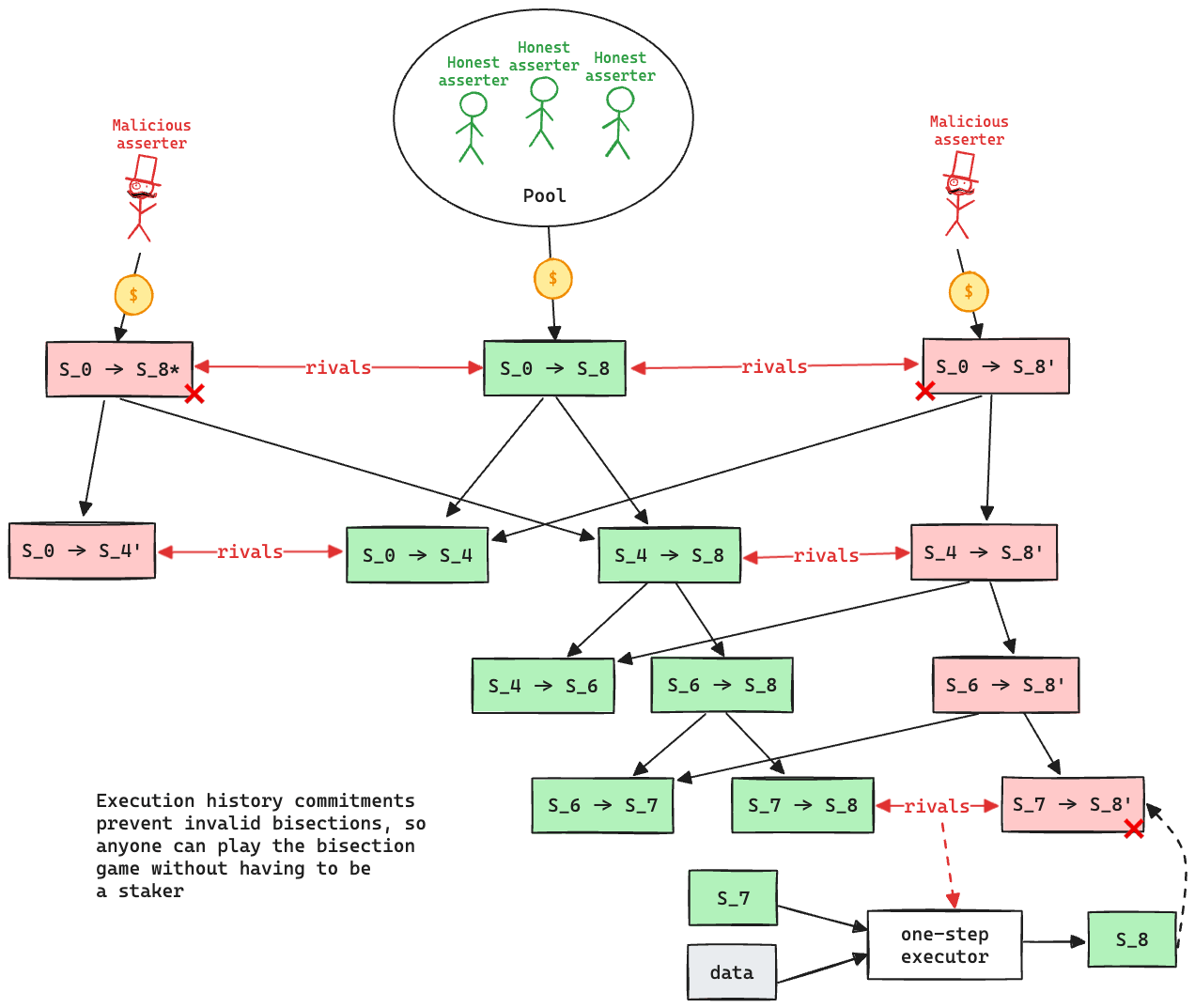
Updates to the system state can be proposed and challenged by anyone who has sufficient funds. If a state rootA cryptographic hash succinctly representing a state using a Merkle tree. passes the challenge periodIn optimistic rollups, the window of time wherein network participants can assert that some fraud was included in a prior block. Most optimistic rollups currently specify a challenge window of 7 days. By extending the period, there is more time for participants to guard against fraud (invalid state transitions), but also more time until withdrawals gets enabled., it is optimistically considered correct and made actionable for withdrawals.
ValidatorsIn the context of L2s, a Validator is an actor that validates the correctness of state transitions. For optimistic rollups this corresponds to challengers, and for ZK rollups this corresponds to the onchain verifier propose state rootsA cryptographic hash succinctly representing a state using a Merkle tree. as children of a previous state root. A state root can have multiple conflicting children. State roots are referred to as “assertions” within the contracts. Each chain of assertions only requires one stake, and validators staked on assertions with a child are considered inactive and can either move their stake to a new nodeA software client that participates in the network. or withdraw it. The function used to propose a new assertion is the stakeOnNewAssertion function. The stake is currently set to 3600.0 ETH, and it can be slashed if the proposal is proven incorrect via a fraud proofAlso referred to as a fault proof, it is the construction of an assertion that fraud was perpetrated on an optimistic rollup. More concretely, that an invalid state transition took place according to the protocol rules. The submitter of a fraud proof would expect a reward from the optimistic rollup protocol for helping maintain the integrity of the system.. The protocol allows such funds to be trustlessly pooled together if necessary. New nodes cannot be created faster than the minimum assertion period, currently set to 15m. An assertion without “rivals” can be confirmed after the challenge periodIn optimistic rollups, the window of time wherein network participants can assert that some fraud was included in a prior block. Most optimistic rollups currently specify a challenge window of 7 days. By extending the period, there is more time for participants to guard against fraud (invalid state transitions), but also more time until withdrawals gets enabled. has passed, currently set to 6d 8h. If a rival is present, then it is checked that the assertion is the winner in the challenge protocol.
A challenge can be started between two siblings, i.e. two different state rootsA cryptographic hash succinctly representing a state using a Merkle tree. that share the same parent, by calling the createLayerZeroEdge function in the ChallengeManager contract. Edges represent assertions, or bisected assertions, within the challenge protocol. Challenges are played via a bisection game, where asserters and challengers play together to find the first instruction of disagreement. Such instruction is then executed onchain in the WASM OneStepProver contract to determine the winner. An edge can only be bisected when rivaled. The bisection process requires no new stake as their validity is checked against a parent “history root” that contains all intermediate states. An edge can also be confirmed if itself or its descendants spend enough time being unrivaled. Such time is set to 6d 8h. If both actors play as slow as possible, the maximum time to confirm an edge is double such value, i.e. 12d 17h. Due to the complexities of maintaining the history root, the challenge protocol is divided into 3 levels, where the lowest level represents assertions over blocksAn ordered list of transactions and chain-related metadata that gets bundled together and published to the L1/DA layer. Nodes execute the transactions contained within blocks to change the rollup chain’s state. Protocol rules dictate what constitutes a valid block, and invalid blocks are skipped over., the highest level represents assertions over single WASM instructions, and intermediate levels represent assertions over chunks of WASM instructions. When moving between levels, a new stake is required. Level 0 (block level) requires a stake of 0.0 ETH, level 1 requires a stake of 555.0 ETH, level 2 requires a stake of 79.0 ETH. The ratio between such stakes can be exploited to perform resource exhaustion attacks.
Funds can be stolen if an attacker successfully performs a resource exhaustion attack.
Program Hashes
Name | Hash | Repository | Verification | Used in | |||||||||||||||||||||||||||||||||||||||||||||||||||||||||||||||||||||||||||||||||||||||||||||||
|---|---|---|---|---|---|---|---|---|---|---|---|---|---|---|---|---|---|---|---|---|---|---|---|---|---|---|---|---|---|---|---|---|---|---|---|---|---|---|---|---|---|---|---|---|---|---|---|---|---|---|---|---|---|---|---|---|---|---|---|---|---|---|---|---|---|---|---|---|---|---|---|---|---|---|---|---|---|---|---|---|---|---|---|---|---|---|---|---|---|---|---|---|---|---|---|---|---|---|---|
Name | Hash | Repository | Verification | Used in | |||||||||||||||||||||||||||||||||||||||||||||||||||||||||||||||||||||||||||||||||||||||||||||||
|---|---|---|---|---|---|---|---|---|---|---|---|---|---|---|---|---|---|---|---|---|---|---|---|---|---|---|---|---|---|---|---|---|---|---|---|---|---|---|---|---|---|---|---|---|---|---|---|---|---|---|---|---|---|---|---|---|---|---|---|---|---|---|---|---|---|---|---|---|---|---|---|---|---|---|---|---|---|---|---|---|---|---|---|---|---|---|---|---|---|---|---|---|---|---|---|---|---|---|---|
Name | Hash | Repository | Verification | Used in | |||||||||||||||||||||||||||||||||||||||||||||||||||||||||||||||||||||||||||||||||||||||||||||||
|---|---|---|---|---|---|---|---|---|---|---|---|---|---|---|---|---|---|---|---|---|---|---|---|---|---|---|---|---|---|---|---|---|---|---|---|---|---|---|---|---|---|---|---|---|---|---|---|---|---|---|---|---|---|---|---|---|---|---|---|---|---|---|---|---|---|---|---|---|---|---|---|---|---|---|---|---|---|---|---|---|---|---|---|---|---|---|---|---|---|---|---|---|---|---|---|---|---|---|---|
0xc10c...dc97 |    Projects used inSearch for projects used in | ||||||||||||||||||||||||||||||||||||||||||||||||||||||||||||||||||||||||||||||||||||||||||||||||||
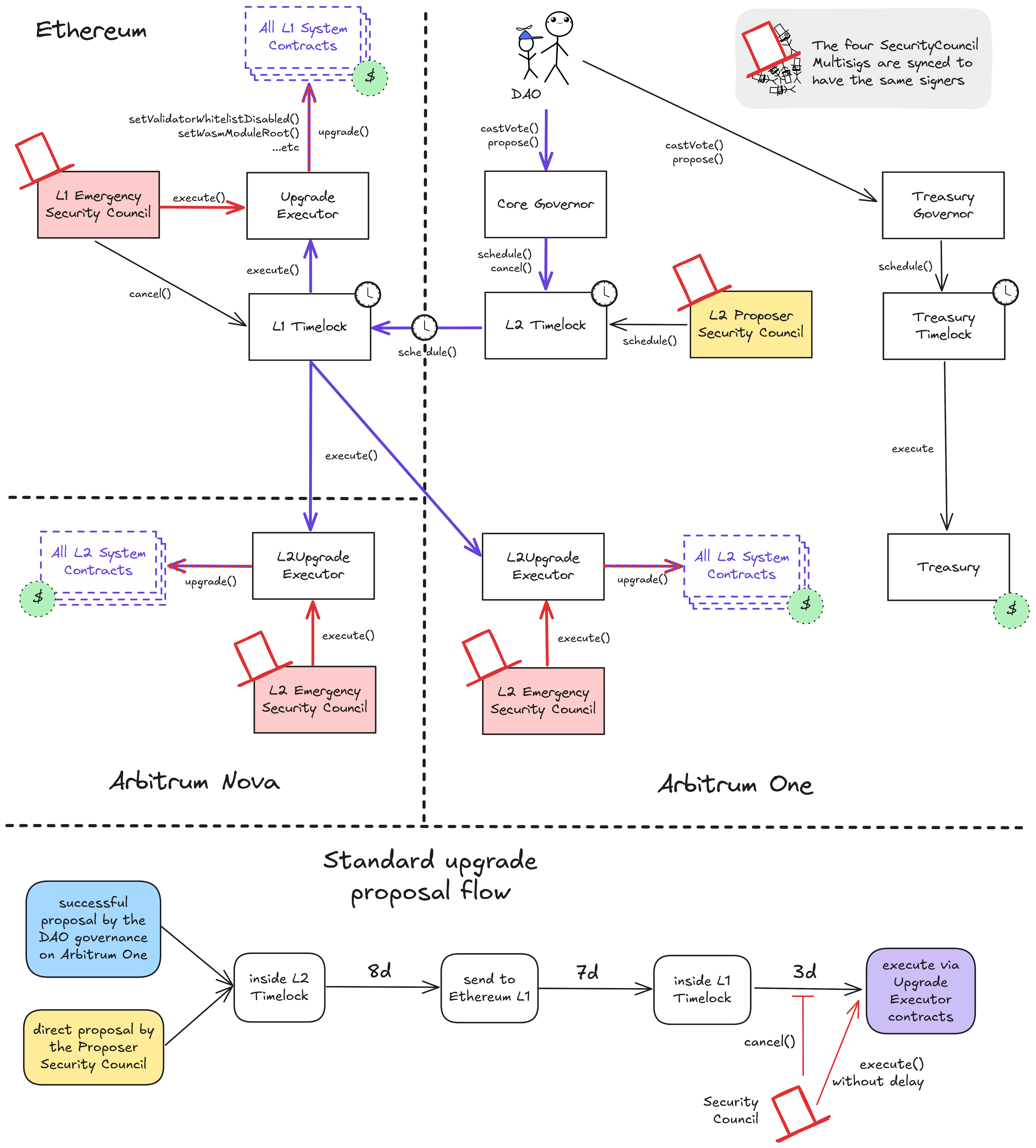
All critical system smart contracts are upgradeable (can be arbitrarily changed). This permission is governed by the Arbitrum Decentralized Autonomous Organization (DAO) and their elected Security CouncilA Security Council is a sufficiently decentralized set of members that is able to upgrade a system. A properly set up Security Council consists of at least 8 members with a threshold greater than 75%. What 'sufficiently decentralized' means is fundamentally subjective and L2BEAT evaluates each case individually. A Security Council is allowed to instantly upgrade Stage 1 rollups.. The Arbitrum DAO controls Arbitrum One and Arbitrum Nova through upgrades and modifications to their smart contracts on Layer 1Layer 1 (L1) is a blockchain that is self-reliant on its validator set for its security and consensus properties. Ethereum is an example of a layer 1. Blockchains started receiving the moniker of layer 1 once layer 2 became a meaningful area of development. Ethereum and the Layer 2s. While the DAO governs through token-weighted governance in their associated ARB token, the Security Council can directly act through multisigs on all three chains. Although they are technically separate and connect to different target permissions, their member- and threshold configuration is kept in sync by a manager contract on Arbitrum One sending crosschain transactions.
Regular upgrades, Admin- and Owner actions originate from either the Arbitrum DAO or the non-emergency (ProposerIn the context of L2s, the actor that proposes a claimed state root on L1. The term is also used in the context of Ethereum to refer to the actor that proposes a new block.-) Security Council on Arbitrum One and pass through multiple delays and timelocks before being executed at their destination. Contrarily, the three Emergency Security Council multisigs (one on each chain: Arbitrum One, Ethereum, Arbitrum Nova) can skip delays and directly access all admin- and upgrade functions of all smart contracts. These two general paths have the same destination: the respective UpgradeExecutor smart contract.
Regular upgrades are scheduled in the L2Layer 2 (L2) is a category of technical solutions aimed to scale the base layer in a trust minimized way. This category includes solutions like rollups as well as state channels and plasma. Other solutions are able to scale further, but with the introduction of additional trust assumptions, which are therefore not trust minimized. Sometimes the term Layer 2 is used to refer to include these solutions too, like validiums and optimiums, but to distinguish between trust minimized and non trust minimized solutions they are often referred to as "light" L2s, opposed to "strong" L2s like rollups. Timelock. The proposer Security Council can do this directly and the Arbitrum DAO (ARB token holders and delegates) must meet a CoreGovernor-enforced 50% threshold of the votable tokens. The L2 Timelock queues the transaction for a 8d delay and then sends it to the Outbox contract on Ethereum. This incurs another delay (the challenge periodIn optimistic rollups, the window of time wherein network participants can assert that some fraud was included in a prior block. Most optimistic rollups currently specify a challenge window of 7 days. By extending the period, there is more time for participants to guard against fraud (invalid state transitions), but also more time until withdrawals gets enabled.) of 6d 8h, which is extended by an additional 2d if the top-level assertion has been challenged. When that has passed, the L1 Timelock delays for additional 3d. Both timelocks serve as delays during which the transparent transaction contents can be audited, and, in the case of the final L1 timelock, cancelled by the Emergency Security Council. Finally, the transaction can be executed, calling Admin- or Owner restricted functions of the respective destination smart contracts through the UpgradeExecutor on Ethereum. If the predefined transaction destination is Arbitrum One or -Nova, this last call is executed on L2 through the canonical bridgeA message-passing protocol between two blockchains. At its most basic, a token bridge consists of a smart contract which can escrow funds on one side of the bridge, and instruct the release or minting of corresponding assets on the other side, but bridges could also support arbitrary messages. How these instructions are validated is a critical factor in assessing the trust assumptions of a bridge. and the aliased address of the L1 Timelock.
OperatorAn operator is the entity charged with managing a rollup and progressing its state. A rollup operator can be a centralized sequencer, proposer, prover, challenger, pauser of admin that is able to perform upgrades. roles like the Sequencers and ValidatorsIn the context of L2s, a Validator is an actor that validates the correctness of state transitions. For optimistic rollups this corresponds to challengers, and for ZK rollups this corresponds to the onchain verifier are managed using the same paths. SequencerA party responsible for ordering and executing transactions on the rollup. The sequencer verifies transactions, compresses the data into a block, and submits the data related to it to enable state reconstruction to Ethereum L1 as a single transaction. The data can be either transaction data or state diffs. changes can be delegated to a Batch Poster Manager role.
Transactions targeting the Arbitrum DAO Treasury can be scheduled in the 3d Treasury Timelock by meeting a TreasuryGovernor-enforced 40% threshold of votable ARB tokens. The Security Council cannot regularly cancel these transactions or schedule different ones but can overwrite them anyway by having upgrade permissions for all the underlying smart contracts.
Governance profile
Security Council
| Composition | 9/12 — 12 members across two 6-seat cohorts, 1-year staggered terms. DAO-elected via on-chain vote with Foundation eligibility screening. |
|---|---|
| Members public | Mapped — 12 entities + addresses published by the Arbitrum Foundation. Mix of individuals (gzeon, zachxbt, Bartek, Yoav, Griff Green, “fred”, Emiliano, Michael Lewellen) and orgs (Gauntlet, Immunefi, Certora, OpenZeppelin). |
| Charter | Arbitrum DAO Constitution §3 — defines 9/12 threshold, transparency reports, conflict-of-interest, removal mechanics, ≤3-per-org cap. |
| Can bypass DAO? | Yes — emergency (9/12, instant) and non-emergency (9/12, still subject to 8d L2Layer 2 (L2) is a category of technical solutions aimed to scale the base layer in a trust minimized way. This category includes solutions like rollups as well as state channels and plasma. Other solutions are able to scale further, but with the introduction of additional trust assumptions, which are therefore not trust minimized. Sometimes the term Layer 2 is used to refer to include these solutions too, like validiums and optimiums, but to distinguish between trust minimized and non trust minimized solutions they are often referred to as "light" L2s, opposed to "strong" L2s like rollups. + 3d L1Layer 1 (L1) is a blockchain that is self-reliant on its validator set for its security and consensus properties. Ethereum is an example of a layer 1. Blockchains started receiving the moniker of layer 1 once layer 2 became a meaningful area of development. timelocks). Non-emergency bypass skips AIP Phases 1–3 only. |
| DAO can override SC? | No — although DAO Constitution §3 gives the DAO authority to modify or eliminate the SC, an active 9/12 SC holds Canceller on both L1Layer 1 (L1) is a blockchain that is self-reliant on its validator set for its security and consensus properties. Ethereum is an example of a layer 1. Blockchains started receiving the moniker of layer 1 once layer 2 became a meaningful area of development. and L2Layer 2 (L2) is a category of technical solutions aimed to scale the base layer in a trust minimized way. This category includes solutions like rollups as well as state channels and plasma. Other solutions are able to scale further, but with the introduction of additional trust assumptions, which are therefore not trust minimized. Sometimes the term Layer 2 is used to refer to include these solutions too, like validiums and optimiums, but to distinguish between trust minimized and non trust minimized solutions they are often referred to as "light" L2s, opposed to "strong" L2s like rollups. Timelocks and can execute emergency upgrades during the ~17.4d execution window. If the SC is inactive or cooperative, the DAO can replace it through normal governance. |
Upgrades
| Normal upgrade path | Forum temp-check → On-chain vote (14d) → L2Layer 2 (L2) is a category of technical solutions aimed to scale the base layer in a trust minimized way. This category includes solutions like rollups as well as state channels and plasma. Other solutions are able to scale further, but with the introduction of additional trust assumptions, which are therefore not trust minimized. Sometimes the term Layer 2 is used to refer to include these solutions too, like validiums and optimiums, but to distinguish between trust minimized and non trust minimized solutions they are often referred to as "light" L2s, opposed to "strong" L2s like rollups. Timelock (8d) → L2→L1Layer 1 (L1) is a blockchain that is self-reliant on its validator set for its security and consensus properties. Ethereum is an example of a layer 1. Blockchains started receiving the moniker of layer 1 once layer 2 became a meaningful area of development. outbox (~6.4d) → L1 Timelock (3d) → execute. Total wall-clock ≈ 41 days for Constitutional AIPs (≈ 34d onchain-enforced), ≈ 27 days for Treasury AIPs. |
|---|---|
| Emergency upgrade path | 9/12 SC, instant — no timelock, no exit windowThe amount of time that users have to exit a system before an unwanted upgrade. It takes into account upgrade delays, forced transaction delays and other time factors. To be considered Stage 1, a rollup needs to have an exit window of at least 7d if upgrades are initiated by a permissioned actor less decentralized than a Security Council. For Stage 2, a rollup needs at least 30d in all cases outside of onchain provable bugs.. E.g. KelpDAO freeze (21 Apr 2026), Stylus stack-depth fix (13 Oct 2025). |
| Exit window | ~17.4d non-emergency · 0 emergency. L2Layer 2 (L2) is a category of technical solutions aimed to scale the base layer in a trust minimized way. This category includes solutions like rollups as well as state channels and plasma. Other solutions are able to scale further, but with the introduction of additional trust assumptions, which are therefore not trust minimized. Sometimes the term Layer 2 is used to refer to include these solutions too, like validiums and optimiums, but to distinguish between trust minimized and non trust minimized solutions they are often referred to as "light" L2s, opposed to "strong" L2s like rollups. Timelock + L2→L1Layer 1 (L1) is a blockchain that is self-reliant on its validator set for its security and consensus properties. Ethereum is an example of a layer 1. Blockchains started receiving the moniker of layer 1 once layer 2 became a meaningful area of development. outbox + L1 Timelock provide the non-emergency window; emergency actions skip all three. |
Token governance
| Governance token |
|
|---|---|
| Voting venue | Tally — two on-chain governors on Arbitrum One: Core (Constitutional) |
| Proposal threshold | 1,000,000 ARB delegated to submit on-chain. 500k ARB delegated to post a Snapshot temperature check. |
| Quorum | 50% of Delegated Voting Power Constitutional · 40% Treasury, with floor/ceiling bounds of 150–450M ARB (Const) / 100–300M ARB (Treasury). Counts “For” + “Abstain”. |
| Execution model | On-chain payload · PermissionlessAnyone willing should be able to join and leave the network at any time, without causing significant disturbance to the network or being detrimental to the party in question. No single entity should have the power to allowlist or blocklist participants. execute. The Governor stores the proposal’s |
Past upgrades
The metrics include upgrades on the currently used proxy contracts. Historical proxy contracts and changes of such are not included.
Ossification
Contracts our research team classifies as critical form the project's critical perimeter. Its clock starts at the ossification genesis, and every critical change resets it (changes within 24 hours count as one). The ossification score is the share of recorded code-bug exploits whose exploited code was younger than this perimeter is today. Battle-tested exposure is the value secured, summed over that unchanged period.
Discovery updates
2026 September 28, 13:20 UTC6changesOssification review: new critical contracts (L2CustomGateway, L1ArbitrumToken, classic Rollup and its ProxyAdmin, retired ChallengeManager), orbitstack template severities (role holders MEDIUM).
Ossification review: new critical contracts (L2CustomGateway, L1ArbitrumToken, classic Rollup and its ProxyAdmin, retired ChallengeManager), orbitstack template severities (role holders MEDIUM).
New and verified contracts
| + | Status: CREATED |
| contract L2CustomGateway (arb1:0x096760F208390250649E3e8763348E783AEF5562) [orbitstack/layer2/L2CustomGateway] | |
| +++ description: Counterpart to the L1CustomGateway. Mints and burns custom ERC20 tokens on L2 for deposits and withdrawals through the L1CustomGateway escrow. | |
| + | Status: CREATED |
| contract ClassicRollupProxyAdmin (eth:0x171a2624302775eF943f4f62E76fd22A6813d7c4) [global/ProxyAdmin] | |
| +++ description: None | |
| + | Status: CREATED |
| contract RollupAdminFacet (eth:0x3CcB27FD59398a015a1eb465582A934fbF318214) [N/A] | |
| +++ description: None | |
| + | Status: CREATED |
| contract L1ArbitrumToken (eth:0xB50721BCf8d664c30412Cfbc6cf7a15145234ad1) [N/A] | |
| +++ description: The ARB token on Ethereum. The L1ARBGateway burns it on deposits to Arbitrum One and mints it on withdrawals. | |
| + | Status: CREATED |
| contract ClassicRollup (eth:0xC12BA48c781F6e392B49Db2E25Cd0c28cD77531A) [N/A] | |
| +++ description: None | |
| + | Status: CREATED |
| contract RollupUserFacet (eth:0xDBE5c009095169D3de4a8D1C70E319fE647A3DBf) [N/A] | |
| +++ description: None | |
2026 September 28, 13:20 UTCHigh severity8changesTimeboost is replaced by Priority Gas Auctions (Constitutional AIP). Tips are paid to the network fee account (L2SurplusFee). The TipCollectionToggler is immutable and can only call setCollectTips . Config related: the ArbOS chain owners are now discovered via ArbOwnerPublic.getAllChainOwners() on the L2UpgradeExecutor. This adds the time-limited, single-purpose chain owner contracts TipCollectionToggler, BaseFeeManager and ResourceConstraintManager with new templates, and their manager multisig.
Timeboost is replaced by Priority Gas Auctions (Constitutional AIP). Tips are paid to the network fee account (L2SurplusFee). The TipCollectionToggler is immutable and can only call setCollectTips.
Config related: the ArbOS chain owners are now discovered via ArbOwnerPublic.getAllChainOwners() on the L2UpgradeExecutor. This adds the time-limited, single-purpose chain owner contracts TipCollectionToggler, BaseFeeManager and ResourceConstraintManager with new templates, and their manager multisig.
| contract L2UpgradeExecutor (arb1:0xCF57572261c7c2BCF21ffD220ea7d1a27D40A827) [orbitstack/layer2/L2UpgradeExecutor] { | |
| +++ description: This contract can upgrade the L2 system's contracts through the L2ProxyAdmin. The upgrades can be done either by the Security Council or by the L1Timelock (via its alias on L2). | |
| +++ severity: HIGH | |
| values.chainOwners.2: | |
| + | "arb1:0x4323dAb775cc15e386FDAC591a39420db6226a63" |
| } | |
| contract Arbitrum L2 Multisig 1 (arb1:0xe128a8100d1b543dE82d04450B3406d57aBF553b) [GnosisSafe] { | |
| +++ description: None | |
| receivedPermissions.0: | |
| + | {"permission":"interact","from":"arb1:0x4323dAb775cc15e386FDAC591a39420db6226a63","description":"toggle the collection of priority fees (tips).","role":".tipCollectionManagers"} |
| } | |
| contract L1Timelock (eth:0xE6841D92B0C345144506576eC13ECf5103aC7f49) [orbitstack/Timelock] { | |
| +++ description: A timelock with access control. The current minimum delay is 3d. Proposals that passed their minimum delay can be executed by the anyone. | |
| values.scheduledTransactions.144: | |
| + | {"id":"0x59470daae279ebdcaae1733764314be84996e57ad3d3fb40a2dab57aec6e7178","decoded":{"chain":"arbitrum","contractName":"","function":"0x481f8dbf","inputs":[{"name":"calldata","value":"0x481f8dbf0000000000000000000000004323dab775cc15e386fdac591a39420db6226a63"}],"address":"arb1:0x0000000000000000000000000000000000000070","calldata":"0x481f8dbf0000000000000000000000004323dab775cc15e386fdac591a39420db6226a63","executor":"eth:0xCF57572261c7c2BCF21ffD220ea7d1a27D40A827","inboxOnEthereum":"eth:0x4Dbd4fc535Ac27206064B68FfCf827b0A60BAB3f"},"raw":{"target":"eth:0xa723C008e76E379c55599D2E4d93879BeaFDa79C","value":0,"data":"0x0000000000000000000000004dbd4fc535ac27206064b68ffcf827b0a60bab3f000000000000000000000000cf57572261c7c2bcf21ffd220ea7d1a27d40a82700000000000000000000000000000000000000000000000000000000000000000000000000000000000000000000000000000000000000000000000000000000000000000000000000000000000000000000000000000000000000000000000000000000000000000000000000000000000000000000000000000000000000c000000000000000000000000000000000000000000000000000000000000000a4bca8c7b5000000000000000000000000000000000000000000000000000000000000007000000000000000000000000000000000000000000000000000000000000000400000000000000000000000000000000000000000000000000000000000000024481f8dbf0000000000000000000000004323dab775cc15e386fdac591a39420db6226a630000000000000000000000000000000000000000000000000000000000000000000000000000000000000000000000000000000000000000","delay":259200}} |
| values.scheduledTransactions.145: | |
| + | {"id":"0x59470daae279ebdcaae1733764314be84996e57ad3d3fb40a2dab57aec6e7178","decoded":{"chain":"arbitrum","contractName":"TipCollectionToggler","function":"activate","inputs":[],"address":"arb1:0x4323dAb775cc15e386FDAC591a39420db6226a63","calldata":"0x0f15f4c0","executor":"eth:0xCF57572261c7c2BCF21ffD220ea7d1a27D40A827","inboxOnEthereum":"eth:0x4Dbd4fc535Ac27206064B68FfCf827b0A60BAB3f"},"raw":{"target":"eth:0xa723C008e76E379c55599D2E4d93879BeaFDa79C","value":0,"data":"0x0000000000000000000000004dbd4fc535ac27206064b68ffcf827b0a60bab3f000000000000000000000000cf57572261c7c2bcf21ffd220ea7d1a27d40a82700000000000000000000000000000000000000000000000000000000000000000000000000000000000000000000000000000000000000000000000000000000000000000000000000000000000000000000000000000000000000000000000000000000000000000000000000000000000000000000000000000000000000c00000000000000000000000000000000000000000000000000000000000000084bca8c7b50000000000000000000000004323dab775cc15e386fdac591a39420db6226a63000000000000000000000000000000000000000000000000000000000000004000000000000000000000000000000000000000000000000000000000000000040f15f4c00000000000000000000000000000000000000000000000000000000000000000000000000000000000000000000000000000000000000000","delay":259200}} |
| } | |
| + | Status: CREATED |
| contract TipCollectionToggler (arb1:0x4323dAb775cc15e386FDAC591a39420db6226a63) [orbitstack/layer2/TipCollectionToggler] | |
| +++ description: ArbOS chain owner that can only toggle the collection of priority fees (tips), which enables PGA transaction ordering. Anyone can remove it from the chain owners after the expiry timestamp. | |
New and verified contracts
| + | Status: CREATED |
| contract BaseFeeManager (arb1:0x6e031B6e9f667Ed6953E627276fBbEfa4c28529A) [orbitstack/layer2/BaseFeeManager] | |
| +++ description: ArbOS chain owner that can only set the L2 base fee and minimum base fee within 0.01-0.1 gwei. Anyone can remove it from the chain owners after the expiry timestamp. | |
| + | Status: CREATED |
| contract ResourceConstraintManager (arb1:0x8F59C7A53b883563B34cbBb6fF021B03973e823a) [orbitstack/layer2/ResourceConstraintManager] | |
| +++ description: ArbOS chain owner that can only set the gas pricing constraints of the L2 base fee model within hardcoded bounds. Anyone can remove it from the chain owners after the expiry timestamp. | |
| + | Status: CREATED |
| contract Arbitrum L2 Multisig 1 (arb1:0xe128a8100d1b543dE82d04450B3406d57aBF553b) [GnosisSafe] | |
| +++ description: None | |
2026 September 18, 10:24 UTC3changesarbitrum: critical contracts and severities for the ossification perimeter
arbitrum: critical contracts and severities for the ossification perimeter
New and verified contracts
| + | Status: CREATED |
| contract L2WETH (arb1:0x82aF49447D8a07e3bd95BD0d56f35241523fBab1) [N/A] | |
| +++ description: Canonical upgradeable WETH token burned by L2WethGateway when withdrawing against the L1 WETH escrow. | |
| + | Status: CREATED |
| contract L1ARBGateway (eth:0xbbcE8aA77782F13D4202a230d978F361B011dB27) [N/A] | |
| +++ description: Canonical reverse gateway for ARB transfers between Ethereum and Arbitrum One. | |
| + | Status: CREATED |
| contract L1WethGateway (eth:0xd92023E9d9911199a6711321D1277285e6d4e2db) [N/A] | |
| +++ description: Canonical WETH gateway escrowing L1 WETH and releasing it for withdrawals proven through the Arbitrum bridge. | |
2026 September 07, 22:08 UTCCritical state change30changesSecurity Council Election Process Improvements AIP, executed 2026-08-31 20:52 UTC (L1Timelock scheduled tx 143 → SecurityCouncilUpgradeAction.perform() ). Both governance contracts were upgraded: - SecurityCouncilManager : adds member self-rotation and a minimum 44-day rotation period, gated by a new MIN ROTATION PERIOD SETTER role held by the L2UpgradeExecutor. - SecurityCouncilNomineeElectionGovernor : election cadence set to 12 months, qualification quorum lowered from 0.2% to 0.1%. - ConstitutionHash updated.
Security Council Election Process Improvements AIP, executed 2026-08-31 20:52 UTC
(L1Timelock scheduled tx #143 → SecurityCouncilUpgradeAction.perform()). Both
governance contracts were upgraded:
SecurityCouncilManager: adds member self-rotation and a minimum 44-day rotation period, gated by a newMIN_ROTATION_PERIOD_SETTERrole held by the L2UpgradeExecutor.SecurityCouncilNomineeElectionGovernor: election cadence set to 12 months, qualification quorum lowered from 0.2% to 0.1%.ConstitutionHashupdated.
| contract ConstitutionHash (arb1:0x1D62fFeB72e4c360CcBbacf7c965153b00260417) [orbitstack/layer2/ConstitutionHash] { | |
| +++ description: Keeps the current hash of the ArbitrumDAO Constitution. Settable by the L2UpgradeExecutor. | |
| values.constitutionHash: | |
| - | "0x263080bed3962d0476fa84fbb32ab81dfff1244e2b145f9864da24353b2f3b05" |
| + | "0x310d1c0495cf8ff7b5e89c26fbca91b230ce6dd2b9b8bde8c1a8605545f25063" |
| } | |
| contract L2SecurityCouncilEmergency (arb1:0x423552c0F05baCCac5Bfa91C6dCF1dc53a0A1641) [orbitstack/layer2/L2SecurityCouncilEmergency] { | |
| +++ description: None | |
| receivedPermissions.2: | |
| + | {"permission":"interact","from":"arb1:0xD509E5f5aEe2A205F554f36E8a7d56094494eDFC","description":"set the minimum period between Security Council member key rotations.","role":".minRotationPeriodSetterAC","via":[{"address":"arb1:0xCF57572261c7c2BCF21ffD220ea7d1a27D40A827"}]} |
| } | |
| contract SecurityCouncilNomineeElectionGovernor (arb1:0x8a1cDA8dee421cD06023470608605934c16A05a0) [orbitstack/layer2/SecurityCouncilNomineeElectionGovernor] { | |
| +++ description: Token governance contract for the Security Council nominee elections. | |
| sourceHashes.1: | |
| - | "0x467a6d321abaf3adf3783b74c4ab2cb9712f8c21a21696fde01fc236733df050" |
| + | "0x2c28a185d54c18615d4892e1c62fd8df740411c245e0a4b2adc39bc22365a4d5" |
| values.$implementation: | |
| - | "arb1:0xd3Ae921B220bedC2f94a5968E25535a476A9518C" |
| + | "arb1:0xB4Fd52807d5856B4CfF85d53D53d1Dc714C4D482" |
| values.$pastUpgrades.2: | |
| + | ["2026-08-31T20:52:09.000Z","0x48468a996d2e64c1b0f067518eb050e1863eb04e59da19d4652910835d00fe26",["arb1:0xB4Fd52807d5856B4CfF85d53D53d1Dc714C4D482"]] |
| values.$upgradeCount: | |
| - | 2 |
| + | 3 |
| values.firstNominationStartDate.year: | |
| - | 2023 |
| + | 2021 |
| values.firstNominationStartDate.month: | |
| - | 9 |
| + | 3 |
| values.quorumNumerator: | |
| - | 20 |
| + | 10 |
| values.cadenceInMonths: | |
| + | 12 |
| values.ROTATION_CUT_OFF_BLOCKS: | |
| + | 21600 |
| implementationNames.arb1:0xd3Ae921B220bedC2f94a5968E25535a476A9518C: | |
| - | "SecurityCouncilNomineeElectionGovernor" |
| implementationNames.arb1:0xB4Fd52807d5856B4CfF85d53D53d1Dc714C4D482: | |
| + | "SecurityCouncilNomineeElectionGovernor" |
| } | |
| contract L2UpgradeExecutor (arb1:0xCF57572261c7c2BCF21ffD220ea7d1a27D40A827) [orbitstack/layer2/L2UpgradeExecutor] { | |
| +++ description: This contract can upgrade the L2 system's contracts through the L2ProxyAdmin. The upgrades can be done either by the Security Council or by the L1Timelock (via its alias on L2). | |
| directlyReceivedPermissions.4: | |
| + | {"permission":"interact","from":"arb1:0xD509E5f5aEe2A205F554f36E8a7d56094494eDFC","description":"set the minimum period between Security Council member key rotations.","role":".minRotationPeriodSetterAC"} |
| } | |
| contract SecurityCouncilManager (arb1:0xD509E5f5aEe2A205F554f36E8a7d56094494eDFC) [orbitstack/layer2/SecurityCouncilManager] { | |
| +++ description: This contract enforces the rules for changing members and cohorts of the SecurityCouncil and creates crosschain messages to Ethereum and Arbitrum Nova to keep the configuration in sync. | |
| sourceHashes.1: | |
| - | "0xf2eeba703974bbc2cb02cd7d24845f71be941a764f033493e85fba52b3d6de28" |
| + | "0x91ac856c76d1dece40ddd75f96a4c2f01abea4b57cea64f43b24149466105b4f" |
| values.$implementation: | |
| - | "arb1:0x468dA0eE5570Bdb1Dd81bFd925BAf028A93Dce64" |
| + | "arb1:0x01B370d9b1ed1591C64C9a4b0FAFF193AF5Fa928" |
| values.$pastUpgrades.1: | |
| + | ["2026-08-31T20:52:09.000Z","0x48468a996d2e64c1b0f067518eb050e1863eb04e59da19d4652910835d00fe26",["arb1:0x01B370d9b1ed1591C64C9a4b0FAFF193AF5Fa928"]] |
| values.$upgradeCount: | |
| - | 1 |
| + | 2 |
| values.DOMAIN_TYPE_HASH: | |
| + | "0x8b73c3c69bb8fe3d512ecc4cf759cc79239f7b179b0ffacaa9a75d522b39400f" |
| values.MIN_ROTATION_PERIOD_SETTER_ROLE: | |
| + | "0xdca740b6747d464c97988ea224a1c2afa5d593dea6c130c887834cb139bbe3cd" |
| values.minRotationPeriod: | |
| + | 3801600 |
| values.minRotationPeriodSetterAC: | |
| + | ["arb1:0xCF57572261c7c2BCF21ffD220ea7d1a27D40A827"] |
| values.NAME_HASH: | |
| + | "0xf935788d54266c928db40f457ef3948e98c56fe8d272b38ba9d240bf19b3fcf5" |
| values.ROTATE_MEMBER_TYPE_HASH: | |
| + | "0x680519cfd93b36ad1cb2f56839eef9e22266c5109fac35adee21f6f49b248260" |
| values.VERSION_HASH: | |
| + | "0xc89efdaa54c0f20c7adf612882df0950f5a951637e0307cdcb4c672f298b8bc6" |
| errors: | |
| - | {"minRotationPeriodSetterAC":"Processing error occurred."} |
| implementationNames.arb1:0x468dA0eE5570Bdb1Dd81bFd925BAf028A93Dce64: | |
| - | "SecurityCouncilManager" |
| implementationNames.arb1:0x01B370d9b1ed1591C64C9a4b0FAFF193AF5Fa928: | |
| + | "SecurityCouncilManager" |
| } | |
| EOA L1Timelock_l2alias (arb1:0xf7951D92B0C345144506576eC13Ecf5103aC905a) { | |
| +++ description: None | |
| receivedPermissions.2: | |
| + | {"permission":"interact","from":"arb1:0xD509E5f5aEe2A205F554f36E8a7d56094494eDFC","description":"set the minimum period between Security Council member key rotations.","role":".minRotationPeriodSetterAC","via":[{"address":"arb1:0xCF57572261c7c2BCF21ffD220ea7d1a27D40A827"}]} |
| } | |
| contract L1Timelock (eth:0xE6841D92B0C345144506576eC13ECf5103aC7f49) [orbitstack/Timelock] { | |
| +++ description: A timelock with access control. The current minimum delay is 3d. Proposals that passed their minimum delay can be executed by the anyone. | |
| values.scheduledTransactions.143: | |
| + | {"id":"0xbf93fbef0a1274cf00bfcbdff101bdc83b9924f9711879d284d6495728356e85","decoded":{"chain":"arbitrum","contractName":"SecurityCouncilUpgradeAction","function":"perform","inputs":[],"address":"arb1:0xeF98Fc7A7F08De47Ed01f3F11f07319c22106445","calldata":"0xb147f40c","executor":"eth:0xCF57572261c7c2BCF21ffD220ea7d1a27D40A827","inboxOnEthereum":"eth:0x4Dbd4fc535Ac27206064B68FfCf827b0A60BAB3f"},"raw":{"target":"eth:0xa723C008e76E379c55599D2E4d93879BeaFDa79C","value":0,"data":"0x0000000000000000000000004dbd4fc535ac27206064b68ffcf827b0a60bab3f000000000000000000000000cf57572261c7c2bcf21ffd220ea7d1a27d40a82700000000000000000000000000000000000000000000000000000000000000000000000000000000000000000000000000000000000000000000000000000000000000000000000000000000000000000000000000000000000000000000000000000000000000000000000000000000000000000000000000000000000000c000000000000000000000000000000000000000000000000000000000000000841cff79cd000000000000000000000000ef98fc7a7f08de47ed01f3f11f07319c2210644500000000000000000000000000000000000000000000000000000000000000400000000000000000000000000000000000000000000000000000000000000004b147f40c0000000000000000000000000000000000000000000000000000000000000000000000000000000000000000000000000000000000000000","delay":259200}} |
| } | |
2026 August 27, 14:18 UTC7changesArbFilteredTransactionsManager (ArbOS 61 transaction-filtering precompile) now tracked; no filterers registered.
ArbFilteredTransactionsManager (ArbOS 61 transaction-filtering precompile) now tracked; no filterers registered.
| contract ArbFilteredTransactionsManager (arb1:0x0000000000000000000000000000000000000074) [orbitstack/ArbFilteredTransactionsManager] { | |
| +++ description: ArbOS 61 transaction-filtering precompile (0x..74). An authorized filterer registers tx hashes here; the state transition function then forcibly fails those transactions, including force-included ones, without delay. Available from ArbOS 61 onwards. On chains where the feature is not enabled (e.g. Arbitrum One and Nova) it has no filterers and no filtered transactions, but is tracked so any future activation is caught immediately. Compare Robinhood, where this precompile is active. | |
| type: | |
| - | "EOA" |
| + | "Contract" |
| proxyType: | |
| - | "EOA" |
| + | "immutable" |
| values.transactionFilterers: | |
| - | "EXPECT_REVERT" |
| + | [] |
| values.$immutable: | |
| + | true |
| sourceHashes: | |
| + | ["0xc92ac7c82ac0ae6811eb5889bb19d300f3f59cc6c21e25d1be2dcc6c4a9db41a"] |
| implementationNames: | |
| + | {"arb1:0x0000000000000000000000000000000000000074":""} |
| } | |
| contract L2ArbitrumToken (arb1:0x912CE59144191C1204E64559FE8253a0e49E6548) [orbitstack/layer2/L2ArbitrumToken] { | |
| +++ description: The ARB token contract. Supply can be increased by the owner once per year by a maximum of 2%. | |
| values.totalSupply: | |
| - | "9999998977630224104158908096" |
| + | "9999998977610261816650915825" |
| } | |
The system has a centralized sequencer
While forcing transaction is open to anyone the system employs a privileged sequencerA party responsible for ordering and executing transactions on the rollup. The sequencer verifies transactions, compresses the data into a block, and submits the data related to it to enable state reconstruction to Ethereum L1 as a single transaction. The data can be either transaction data or state diffs. that has priority for submitting transaction batches and ordering transactions.
MEV can be extracted if the operator exploits their centralized position and frontruns user transactions.
Users can force any transaction
Because the state of the system is based on transactions submitted on the underlying host chain and anyone can submit their transactions there it allows the users to circumvent censorship by interacting with the smart contract on the host chain directly. After a delay of 1d in which a SequencerA party responsible for ordering and executing transactions on the rollup. The sequencer verifies transactions, compresses the data into a block, and submits the data related to it to enable state reconstruction to Ethereum L1 as a single transaction. The data can be either transaction data or state diffs. has failed to include a transaction that was directly posted to the smart contract, it can be forcefully included by anyone on the host chain, which finalizes its ordering.
Transactions are ordered by a centralized sequencer
Arbitrum One uses a single centralized sequencerA party responsible for ordering and executing transactions on the rollup. The sequencer verifies transactions, compresses the data into a block, and submits the data related to it to enable state reconstruction to Ethereum L1 as a single transaction. The data can be either transaction data or state diffs. for fast confirmations. Users can bypass it by first enqueueing a message on Ethereum. If the sequencer does not include it before the message-specific delay expires, anyone can submit a second Ethereum transaction to force the delayed queue into the canonical order.
Buffered forced transactions
To force transactions from the host chain, users must first enqueue “delayed” messages in the “delayed” inbox of the BridgeA message-passing protocol between two blockchains. At its most basic, a token bridge consists of a smart contract which can escrow funds on one side of the bridge, and instruct the release or minting of corresponding assets on the other side, but bridges could also support arbitrary messages. How these instructions are validated is a critical factor in assessing the trust assumptions of a bridge. contract. Only authorized Inboxes are allowed to enqueue delayed messages, and the so-called Inbox contract is the one used as the entry point by calling the sendMessage or sendMessageFromOrigin functions. If the centralized sequencer doesn’t process the request within some time bound, users can call the forceInclusion function on the SequencerInbox contract to include the message in the canonical chain. The time bound is defined to be the minimum between 1d and the time left in the delay buffer. The delay buffer gets replenished over time and gets consumed every time the sequencer doesn’t timely process a message. Only messages processed with a delay greater than 30m consume the buffer. The buffer is capped at 2d. The replenish rate is currently set at 1m every 20m. Even if the buffer is fully consumed, messages are still allowed to be delayed up to 30m.
| Centralized sequencing spec sheet | |
|---|---|
| Trusted preconfirmation | 250 ms L2 block time |
| Trusted ordering | Fee order per 125 ms round |
| Sequencer | Redis HA |
| Real-time censorship resistance | |
| Forced inclusion | 2 L1 txs: enqueue + force |
| Inclusion delay | 150-7,200 L1 blocks |
| Inclusion mechanics | Address alias |
| Exit delay | 1d inclusion + 14d 18h state |
| Exit economics | Favors defender 6.49× |
Censorship resistance
The centralized sequencerA party responsible for ordering and executing transactions on the rollup. The sequencer verifies transactions, compresses the data into a block, and submits the data related to it to enable state reconstruction to Ethereum L1 as a single transaction. The data can be either transaction data or state diffs. provides no real-time censorship resistance. The delayed inbox provides eventual censorship resistance, assuming Ethereum includes both the enqueue transaction and, when needed, the force-inclusion transaction.
Regular messaging
The user initiates L2Layer 2 (L2) is a category of technical solutions aimed to scale the base layer in a trust minimized way. This category includes solutions like rollups as well as state channels and plasma. Other solutions are able to scale further, but with the introduction of additional trust assumptions, which are therefore not trust minimized. Sometimes the term Layer 2 is used to refer to include these solutions too, like validiums and optimiums, but to distinguish between trust minimized and non trust minimized solutions they are often referred to as "light" L2s, opposed to "strong" L2s like rollups.->L1Layer 1 (L1) is a blockchain that is self-reliant on its validator set for its security and consensus properties. Ethereum is an example of a layer 1. Blockchains started receiving the moniker of layer 1 once layer 2 became a meaningful area of development. messages by submitting a regular transaction on this chain. When the blockAn ordered list of transactions and chain-related metadata that gets bundled together and published to the L1/DA layer. Nodes execute the transactions contained within blocks to change the rollup chain’s state. Protocol rules dictate what constitutes a valid block, and invalid blocks are skipped over. containing that transaction is settled, the message becomes available for processing on L1. The process of block finalization usually takes several days to complete.
Autonomous exit
Users can (eventually) exit the system by pushing the transaction on L1Layer 1 (L1) is a blockchain that is self-reliant on its validator set for its security and consensus properties. Ethereum is an example of a layer 1. Blockchains started receiving the moniker of layer 1 once layer 2 became a meaningful area of development. and providing the corresponding state rootA cryptographic hash succinctly representing a state using a Merkle tree.. The only way to prevent such withdrawal is via an upgrade.
EVM compatible and Stylus smart contracts are supported
Arbitrum One supports smart contracts written in Solidity and other programming languages (Rust, C++) that compile to WASM. Such smart contracts are executed by nodes using either a geth fork or a fork of wasmer inside the Nitro nodeA software client that participates in the network., and can be proven with the onchain WASM VM.
Arbitrum DAO is in charge of upgrades
Arbitrum DAO allows $ARB token holders to propose and vote on changes to the organization and the technologies it governs. The governance smart contracts are implemented on Arbitrum One rollupA blockchain that inherits consensus and data availability from another blockchain called L1. Rollups enable trust minimized bridges with the base layer via proof systems, either optimistic or zero-knowledge. A rollup without a bridge, or without considering the bridge, is called a sovereign rollup. chain. The DAO can upgrade the Arbitrum One contracts on L2Layer 2 (L2) is a category of technical solutions aimed to scale the base layer in a trust minimized way. This category includes solutions like rollups as well as state channels and plasma. Other solutions are able to scale further, but with the introduction of additional trust assumptions, which are therefore not trust minimized. Sometimes the term Layer 2 is used to refer to include these solutions too, like validiums and optimiums, but to distinguish between trust minimized and non trust minimized solutions they are often referred to as "light" L2s, opposed to "strong" L2s like rollups. with 2d delay and - using L2 --> L1Layer 1 (L1) is a blockchain that is self-reliant on its validator set for its security and consensus properties. Ethereum is an example of a layer 1. Blockchains started receiving the moniker of layer 1 once layer 2 became a meaningful area of development. Governance Relay, update contracts on L1 with additional 3d delay + 6d 8h delay for all L2 --> L1 messages (in total a delay of 11d 8h), with an additional 8d if a challenge has been present in the state rootA cryptographic hash succinctly representing a state using a Merkle tree. that relays the message. The Security CouncilA Security Council is a sufficiently decentralized set of members that is able to upgrade a system. A properly set up Security Council consists of at least 8 members with a threshold greater than 75%. What 'sufficiently decentralized' means is fundamentally subjective and L2BEAT evaluates each case individually. A Security Council is allowed to instantly upgrade Stage 1 rollups. can upgrade the contracts without any delay. It can also cancel any upgrades initiated by the DAO.
Arbitrum One
Actors:
A Multisig with 9/12 threshold. It uses the following modules: L2UpgradeExecutor (This contract can upgrade the L2Layer 2 (L2) is a category of technical solutions aimed to scale the base layer in a trust minimized way. This category includes solutions like rollups as well as state channels and plasma. Other solutions are able to scale further, but with the introduction of additional trust assumptions, which are therefore not trust minimized. Sometimes the term Layer 2 is used to refer to include these solutions too, like validiums and optimiums, but to distinguish between trust minimized and non trust minimized solutions they are often referred to as "light" L2s, opposed to "strong" L2s like rollups. system’s contracts through the L2ProxyAdmin. The upgrades can be done either by the Security CouncilA Security Council is a sufficiently decentralized set of members that is able to upgrade a system. A properly set up Security Council consists of at least 8 members with a threshold greater than 75%. What 'sufficiently decentralized' means is fundamentally subjective and L2BEAT evaluates each case individually. A Security Council is allowed to instantly upgrade Stage 1 rollups. or by the L1Timelock (via its alias on L2)).
- Can upgrade with 17d 8h delay
- Outbox L2Timelock with 8d delay → Outbox with 6d 8h delay → BridgeA message-passing protocol between two blockchains. At its most basic, a token bridge consists of a smart contract which can escrow funds on one side of the bridge, and instruct the release or minting of corresponding assets on the other side, but bridges could also support arbitrary messages. How these instructions are validated is a critical factor in assessing the trust assumptions of a bridge. → L1Timelock with 3d delay → UpgradeExecutor → ArbitrumProxyAdmin
- SequencerInbox L2Timelock with 8d delay → Outbox with 6d 8h delay → Bridge → L1Timelock with 3d delay → UpgradeExecutor → ArbitrumProxyAdmin
- UpgradeExecutor L2Timelock with 8d delay → Outbox with 6d 8h delay → Bridge → L1Timelock with 3d delay → UpgradeExecutor → UpgradeExecutorAdmin
- Inbox L2Timelock with 8d delay → Outbox with 6d 8h delay → Bridge → L1Timelock with 3d delay → UpgradeExecutor → ArbitrumProxyAdmin
- RollupProxy L2Timelock with 8d delay → Outbox with 6d 8h delay → Bridge → L1Timelock with 3d delay → UpgradeExecutor
- RollupEventInbox L2Timelock with 8d delay → Outbox with 6d 8h delay → Bridge → L1Timelock with 3d delay → UpgradeExecutor → ArbitrumProxyAdmin
- OutboxV0 L2Timelock with 8d delay → Outbox with 6d 8h delay → Bridge → L1Timelock with 3d delay → UpgradeExecutor → ArbitrumProxyAdmin
- GatewayRouter L2Timelock with 8d delay → Outbox with 6d 8h delay → Bridge → L1Timelock with 3d delay → UpgradeExecutor → GatewaysAdmin
- OutboxV1 L2Timelock with 8d delay → Outbox with 6d 8h delay → Bridge → L1Timelock with 3d delay → UpgradeExecutor → ArbitrumProxyAdmin
- Bridge L2Timelock with 8d delay → Outbox with 6d 8h delay → Bridge → L1Timelock with 3d delay → UpgradeExecutor → ArbitrumProxyAdmin
- L1ERC20Gateway L2Timelock with 8d delay → Outbox with 6d 8h delay → Bridge → L1Timelock with 3d delay → UpgradeExecutor → GatewaysAdmin
- EdgeChallengeManager L2Timelock with 8d delay → Outbox with 6d 8h delay → Bridge → L1Timelock with 3d delay → UpgradeExecutor → ArbitrumProxyAdmin
- L1ArbitrumToken L2Timelock with 8d delay → Outbox with 6d 8h delay → Bridge → L1Timelock with 3d delay → UpgradeExecutor → UpgradeExecutorAdmin
- L1ARBGateway L2Timelock with 8d delay → Outbox with 6d 8h delay → Bridge → L1Timelock with 3d delay → UpgradeExecutor → UpgradeExecutorAdmin
- ClassicRollup L2Timelock with 8d delay → Outbox with 6d 8h delay → Bridge → L1Timelock with 3d delay → UpgradeExecutor → ClassicRollupProxyAdmin
- L1CustomGateway L2Timelock with 8d delay → Outbox with 6d 8h delay → Bridge → L1Timelock with 3d delay → UpgradeExecutor → GatewaysAdmin
- L1WethGateway L2Timelock with 8d delay → Outbox with 6d 8h delay → Bridge → L1Timelock with 3d delay → UpgradeExecutor → GatewaysAdmin
- L1Timelock L2Timelock with 8d delay → Outbox with 6d 8h delay → Bridge → L1Timelock with 3d delay → UpgradeExecutor → UpgradeExecutorAdmin
- Can interact with L2Timelock
- propose transactions
- Can interact with SecurityCouncilManager
- schedule a proposal to add a new member to the Security Council
- schedule a proposal to remove a Security Council member
- schedule a proposal to replace a Security Council member
- schedule a proposal to rotate a Security Council member (same member, new address)
- Can interact with RollupProxy
- Pause and unpause and set important roles and parameters in the system contracts: Can delegate SequencerA party responsible for ordering and executing transactions on the rollup. The sequencer verifies transactions, compresses the data into a block, and submits the data related to it to enable state reconstruction to Ethereum L1 as a single transaction. The data can be either transaction data or state diffs. management to a BatchPosterManager address, manage data availabilityThe property of a rollup's data being reachable by any node retrieving the data that were rolled up and executed to reach the proposed state. Data availability (DA), specifically decoupling it from the rollup nodes themselves, is one of the preeminent factors which allows a rollup to scale securely. A rollup is faced with a decision of what to use as a DA layer to guarantee that any node can retrieve this data--permissionlessly under any circumstance. For this reason, using Ethereum for DA currently provides the strongest security guarantees. If data is stored somewhere other than a permissionless L1, then the project is not a rollup, but rather a validium or an optimium., DACs and the fastConfirmer role, set the Sequencer-only window, introduce an allowList to the bridge and whitelist Inboxes/Outboxes with 17d 8h delay L2Timelock with 8d delay → Outbox with 6d 8h delay → Bridge → L1Timelock with 3d delay → UpgradeExecutor
- Can interact with L1Timelock
- cancel queued transactions with 17d 8h delay L2Timelock with 8d delay → Outbox with 6d 8h delay → Bridge → L1Timelock with 3d delay → UpgradeExecutor
- propose transactions with 14d 8h delay L2Timelock with 8d delay → Outbox with 6d 8h delay → Bridge
- update the minimum delay and manage all access control roles of the timelock with 17d 8h delay L2Timelock with 8d delay → Outbox with 6d 8h delay → Bridge → L1Timelock with 3d delay → UpgradeExecutor
Token governance contract accepting and managing constitutional Arbitrum Improvement Proposals (AIPs, core proposals). Uses DVP-based quorum (percentage of Delegated Voting Power with floor and ceiling bounds).
- Can upgrade with 17d 8h delay
- Outbox L2Timelock with 8d delay → Outbox with 6d 8h delay → BridgeA message-passing protocol between two blockchains. At its most basic, a token bridge consists of a smart contract which can escrow funds on one side of the bridge, and instruct the release or minting of corresponding assets on the other side, but bridges could also support arbitrary messages. How these instructions are validated is a critical factor in assessing the trust assumptions of a bridge. → L1Timelock with 3d delay → UpgradeExecutor → ArbitrumProxyAdmin
- SequencerInbox L2Timelock with 8d delay → Outbox with 6d 8h delay → Bridge → L1Timelock with 3d delay → UpgradeExecutor → ArbitrumProxyAdmin
- UpgradeExecutor L2Timelock with 8d delay → Outbox with 6d 8h delay → Bridge → L1Timelock with 3d delay → UpgradeExecutor → UpgradeExecutorAdmin
- Inbox L2Timelock with 8d delay → Outbox with 6d 8h delay → Bridge → L1Timelock with 3d delay → UpgradeExecutor → ArbitrumProxyAdmin
- RollupProxy L2Timelock with 8d delay → Outbox with 6d 8h delay → Bridge → L1Timelock with 3d delay → UpgradeExecutor
- RollupEventInbox L2Timelock with 8d delay → Outbox with 6d 8h delay → Bridge → L1Timelock with 3d delay → UpgradeExecutor → ArbitrumProxyAdmin
- OutboxV0 L2Timelock with 8d delay → Outbox with 6d 8h delay → Bridge → L1Timelock with 3d delay → UpgradeExecutor → ArbitrumProxyAdmin
- GatewayRouter L2Timelock with 8d delay → Outbox with 6d 8h delay → Bridge → L1Timelock with 3d delay → UpgradeExecutor → GatewaysAdmin
- OutboxV1 L2Timelock with 8d delay → Outbox with 6d 8h delay → Bridge → L1Timelock with 3d delay → UpgradeExecutor → ArbitrumProxyAdmin
- Bridge L2Timelock with 8d delay → Outbox with 6d 8h delay → Bridge → L1Timelock with 3d delay → UpgradeExecutor → ArbitrumProxyAdmin
- L1ERC20Gateway L2Timelock with 8d delay → Outbox with 6d 8h delay → Bridge → L1Timelock with 3d delay → UpgradeExecutor → GatewaysAdmin
- EdgeChallengeManager L2Timelock with 8d delay → Outbox with 6d 8h delay → Bridge → L1Timelock with 3d delay → UpgradeExecutor → ArbitrumProxyAdmin
- L1ArbitrumToken L2Timelock with 8d delay → Outbox with 6d 8h delay → Bridge → L1Timelock with 3d delay → UpgradeExecutor → UpgradeExecutorAdmin
- L1ARBGateway L2Timelock with 8d delay → Outbox with 6d 8h delay → Bridge → L1Timelock with 3d delay → UpgradeExecutor → UpgradeExecutorAdmin
- ClassicRollup L2Timelock with 8d delay → Outbox with 6d 8h delay → Bridge → L1Timelock with 3d delay → UpgradeExecutor → ClassicRollupProxyAdmin
- L1CustomGateway L2Timelock with 8d delay → Outbox with 6d 8h delay → Bridge → L1Timelock with 3d delay → UpgradeExecutor → GatewaysAdmin
- L1WethGateway L2Timelock with 8d delay → Outbox with 6d 8h delay → Bridge → L1Timelock with 3d delay → UpgradeExecutor → GatewaysAdmin
- L1Timelock L2Timelock with 8d delay → Outbox with 6d 8h delay → Bridge → L1Timelock with 3d delay → UpgradeExecutor → UpgradeExecutorAdmin
- Can interact with L2Timelock
- cancel queued transactions
- propose transactions
- Can interact with RollupProxy
- Pause and unpause and set important roles and parameters in the system contracts: Can delegate SequencerA party responsible for ordering and executing transactions on the rollup. The sequencer verifies transactions, compresses the data into a block, and submits the data related to it to enable state reconstruction to Ethereum L1 as a single transaction. The data can be either transaction data or state diffs. management to a BatchPosterManager address, manage data availabilityThe property of a rollup's data being reachable by any node retrieving the data that were rolled up and executed to reach the proposed state. Data availability (DA), specifically decoupling it from the rollup nodes themselves, is one of the preeminent factors which allows a rollup to scale securely. A rollup is faced with a decision of what to use as a DA layer to guarantee that any node can retrieve this data--permissionlessly under any circumstance. For this reason, using Ethereum for DA currently provides the strongest security guarantees. If data is stored somewhere other than a permissionless L1, then the project is not a rollup, but rather a validium or an optimium., DACs and the fastConfirmer role, set the Sequencer-only window, introduce an allowList to the bridge and whitelist Inboxes/Outboxes with 17d 8h delay L2Timelock with 8d delay → Outbox with 6d 8h delay → Bridge → L1Timelock with 3d delay → UpgradeExecutor
- Can interact with L1Timelock
- cancel queued transactions with 17d 8h delay L2Timelock with 8d delay → Outbox with 6d 8h delay → Bridge → L1Timelock with 3d delay → UpgradeExecutor
- propose transactions with 14d 8h delay L2Timelock with 8d delay → Outbox with 6d 8h delay → Bridge
- update the minimum delay and manage all access control roles of the timelock with 17d 8h delay L2Timelock with 8d delay → Outbox with 6d 8h delay → Bridge → L1Timelock with 3d delay → UpgradeExecutor
A Multisig with 9/12 threshold. It uses the following modules: L2UpgradeExecutor (This contract can upgrade the L2Layer 2 (L2) is a category of technical solutions aimed to scale the base layer in a trust minimized way. This category includes solutions like rollups as well as state channels and plasma. Other solutions are able to scale further, but with the introduction of additional trust assumptions, which are therefore not trust minimized. Sometimes the term Layer 2 is used to refer to include these solutions too, like validiums and optimiums, but to distinguish between trust minimized and non trust minimized solutions they are often referred to as "light" L2s, opposed to "strong" L2s like rollups. system’s contracts through the L2ProxyAdmin. The upgrades can be done either by the Security CouncilA Security Council is a sufficiently decentralized set of members that is able to upgrade a system. A properly set up Security Council consists of at least 8 members with a threshold greater than 75%. What 'sufficiently decentralized' means is fundamentally subjective and L2BEAT evaluates each case individually. A Security Council is allowed to instantly upgrade Stage 1 rollups. or by the L1Timelock (via its alias on L2)).
- Can upgrade with no delay
- L2CustomGateway L2UpgradeExecutor → L2GatewaysProxyAdmin
- L2ERC20Gateway L2UpgradeExecutor → L2GatewaysProxyAdmin
- L2Timelock L2UpgradeExecutor → L2ProxyAdmin
- SecurityCouncilMemberElectionGovernor L2UpgradeExecutor → L2ProxyAdmin
- L2GatewayRouter L2UpgradeExecutor → L2GatewaysProxyAdmin
- L2WethGateway L2UpgradeExecutor → L2GatewaysProxyAdmin
- SecurityCouncilMemberRemovalGovernor L2UpgradeExecutor → L2ProxyAdmin
- TreasuryGovernor L2UpgradeExecutor → L2ProxyAdmin
- L2WETH L2UpgradeExecutor → L2GatewaysProxyAdmin
- SecurityCouncilNomineeElectionGovernor L2UpgradeExecutor → L2ProxyAdmin
- L2ArbitrumToken L2UpgradeExecutor → L2ProxyAdmin
- TreasuryTimelock L2UpgradeExecutor → L2ProxyAdmin
- L2ARBGateway L2UpgradeExecutor → L2ProxyAdmin
- L2UpgradeExecutor L2UpgradeExecutor → L2ProxyAdmin
- SecurityCouncilManager L2UpgradeExecutor → L2ProxyAdmin
- CoreGovernor L2UpgradeExecutor → L2ProxyAdmin
- Can interact with L2Timelock
- manage all access control roles and change the minimum delay with 8d delay L2UpgradeExecutor with 8d delay
- Can interact with SecurityCouncilManager
- manage all access control roles L2UpgradeExecutor
- set the minimum period between Security Council member key rotations L2UpgradeExecutor
Token governance contract for the Security CouncilA Security Council is a sufficiently decentralized set of members that is able to upgrade a system. A properly set up Security Council consists of at least 8 members with a threshold greater than 75%. What 'sufficiently decentralized' means is fundamentally subjective and L2BEAT evaluates each case individually. A Security Council is allowed to instantly upgrade Stage 1 rollups. member elections.
- Can interact with SecurityCouncilManager
- schedule a proposal to replace a Security Council member cohort
Token governance contract for the Security CouncilA Security Council is a sufficiently decentralized set of members that is able to upgrade a system. A properly set up Security Council consists of at least 8 members with a threshold greater than 75%. What 'sufficiently decentralized' means is fundamentally subjective and L2BEAT evaluates each case individually. A Security Council is allowed to instantly upgrade Stage 1 rollups. member removals.
- Can interact with SecurityCouncilManager
- schedule a proposal to remove a Security Council member
A Multisig with 4/6 threshold.
- Can interact with TipCollectionToggler
- toggle the collection of priority fees (tips)
- Can interact with BaseFeeManager
- set the L2Layer 2 (L2) is a category of technical solutions aimed to scale the base layer in a trust minimized way. This category includes solutions like rollups as well as state channels and plasma. Other solutions are able to scale further, but with the introduction of additional trust assumptions, which are therefore not trust minimized. Sometimes the term Layer 2 is used to refer to include these solutions too, like validiums and optimiums, but to distinguish between trust minimized and non trust minimized solutions they are often referred to as "light" L2s, opposed to "strong" L2s like rollups. base fee and minimum base fee within 0.01-0.1 gwei
- Can interact with ResourceConstraintManager
- set the gasA virtual fuel used to execute smart contracts on a rollup. The EVM (or other VM within the rollup) uses an accounting mechanism to correspond the consumption of gas to the consumption of computing resources, and to limit the consumption of computing resources. pricing constraints of the L2 base fee model within hardcoded bounds
A Multisig with 3/5 threshold.
- Can upgrade with no delay
- L2CustomGateway L2UpgradeExecutor → L2GatewaysProxyAdmin
- L2ERC20Gateway L2UpgradeExecutor → L2GatewaysProxyAdmin
- L2Timelock L2UpgradeExecutor → L2ProxyAdmin
- SecurityCouncilMemberElectionGovernor L2UpgradeExecutor → L2ProxyAdmin
- L2GatewayRouter L2UpgradeExecutor → L2GatewaysProxyAdmin
- L2WethGateway L2UpgradeExecutor → L2GatewaysProxyAdmin
- SecurityCouncilMemberRemovalGovernor L2UpgradeExecutor → L2ProxyAdmin
- TreasuryGovernor L2UpgradeExecutor → L2ProxyAdmin
- L2WETH L2UpgradeExecutor → L2GatewaysProxyAdmin
- SecurityCouncilNomineeElectionGovernor L2UpgradeExecutor → L2ProxyAdmin
- L2ArbitrumToken L2UpgradeExecutor → L2ProxyAdmin
- TreasuryTimelock L2UpgradeExecutor → L2ProxyAdmin
- L2ARBGateway L2UpgradeExecutor → L2ProxyAdmin
- L2UpgradeExecutor L2UpgradeExecutor → L2ProxyAdmin
- SecurityCouncilManager L2UpgradeExecutor → L2ProxyAdmin
- CoreGovernor L2UpgradeExecutor → L2ProxyAdmin
- Can interact with L2Timelock
- manage all access control roles and change the minimum delay with 8d delay L2UpgradeExecutor with 8d delay
- Can interact with SecurityCouncilManager
- manage all access control roles L2UpgradeExecutor
- set the minimum period between Security CouncilA Security Council is a sufficiently decentralized set of members that is able to upgrade a system. A properly set up Security Council consists of at least 8 members with a threshold greater than 75%. What 'sufficiently decentralized' means is fundamentally subjective and L2BEAT evaluates each case individually. A Security Council is allowed to instantly upgrade Stage 1 rollups. member key rotations L2UpgradeExecutor
Ethereum
Actors:
A Multisig with 9/12 threshold. It uses the following modules: UpgradeExecutor (Central contract defining the access control permissions for upgrading the system contract implementations).
- Can upgrade with no delay
- Outbox UpgradeExecutor → ArbitrumProxyAdmin
- SequencerInbox UpgradeExecutor → ArbitrumProxyAdmin
- UpgradeExecutor UpgradeExecutor → UpgradeExecutorAdmin
- Inbox UpgradeExecutor → ArbitrumProxyAdmin
- RollupProxy UpgradeExecutor
- RollupEventInbox UpgradeExecutor → ArbitrumProxyAdmin
- OutboxV0 UpgradeExecutor → ArbitrumProxyAdmin
- GatewayRouter UpgradeExecutor → GatewaysAdmin
- OutboxV1 UpgradeExecutor → ArbitrumProxyAdmin
- BridgeA message-passing protocol between two blockchains. At its most basic, a token bridge consists of a smart contract which can escrow funds on one side of the bridge, and instruct the release or minting of corresponding assets on the other side, but bridges could also support arbitrary messages. How these instructions are validated is a critical factor in assessing the trust assumptions of a bridge. UpgradeExecutor → ArbitrumProxyAdmin
- L1ERC20Gateway UpgradeExecutor → GatewaysAdmin
- EdgeChallengeManager UpgradeExecutor → ArbitrumProxyAdmin
- L1ArbitrumToken UpgradeExecutor → UpgradeExecutorAdmin
- L1ARBGateway UpgradeExecutor → UpgradeExecutorAdmin
- ClassicRollup UpgradeExecutor → ClassicRollupProxyAdmin
- L1CustomGateway UpgradeExecutor → GatewaysAdmin
- L1WethGateway UpgradeExecutor → GatewaysAdmin
- L1Timelock UpgradeExecutor → UpgradeExecutorAdmin
- Can interact with RollupProxy
- Pause and unpause and set important roles and parameters in the system contracts: Can delegate SequencerA party responsible for ordering and executing transactions on the rollup. The sequencer verifies transactions, compresses the data into a block, and submits the data related to it to enable state reconstruction to Ethereum L1 as a single transaction. The data can be either transaction data or state diffs. management to a BatchPosterManager address, manage data availabilityThe property of a rollup's data being reachable by any node retrieving the data that were rolled up and executed to reach the proposed state. Data availability (DA), specifically decoupling it from the rollup nodes themselves, is one of the preeminent factors which allows a rollup to scale securely. A rollup is faced with a decision of what to use as a DA layer to guarantee that any node can retrieve this data--permissionlessly under any circumstance. For this reason, using Ethereum for DA currently provides the strongest security guarantees. If data is stored somewhere other than a permissionless L1, then the project is not a rollup, but rather a validium or an optimium., DACs and the fastConfirmer role, set the Sequencer-only window, introduce an allowList to the bridge and whitelist Inboxes/Outboxes UpgradeExecutor
- Can interact with L1Timelock
- cancel queued transactions UpgradeExecutor
- update the minimum delay and manage all access control roles of the timelock UpgradeExecutor
Participants (12):
0xEEFF…7C1E0xeEB8…8398DZack23PabloSabbatella-OpsekzachxbtImmunefiMichael Lewellen - blockaidgzeon-OffchainLabsEmilianoBonassi-ConduitGriffGreen-Givethbartek.eth-L2BEATyoav.eth-EFA Multisig with 4/6 threshold.
- Can interact with SequencerInbox
- Add/remove batchPosters (Sequencers)
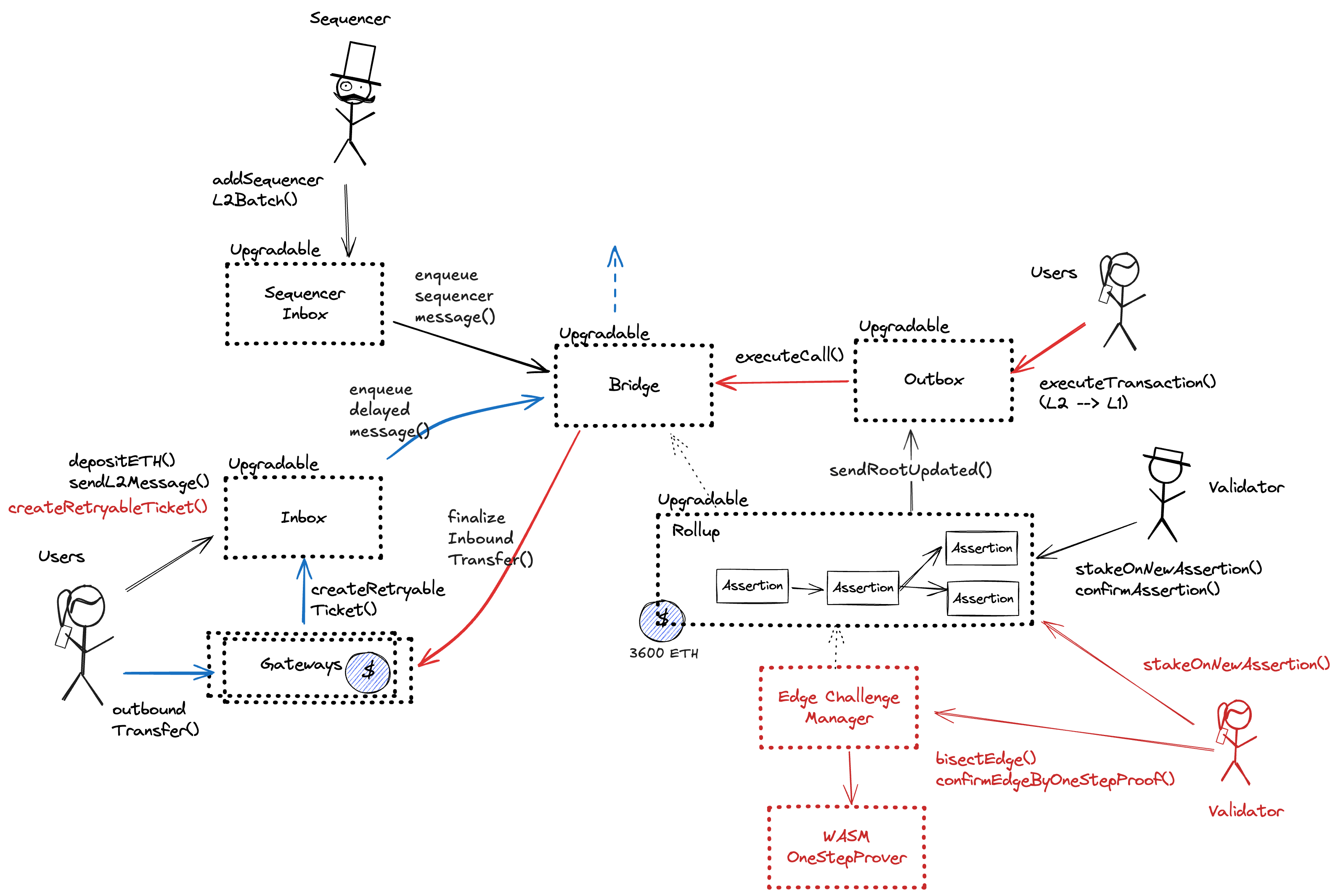
Ethereum
A sequencerA party responsible for ordering and executing transactions on the rollup. The sequencer verifies transactions, compresses the data into a block, and submits the data related to it to enable state reconstruction to Ethereum L1 as a single transaction. The data can be either transaction data or state diffs. (registered in this contract) can submit transaction batches or commitments here.
- Roles:
- admin: ArbitrumProxyAdmin; ultimately Arbitrum Security CouncilA Security Council is a sufficiently decentralized set of members that is able to upgrade a system. A properly set up Security Council consists of at least 8 members with a threshold greater than 75%. What 'sufficiently decentralized' means is fundamentally subjective and L2BEAT evaluates each case individually. A Security Council is allowed to instantly upgrade Stage 1 rollups., CoreGovernor, L2SecurityCouncilPropose
- batchPosterManager: Arbitrum Multisig 1
- batchPosters: EOA 1, EOA 2, EOA 3
Central contract for the project’s configuration like its execution logic hashA fixed-length fingerprint of variable-size input, produced by a hash function. (wasmModuleRoot) and addresses of the other system contracts. Entry point for Proposers creating new assertions (state commitments) and Challengers submitting fraud proofs (In the Orbit stack, these two roles are both called ValidatorsIn the context of L2s, a Validator is an actor that validates the correctness of state transitions. For optimistic rollups this corresponds to challengers, and for ZK rollups this corresponds to the onchain verifier).
- Roles:
- admin: UpgradeExecutor; ultimately Arbitrum Security CouncilA Security Council is a sufficiently decentralized set of members that is able to upgrade a system. A properly set up Security Council consists of at least 8 members with a threshold greater than 75%. What 'sufficiently decentralized' means is fundamentally subjective and L2BEAT evaluates each case individually. A Security Council is allowed to instantly upgrade Stage 1 rollups., CoreGovernor, L2SecurityCouncilPropose
- owner: UpgradeExecutor; ultimately Arbitrum Security Council, CoreGovernor, L2SecurityCouncilPropose
Escrow contract for the project’s gasA virtual fuel used to execute smart contracts on a rollup. The EVM (or other VM within the rollup) uses an accounting mechanism to correspond the consumption of gas to the consumption of computing resources, and to limit the consumption of computing resources. token (can be different from ETH). Keeps a list of allowed Inboxes and Outboxes for canonical bridgeA message-passing protocol between two blockchains. At its most basic, a token bridge consists of a smart contract which can escrow funds on one side of the bridge, and instruct the release or minting of corresponding assets on the other side, but bridges could also support arbitrary messages. How these instructions are validated is a critical factor in assessing the trust assumptions of a bridge. messaging.
- Roles:
- admin: ArbitrumProxyAdmin; ultimately Arbitrum Security CouncilA Security Council is a sufficiently decentralized set of members that is able to upgrade a system. A properly set up Security Council consists of at least 8 members with a threshold greater than 75%. What 'sufficiently decentralized' means is fundamentally subjective and L2BEAT evaluates each case individually. A Security Council is allowed to instantly upgrade Stage 1 rollups., CoreGovernor, L2SecurityCouncilPropose
- mainOutboxAddress: Outbox
Contract that implements the main challenge protocol logic of the fraud proof systemThe infrastructure that allows projects to verify their state transitions. It is composed by onchain verifiers and offchain provers. The main two flavors are optimistic and ZK proof systems, but they can be combined in a hybrid model. In general though, if a system is able to accept state roots optimistically, even if it has a ZK component, it is considered an optimistic proof system..
- Roles:
- admin: ArbitrumProxyAdmin; ultimately Arbitrum Security CouncilA Security Council is a sufficiently decentralized set of members that is able to upgrade a system. A properly set up Security Council consists of at least 8 members with a threshold greater than 75%. What 'sufficiently decentralized' means is fundamentally subjective and L2BEAT evaluates each case individually. A Security Council is allowed to instantly upgrade Stage 1 rollups., CoreGovernor, L2SecurityCouncilPropose
A timelock with access control. The current minimum delay is 3d. Proposals that passed their minimum delay can be executed by the anyone.
- Roles:
- admin: UpgradeExecutorAdmin; ultimately Arbitrum Security CouncilA Security Council is a sufficiently decentralized set of members that is able to upgrade a system. A properly set up Security Council consists of at least 8 members with a threshold greater than 75%. What 'sufficiently decentralized' means is fundamentally subjective and L2BEAT evaluates each case individually. A Security Council is allowed to instantly upgrade Stage 1 rollups., CoreGovernor, L2SecurityCouncilPropose
- canceller: UpgradeExecutor; ultimately Arbitrum Security Council, CoreGovernor, L2SecurityCouncilPropose
- proposerIn the context of L2s, the actor that proposes a claimed state root on L1. The term is also used in the context of Ethereum to refer to the actor that proposes a new block.: BridgeA message-passing protocol between two blockchains. At its most basic, a token bridge consists of a smart contract which can escrow funds on one side of the bridge, and instruct the release or minting of corresponding assets on the other side, but bridges could also support arbitrary messages. How these instructions are validated is a critical factor in assessing the trust assumptions of a bridge.; ultimately CoreGovernor, L2SecurityCouncilPropose
- timelockAdmin: UpgradeExecutor; ultimately Arbitrum Security Council, CoreGovernor, L2SecurityCouncilPropose
Facilitates L2Layer 2 (L2) is a category of technical solutions aimed to scale the base layer in a trust minimized way. This category includes solutions like rollups as well as state channels and plasma. Other solutions are able to scale further, but with the introduction of additional trust assumptions, which are therefore not trust minimized. Sometimes the term Layer 2 is used to refer to include these solutions too, like validiums and optimiums, but to distinguish between trust minimized and non trust minimized solutions they are often referred to as "light" L2s, opposed to "strong" L2s like rollups. to L1Layer 1 (L1) is a blockchain that is self-reliant on its validator set for its security and consensus properties. Ethereum is an example of a layer 1. Blockchains started receiving the moniker of layer 1 once layer 2 became a meaningful area of development. contract calls: Messages initiated from L2 (for example withdrawal messages) eventually resolve in execution on L1. Is also used to relay governance action messages from Arbitrum One to Ethereum, allowing the L2Timelock and its Governance actors on L2 to act as this address and inherit all its listed permissions.
- Roles:
- admin: ArbitrumProxyAdmin; ultimately Arbitrum Security CouncilA Security Council is a sufficiently decentralized set of members that is able to upgrade a system. A properly set up Security Council consists of at least 8 members with a threshold greater than 75%. What 'sufficiently decentralized' means is fundamentally subjective and L2BEAT evaluates each case individually. A Security Council is allowed to instantly upgrade Stage 1 rollups., CoreGovernor, L2SecurityCouncilPropose
Facilitates sending L1Layer 1 (L1) is a blockchain that is self-reliant on its validator set for its security and consensus properties. Ethereum is an example of a layer 1. Blockchains started receiving the moniker of layer 1 once layer 2 became a meaningful area of development. to L2Layer 2 (L2) is a category of technical solutions aimed to scale the base layer in a trust minimized way. This category includes solutions like rollups as well as state channels and plasma. Other solutions are able to scale further, but with the introduction of additional trust assumptions, which are therefore not trust minimized. Sometimes the term Layer 2 is used to refer to include these solutions too, like validiums and optimiums, but to distinguish between trust minimized and non trust minimized solutions they are often referred to as "light" L2s, opposed to "strong" L2s like rollups. messages like depositing ETH, but does not escrow funds.
- Roles:
- admin: ArbitrumProxyAdmin; ultimately Arbitrum Security CouncilA Security Council is a sufficiently decentralized set of members that is able to upgrade a system. A properly set up Security Council consists of at least 8 members with a threshold greater than 75%. What 'sufficiently decentralized' means is fundamentally subjective and L2BEAT evaluates each case individually. A Security Council is allowed to instantly upgrade Stage 1 rollups., CoreGovernor, L2SecurityCouncilPropose
Escrows deposited ERC-20 assets for the canonical BridgeA message-passing protocol between two blockchains. At its most basic, a token bridge consists of a smart contract which can escrow funds on one side of the bridge, and instruct the release or minting of corresponding assets on the other side, but bridges could also support arbitrary messages. How these instructions are validated is a critical factor in assessing the trust assumptions of a bridge.. Upon depositing, a generic token representation will be minted at the destination. Withdrawals are initiated by the Outbox contract.
- Roles:
- admin: GatewaysAdmin; ultimately Arbitrum Security CouncilA Security Council is a sufficiently decentralized set of members that is able to upgrade a system. A properly set up Security Council consists of at least 8 members with a threshold greater than 75%. What 'sufficiently decentralized' means is fundamentally subjective and L2BEAT evaluates each case individually. A Security Council is allowed to instantly upgrade Stage 1 rollups., CoreGovernor, L2SecurityCouncilPropose
All supported tokens in this escrow are included in the value secured calculation.
The ARB token on Ethereum. The L1ARBGateway burns it on deposits to Arbitrum One and mints it on withdrawals.
- Roles:
- admin: UpgradeExecutorAdmin; ultimately Arbitrum Security CouncilA Security Council is a sufficiently decentralized set of members that is able to upgrade a system. A properly set up Security Council consists of at least 8 members with a threshold greater than 75%. What 'sufficiently decentralized' means is fundamentally subjective and L2BEAT evaluates each case individually. A Security Council is allowed to instantly upgrade Stage 1 rollups., CoreGovernor, L2SecurityCouncilPropose
Canonical reverse gateway for ARB transfers between Ethereum and Arbitrum One.
- Roles:
- admin: UpgradeExecutorAdmin; ultimately Arbitrum Security CouncilA Security Council is a sufficiently decentralized set of members that is able to upgrade a system. A properly set up Security Council consists of at least 8 members with a threshold greater than 75%. What 'sufficiently decentralized' means is fundamentally subjective and L2BEAT evaluates each case individually. A Security Council is allowed to instantly upgrade Stage 1 rollups., CoreGovernor, L2SecurityCouncilPropose
Canonical WETH gateway escrowing L1Layer 1 (L1) is a blockchain that is self-reliant on its validator set for its security and consensus properties. Ethereum is an example of a layer 1. Blockchains started receiving the moniker of layer 1 once layer 2 became a meaningful area of development. WETH and releasing it for withdrawals proven through the Arbitrum bridgeA message-passing protocol between two blockchains. At its most basic, a token bridge consists of a smart contract which can escrow funds on one side of the bridge, and instruct the release or minting of corresponding assets on the other side, but bridges could also support arbitrary messages. How these instructions are validated is a critical factor in assessing the trust assumptions of a bridge..
- Roles:
- admin: GatewaysAdmin; ultimately Arbitrum Security CouncilA Security Council is a sufficiently decentralized set of members that is able to upgrade a system. A properly set up Security Council consists of at least 8 members with a threshold greater than 75%. What 'sufficiently decentralized' means is fundamentally subjective and L2BEAT evaluates each case individually. A Security Council is allowed to instantly upgrade Stage 1 rollups., CoreGovernor, L2SecurityCouncilPropose

This routing contract maps tokens to the correct escrow (gateway) to be then bridged with canonical messaging.
- Roles:
- admin: GatewaysAdmin; ultimately Arbitrum Security CouncilA Security Council is a sufficiently decentralized set of members that is able to upgrade a system. A properly set up Security Council consists of at least 8 members with a threshold greater than 75%. What 'sufficiently decentralized' means is fundamentally subjective and L2BEAT evaluates each case individually. A Security Council is allowed to instantly upgrade Stage 1 rollups., CoreGovernor, L2SecurityCouncilPropose
Simple escrow that accepts tokens and allows to configure permissioned addresses that can access the tokens.
Escrows deposited assets for the canonical bridgeA message-passing protocol between two blockchains. At its most basic, a token bridge consists of a smart contract which can escrow funds on one side of the bridge, and instruct the release or minting of corresponding assets on the other side, but bridges could also support arbitrary messages. How these instructions are validated is a critical factor in assessing the trust assumptions of a bridge. that are externally governed or need custom token contracts with e.g. minting rights or upgradeabilityThe ability for rollup smart contracts and parameters used in a rollup to be updated by holders of an admin key. Upgradeability represents a vector of risk for users, and should be decentralized and combined with time delays for greater security guarantees..
- Roles:
- admin: GatewaysAdmin; ultimately Arbitrum Security CouncilA Security Council is a sufficiently decentralized set of members that is able to upgrade a system. A properly set up Security Council consists of at least 8 members with a threshold greater than 75%. What 'sufficiently decentralized' means is fundamentally subjective and L2BEAT evaluates each case individually. A Security Council is allowed to instantly upgrade Stage 1 rollups., CoreGovernor, L2SecurityCouncilPropose
All supported tokens in this escrow are included in the value secured calculation.
Counterpart of the L2DaiGateway. Allows for bridging DAI from L1Layer 1 (L1) is a blockchain that is self-reliant on its validator set for its security and consensus properties. Ethereum is an example of a layer 1. Blockchains started receiving the moniker of layer 1 once layer 2 became a meaningful area of development. to L2Layer 2 (L2) is a category of technical solutions aimed to scale the base layer in a trust minimized way. This category includes solutions like rollups as well as state channels and plasma. Other solutions are able to scale further, but with the introduction of additional trust assumptions, which are therefore not trust minimized. Sometimes the term Layer 2 is used to refer to include these solutions too, like validiums and optimiums, but to distinguish between trust minimized and non trust minimized solutions they are often referred to as "light" L2s, opposed to "strong" L2s like rollups..
One of the modular contracts used for the last step of a fraud proofAlso referred to as a fault proof, it is the construction of an assertion that fraud was perpetrated on an optimistic rollup. More concretely, that an invalid state transition took place according to the protocol rules. The submitter of a fraud proof would expect a reward from the optimistic rollup protocol for helping maintain the integrity of the system., which is simulated inside a WASM virtual machine.
Collects the excess stake when rival nodes are created and allows to send them to the L2Layer 2 (L2) is a category of technical solutions aimed to scale the base layer in a trust minimized way. This category includes solutions like rollups as well as state channels and plasma. Other solutions are able to scale further, but with the introduction of additional trust assumptions, which are therefore not trust minimized. Sometimes the term Layer 2 is used to refer to include these solutions too, like validiums and optimiums, but to distinguish between trust minimized and non trust minimized solutions they are often referred to as "light" L2s, opposed to "strong" L2s like rollups. treasury.
One of the modular contracts used for the last step of a fraud proofAlso referred to as a fault proof, it is the construction of an assertion that fraud was perpetrated on an optimistic rollup. More concretely, that an invalid state transition took place according to the protocol rules. The submitter of a fraud proof would expect a reward from the optimistic rollup protocol for helping maintain the integrity of the system., which is simulated inside a WASM virtual machine.
Helper contract sending configuration data over the bridgeA message-passing protocol between two blockchains. At its most basic, a token bridge consists of a smart contract which can escrow funds on one side of the bridge, and instruct the release or minting of corresponding assets on the other side, but bridges could also support arbitrary messages. How these instructions are validated is a critical factor in assessing the trust assumptions of a bridge. during the systems initialization.
- Roles:
- admin: ArbitrumProxyAdmin; ultimately Arbitrum Security CouncilA Security Council is a sufficiently decentralized set of members that is able to upgrade a system. A properly set up Security Council consists of at least 8 members with a threshold greater than 75%. What 'sufficiently decentralized' means is fundamentally subjective and L2BEAT evaluates each case individually. A Security Council is allowed to instantly upgrade Stage 1 rollups., CoreGovernor, L2SecurityCouncilPropose
- Roles:
- admin: ArbitrumProxyAdmin; ultimately Arbitrum Security CouncilA Security Council is a sufficiently decentralized set of members that is able to upgrade a system. A properly set up Security Council consists of at least 8 members with a threshold greater than 75%. What 'sufficiently decentralized' means is fundamentally subjective and L2BEAT evaluates each case individually. A Security Council is allowed to instantly upgrade Stage 1 rollups., CoreGovernor, L2SecurityCouncilPropose
- Roles:
- admin: ArbitrumProxyAdmin; ultimately Arbitrum Security CouncilA Security Council is a sufficiently decentralized set of members that is able to upgrade a system. A properly set up Security Council consists of at least 8 members with a threshold greater than 75%. What 'sufficiently decentralized' means is fundamentally subjective and L2BEAT evaluates each case individually. A Security Council is allowed to instantly upgrade Stage 1 rollups., CoreGovernor, L2SecurityCouncilPropose
One of the modular contracts used for the last step of a fraud proofAlso referred to as a fault proof, it is the construction of an assertion that fraud was perpetrated on an optimistic rollup. More concretely, that an invalid state transition took place according to the protocol rules. The submitter of a fraud proof would expect a reward from the optimistic rollup protocol for helping maintain the integrity of the system., which is simulated inside a WASM virtual machine.
One of the modular contracts used for the last step of a fraud proofAlso referred to as a fault proof, it is the construction of an assertion that fraud was perpetrated on an optimistic rollup. More concretely, that an invalid state transition took place according to the protocol rules. The submitter of a fraud proof would expect a reward from the optimistic rollup protocol for helping maintain the integrity of the system., which is simulated inside a WASM virtual machine.
One of the modular contracts used for the last step of a fraud proofAlso referred to as a fault proof, it is the construction of an assertion that fraud was perpetrated on an optimistic rollup. More concretely, that an invalid state transition took place according to the protocol rules. The submitter of a fraud proof would expect a reward from the optimistic rollup protocol for helping maintain the integrity of the system., which is simulated inside a WASM virtual machine.
Central contract defining the access control permissions for upgrading the system contract implementations.
- Roles:
- admin: UpgradeExecutorAdmin; ultimately Arbitrum Security CouncilA Security Council is a sufficiently decentralized set of members that is able to upgrade a system. A properly set up Security Council consists of at least 8 members with a threshold greater than 75%. What 'sufficiently decentralized' means is fundamentally subjective and L2BEAT evaluates each case individually. A Security Council is allowed to instantly upgrade Stage 1 rollups., CoreGovernor, L2SecurityCouncilPropose
- executors: Arbitrum Security Council, L1Timelock
Arbitrum One
Delays constitutional AIPs from the CoreGovernor by 8d.
- Roles:
- admin: L2ProxyAdmin; ultimately L1Timelock_l2alias, L2SecurityCouncilEmergency
- canceller: CoreGovernor
- proposerIn the context of L2s, the actor that proposes a claimed state root on L1. The term is also used in the context of Ethereum to refer to the actor that proposes a new block.: CoreGovernor, L2SecurityCouncilPropose, SecurityCouncilManager
- timelockAdmin: L2UpgradeExecutor; ultimately L1Timelock_l2alias, L2SecurityCouncilEmergency
Token governance contract used for creating non-constitutional AIPs (treasury proposals), e.g., transferring funds out of the DAO Treasury. Uses DVP-based quorum (percentage of Delegated Voting Power with floor and ceiling bounds).
- Roles:
- admin: L2ProxyAdmin; ultimately L1Timelock_l2alias, L2SecurityCouncilEmergency
Token governance contract for the Security CouncilA Security Council is a sufficiently decentralized set of members that is able to upgrade a system. A properly set up Security Council consists of at least 8 members with a threshold greater than 75%. What 'sufficiently decentralized' means is fundamentally subjective and L2BEAT evaluates each case individually. A Security Council is allowed to instantly upgrade Stage 1 rollups. nominee elections.
- Roles:
- admin: L2ProxyAdmin; ultimately L1Timelock_l2alias, L2SecurityCouncilEmergency
Delays treasury proposals from the TreasuryGovernor by 259200 seconds. Is used as the main recipient for the ETH from L2SurplusFee and L2BaseFee contracts.
- Roles:
- admin: L2ProxyAdmin; ultimately L1Timelock_l2alias, L2SecurityCouncilEmergency
This contract can upgrade the L2Layer 2 (L2) is a category of technical solutions aimed to scale the base layer in a trust minimized way. This category includes solutions like rollups as well as state channels and plasma. Other solutions are able to scale further, but with the introduction of additional trust assumptions, which are therefore not trust minimized. Sometimes the term Layer 2 is used to refer to include these solutions too, like validiums and optimiums, but to distinguish between trust minimized and non trust minimized solutions they are often referred to as "light" L2s, opposed to "strong" L2s like rollups. system’s contracts through the L2ProxyAdmin. The upgrades can be done either by the Security CouncilA Security Council is a sufficiently decentralized set of members that is able to upgrade a system. A properly set up Security Council consists of at least 8 members with a threshold greater than 75%. What 'sufficiently decentralized' means is fundamentally subjective and L2BEAT evaluates each case individually. A Security Council is allowed to instantly upgrade Stage 1 rollups. or by the L1Timelock (via its alias on L2).
- Roles:
- admin: L2ProxyAdmin; ultimately L1Timelock_l2alias, L2SecurityCouncilEmergency
- executors: L1Timelock_l2alias, L2SecurityCouncilEmergency
This contract enforces the rules for changing members and cohorts of the SecurityCouncil and creates crosschain messages to Ethereum and Arbitrum Nova to keep the configuration in sync.
- Roles:
- admin: L2ProxyAdmin; ultimately L1Timelock_l2alias, L2SecurityCouncilEmergency
- cohortReplacer: SecurityCouncilMemberElectionGovernor
- defaultAdmin: L2UpgradeExecutor; ultimately L1Timelock_l2alias, L2SecurityCouncilEmergency
- memberAdder: L2SecurityCouncilPropose
- memberRemover: L2SecurityCouncilPropose, SecurityCouncilMemberRemovalGovernor
- memberReplacer: L2SecurityCouncilPropose
- memberRotator: L2SecurityCouncilPropose
- minRotationPeriodSetter: L2UpgradeExecutor; ultimately L1Timelock_l2alias, L2SecurityCouncilEmergency
Counterpart to the L1CustomGateway. Mints and burns custom ERC20 tokens on L2Layer 2 (L2) is a category of technical solutions aimed to scale the base layer in a trust minimized way. This category includes solutions like rollups as well as state channels and plasma. Other solutions are able to scale further, but with the introduction of additional trust assumptions, which are therefore not trust minimized. Sometimes the term Layer 2 is used to refer to include these solutions too, like validiums and optimiums, but to distinguish between trust minimized and non trust minimized solutions they are often referred to as "light" L2s, opposed to "strong" L2s like rollups. for deposits and withdrawals through the L1CustomGateway escrow.
- Roles:
- admin: L2GatewaysProxyAdmin; ultimately L1Timelock_l2alias, L2SecurityCouncilEmergency
Counterpart to the L1ERC20Gateway. Can mint (deposit to L2Layer 2 (L2) is a category of technical solutions aimed to scale the base layer in a trust minimized way. This category includes solutions like rollups as well as state channels and plasma. Other solutions are able to scale further, but with the introduction of additional trust assumptions, which are therefore not trust minimized. Sometimes the term Layer 2 is used to refer to include these solutions too, like validiums and optimiums, but to distinguish between trust minimized and non trust minimized solutions they are often referred to as "light" L2s, opposed to "strong" L2s like rollups.) and burn (withdraw to L1Layer 1 (L1) is a blockchain that is self-reliant on its validator set for its security and consensus properties. Ethereum is an example of a layer 1. Blockchains started receiving the moniker of layer 1 once layer 2 became a meaningful area of development.) ERC20 tokens on L2.
- Roles:
- admin: L2GatewaysProxyAdmin; ultimately L1Timelock_l2alias, L2SecurityCouncilEmergency
Router managing token <–> gateway mapping on L2Layer 2 (L2) is a category of technical solutions aimed to scale the base layer in a trust minimized way. This category includes solutions like rollups as well as state channels and plasma. Other solutions are able to scale further, but with the introduction of additional trust assumptions, which are therefore not trust minimized. Sometimes the term Layer 2 is used to refer to include these solutions too, like validiums and optimiums, but to distinguish between trust minimized and non trust minimized solutions they are often referred to as "light" L2s, opposed to "strong" L2s like rollups..
- Roles:
- admin: L2GatewaysProxyAdmin; ultimately L1Timelock_l2alias, L2SecurityCouncilEmergency
Counterpart to the BridgeA message-passing protocol between two blockchains. At its most basic, a token bridge consists of a smart contract which can escrow funds on one side of the bridge, and instruct the release or minting of corresponding assets on the other side, but bridges could also support arbitrary messages. How these instructions are validated is a critical factor in assessing the trust assumptions of a bridge. on L1Layer 1 (L1) is a blockchain that is self-reliant on its validator set for its security and consensus properties. Ethereum is an example of a layer 1. Blockchains started receiving the moniker of layer 1 once layer 2 became a meaningful area of development.. Mints and burns WETH on L2Layer 2 (L2) is a category of technical solutions aimed to scale the base layer in a trust minimized way. This category includes solutions like rollups as well as state channels and plasma. Other solutions are able to scale further, but with the introduction of additional trust assumptions, which are therefore not trust minimized. Sometimes the term Layer 2 is used to refer to include these solutions too, like validiums and optimiums, but to distinguish between trust minimized and non trust minimized solutions they are often referred to as "light" L2s, opposed to "strong" L2s like rollups..
- Roles:
- admin: L2GatewaysProxyAdmin; ultimately L1Timelock_l2alias, L2SecurityCouncilEmergency
Canonical upgradeable WETH token burned by L2WethGateway when withdrawing against the L1Layer 1 (L1) is a blockchain that is self-reliant on its validator set for its security and consensus properties. Ethereum is an example of a layer 1. Blockchains started receiving the moniker of layer 1 once layer 2 became a meaningful area of development. WETH escrow.
- Roles:
- admin: L2GatewaysProxyAdmin; ultimately L1Timelock_l2alias, L2SecurityCouncilEmergency
ARB sent from L2Layer 2 (L2) is a category of technical solutions aimed to scale the base layer in a trust minimized way. This category includes solutions like rollups as well as state channels and plasma. Other solutions are able to scale further, but with the introduction of additional trust assumptions, which are therefore not trust minimized. Sometimes the term Layer 2 is used to refer to include these solutions too, like validiums and optimiums, but to distinguish between trust minimized and non trust minimized solutions they are often referred to as "light" L2s, opposed to "strong" L2s like rollups. to L1Layer 1 (L1) is a blockchain that is self-reliant on its validator set for its security and consensus properties. Ethereum is an example of a layer 1. Blockchains started receiving the moniker of layer 1 once layer 2 became a meaningful area of development. is escrowed in this contract and minted on L1.
- Roles:
- admin: L2ProxyAdmin; ultimately L1Timelock_l2alias, L2SecurityCouncilEmergency
Counterpart to the L1DaiGateway. Can mint (deposit to L2Layer 2 (L2) is a category of technical solutions aimed to scale the base layer in a trust minimized way. This category includes solutions like rollups as well as state channels and plasma. Other solutions are able to scale further, but with the introduction of additional trust assumptions, which are therefore not trust minimized. Sometimes the term Layer 2 is used to refer to include these solutions too, like validiums and optimiums, but to distinguish between trust minimized and non trust minimized solutions they are often referred to as "light" L2s, opposed to "strong" L2s like rollups.) and burn (withdraw to L1Layer 1 (L1) is a blockchain that is self-reliant on its validator set for its security and consensus properties. Ethereum is an example of a layer 1. Blockchains started receiving the moniker of layer 1 once layer 2 became a meaningful area of development.) DAI tokens on L2.
Counterpart to the L1LPTGateway. Can mint (deposit to L2Layer 2 (L2) is a category of technical solutions aimed to scale the base layer in a trust minimized way. This category includes solutions like rollups as well as state channels and plasma. Other solutions are able to scale further, but with the introduction of additional trust assumptions, which are therefore not trust minimized. Sometimes the term Layer 2 is used to refer to include these solutions too, like validiums and optimiums, but to distinguish between trust minimized and non trust minimized solutions they are often referred to as "light" L2s, opposed to "strong" L2s like rollups.) and burn (withdraw to L1Layer 1 (L1) is a blockchain that is self-reliant on its validator set for its security and consensus properties. Ethereum is an example of a layer 1. Blockchains started receiving the moniker of layer 1 once layer 2 became a meaningful area of development.) LPT on L2.
ArbOS transaction-filtering precompile (0x…74), available from ArbOS 60. An authorized filterer registers tx hashes here; the state transition function then forcibly fails those transactions, including force-included ones, without delay. With no filterers set, no transaction hashes can be added or removed; hashes added earlier stay filtered.
Keeps the current hashA fixed-length fingerprint of variable-size input, produced by a hash function. of the ArbitrumDAO Constitution. Settable by the L2UpgradeExecutor.
This contract receives all SurplusFees: Transaction fee component that covers the cost beyond that covered by the L2Layer 2 (L2) is a category of technical solutions aimed to scale the base layer in a trust minimized way. This category includes solutions like rollups as well as state channels and plasma. Other solutions are able to scale further, but with the introduction of additional trust assumptions, which are therefore not trust minimized. Sometimes the term Layer 2 is used to refer to include these solutions too, like validiums and optimiums, but to distinguish between trust minimized and non trust minimized solutions they are often referred to as "light" L2s, opposed to "strong" L2s like rollups. Base Fee during chain congestion. It also receives the priority fees (tips) collected while ArbOS tip collection is enabled. They are withdrawable to a configurable set of recipients.
ArbOS chain owner that can only toggle the collection of priority fees (tips), which enables PGA transaction ordering. Anyone can remove it from the chain owners after the expiry timestamp.
- Roles:
- tipCollectionManagers: Arbitrum L2Layer 2 (L2) is a category of technical solutions aimed to scale the base layer in a trust minimized way. This category includes solutions like rollups as well as state channels and plasma. Other solutions are able to scale further, but with the introduction of additional trust assumptions, which are therefore not trust minimized. Sometimes the term Layer 2 is used to refer to include these solutions too, like validiums and optimiums, but to distinguish between trust minimized and non trust minimized solutions they are often referred to as "light" L2s, opposed to "strong" L2s like rollups. Multisig 1
ArbOS chain owner that can only set the L2Layer 2 (L2) is a category of technical solutions aimed to scale the base layer in a trust minimized way. This category includes solutions like rollups as well as state channels and plasma. Other solutions are able to scale further, but with the introduction of additional trust assumptions, which are therefore not trust minimized. Sometimes the term Layer 2 is used to refer to include these solutions too, like validiums and optimiums, but to distinguish between trust minimized and non trust minimized solutions they are often referred to as "light" L2s, opposed to "strong" L2s like rollups. base fee and minimum base fee within 0.01-0.1 gwei. Anyone can remove it from the chain owners after the expiry timestamp.
- Roles:
- baseFeeManagers: Arbitrum L2 Multisig 1
ArbOS chain owner that can only set the gasA virtual fuel used to execute smart contracts on a rollup. The EVM (or other VM within the rollup) uses an accounting mechanism to correspond the consumption of gas to the consumption of computing resources, and to limit the consumption of computing resources. pricing constraints of the L2Layer 2 (L2) is a category of technical solutions aimed to scale the base layer in a trust minimized way. This category includes solutions like rollups as well as state channels and plasma. Other solutions are able to scale further, but with the introduction of additional trust assumptions, which are therefore not trust minimized. Sometimes the term Layer 2 is used to refer to include these solutions too, like validiums and optimiums, but to distinguish between trust minimized and non trust minimized solutions they are often referred to as "light" L2s, opposed to "strong" L2s like rollups. base fee model within hardcoded bounds. Anyone can remove it from the chain owners after the expiry timestamp.
- Roles:
- resourceConstraintManagers: Arbitrum L2 Multisig 1
The ARB token contract. Supply can be increased by the owner once per year by a maximum of 2%.
- Roles:
- admin: L2ProxyAdmin; ultimately L1Timelock_l2alias, L2SecurityCouncilEmergency
Contract used by the security councilA Security Council is a sufficiently decentralized set of members that is able to upgrade a system. A properly set up Security Council consists of at least 8 members with a threshold greater than 75%. What 'sufficiently decentralized' means is fundamentally subjective and L2BEAT evaluates each case individually. A Security Council is allowed to instantly upgrade Stage 1 rollups. management system to sync SecurityCouncil members between the L1Layer 1 (L1) is a blockchain that is self-reliant on its validator set for its security and consensus properties. Ethereum is an example of a layer 1. Blockchains started receiving the moniker of layer 1 once layer 2 became a meaningful area of development. and the L2Layer 2 (L2) is a category of technical solutions aimed to scale the base layer in a trust minimized way. This category includes solutions like rollups as well as state channels and plasma. Other solutions are able to scale further, but with the introduction of additional trust assumptions, which are therefore not trust minimized. Sometimes the term Layer 2 is used to refer to include these solutions too, like validiums and optimiums, but to distinguish between trust minimized and non trust minimized solutions they are often referred to as "light" L2s, opposed to "strong" L2s like rollups..
This contract receives all BaseFees: The transaction fee component that covers the minimum cost of Arbitrum transaction execution. They are withdrawable to a configurable set of recipients.
- Roles:
- owner: L2UpgradeExecutor
- Roles:
- owner: L2UpgradeExecutor
The current deployment carries some associated risks:
Funds can be stolen if a contract receives a malicious code upgrade. There is a 17d 8h delay on code upgrades unless upgrade is initiated by the Security Council in which case there is no delay.
Program Hashes
Name | Hash | Repository | Verification | Used in | |||||||||||||||||||||||||||||||||||||||||||||||||||||||||||||||||||||||||||||||||||||||||||||||
|---|---|---|---|---|---|---|---|---|---|---|---|---|---|---|---|---|---|---|---|---|---|---|---|---|---|---|---|---|---|---|---|---|---|---|---|---|---|---|---|---|---|---|---|---|---|---|---|---|---|---|---|---|---|---|---|---|---|---|---|---|---|---|---|---|---|---|---|---|---|---|---|---|---|---|---|---|---|---|---|---|---|---|---|---|---|---|---|---|---|---|---|---|---|---|---|---|---|---|---|
Name | Hash | Repository | Verification | Used in | |||||||||||||||||||||||||||||||||||||||||||||||||||||||||||||||||||||||||||||||||||||||||||||||
|---|---|---|---|---|---|---|---|---|---|---|---|---|---|---|---|---|---|---|---|---|---|---|---|---|---|---|---|---|---|---|---|---|---|---|---|---|---|---|---|---|---|---|---|---|---|---|---|---|---|---|---|---|---|---|---|---|---|---|---|---|---|---|---|---|---|---|---|---|---|---|---|---|---|---|---|---|---|---|---|---|---|---|---|---|---|---|---|---|---|---|---|---|---|---|---|---|---|---|---|
Name | Hash | Repository | Verification | Used in | |||||||||||||||||||||||||||||||||||||||||||||||||||||||||||||||||||||||||||||||||||||||||||||||
|---|---|---|---|---|---|---|---|---|---|---|---|---|---|---|---|---|---|---|---|---|---|---|---|---|---|---|---|---|---|---|---|---|---|---|---|---|---|---|---|---|---|---|---|---|---|---|---|---|---|---|---|---|---|---|---|---|---|---|---|---|---|---|---|---|---|---|---|---|---|---|---|---|---|---|---|---|---|---|---|---|---|---|---|---|---|---|---|---|---|---|---|---|---|---|---|---|---|---|---|
0xc10c...dc97 | Projects used inSearch for projects used in | ||||||||||||||||||||||||||||||||||||||||||||||||||||||||||||||||||||||||||||||||||||||||||||||||||
Arbitrum One