Search
Search for projects by name or address
 Linea
LineaLinea
Badges
About
Linea is a ZK Rollup powered by a zkEVM developed at Consensys, designed to scale the Ethereum network.
- Compromising ≥75% of the Security Council should be the only way (other than bugs) for a rollup to indefinitely block an L2→L1 message (e.g. a withdrawal) or push an invalid L2→L1 message (e.g. an invalid withdrawal) with a <7d exit window.
Badges
About
Linea is a ZK Rollup powered by a zkEVM developed at Consensys, designed to scale the Ethereum network.
The section shows the operating costs that L2s pay to Ethereum.
This section shows how much data the project publishes to Ethereum over time. It leaves out data posted to other data-availability (DA) layers. The project currently posts data to Ethereum.
This section shows how "live" the project's operators are by displaying how frequently they submit transactions of the selected type. It also highlights anomalies - significant deviations from their typical schedule.
Last 30 day anomalies
All liveness anomalies detected for this project in the last 30 days, helping you review recent downtime and availability issues.
No Tx data submissions were performed for 1d 18h (from 2026 Oct 06, 14:25 UTC until 2026 Oct 08, 09:14 UTC). These typically occur every 21m 8s on average.
No State updates were performed for 2d 20h (from 2026 Oct 05, 12:34 UTC until 2026 Oct 08, 09:13 UTC). These typically occur every 9m 56s on average.
No Tx data submissions were performed for 1d 1h (from 2026 Oct 05, 12:34 UTC until 2026 Oct 06, 14:08 UTC). These typically occur every 21m 8s on average.
No State updates were performed for 2d 8h (from 2026 Sep 02, 03:12 UTC until 2026 Sep 04, 11:15 UTC). These typically occur every 9m 56s on average.
No Tx data submissions were performed for 2d 8h (from 2026 Sep 02, 03:11 UTC until 2026 Sep 04, 11:15 UTC). These typically occur every 21m 8s on average.
Proof system is complete
2024 Jun 9th
The Linea proof systemThe infrastructure that allows projects to verify their state transitions. It is composed by onchain verifiers and offchain provers. The main two flavors are optimistic and ZK proof systems, but they can be combined in a hybrid model. In general though, if a system is able to accept state roots optimistically, even if it has a ZK component, it is considered an optimistic proof system. and verifierAn entity in a ZK-Rollup, often a smart contract, that verifies zero-knowledge proofs submitted by a prover. on ethereum covers 100% of the zkEVM.
Funds can be stolen if
Funds can be frozen if
Users can be censored if
MEV can be extracted if
There is no mechanism to have transactions be included if the sequencerA party responsible for ordering and executing transactions on the rollup. The sequencer verifies transactions, compresses the data into a block, and submits the data related to it to enable state reconstruction to Ethereum L1 as a single transaction. The data can be either transaction data or state diffs. is down or censoring. Eventually (after 6 months of no finalized blocksAn ordered list of transactions and chain-related metadata that gets bundled together and published to the L1/DA layer. Nodes execute the transactions contained within blocks to change the rollup chain’s state. Protocol rules dictate what constitutes a valid block, and invalid blocks are skipped over.) the OperatorAn operator is the entity charged with managing a rollup and progressing its state. A rollup operator can be a centralized sequencer, proposer, prover, challenger, pauser of admin that is able to perform upgrades. role becomes public, theoretically allowing anyone to post data.
SNARKs are succinct zero knowledge proofs that ensure state correctness, but require trusted setupGeneration of a piece of data that must then be used for some cryptographic protocol to run. Generating this data requires some secret information. The "trust" comes from the fact the secret must be destroyed after the ceremony, otherwise cryptographic properties of the protocol could be broken. Once the data is generated, and the secrets are forgotten, no further participation from the creators of the ceremony is required. There are two types of trusted setups for SNARKs: (i) trusted setup per circuit where it is generated from scratch for each circuit, (ii) trusted universal setup per proving system where it can be used for several circuits..
All of the data needed for proof construction is published on Ethereum L1Layer 1 (L1) is a blockchain that is self-reliant on its validator set for its security and consensus properties. Ethereum is an example of a layer 1. Blockchains started receiving the moniker of layer 1 once layer 2 became a meaningful area of development.. Unlike most ZK rollups, transaction data is posted instead of state diffs.
There is no window for users to exit in case of an unwanted upgrade since contracts are instantly upgradable.
Only the whitelisted proposers can publish state rootsA cryptographic hash succinctly representing a state using a Merkle tree. on L1Layer 1 (L1) is a blockchain that is self-reliant on its validator set for its security and consensus properties. Ethereum is an example of a layer 1. Blockchains started receiving the moniker of layer 1 once layer 2 became a meaningful area of development., so in the event of failure the withdrawals are frozen. Eventually (after 6 months of no finalized blocksAn ordered list of transactions and chain-related metadata that gets bundled together and published to the L1/DA layer. Nodes execute the transactions contained within blocks to change the rollup chain’s state. Protocol rules dictate what constitutes a valid block, and invalid blocks are skipped over.) the OperatorAn operator is the entity charged with managing a rollup and progressing its state. A rollup operator can be a centralized sequencer, proposer, prover, challenger, pauser of admin that is able to perform upgrades. role becomes public, theoretically allowing anyone to propose state with valid proofs.
All data required for proofs is published on chain
All the data that is used to construct the system state is published on chain in the form of cheap blobsThe data that a rollup publishes to its L1/data availability (DA) layer. They consist of the L2 transactions that are rolled up, along with some metadata. Blobs are introduced as a new transaction type within Ethereum with EIP-4844, and has rollup scaling specifically in mind. Blobs persist on Ethereum’s Beacon Chain ephemerally. or calldata. This ensures that it will be available for enough time.
EthereumThe nodeA software client that participates in the network. software (Linea Besu) and a guide to reconstruct the state from L1Layer 1 (L1) is a blockchain that is self-reliant on its validator set for its security and consensus properties. Ethereum is an example of a layer 1. Blockchains started receiving the moniker of layer 1 once layer 2 became a meaningful area of development. is available here. Other node implementations like Nethermind, Geth or Erigon can sync too, but state derivation from L1 and Linea-specific features are unsupported.
Linea uses a bespoke lossless compression scheme based on LZSS (deflate-like). It is available as a dedicated library and a zk-decompression circuit in Gnark.
Is available via the official Linea docs for Linea Besu (preloaded), Besu, Erigon, Nethermind, Geth.
Linea groups L2Layer 2 (L2) is a category of technical solutions aimed to scale the base layer in a trust minimized way. This category includes solutions like rollups as well as state channels and plasma. Other solutions are able to scale further, but with the introduction of additional trust assumptions, which are therefore not trust minimized. Sometimes the term Layer 2 is used to refer to include these solutions too, like validiums and optimiums, but to distinguish between trust minimized and non trust minimized solutions they are often referred to as "light" L2s, opposed to "strong" L2s like rollups. blocksAn ordered list of transactions and chain-related metadata that gets bundled together and published to the L1/DA layer. Nodes execute the transactions contained within blocks to change the rollup chain’s state. Protocol rules dictate what constitutes a valid block, and invalid blocks are skipped over. into batches which are then posted to L1Layer 1 (L1) is a blockchain that is self-reliant on its validator set for its security and consensus properties. Ethereum is an example of a layer 1. Blockchains started receiving the moniker of layer 1 once layer 2 became a meaningful area of development. for proving. Each batch (whether sent as a blobThe data that a rollup publishes to its L1/data availability (DA) layer. They consist of the L2 transactions that are rolled up, along with some metadata. Blobs are introduced as a new transaction type within Ethereum with EIP-4844, and has rollup scaling specifically in mind. Blobs persist on Ethereum’s Beacon Chain ephemerally. or compressed calldata) contains L2 blocks. Blocks in turn include the transactions with unnecessary data stripped. More info on the compression, packing and blob structure.
Each update to the system state must be accompanied by a ZK proof that ensures that the new state was derived by correctly applying a series of valid user transactions to the previous state. These proofs are then verified on Ethereum by a smart contract.
The Linea proverAn entity that generates the cryptographic proof to convince the verifier that the statement is true. In a ZK-Rollup, the prover generates the ZK (validity) proof to submit to the verifier contract. code is available on Github. Linea splits proving into: Corset (Go + Lisp DSL) expands EVM execution traces and generates a bespoke constraint system for the zk-EVM. gnark (Go) ingests the expanded traces and constraint system, instantiates the circuits and produces the SNARKShort for "succinct non-interactive argument of knowledge", a SNARK is a widely used type of zero-knowledge proof that is short and fast to verify. Different kinds of SNARKs are usually systematized by proof size, verification time, and type of setup. The most famous SNARKs are Groth16, PLONK/Marlin, Bulletproofs, and STARKs. proof.
The constraint system lives in the public linea-constraints repo and is authored in a Lisp-style DSL before being compiled to Go. Gnark then turns those constraints into PLONKA zk-SNARK proving system introduced by Gabizon, Williamson and Ciobotaru in 2019 that allows proving custom circuits. Plonk is based on KZG polynomial commitments and thus requires a universal trusted setup.-compatible circuits over BN254. Internally, Linea’s flow uses a recursive proof stack called Vortex → Arcane → PLONK compression: Vortex/Arcane supply small inner proofs that are finally aggregated into a single PLONK proof that the L1Layer 1 (L1) is a blockchain that is self-reliant on its validator set for its security and consensus properties. Ethereum is an example of a layer 1. Blockchains started receiving the moniker of layer 1 once layer 2 became a meaningful area of development. contract can verify.
Linea uses a PlonkA zk-SNARK proving system introduced by Gabizon, Williamson and Ciobotaru in 2019 that allows proving custom circuits. Plonk is based on KZG polynomial commitments and thus requires a universal trusted setup.-based proof systemThe infrastructure that allows projects to verify their state transitions. It is composed by onchain verifiers and offchain provers. The main two flavors are optimistic and ZK proof systems, but they can be combined in a hybrid model. In general though, if a system is able to accept state roots optimistically, even if it has a ZK component, it is considered an optimistic proof system. which requires a trusted setupGeneration of a piece of data that must then be used for some cryptographic protocol to run. Generating this data requires some secret information. The "trust" comes from the fact the secret must be destroyed after the ceremony, otherwise cryptographic properties of the protocol could be broken. Once the data is generated, and the secrets are forgotten, no further participation from the creators of the ceremony is required. There are two types of trusted setups for SNARKs: (i) trusted setup per circuit where it is generated from scratch for each circuit, (ii) trusted universal setup per proving system where it can be used for several circuits.. The verification keys are hardcoded in the verifierAn entity in a ZK-Rollup, often a smart contract, that verifies zero-knowledge proofs submitted by a prover. contract on-chain.
Each update to the system state must be accompanied by a ZK proof that ensures that the new state was derived by correctly applying a series of valid user transactions to the previous state. These proofs are then verified on Ethereum by a smart contract.

Trusted Setups
Onchain verifier
Used in
Onchain verifier | Used in |
Past upgrades
The metrics include upgrades on the currently used proxy contracts. Historical proxy contracts and changes of such are not included.
Ossification
Contracts our research team classifies as critical form the project's critical perimeter. Its clock starts at the ossification genesis, and every critical change resets it (changes within 24 hours count as one). The ossification score is the share of recorded code-bug exploits whose exploited code was younger than this perimeter is today. Battle-tested exposure is the value secured, summed over that unchanged period.
Discovery updates
2026 October 13, 13:14 UTC1changeETH withdrawal reserve was topped-up, so withdrawal reserve is above minimum again.
ETH withdrawal reserve was topped-up, so withdrawal reserve is above minimum again.
| contract YieldManager (eth:0xeb63cABDd78537b9b72A2AFB573F7caa91bd8D94) [linea/YieldManager] { | |
| +++ description: Manages flows of ETH and staked ETH in and out of rollup contract reserves. Tracks the available ETH balance for L2 exits, configures target parameters for amount of staked ETH, communicates with yield provider adaptors. | |
| +++ description: True when the LineaRollup ETH balance (the withdrawal reserve backing L2 exits) is below the effective minimum reserve. While true, no more ETH can be moved to the YieldManager or staked, and anyone can permissionlessly trigger unstaking from yield providers (with beacon chain proofs) and replenish the reserve up to the target. Refilling a deficit depends on beacon chain withdrawal latency. | |
| +++ severity: MEDIUM | |
| values.isWithdrawalReserveBelowMinimum: | |
| - | true |
| + | false |
| } | |
2026 October 08, 10:23 UTCCritical state change4changesUpgraded Linea type 1 verifier, it is not yet reproduced from the sources. Also, because of ETH withdrawals from Linea, withdraw reserves are below the limits. Staking stops and anyone can unstake some Lido-staked positions.
Upgraded Linea type 1 verifier, it is not yet reproduced from the sources.
Also, because of ETH withdrawals from Linea, withdraw reserves are below the limits. Staking stops and anyone can unstake some Lido-staked positions.
| - | Status: DELETED |
| contract PlonkVerifierFull (eth:0x09ac9f7E5Fb37e241e0B1e52aaF01eFE0a488a77) [N/A] | |
| +++ description: None | |
| contract LineaRollup (eth:0xd19d4B5d358258f05D7B411E21A1460D11B0876F) [linea/LineaRollup_ForcedTrx_v8_0] { | |
| +++ description: The main contract of the Linea zkEVM rollup. Contains state roots, the verifier addresses and manages messages between L1 and the L2. ETH deployed to the rollup contract can be transfered to a yield protocol. | |
| +++ description: Mapping of proof type to ZK Plonk Verifier contract. | |
| +++ severity: HIGH | |
| values.verifiers.1: | |
| - | "eth:0x09ac9f7E5Fb37e241e0B1e52aaF01eFE0a488a77" |
| + | "eth:0x1d930e3Fac9fbc7026eC17962d2F57d558d37532" |
| } | |
| contract YieldManager (eth:0xeb63cABDd78537b9b72A2AFB573F7caa91bd8D94) [linea/YieldManager] { | |
| +++ description: Manages flows of ETH and staked ETH in and out of rollup contract reserves. Tracks the available ETH balance for L2 exits, configures target parameters for amount of staked ETH, communicates with yield provider adaptors. | |
| +++ description: True when the LineaRollup ETH balance (the withdrawal reserve backing L2 exits) is below the effective minimum reserve. While true, no more ETH can be moved to the YieldManager or staked, and anyone can permissionlessly trigger unstaking from yield providers (with beacon chain proofs) and replenish the reserve up to the target. Refilling a deficit depends on beacon chain withdrawal latency. | |
| +++ severity: MEDIUM | |
| values.isWithdrawalReserveBelowMinimum: | |
| - | false |
| + | true |
| } | |
| + | Status: CREATED |
| contract PlonkVerifierFull (eth:0x1d930e3Fac9fbc7026eC17962d2F57d558d37532) [N/A] | |
| +++ description: None | |
2026 September 04, 14:03 UTCCritical state change4changesETH withdrawal reserve was topped-up, so withdrawal reserve is above minimum again. Also, verifier 0 was upgraded. It is not yet reproduced from the sources.
ETH withdrawal reserve was topped-up, so withdrawal reserve is above minimum again.
Also, verifier 0 was upgraded. It is not yet reproduced from the sources.
| - | Status: DELETED |
| contract PlonkVerifierFull (eth:0x218C3339ff3fea595c02Ac31Ca8A782f5028C4dc) [N/A] | |
| +++ description: None | |
| contract LineaRollup (eth:0xd19d4B5d358258f05D7B411E21A1460D11B0876F) [linea/LineaRollup_ForcedTrx_v8_0] { | |
| +++ description: The main contract of the Linea zkEVM rollup. Contains state roots, the verifier addresses and manages messages between L1 and the L2. ETH deployed to the rollup contract can be transfered to a yield protocol. | |
| +++ description: Mapping of proof type to ZK Plonk Verifier contract. | |
| values.verifiers.0: | |
| - | "eth:0x218C3339ff3fea595c02Ac31Ca8A782f5028C4dc" |
| + | "eth:0xAFF26999780901ee8B48f0a1271a177ff46fD53F" |
| } | |
| contract YieldManager (eth:0xeb63cABDd78537b9b72A2AFB573F7caa91bd8D94) [linea/YieldManager] { | |
| +++ description: Manages flows of ETH and staked ETH in and out of rollup contract reserves. Tracks the available ETH balance for L2 exits, configures target parameters for amount of staked ETH, communicates with yield provider adaptors. | |
| +++ description: True when the LineaRollup ETH balance (the withdrawal reserve backing L2 exits) is below the effective minimum reserve. While true, no more ETH can be moved to the YieldManager or staked, and anyone can permissionlessly trigger unstaking from yield providers (with beacon chain proofs) and replenish the reserve up to the target. Refilling a deficit depends on beacon chain withdrawal latency. | |
| +++ severity: HIGH | |
| values.isWithdrawalReserveBelowMinimum: | |
| - | true |
| + | false |
| } | |
| + | Status: CREATED |
| contract PlonkVerifierFull (eth:0xAFF26999780901ee8B48f0a1271a177ff46fD53F) [N/A] | |
| +++ description: None | |
2026 September 03, 11:32 UTCHigh severity1changeWithdrawal reserve (LineaRollup ETH balance) fell below the 17,500 ETH minimum after a bridge-relayer EOA claimed ~5,087 ETH in three L2- L1 messages on Sep 2, one day after 23,408 ETH was staked into the Lido vault down to the exact 20,000 ETH target. The operator paused staking and requested 5,091 ETH of partial validator withdrawals (EIP-7002) the same hour; the ETH is pending on the beacon chain and will be routed back to the rollup. While the flag is true, no new ETH can be staked and reserve replenishment / unstaking are permissionless.
Withdrawal reserve (LineaRollup ETH balance) fell below the 17,500 ETH minimum after a bridge-relayer EOA claimed ~5,087 ETH in three L2->L1 messages on Sep 2, one day after 23,408 ETH was staked into the Lido vault down to the exact 20,000 ETH target. The operator paused staking and requested 5,091 ETH of partial validator withdrawals (EIP-7002) the same hour; the ETH is pending on the beacon chain and will be routed back to the rollup. While the flag is true, no new ETH can be staked and reserve replenishment / unstaking are permissionless.
| contract YieldManager (eth:0xeb63cABDd78537b9b72A2AFB573F7caa91bd8D94) [linea/YieldManager] { | |
| +++ description: Manages flows of ETH and staked ETH in and out of rollup contract reserves. Tracks the available ETH balance for L2 exits, configures target parameters for amount of staked ETH, communicates with yield provider adaptors. | |
| +++ description: True when the LineaRollup ETH balance (the withdrawal reserve backing L2 exits) is below the effective minimum reserve. While true, no more ETH can be moved to the YieldManager or staked, and anyone can permissionlessly trigger unstaking from yield providers (with beacon chain proofs) and replenish the reserve up to the target. Refilling a deficit depends on beacon chain withdrawal latency. | |
| +++ severity: HIGH | |
| values.isWithdrawalReserveBelowMinimum: | |
| - | false |
| + | true |
| } | |
2026 September 01, 12:16 UTCCritical state change8changesSingle line change (replace msg.sender) in the rollup: https://disco.l2beat.com/diff/eth:0x59290394dDC1cF84e671701A929710643c343530/eth:0x052b73d934E9412045Bf731574463Fd026D74645 min and target Reserve percentage ~halved in the yield manager.
Single line change (replace msg.sender) in the rollup: https://disco.l2beat.com/diff/eth:0x59290394dDC1cF84e671701A929710643c343530/eth:0x052b73d934E9412045Bf731574463Fd026D74645
min and target Reserve percentage ~halved in the yield manager.
| contract LineaRollup (eth:0xd19d4B5d358258f05D7B411E21A1460D11B0876F) [linea/LineaRollup_ForcedTrx_v8_0] { | |
| +++ description: The main contract of the Linea zkEVM rollup. Contains state roots, the verifier addresses and manages messages between L1 and the L2. ETH deployed to the rollup contract can be transfered to a yield protocol. | |
| sourceHashes.1: | |
| - | "0xf3482110e327210ee9824abef6aa6fea72bf9a49a46187d08853a978c2210c65" |
| + | "0x99448a403aaba56b396cab263fdccd1a13345cb737178fc7813f1a5bf8d927d5" |
| values.$implementation: | |
| - | "eth:0x59290394dDC1cF84e671701A929710643c343530" |
| + | "eth:0x052b73d934E9412045Bf731574463Fd026D74645" |
| values.$pastUpgrades.12: | |
| + | ["2026-09-01T09:07:47.000Z","0x0e551aff381b8c6c4c73eafddb326906ac0d3599295444324cee8b988aaa6a6a",["eth:0x052b73d934E9412045Bf731574463Fd026D74645"]] |
| values.$upgradeCount: | |
| - | 12 |
| + | 13 |
| implementationNames.eth:0x59290394dDC1cF84e671701A929710643c343530: | |
| - | "LineaRollup" |
| implementationNames.eth:0x052b73d934E9412045Bf731574463Fd026D74645: | |
| + | "LineaRollup" |
| } | |
| contract YieldManager (eth:0xeb63cABDd78537b9b72A2AFB573F7caa91bd8D94) [linea/YieldManager] { | |
| +++ description: Manages flows of ETH and staked ETH in and out of rollup contract reserves. Tracks the available ETH balance for L2 exits, configures target parameters for amount of staked ETH, communicates with yield provider adaptors. | |
| +++ description: Value relative to TVS, part of the computation of minimal rollup ETH reserve. | |
| values.minimumWithdrawalReservePercentageBps: | |
| - | 8500 |
| + | 3500 |
| +++ description: Value relative to TVS, part of the computation of target rollup ETH reserve. | |
| values.targetWithdrawalReservePercentageBps: | |
| - | 9000 |
| + | 4000 |
| } | |
The system has a centralized sequencer
Only a trusted sequencerA party responsible for ordering and executing transactions on the rollup. The sequencer verifies transactions, compresses the data into a block, and submits the data related to it to enable state reconstruction to Ethereum L1 as a single transaction. The data can be either transaction data or state diffs. is allowed to submit transaction batches. A mechanism for users to submit their own batches is currently disabled.
MEV can be extracted if the operator exploits their centralized position and frontruns user transactions.
Funds can be frozen if the sequencer refuses to include an exit transaction (CRITICAL).
Users can't force any transaction
There is no general mechanism to force the sequencerA party responsible for ordering and executing transactions on the rollup. The sequencer verifies transactions, compresses the data into a block, and submits the data related to it to enable state reconstruction to Ethereum L1 as a single transaction. The data can be either transaction data or state diffs. to include the transaction.
Users can be censored if the operator refuses to include their transactions.
Regular messaging
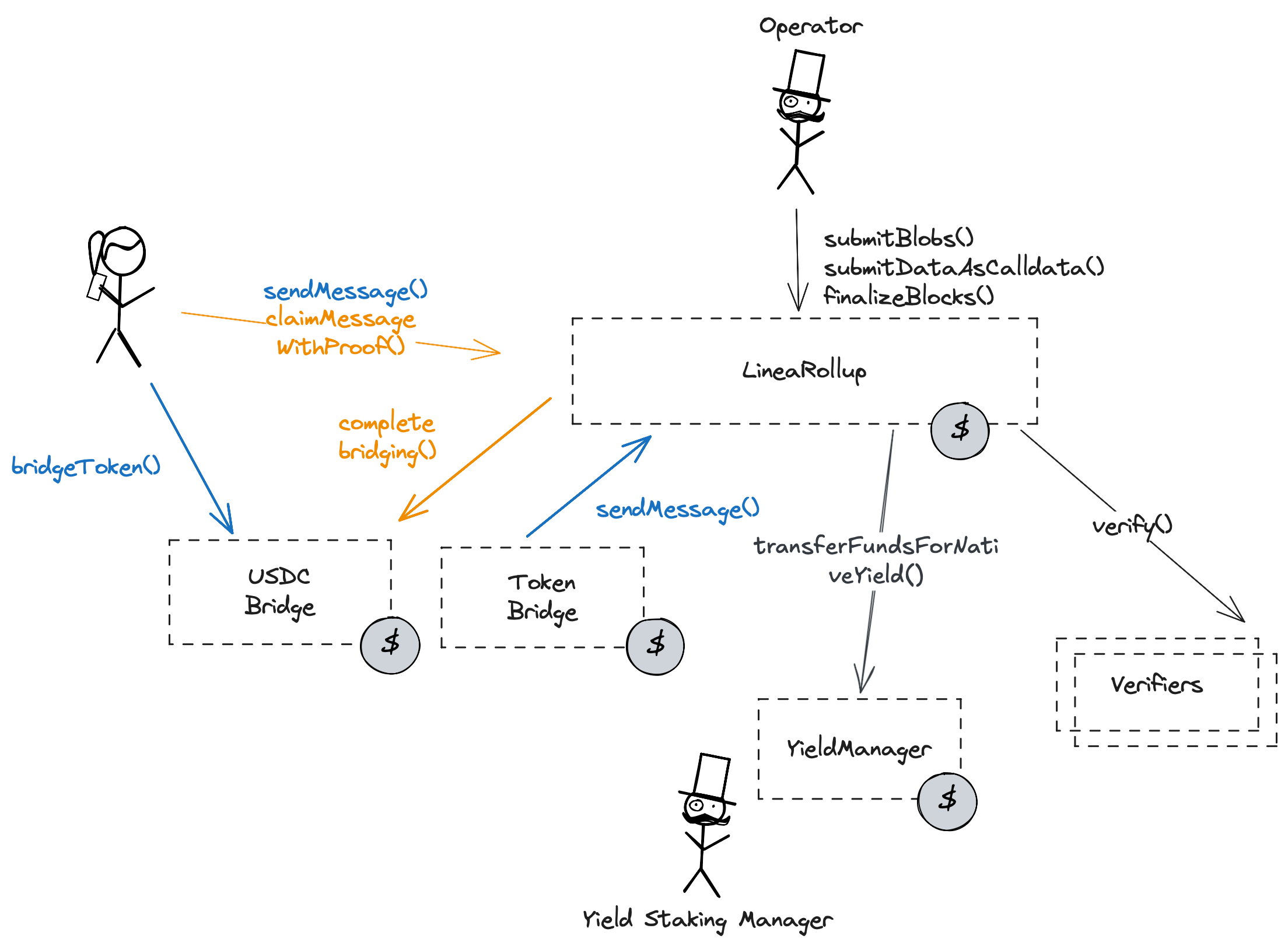
The user initiates L2Layer 2 (L2) is a category of technical solutions aimed to scale the base layer in a trust minimized way. This category includes solutions like rollups as well as state channels and plasma. Other solutions are able to scale further, but with the introduction of additional trust assumptions, which are therefore not trust minimized. Sometimes the term Layer 2 is used to refer to include these solutions too, like validiums and optimiums, but to distinguish between trust minimized and non trust minimized solutions they are often referred to as "light" L2s, opposed to "strong" L2s like rollups.->L1Layer 1 (L1) is a blockchain that is self-reliant on its validator set for its security and consensus properties. Ethereum is an example of a layer 1. Blockchains started receiving the moniker of layer 1 once layer 2 became a meaningful area of development. messages by submitting a regular transaction on this chain. When the blockAn ordered list of transactions and chain-related metadata that gets bundled together and published to the L1/DA layer. Nodes execute the transactions contained within blocks to change the rollup chain’s state. Protocol rules dictate what constitutes a valid block, and invalid blocks are skipped over. containing that transaction is settled, the message becomes available for processing on L1. ZK proofs are required to settle blocks. Note that withdrawal requests can be censored by the SequencerA party responsible for ordering and executing transactions on the rollup. The sequencer verifies transactions, compresses the data into a block, and submits the data related to it to enable state reconstruction to Ethereum L1 as a single transaction. The data can be either transaction data or state diffs.. Currently, there is a general limit of 10000.0 ETH that can be withdrawn within each 1d time window. Users can (eventually, after 6 months of inactivity from the centralized OperatorAn operator is the entity charged with managing a rollup and progressing its state. A rollup operator can be a centralized sequencer, proposer, prover, challenger, pauser of admin that is able to perform upgrades.) exit by replacing the Operator. In such a case they need to self-propose and prove their new state on the base layer with the required software which is currently not made available.
Funds can be frozen if the operator censors withdrawal transaction.
Ethereum
Actors:
A public proxy contract forwarding calls to a predefined target contract (LineaRollup). Can be called by any address.
- Can interact with LineaRollup
- submit and finalize blocksAn ordered list of transactions and chain-related metadata that gets bundled together and published to the L1/DA layer. Nodes execute the transactions contained within blocks to change the rollup chain’s state. Protocol rules dictate what constitutes a valid block, and invalid blocks are skipped over. as the OperatorAn operator is the entity charged with managing a rollup and progressing its state. A rollup operator can be a centralized sequencer, proposer, prover, challenger, pauser of admin that is able to perform upgrades. role when 6 months of no finalizations have passed
A Multisig with 5/9 threshold.
- Can upgrade with no delay
- TokenBridge Timelock → ProxyAdmin
- L1USDCBridge ProxyAdmin
- LineaRollup Timelock → ProxyAdmin
- YieldManager Timelock → ProxyAdmin
- Can interact with TokenBridge
- can pause the bridgeA message-passing protocol between two blockchains. At its most basic, a token bridge consists of a smart contract which can escrow funds on one side of the bridge, and instruct the release or minting of corresponding assets on the other side, but bridges could also support arbitrary messages. How these instructions are validated is a critical factor in assessing the trust assumptions of a bridge.
- can pause token bridging actions initiated from the other layer
- can pause token bridging actions initiated from this layer
- can prevent tokens that have not been bridged already from being bridged by assigning them a reserved status with 3mo delay or with no delay Delay with 3mo delay → Linea Multisig 2 - or - acting directly
- can remove the reserved status from a token, meaning that it is allowed to be bridged again with 3mo delay or with no delay Delay with 3mo delay → Linea Multisig 2 - or - acting directly
- can set custom ERC20 contracts for specific ERC20s with 3mo delay or with no delay Delay with 3mo delay → Linea Multisig 2 - or - acting directly
- can set the contract used as the source of truth from crosschain messages
- can unpause token bridging actions initiated from the other layer
- can unpause token bridging actions initiated from this layer
- manage all critical access control roles and permissions (full admin of the main bridge escrow)
- Can interact with Delay
- enable/disable the module, set delays and expiration of transactions, set the target with 3mo delay Delay with 3mo delay → Linea Multisig 2
- Can interact with UpgradeableBeacon
- change the beacon implementation
- Can interact with LineaRollup
- manage all critical access control roles and permissions (full admin of the rollupA blockchain that inherits consensus and data availability from another blockchain called L1. Rollups enable trust minimized bridges with the base layer via proof systems, either optimistic or zero-knowledge. A rollup without a bridge, or without considering the bridge, is called a sovereign rollup. system)
- pause the rollup for 2d, followed by 2d cooldown, during which the rollup cannot be paused, except by the Security CouncilA Security Council is a sufficiently decentralized set of members that is able to upgrade a system. A properly set up Security Council consists of at least 8 members with a threshold greater than 75%. What 'sufficiently decentralized' means is fundamentally subjective and L2BEAT evaluates each case individually. A Security Council is allowed to instantly upgrade Stage 1 rollups.
- pause the rollup indefinitely
- send ETH from the rollup bridge to the YieldManager
- set the address of the yield manager contract that receives ETH from rollup bridge
- Can interact with Timelock
- cancel queued transactions
- execute transactions that are ready
- manage all access control roles and change the minimum delay Timelock
- propose transactions with 3mo delay or with no delay Delay with 3mo delay → Linea Multisig 2 - or - acting directly
- Can interact with YieldManager
- manage native yield staking: modify reserve parameters, set yield pools, set yield receiver addresses
- operate native yield staking: stake and unstake, collect yield, pause and unpause, ossify yield managers
A Multisig with 3/5 threshold. It uses the following modules: Delay (A simple Safe module for that can queue and execute transactions as Linea Multisig 2 after a delay of currently 3mo, if registered as a module there).
- Can interact with TokenBridge
- can prevent tokens that have not been bridged already from being bridged by assigning them a reserved status
- can remove the reserved status from a token, meaning that it is allowed to be bridged again
- can set custom ERC20 contracts for specific ERC20s
- Can interact with Delay
- enable/disable the module, set delays and expiration of transactions, set the target
- Can interact with Timelock
- propose transactions
A Multisig with 1/4 threshold. Member of Linea Security CouncilA Security Council is a sufficiently decentralized set of members that is able to upgrade a system. A properly set up Security Council consists of at least 8 members with a threshold greater than 75%. What 'sufficiently decentralized' means is fundamentally subjective and L2BEAT evaluates each case individually. A Security Council is allowed to instantly upgrade Stage 1 rollups..
- Can interact with TokenBridge
- can pause the bridgeA message-passing protocol between two blockchains. At its most basic, a token bridge consists of a smart contract which can escrow funds on one side of the bridge, and instruct the release or minting of corresponding assets on the other side, but bridges could also support arbitrary messages. How these instructions are validated is a critical factor in assessing the trust assumptions of a bridge.
- Can interact with LineaRollup
- pause the rollupA blockchain that inherits consensus and data availability from another blockchain called L1. Rollups enable trust minimized bridges with the base layer via proof systems, either optimistic or zero-knowledge. A rollup without a bridge, or without considering the bridge, is called a sovereign rollup. for 2d, followed by 2d cooldown, during which the rollup cannot be paused, except by the Security CouncilA Security Council is a sufficiently decentralized set of members that is able to upgrade a system. A properly set up Security Council consists of at least 8 members with a threshold greater than 75%. What 'sufficiently decentralized' means is fundamentally subjective and L2BEAT evaluates each case individually. A Security Council is allowed to instantly upgrade Stage 1 rollups.
- Can interact with LineaRollup
- Allowed to prove blocksAn ordered list of transactions and chain-related metadata that gets bundled together and published to the L1/DA layer. Nodes execute the transactions contained within blocks to change the rollup chain’s state. Protocol rules dictate what constitutes a valid block, and invalid blocks are skipped over. and post the corresponding transaction data
- Can interact with AddressFilter
- add and remove addresses to the filter list. Addresses in this list can not send forced transactions from L1Layer 1 (L1) is a blockchain that is self-reliant on its validator set for its security and consensus properties. Ethereum is an example of a layer 1. Blockchains started receiving the moniker of layer 1 once layer 2 became a meaningful area of development.
- Can interact with LineaRollup
- send ETH from the rollupA blockchain that inherits consensus and data availability from another blockchain called L1. Rollups enable trust minimized bridges with the base layer via proof systems, either optimistic or zero-knowledge. A rollup without a bridge, or without considering the bridge, is called a sovereign rollup. bridgeA message-passing protocol between two blockchains. At its most basic, a token bridge consists of a smart contract which can escrow funds on one side of the bridge, and instruct the release or minting of corresponding assets on the other side, but bridges could also support arbitrary messages. How these instructions are validated is a critical factor in assessing the trust assumptions of a bridge. to the YieldManager
- Can interact with YieldManager
- operate native yield staking: stake and unstake, collect yield, pause and unpause, ossify yield managers
Linea
Actors:
A Multisig with 3/5 threshold.
- Can interact with TokenBridge
- can prevent tokens that have not been bridged already from being bridged by assigning them a reserved status
- can remove the reserved status from a token, meaning that it is allowed to be bridged again
- can set custom ERC20 contracts for specific ERC20s
- Can interact with L2Timelock
- propose transactions
A Multisig with 5/9 threshold.
- Can upgrade with no delay
- TokenBridge L2Timelock → ProxyAdmin
- L2MessageService L2Timelock → ProxyAdmin
- L2USDCBridge ProxyAdmin
- Can interact with TokenBridge
- can pause the bridgeA message-passing protocol between two blockchains. At its most basic, a token bridge consists of a smart contract which can escrow funds on one side of the bridge, and instruct the release or minting of corresponding assets on the other side, but bridges could also support arbitrary messages. How these instructions are validated is a critical factor in assessing the trust assumptions of a bridge.
- can pause token bridging actions initiated from the other layer
- can pause token bridging actions initiated from this layer
- can prevent tokens that have not been bridged already from being bridged by assigning them a reserved status
- can remove the reserved status from a token, meaning that it is allowed to be bridged again
- can set custom ERC20 contracts for specific ERC20s
- can set the contract used as the source of truth from crosschain messages
- can unpause token bridging actions initiated from the other layer
- can unpause token bridging actions initiated from this layer
- manage all critical access control roles and permissions (full admin of the main bridge escrow)
- Can interact with L2Timelock
- cancel queued transactions
- execute transactions that are ready
- manage all access control roles and change the minimum delay L2Timelock
- propose transactions
- Can interact with UpgradeableBeacon
- change the beacon implementation
- Can interact with TokenBridge
- can pause the bridgeA message-passing protocol between two blockchains. At its most basic, a token bridge consists of a smart contract which can escrow funds on one side of the bridge, and instruct the release or minting of corresponding assets on the other side, but bridges could also support arbitrary messages. How these instructions are validated is a critical factor in assessing the trust assumptions of a bridge.
- Can interact with L2MessageService
- Can anchor L1Layer 1 (L1) is a blockchain that is self-reliant on its validator set for its security and consensus properties. Ethereum is an example of a layer 1. Blockchains started receiving the moniker of layer 1 once layer 2 became a meaningful area of development. data on the L2Layer 2 (L2) is a category of technical solutions aimed to scale the base layer in a trust minimized way. This category includes solutions like rollups as well as state channels and plasma. Other solutions are able to scale further, but with the introduction of additional trust assumptions, which are therefore not trust minimized. Sometimes the term Layer 2 is used to refer to include these solutions too, like validiums and optimiums, but to distinguish between trust minimized and non trust minimized solutions they are often referred to as "light" L2s, opposed to "strong" L2s like rollups.. A check is supposed to be added to the proof systemThe infrastructure that allows projects to verify their state transitions. It is composed by onchain verifiers and offchain provers. The main two flavors are optimistic and ZK proof systems, but they can be combined in a hybrid model. In general though, if a system is able to accept state roots optimistically, even if it has a ZK component, it is considered an optimistic proof system. on L1 so that it is not possible to settle if the anchor is not correct. The function is permissioned because otherwise anyone can cause a livenessLiveness refers to the ability of a system to respond to requests and to process them in a timely manner. In the context of L2s, it refers to the ability of settling transactions, proofs and state roots to the base layer. failure by posting an invalid anchor
Ethereum
Contract used to bridgeA message-passing protocol between two blockchains. At its most basic, a token bridge consists of a smart contract which can escrow funds on one side of the bridge, and instruct the release or minting of corresponding assets on the other side, but bridges could also support arbitrary messages. How these instructions are validated is a critical factor in assessing the trust assumptions of a bridge. and escrow ERC-20 tokens.
- Roles:
- admin: ProxyAdmin; ultimately Linea Security CouncilA Security Council is a sufficiently decentralized set of members that is able to upgrade a system. A properly set up Security Council consists of at least 8 members with a threshold greater than 75%. What 'sufficiently decentralized' means is fundamentally subjective and L2BEAT evaluates each case individually. A Security Council is allowed to instantly upgrade Stage 1 rollups.
- allPausers: EOA 1, Linea Security Council
- allUnpausers: Linea Security Council
- completeTokenBridgingPausers: Linea Security Council
- completeTokenBridgingUnpausers: Linea Security Council
- customContractSetters: Linea Multisig 2, Linea Security Council; ultimately Linea Security Council
- defaultAdmin: Linea Security Council
- initiateTokenBridgingPausers: Linea Security Council
- initiateTokenBridgingUnpausers: Linea Security Council
- messageServiceSetters: Linea Security Council
- reserveTokenRemovers: Linea Multisig 2, Linea Security Council; ultimately Linea Security Council
- reserveTokenSetters: Linea Multisig 2, Linea Security Council; ultimately Linea Security Council
All supported tokens in this escrow are included in the value secured calculation.
Standard implementation used for assets that are native to the other layer and are bridged to this layer.
- Roles:
- owner: Linea Security CouncilA Security Council is a sufficiently decentralized set of members that is able to upgrade a system. A properly set up Security Council consists of at least 8 members with a threshold greater than 75%. What 'sufficiently decentralized' means is fundamentally subjective and L2BEAT evaluates each case individually. A Security Council is allowed to instantly upgrade Stage 1 rollups.
Yield provider adaptor, delegatecalled by the YieldManager, that deploys rollupA blockchain that inherits consensus and data availability from another blockchain called L1. Rollups enable trust minimized bridges with the base layer via proof systems, either optimistic or zero-knowledge. A rollup without a bridge, or without considering the bridge, is called a sovereign rollup. ETH into a Lido V3 staking vault (stVault) and its beacon chain validatorsIn the context of L2s, a Validator is an actor that validates the correctness of state transitions. For optimistic rollups this corresponds to challengers, and for ZK rollups this corresponds to the onchain verifier. Withdrawals back to the reserve are requested via EIP-7002 partial validator withdrawals, so refilling the reserve is subject to beacon chain latency; while the reserve is in deficit anyone can trigger them with a validator proof.
L1Layer 1 (L1) is a blockchain that is self-reliant on its validator set for its security and consensus properties. Ethereum is an example of a layer 1. Blockchains started receiving the moniker of layer 1 once layer 2 became a meaningful area of development. side of the old and now unused USDC bridgeA message-passing protocol between two blockchains. At its most basic, a token bridge consists of a smart contract which can escrow funds on one side of the bridge, and instruct the release or minting of corresponding assets on the other side, but bridges could also support arbitrary messages. How these instructions are validated is a critical factor in assessing the trust assumptions of a bridge..
- Roles:
- admin: ProxyAdmin; ultimately Linea Security CouncilA Security Council is a sufficiently decentralized set of members that is able to upgrade a system. A properly set up Security Council consists of at least 8 members with a threshold greater than 75%. What 'sufficiently decentralized' means is fundamentally subjective and L2BEAT evaluates each case individually. A Security Council is allowed to instantly upgrade Stage 1 rollups.
Blocklist consulted by the LineaRollup forced-transaction path: an address on this list cannot force-include transactions from L1Layer 1 (L1) is a blockchain that is self-reliant on its validator set for its security and consensus properties. Ethereum is an example of a layer 1. Blockchains started receiving the moniker of layer 1 once layer 2 became a meaningful area of development., so the contract gates the escape hatchThe facility for any user of a rollup to exit the system with their assets under any circumstance. Most relevant in rollups with a centralized proposer, wherein users do not have the ability to propose blocks, but can nonetheless exit the rollup by interacting with a smart contract on L1..
- Roles:
- defaultAdmin: EOA 4
A simple Safe module for that can queue and execute transactions as Linea Multisig 2 after a delay of currently 3mo, if registered as a module there.
- Roles:
- owner: Linea Multisig 2; ultimately Linea Security CouncilA Security Council is a sufficiently decentralized set of members that is able to upgrade a system. A properly set up Security Council consists of at least 8 members with a threshold greater than 75%. What 'sufficiently decentralized' means is fundamentally subjective and L2BEAT evaluates each case individually. A Security Council is allowed to instantly upgrade Stage 1 rollups.
- zodiacModule_modules: Linea Security Council
A beacon with an upgradeable implementation currently set as BridgedToken. Beacon proxy contracts pointing to this beacon will all use its implementation.
- Roles:
- owner: Linea Security CouncilA Security Council is a sufficiently decentralized set of members that is able to upgrade a system. A properly set up Security Council consists of at least 8 members with a threshold greater than 75%. What 'sufficiently decentralized' means is fundamentally subjective and L2BEAT evaluates each case individually. A Security Council is allowed to instantly upgrade Stage 1 rollups.
The main contract of the Linea zkEVM rollupA blockchain that inherits consensus and data availability from another blockchain called L1. Rollups enable trust minimized bridges with the base layer via proof systems, either optimistic or zero-knowledge. A rollup without a bridge, or without considering the bridge, is called a sovereign rollup.. Contains state rootsA cryptographic hash succinctly representing a state using a Merkle tree., the verifierAn entity in a ZK-Rollup, often a smart contract, that verifies zero-knowledge proofs submitted by a prover. addresses and manages messages between L1Layer 1 (L1) is a blockchain that is self-reliant on its validator set for its security and consensus properties. Ethereum is an example of a layer 1. Blockchains started receiving the moniker of layer 1 once layer 2 became a meaningful area of development. and the L2Layer 2 (L2) is a category of technical solutions aimed to scale the base layer in a trust minimized way. This category includes solutions like rollups as well as state channels and plasma. Other solutions are able to scale further, but with the introduction of additional trust assumptions, which are therefore not trust minimized. Sometimes the term Layer 2 is used to refer to include these solutions too, like validiums and optimiums, but to distinguish between trust minimized and non trust minimized solutions they are often referred to as "light" L2s, opposed to "strong" L2s like rollups.. ETH deployed to the rollup contract can be transfered to a yield protocol.
- Roles:
- admin: ProxyAdmin; ultimately Linea Security CouncilA Security Council is a sufficiently decentralized set of members that is able to upgrade a system. A properly set up Security Council consists of at least 8 members with a threshold greater than 75%. What 'sufficiently decentralized' means is fundamentally subjective and L2BEAT evaluates each case individually. A Security Council is allowed to instantly upgrade Stage 1 rollups.
- defaultAdmin: Linea Security Council
- ethStaker: EOA 5, Linea Security Council
- livenessRecoveryOperator: CallForwardingProxy
- operators: EOA 2, EOA 3
- pauseAll: EOA 1, Linea Security Council
- securityCouncil: Linea Security Council
- yieldManagerSetter: Linea Security Council
A standard timelock with access control. The current minimum delay is 0s.
- Roles:
- canceller: Linea Security CouncilA Security Council is a sufficiently decentralized set of members that is able to upgrade a system. A properly set up Security Council consists of at least 8 members with a threshold greater than 75%. What 'sufficiently decentralized' means is fundamentally subjective and L2BEAT evaluates each case individually. A Security Council is allowed to instantly upgrade Stage 1 rollups.
- executor: Linea Security Council
- proposerIn the context of L2s, the actor that proposes a claimed state root on L1. The term is also used in the context of Ethereum to refer to the actor that proposes a new block.: Linea Multisig 2, Linea Security Council; ultimately Linea Security Council
- timelockAdmin: Timelock; ultimately Linea Security Council
Manages flows of ETH and staked ETH in and out of rollupA blockchain that inherits consensus and data availability from another blockchain called L1. Rollups enable trust minimized bridges with the base layer via proof systems, either optimistic or zero-knowledge. A rollup without a bridge, or without considering the bridge, is called a sovereign rollup. contract reserves. Tracks the available ETH balance for L2Layer 2 (L2) is a category of technical solutions aimed to scale the base layer in a trust minimized way. This category includes solutions like rollups as well as state channels and plasma. Other solutions are able to scale further, but with the introduction of additional trust assumptions, which are therefore not trust minimized. Sometimes the term Layer 2 is used to refer to include these solutions too, like validiums and optimiums, but to distinguish between trust minimized and non trust minimized solutions they are often referred to as "light" L2s, opposed to "strong" L2s like rollups. exits, configures target parameters for amount of staked ETH, communicates with yield provider adaptors.
- Roles:
- admin: ProxyAdmin; ultimately Linea Security CouncilA Security Council is a sufficiently decentralized set of members that is able to upgrade a system. A properly set up Security Council consists of at least 8 members with a threshold greater than 75%. What 'sufficiently decentralized' means is fundamentally subjective and L2BEAT evaluates each case individually. A Security Council is allowed to instantly upgrade Stage 1 rollups.
- yieldStakingManager: Linea Security Council
- yieldStakingOperator: EOA 5, Linea Security Council
- Roles:
- owner: Timelock
Linea
- Roles:
- owner: L2Timelock
Contract used to bridgeA message-passing protocol between two blockchains. At its most basic, a token bridge consists of a smart contract which can escrow funds on one side of the bridge, and instruct the release or minting of corresponding assets on the other side, but bridges could also support arbitrary messages. How these instructions are validated is a critical factor in assessing the trust assumptions of a bridge. and escrow ERC-20 tokens.
- Roles:
- admin: ProxyAdmin; ultimately Linea Multisig 3
- allPausers: EOA 6, Linea Multisig 3
- allUnpausers: Linea Multisig 3
- completeTokenBridgingPausers: Linea Multisig 3
- completeTokenBridgingUnpausers: Linea Multisig 3
- customContractSetters: Linea Multisig 3, Linea Multisig 4
- defaultAdmin: Linea Multisig 3
- initiateTokenBridgingPausers: Linea Multisig 3
- initiateTokenBridgingUnpausers: Linea Multisig 3
- messageServiceSetters: Linea Multisig 3
- reserveTokenRemovers: Linea Multisig 3, Linea Multisig 4
- reserveTokenSetters: Linea Multisig 3, Linea Multisig 4
- Roles:
- admin: ProxyAdmin; ultimately Linea Multisig 3
- l1l2MessageSetter: EOA 7
L2Layer 2 (L2) is a category of technical solutions aimed to scale the base layer in a trust minimized way. This category includes solutions like rollups as well as state channels and plasma. Other solutions are able to scale further, but with the introduction of additional trust assumptions, which are therefore not trust minimized. Sometimes the term Layer 2 is used to refer to include these solutions too, like validiums and optimiums, but to distinguish between trust minimized and non trust minimized solutions they are often referred to as "light" L2s, opposed to "strong" L2s like rollups. side of the old and now unused USDC bridgeA message-passing protocol between two blockchains. At its most basic, a token bridge consists of a smart contract which can escrow funds on one side of the bridge, and instruct the release or minting of corresponding assets on the other side, but bridges could also support arbitrary messages. How these instructions are validated is a critical factor in assessing the trust assumptions of a bridge..
- Roles:
- admin: ProxyAdmin; ultimately Linea Multisig 3
A standard timelock with access control. The current minimum delay is 0s.
- Roles:
- canceller: Linea Multisig 3
- executor: Linea Multisig 3
- proposerIn the context of L2s, the actor that proposes a claimed state root on L1. The term is also used in the context of Ethereum to refer to the actor that proposes a new block.: Linea Multisig 3, Linea Multisig 4
- timelockAdmin: L2Timelock; ultimately Linea Multisig 3
- Roles:
- owner: Linea Multisig 3
Voyage XP tokens are non-transferrable, soulbound tokens that are distributed to recognize the community’s contribution toward the growth of the Linea ecosystem.
Standard implementation used for assets that are native to the other layer and are bridged to this layer.
A beacon with an upgradeable implementation currently set as BridgedToken. Beacon proxy contracts pointing to this beacon will all use its implementation.
- Roles:
- owner: Linea Multisig 3
The current deployment carries some associated risks:
Funds can be stolen if a contract receives a malicious code upgrade. There is a 0s delay on code upgrades.