Search
Search for projects by name or address
 Powerloom
Badges
About
Powerloom Mainnet is the Layer-2 chain supporting Powerloom’s composable data network where devs, orgs, and end-users get access to ready-to-consume, affordable, and verifiable onchain datasets.
Badges
About
Powerloom Mainnet is the Layer-2 chain supporting Powerloom’s composable data network where devs, orgs, and end-users get access to ready-to-consume, affordable, and verifiable onchain datasets.
Why is the project listed in others?
Consequence: projects without a sufficiently decentralized set of challengers rely on few entities to safely update the state. A small set of challengers can collude with the proposer to finalize an invalid state, which can cause loss of funds.
Consequence: projects without a sufficiently decentralized data availability committee rely on few entities to safely attest data availability on Ethereum. A small set of entities can collude with the proposer to finalize an unavailable state, which can cause loss of funds.
Learn more about the recategorisation here.
The section shows the operating costs that L2s pay to Ethereum.
This section shows how "live" the project's operators are by displaying how frequently they submit transactions of the selected type. It also highlights anomalies - significant deviations from their typical schedule.
Funds can be stolen if
Funds can be lost if
Users can be censored if
MEV can be extracted if
No actor outside of the single Proposer can submit fraud proofs. Interactive proofs (INT) require multiple transactions over time to resolve. The challenge protocol can be subject to delay attacks. There is a 5d 14h challenge period.
Proof construction relies fully on data that is NOT published onchain. There exists a Data Availability Committee (DAC) with a threshold of 1/1 that is tasked with protecting and supplying the data.
There is no window for users to exit in case of an unwanted upgrade since contracts are instantly upgradable.
Only the whitelisted proposers can publish state roots on L1, so in the event of failure the withdrawals are frozen.
Data is not stored on chain
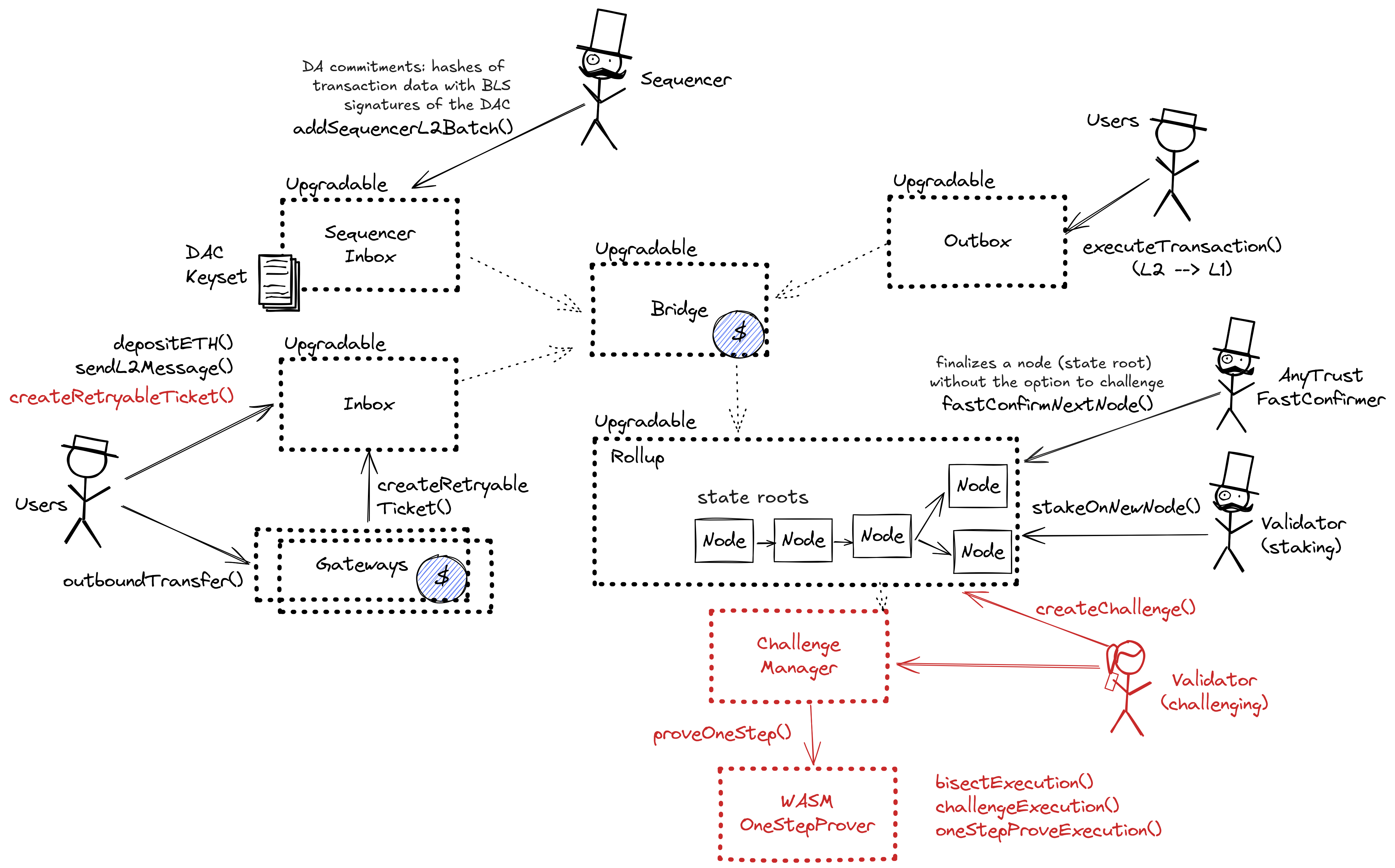
Users transactions are not published onchain, but rather sent to external trusted parties, also known as committee members (DAC). Members of the DAC collectively produce a Data Availability Certificate (comprising BLS signatures from a quorum) guaranteeing that the data behind the new transaction batch will be available until the expiry period elapses (currently a minimum of two weeks). This signature is not verified by L1, however external Validators will skip the batch if BLS signature is not valid resulting. This will result in a fraud proof challenge if this batch is included in a consecutive state update. It is assumed that at least one honest DAC member that signed the batch will reveal tx data to the Validators if Sequencer decides to act maliciously and withhold the data. If the Sequencer cannot gather enough signatures from the DAC, it will “fall back to rollup” mode and by posting the full data directly to the L1 chain. The current DAC threshold is 1 out of 1.
Funds can be lost if the external data becomes unavailable (CRITICAL).
Users can be censored if the committee restricts their access to the external data.
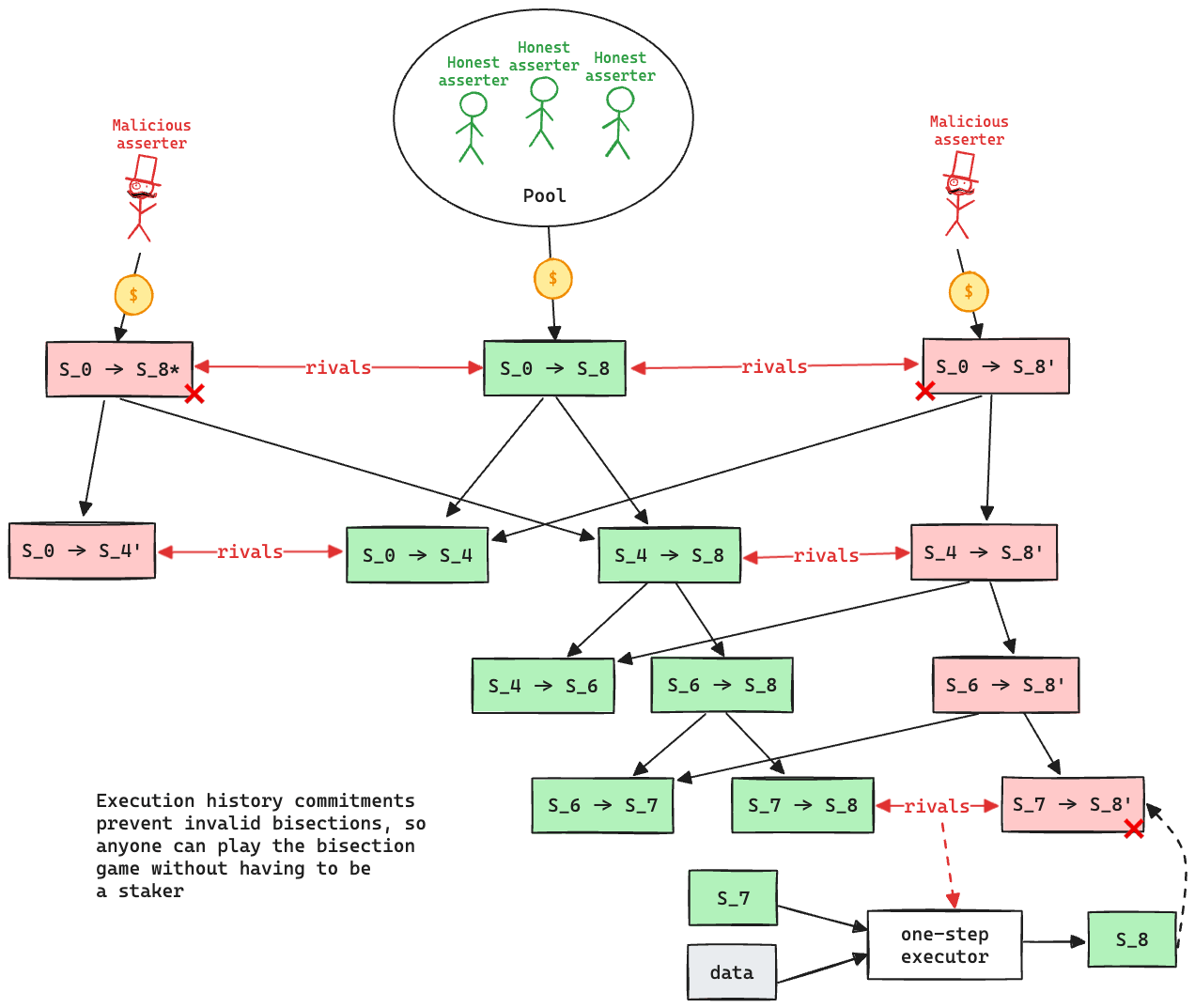
Updates to the system state can be proposed and challenged by a set of whitelisted validators. If a state root passes the challenge period, it is optimistically considered correct and made actionable for withdrawals.
Validators propose state roots as children of a previous state root. A state root can have multiple conflicting children. State roots are referred to as “assertions” within the contracts. Each chain of assertions only requires one stake, and validators staked on assertions with a child are considered inactive and can either move their stake to a new node or withdraw it. The function used to propose a new assertion is the stakeOnNewAssertion function. The stake is currently set to 0.1 ETH, and it can be slashed if the proposal is proven incorrect via a fraud proof. The protocol allows such funds to be trustlessly pooled together if necessary. New nodes cannot be created faster than the minimum assertion period, currently set to 15m. An assertion without “rivals” can be confirmed after the challenge period has passed, currently set to 5d 14h. If a rival is present, then it is checked that the assertion is the winner in the challenge protocol.
Funds can be stolen if no whitelisted challenger disputes an invalid state root before the challenge window expires (CRITICAL).
A challenge can be started between two siblings, i.e. two different state roots that share the same parent, by calling the createLayerZeroEdge function in the ChallengeManager contract. Edges represent assertions, or bisected assertions, within the challenge protocol. Challenges are played via a bisection game, where asserters and challengers play together to find the first instruction of disagreement. Such instruction is then executed onchain in the WASM OneStepProver contract to determine the winner. An edge can only be bisected when rivaled. The bisection process requires no new stake as their validity is checked against a parent “history root” that contains all intermediate states. An edge can also be confirmed if itself or its descendants spend enough time being unrivaled. Such time is set to 5d 14h. If both actors play as slow as possible, the maximum time to confirm an edge is double such value, i.e. 11d 4h. Due to the complexities of maintaining the history root, the challenge protocol is divided into 3 levels, where the lowest level represents assertions over blocks, the highest level represents assertions over single WASM instructions, and intermediate levels represent assertions over chunks of WASM instructions. When moving between levels, a new stake is required. Level 0 (block level) requires a stake of 0.0 ETH, level 1 requires a stake of 0.1 ETH, level 2 requires a stake of 0.1 ETH. The ratio between such stakes can be exploited to perform resource exhaustion attacks.
Funds can be stolen if an attacker successfully performs a resource exhaustion attack.
Program Hashes
Name | Hash | Repository | Verification | Used in | |||||||||||||||||||||||||||||||||||||||||||||||||||||||||||||||||||||||||||||||||||||||||||||||
|---|---|---|---|---|---|---|---|---|---|---|---|---|---|---|---|---|---|---|---|---|---|---|---|---|---|---|---|---|---|---|---|---|---|---|---|---|---|---|---|---|---|---|---|---|---|---|---|---|---|---|---|---|---|---|---|---|---|---|---|---|---|---|---|---|---|---|---|---|---|---|---|---|---|---|---|---|---|---|---|---|---|---|---|---|---|---|---|---|---|---|---|---|---|---|---|---|---|---|---|
0x8a75...a499 |      Projects used inSearch for projects used in | ||||||||||||||||||||||||||||||||||||||||||||||||||||||||||||||||||||||||||||||||||||||||||||||||||
Past upgrades
The metrics include upgrades on the currently used proxy contracts. Historical proxy contracts and changes of such are not included.
2026 June 11, 11:26 UTC3changesConduit Multisig 1 dropped two signers.
Conduit Multisig 1 dropped two signers.
| contract Conduit Multisig 1 (eth:0x4a4962275DF8C60a80d3a25faEc5AA7De116A746) [GnosisSafe] { | |
| +++ description: None | |
| values.$members.4: | |
| - | "eth:0x65D1d44B8B2fE15d45A03708E0835C7E98a56007" |
| values.$members.8: | |
| - | "eth:0xa4000bDD2bB92ce6750b31F1eeda47Bd1cB8e6e4" |
| values.multisigThreshold: | |
| - | "4 of 12 (33%)" |
| + | "4 of 10 (40%)" |
| } | |
2026 June 02, 11:13 UTC2changesConduit Multisig 1 rotated one signer (operator key 0x3840…fd5f → 0xcdC9…4853 ); same rotation propagated across Conduit Multisigs 1/2/3 on eth/arb1/base.
Conduit Multisig 1 rotated one signer (operator key 0x3840…fd5f → 0xcdC9…4853); same rotation propagated across Conduit Multisigs 1/2/3 on eth/arb1/base.
| contract Conduit Multisig 1 (eth:0x4a4962275DF8C60a80d3a25faEc5AA7De116A746) [GnosisSafe] { | |
| +++ description: None | |
| values.$members.0: | |
| + | "eth:0xcdC931935768c0562AfE989A366a3Dc4d52F4853" |
| values.$members.8: | |
| - | "eth:0x3840f487A17A41100DD1Bf0946c34f132a57Fd5f" |
| } | |
2026 May 05, 15:18 UTC2changesConduit Multisig 1 ( eth:0x4a496227... ) — signer 0x381624F7 removed. Threshold unchanged at 4; total signers 13 → 12 (31% → 33%). Shared multisig (referenced by multiple Conduit-managed chains).
Conduit Multisig 1 (eth:0x4a496227...) — signer 0x381624F7 removed. Threshold unchanged at 4; total signers 13 → 12 (31% → 33%). Shared multisig (referenced by multiple Conduit-managed chains).
| contract Conduit Multisig 1 (eth:0x4a4962275DF8C60a80d3a25faEc5AA7De116A746) { | |
| +++ description: None | |
| values.$members.1: | |
| - | "eth:0x381624F7912BddD83dc67c6C53Ef6FE61B87Cf07" |
| values.multisigThreshold: | |
| - | "4 of 13 (31%)" |
| + | "4 of 12 (33%)" |
| } | |
2026 February 11, 15:34 UTCHigh severity68changesUpgrade to BoLD dispute protocol and ArbOS v51 "Dia" (nitro-contracts v3.1.0+). RollupProxy replaced with a new BoLD-enabled contract ( isPostBoLD: true ). Assertion-based state management replaces the old node-based system. Validators stake 0.1 ETH (WETH), validator whitelist remains enabled. ChallengeManager replaced with EdgeChallengeManager implementing the BoLD multi-level bisection protocol: block-level edges (height 67M), 1 big-step level (height 524K), small-step edges (height 8.4M), with 0.1 ETH stake for big-step and small-step edges. All core contracts upgraded: Bridge, Inbox, Outbox, RollupEventInbox, SequencerInbox. SequencerInbox gains delay buffer support ( isDelayBufferable: true , currently set to max/disabled) and feeTokenPricer field. delayBlocks increased from 5760 to 7200. All four OneStepProvers and OneStepProofEntry replaced with new versions. ValidatorUtils removed (no longer needed in BoLD). ArbOS updated to v51 "Dia" (wasmModuleRoot 0x8a7513bf... ), adding Ethereum Fusaka support (secp256r1, BLS12-381, CLZ opcode), improved gas pricing, and native token mint/burn support.
Upgrade to BoLD dispute protocol and ArbOS v51 “Dia” (nitro-contracts v3.1.0+).
RollupProxy replaced with a new BoLD-enabled contract (isPostBoLD: true). Assertion-based state management replaces the old node-based system. Validators stake 0.1 ETH (WETH), validator whitelist remains enabled.
ChallengeManager replaced with EdgeChallengeManager implementing the BoLD multi-level bisection protocol: block-level edges (height 67M), 1 big-step level (height 524K), small-step edges (height 8.4M), with 0.1 ETH stake for big-step and small-step edges.
All core contracts upgraded: Bridge, Inbox, Outbox, RollupEventInbox, SequencerInbox. SequencerInbox gains delay buffer support (isDelayBufferable: true, currently set to max/disabled) and feeTokenPricer field. delayBlocks increased from 5760 to 7200.
All four OneStepProvers and OneStepProofEntry replaced with new versions. ValidatorUtils removed (no longer needed in BoLD).
ArbOS updated to v51 “Dia” (wasmModuleRoot 0x8a7513bf...), adding Ethereum Fusaka support (secp256r1, BLS12-381, CLZ opcode), improved gas pricing, and native token mint/burn support.
| contract RollupEventInbox (eth:0x02f3a60D25abF1844740a39cd9679227309a1Fa6) { | |
| +++ description: Helper contract sending configuration data over the bridge during the systems initialization. | |
| sourceHashes.1: | |
| - | "0x35bd9f6436158f2147578ce95b85de68f435e81f1f3ed3858f7523a8c4825a1a" |
| + | "0x089ac3cec821c0f014f284ec4ec1039ef6bc50b6ad3ee47c82e20af65cc30c33" |
| values.$implementation: | |
| - | "eth:0xb0f031Cd10598c6b4C33FcE1675F26CF937091da" |
| + | "eth:0x0d079b22B0B4083b9b0bDc62Bf1a4EAF4a95bDEe" |
| values.$pastUpgrades.1: | |
| + | ["2026-02-09T09:22:35.000Z","0xafbcbe360ba3526a2f683ac3199504e90bd3b4647b959e94aef6c5b5487a0461",["eth:0x0d079b22B0B4083b9b0bDc62Bf1a4EAF4a95bDEe"]] |
| values.$upgradeCount: | |
| - | 1 |
| + | 2 |
| values.rollup: | |
| - | "eth:0x9f3dC4D1f6c6D9F2273d8b497E460E6E727210e8" |
| + | "eth:0xc3196FEE2b194bf699076865060d566c7Cb02892" |
| implementationNames.eth:0xb0f031Cd10598c6b4C33FcE1675F26CF937091da: | |
| - | "ERC20RollupEventInbox" |
| implementationNames.eth:0x0d079b22B0B4083b9b0bDc62Bf1a4EAF4a95bDEe: | |
| + | "ERC20RollupEventInbox" |
| } | |
| - | Status: DELETED |
| contract OneStepProverMath (eth:0x036147913eEb42E97790F9a693246c8444290AB6) | |
| +++ description: One of the modular contracts used for the last step of a fraud proof, which is simulated inside a WASM virtual machine. | |
| - | Status: DELETED |
| contract ChallengeManager (eth:0x0B5BbEedB3E8bc9a2352fFa0aED56b6fad8d3040) | |
| +++ description: Contract that allows challenging state roots. Can be called through the RollupProxy by Validators or the UpgradeExecutor. | |
| - | Status: DELETED |
| contract OneStepProverMemory (eth:0x21c6F81b1063f09A6c26EDc74fBb9beb349A5E96) | |
| +++ description: One of the modular contracts used for the last step of a fraud proof, which is simulated inside a WASM virtual machine. | |
| - | Status: DELETED |
| contract OneStepProverHostIo (eth:0x231173CC90cB8486A7dbD1733B5105254316D50A) | |
| +++ description: One of the modular contracts used for the last step of a fraud proof, which is simulated inside a WASM virtual machine. | |
| contract ProxyAdmin (eth:0x256bBeDabDBa636a9Cd17890841C941a28e9437e) { | |
| +++ description: None | |
| directlyReceivedPermissions.1: | |
| - | {"permission":"upgrade","from":"eth:0x0B5BbEedB3E8bc9a2352fFa0aED56b6fad8d3040","role":"admin"} |
| directlyReceivedPermissions.8: | |
| + | {"permission":"upgrade","from":"eth:0xfFfEB1c8C3ec3c45c17E4E1EB547452DF9FF1A76","role":"admin"} |
| } | |
| EOA (eth:0x401Ba2e5037e3d8D1c32E77Dfd371501618604Bf) { | |
| +++ description: None | |
| receivedPermissions.0: | |
| - | {"permission":"fastconfirm","from":"eth:0x9f3dC4D1f6c6D9F2273d8b497E460E6E727210e8","description":"Can finalize a state root before the challenge period has passed. This allows withdrawing from the bridge based on the state root.","role":".anyTrustFastConfirmer","via":[{"address":"eth:0xA7A2cc389aFCcDE8A1F47F14dA88e82e7D99b68F"}]} |
| receivedPermissions.1: | |
| - | {"permission":"validate","from":"eth:0x9f3dC4D1f6c6D9F2273d8b497E460E6E727210e8","description":"Can propose new state roots (called nodes) and challenge state roots on the host chain.","role":".validators","via":[{"address":"eth:0xA7A2cc389aFCcDE8A1F47F14dA88e82e7D99b68F"}]} |
| receivedPermissions.2.role: | |
| - | ".validators" |
| + | ".getValidators" |
| receivedPermissions.2.from: | |
| - | "eth:0x9f3dC4D1f6c6D9F2273d8b497E460E6E727210e8" |
| + | "eth:0xc3196FEE2b194bf699076865060d566c7Cb02892" |
| } | |
| contract Conduit Multisig 1 (eth:0x4a4962275DF8C60a80d3a25faEc5AA7De116A746) { | |
| +++ description: None | |
| receivedPermissions.0.description: | |
| - | "Pause and unpause and set important roles and parameters in the system contracts: Can delegate Sequencer management to a BatchPosterManager address, manage data availability, DACs and the fastConfirmer role, set the Sequencer-only window, introduce an allowList to the bridge and whitelist Inboxes/Outboxes." |
| + | "Pause and unpause and set important roles and parameters in the system contracts: Can delegate Sequencer management to a BatchPosterManager address, manage data availability and DACs, set the Sequencer-only window, introduce an allowList to the bridge and whitelist Inboxes/Outboxes." |
| receivedPermissions.0.from: | |
| - | "eth:0x9f3dC4D1f6c6D9F2273d8b497E460E6E727210e8" |
| + | "eth:0xc3196FEE2b194bf699076865060d566c7Cb02892" |
| receivedPermissions.2: | |
| - | {"permission":"upgrade","from":"eth:0x0B5BbEedB3E8bc9a2352fFa0aED56b6fad8d3040","role":"admin","via":[{"address":"eth:0x256bBeDabDBa636a9Cd17890841C941a28e9437e"},{"address":"eth:0x6a23390d8a086c1091188f8Db702E91DCA38805F"}]} |
| receivedPermissions.10: | |
| - | {"permission":"upgrade","from":"eth:0x9f3dC4D1f6c6D9F2273d8b497E460E6E727210e8","role":"admin","via":[{"address":"eth:0x6a23390d8a086c1091188f8Db702E91DCA38805F"}]} |
| receivedPermissions.10: | |
| + | {"permission":"upgrade","from":"eth:0xc3196FEE2b194bf699076865060d566c7Cb02892","role":"admin","via":[{"address":"eth:0x6a23390d8a086c1091188f8Db702E91DCA38805F"}]} |
| receivedPermissions.11: | |
| + | {"permission":"upgrade","from":"eth:0xfFfEB1c8C3ec3c45c17E4E1EB547452DF9FF1A76","role":"admin","via":[{"address":"eth:0x256bBeDabDBa636a9Cd17890841C941a28e9437e"},{"address":"eth:0x6a23390d8a086c1091188f8Db702E91DCA38805F"}]} |
| } | |
| contract Bridge (eth:0x53b168016aA2E3469B5D76315311aAC4Ce0020DB) { | |
| +++ description: Escrow contract for the project's gas token (can be different from ETH). Keeps a list of allowed Inboxes and Outboxes for canonical bridge messaging. | |
| sourceHashes.1: | |
| - | "0x73087d4667e81f676a10708feb2774bab3a9a558a1987b8ac4f112cc464bba96" |
| + | "0x7f62b9bd4a0aac711ca355a523b1d934ab93ae14c5fae5a860c0ded42ee5a3c3" |
| values.$implementation: | |
| - | "eth:0xd7FD189F1652378f32dA3db7926e51a7b0344797" |
| + | "eth:0x81be1Bf06cB9B23e8EEDa3145c3366A912DAD9D6" |
| values.$pastUpgrades.1: | |
| + | ["2026-02-09T09:22:35.000Z","0xafbcbe360ba3526a2f683ac3199504e90bd3b4647b959e94aef6c5b5487a0461",["eth:0x81be1Bf06cB9B23e8EEDa3145c3366A912DAD9D6"]] |
| values.$upgradeCount: | |
| - | 1 |
| + | 2 |
| values.rollup: | |
| - | "eth:0x9f3dC4D1f6c6D9F2273d8b497E460E6E727210e8" |
| + | "eth:0xc3196FEE2b194bf699076865060d566c7Cb02892" |
| implementationNames.eth:0xd7FD189F1652378f32dA3db7926e51a7b0344797: | |
| - | "ERC20Bridge" |
| implementationNames.eth:0x81be1Bf06cB9B23e8EEDa3145c3366A912DAD9D6: | |
| + | "ERC20Bridge" |
| } | |
| contract UpgradeExecutor (eth:0x6a23390d8a086c1091188f8Db702E91DCA38805F) { | |
| +++ description: Central contract defining the access control permissions for upgrading the system contract implementations. | |
| directlyReceivedPermissions.1.description: | |
| - | "Pause and unpause and set important roles and parameters in the system contracts: Can delegate Sequencer management to a BatchPosterManager address, manage data availability, DACs and the fastConfirmer role, set the Sequencer-only window, introduce an allowList to the bridge and whitelist Inboxes/Outboxes." |
| + | "Pause and unpause and set important roles and parameters in the system contracts: Can delegate Sequencer management to a BatchPosterManager address, manage data availability and DACs, set the Sequencer-only window, introduce an allowList to the bridge and whitelist Inboxes/Outboxes." |
| directlyReceivedPermissions.1.from: | |
| - | "eth:0x9f3dC4D1f6c6D9F2273d8b497E460E6E727210e8" |
| + | "eth:0xc3196FEE2b194bf699076865060d566c7Cb02892" |
| directlyReceivedPermissions.2.from: | |
| - | "eth:0x9f3dC4D1f6c6D9F2273d8b497E460E6E727210e8" |
| + | "eth:0xc3196FEE2b194bf699076865060d566c7Cb02892" |
| } | |
| - | Status: DELETED |
| contract OneStepProver0 (eth:0x72b55c2C38EadE57C10047746632A369A060A46E) | |
| +++ description: One of the modular contracts used for the last step of a fraud proof, which is simulated inside a WASM virtual machine. | |
| contract Inbox (eth:0x7d4509336b154C17Df80D03A19C051ddAcdA2e7f) { | |
| +++ description: Facilitates sending L1 to L2 messages like depositing ETH, but does not escrow funds. | |
| sourceHashes.1: | |
| - | "0x25984fdfffb8141859c99299fb29e7a7460732d77111e5fe23792baa99f336a3" |
| + | "0x82dad78abdf27e168de1ae177b8055db4167106d71273d9a3264e9898a6055e4" |
| values.$implementation: | |
| - | "eth:0x6C051397fee2d79ccf92d1f3c5c6547fEBD838F4" |
| + | "eth:0xD210b64eD9D47Ef8Acf1A3284722FcC7Fc6A1f4e" |
| values.$pastUpgrades.2: | |
| + | ["2026-02-09T09:22:35.000Z","0xafbcbe360ba3526a2f683ac3199504e90bd3b4647b959e94aef6c5b5487a0461",["eth:0xD210b64eD9D47Ef8Acf1A3284722FcC7Fc6A1f4e"]] |
| values.$upgradeCount: | |
| - | 2 |
| + | 3 |
| implementationNames.eth:0x6C051397fee2d79ccf92d1f3c5c6547fEBD838F4: | |
| - | "ERC20Inbox" |
| implementationNames.eth:0xD210b64eD9D47Ef8Acf1A3284722FcC7Fc6A1f4e: | |
| + | "ERC20Inbox" |
| } | |
| - | Status: DELETED |
| contract ValidatorUtils (eth:0x84eA2523b271029FFAeB58fc6E6F1435a280db44) | |
| +++ description: This contract implements view only utilities for validators. | |
| contract SequencerInbox (eth:0x903Af716AA8C7C27Fd785F453D5a59C20E06bDeC) { | |
| +++ description: A sequencer (registered in this contract) can submit transaction batches or commitments here. | |
| sourceHashes.1: | |
| - | "0x6bb86ac4bd0d31e049f543fcf0a8f94c952252222f115246ef9d5b8104d803cc" |
| + | "0xb57f3e67e08492b235337cda4f3ea0117e3e043cceaf8e9a7a51b57611ba99de" |
| values.$implementation: | |
| - | "eth:0xaEd84B70Be8117112a5aa0d93a7fBff463A03b18" |
| + | "eth:0x6F2E7F9B5Db5e4e9B5B1181D2Eb0e4972500C324" |
| values.$pastUpgrades.2: | |
| + | ["2026-02-09T09:22:35.000Z","0xafbcbe360ba3526a2f683ac3199504e90bd3b4647b959e94aef6c5b5487a0461",["eth:0x6F2E7F9B5Db5e4e9B5B1181D2Eb0e4972500C324"]] |
| values.$upgradeCount: | |
| - | 2 |
| + | 3 |
| values.maxTimeVariation.delayBlocks: | |
| - | 5760 |
| + | 7200 |
| values.reader4844: | |
| - | "eth:0x6c5c9E6c080a6C25f49DfFE85cfA71aaEAAfdE74" |
| + | "eth:0xB1F1A77AB63671a6355Fa5c8423f436118943411" |
| values.rollup: | |
| - | "eth:0x9f3dC4D1f6c6D9F2273d8b497E460E6E727210e8" |
| + | "eth:0xc3196FEE2b194bf699076865060d566c7Cb02892" |
| values.feeTokenPricer: | |
| + | "eth:0x0000000000000000000000000000000000000000" |
| values.isDelayBufferable: | |
| + | true |
| implementationNames.eth:0xaEd84B70Be8117112a5aa0d93a7fBff463A03b18: | |
| - | "SequencerInbox" |
| implementationNames.eth:0x6F2E7F9B5Db5e4e9B5B1181D2Eb0e4972500C324: | |
| + | "SequencerInbox" |
| } | |
| - | Status: DELETED |
| contract RollupProxy (eth:0x9f3dC4D1f6c6D9F2273d8b497E460E6E727210e8) | |
| +++ description: Central contract for the project's configuration like its execution logic hash (`wasmModuleRoot`) and addresses of the other system contracts. Entry point for Proposers creating new Rollup Nodes (state commitments) and Challengers submitting fraud proofs (In the Orbit stack, these two roles are both held by the Validators). | |
| - | Status: DELETED |
| contract OneStepProofEntry (eth:0x9f403f2054736884518E6D3f510C02f5959BDCC6) | |
| +++ description: One of the modular contracts used for the last step of a fraud proof, which is simulated inside a WASM virtual machine. | |
| contract GnosisSafeL2 (eth:0xA7A2cc389aFCcDE8A1F47F14dA88e82e7D99b68F) { | |
| +++ description: None | |
| directlyReceivedPermissions: | |
| - | [{"permission":"fastconfirm","from":"eth:0x9f3dC4D1f6c6D9F2273d8b497E460E6E727210e8","description":"Can finalize a state root before the challenge period has passed. This allows withdrawing from the bridge based on the state root.","role":".anyTrustFastConfirmer"},{"permission":"validate","from":"eth:0x9f3dC4D1f6c6D9F2273d8b497E460E6E727210e8","description":"Can propose new state roots (called nodes) and challenge state roots on the host chain.","role":".validators"}] |
| } | |
| contract Outbox (eth:0xc0dd0a059a8a948B7737D00bfC9024475C791259) { | |
| +++ description: Facilitates L2 to L1 contract calls: Messages initiated from L2 (for example withdrawal messages) eventually resolve in execution on L1. | |
| values.$implementation: | |
| - | "eth:0x1f24EDD5161f82588007f33B72b0b28e46cCE878" |
| + | "eth:0x17E0C5fE0dFF2AE4cfC9E96d9Ccd112DaF5c0386" |
| values.$pastUpgrades.1: | |
| + | ["2026-02-09T09:22:35.000Z","0xafbcbe360ba3526a2f683ac3199504e90bd3b4647b959e94aef6c5b5487a0461",["eth:0x17E0C5fE0dFF2AE4cfC9E96d9Ccd112DaF5c0386"]] |
| values.$upgradeCount: | |
| - | 1 |
| + | 2 |
| values.rollup: | |
| - | "eth:0x9f3dC4D1f6c6D9F2273d8b497E460E6E727210e8" |
| + | "eth:0xc3196FEE2b194bf699076865060d566c7Cb02892" |
| implementationNames.eth:0x1f24EDD5161f82588007f33B72b0b28e46cCE878: | |
| - | "ERC20Outbox" |
| implementationNames.eth:0x17E0C5fE0dFF2AE4cfC9E96d9Ccd112DaF5c0386: | |
| + | "ERC20Outbox" |
| } | |
| + | Status: CREATED |
| contract OneStepProverMemory (eth:0x29efff3EfE3E01A3F69011a054C33410edFc2283) | |
| +++ description: One of the modular contracts used for the last step of a fraud proof, which is simulated inside a WASM virtual machine. | |
| + | Status: CREATED |
| contract OneStepProver0 (eth:0x7368F782E109518fD3914e8b315eE45E51C15835) | |
| +++ description: One of the modular contracts used for the last step of a fraud proof, which is simulated inside a WASM virtual machine. | |
| + | Status: CREATED |
| contract OneStepProofEntry (eth:0x91cB57F200Bd5F897E41C164425Ab4DB0991A64f) | |
| +++ description: One of the modular contracts used for the last step of a fraud proof, which is simulated inside a WASM virtual machine. | |
| + | Status: CREATED |
| contract RollupProxy (eth:0xc3196FEE2b194bf699076865060d566c7Cb02892) | |
| +++ description: Central contract for the project's configuration like its execution logic hash (`wasmModuleRoot`) and addresses of the other system contracts. Entry point for Proposers creating new assertions (state commitments) and Challengers submitting fraud proofs (In the Orbit stack, these two roles are both called Validators). | |
| + | Status: CREATED |
| contract OneStepProverMath (eth:0xD1D75248ed95450B793d80F9fb418C2eD4c5F5e4) | |
| +++ description: One of the modular contracts used for the last step of a fraud proof, which is simulated inside a WASM virtual machine. | |
| + | Status: CREATED |
| contract OneStepProverHostIo (eth:0xDdaD5E59D056078A4E67a9d42e21Ce8057F22D60) | |
| +++ description: One of the modular contracts used for the last step of a fraud proof, which is simulated inside a WASM virtual machine. | |
| + | Status: CREATED |
| contract EdgeChallengeManager (eth:0xfFfEB1c8C3ec3c45c17E4E1EB547452DF9FF1A76) | |
| +++ description: Contract that implements the main challenge protocol logic of the fraud proof system. | |
2026 January 27, 11:50 UTC2changesNew member added to Conduit Multisig 1, increasing from 4 of 12 to 4 of 13 threshold.
New member added to Conduit Multisig 1, increasing from 4 of 12 to 4 of 13 threshold.
| contract Conduit Multisig 1 (eth:0x4a4962275DF8C60a80d3a25faEc5AA7De116A746) { | |
| +++ description: None | |
| values.$members.0: | |
| + | "eth:0xA9FCCc53F1c9095DA867Bd648683F8bdCcc78d09" |
| values.multisigThreshold: | |
| - | "4 of 12 (33%)" |
| + | "4 of 13 (31%)" |
| } | |
The system has a centralized sequencer
While forcing transaction is open to anyone the system employs a privileged sequencer that has priority for submitting transaction batches and ordering transactions.
MEV can be extracted if the operator exploits their centralized position and frontruns user transactions.
Users can force any transaction
Because the state of the system is based on transactions submitted on the underlying host chain and anyone can submit their transactions there it allows the users to circumvent censorship by interacting with the smart contract on the host chain directly. After a delay of 1d in which a Sequencer has failed to include a transaction that was directly posted to the smart contract, it can be forcefully included by anyone on the host chain, which finalizes its ordering.
Buffered forced transactions
To force transactions from the host chain, users must first enqueue “delayed” messages in the “delayed” inbox of the Bridge contract. Only authorized Inboxes are allowed to enqueue delayed messages, and the so-called Inbox contract is the one used as the entry point by calling the sendMessage or sendMessageFromOrigin functions. If the centralized sequencer doesn’t process the request within some time bound, users can call the forceInclusion function on the SequencerInbox contract to include the message in the canonical chain. The time bound is defined to be the minimum between 1d and the time left in the delay buffer. The delay buffer gets replenished over time and gets consumed every time the sequencer doesn’t timely process a message. Only messages processed with a delay greater than 428424622y 1mo consume the buffer. The buffer is capped at 428424622y 1mo. The replenish rate is currently set at 1m every 20m. Even if the buffer is fully consumed, messages are still allowed to be delayed up to 428424622y 1mo.
Autonomous exit
Users can (eventually) exit the system by pushing the transaction on L1 and providing the corresponding state root. The only way to prevent such withdrawal is via an upgrade.
EVM compatible smart contracts are supported
Arbitrum One uses Nitro technology that allows running fraud proofs by executing EVM code on top of WASM.
Ethereum
Actors:
A Multisig with 4/10 threshold.
- Can upgrade with no delay
- RollupEventInbox UpgradeExecutor → ProxyAdmin
- L1OrbitUSDCGateway ProxyAdmin
- ERC20Gateway UpgradeExecutor → ProxyAdmin
- Bridge UpgradeExecutor → ProxyAdmin
- UpgradeExecutor UpgradeExecutor → ProxyAdmin
- Inbox UpgradeExecutor → ProxyAdmin
- GatewayRouter UpgradeExecutor → ProxyAdmin
- SequencerInbox UpgradeExecutor → ProxyAdmin
- Outbox UpgradeExecutor → ProxyAdmin
- RollupProxy UpgradeExecutor
- EdgeChallengeManager UpgradeExecutor → ProxyAdmin
- Can interact with RollupProxy
- Pause and unpause and set important roles and parameters in the system contracts: Can delegate Sequencer management to a BatchPosterManager address, manage data availability and DACs, set the Sequencer-only window, introduce an allowList to the bridge and whitelist Inboxes/Outboxes UpgradeExecutor
Participants (10):
0xcdC9…48530xA9FC…8d090x6BB4…83A60x2103…911c0x8117…E7Ac0xA073…bda20xF331…647D0xa0C6…90380xefCf…dD5C0x4D80…5BAeMember of GnosisSafeL2.
- Can interact with RollupProxy
- Can propose new state roots (called nodes) and challenge state roots on the host chain
Ethereum

A sequencer (registered in this contract) can submit transaction batches or commitments here.
- Roles:
- admin: ProxyAdmin; ultimately Conduit Multisig 1
- batchPosters: EOA 1, EOA 10, EOA 2, EOA 4, EOA 5, EOA 6, EOA 7, EOA 8, EOA 9
Central contract for the project’s configuration like its execution logic hash (wasmModuleRoot) and addresses of the other system contracts. Entry point for Proposers creating new assertions (state commitments) and Challengers submitting fraud proofs (In the Orbit stack, these two roles are both called Validators).
- Roles:
- admin: UpgradeExecutor; ultimately Conduit Multisig 1
- getValidators: EOA 3
- owner: UpgradeExecutor; ultimately Conduit Multisig 1
Contract that implements the main challenge protocol logic of the fraud proof system.
- Roles:
- admin: ProxyAdmin; ultimately Conduit Multisig 1
Central contract defining the access control permissions for upgrading the system contract implementations.
- Roles:
- admin: ProxyAdmin; ultimately Conduit Multisig 1
- executors: Conduit Multisig 1
Escrows deposited ERC-20 assets for the canonical Bridge. Upon depositing, a generic token representation will be minted at the destination. Withdrawals are initiated by the Outbox contract.
- Roles:
- admin: ProxyAdmin; ultimately Conduit Multisig 1
This routing contract maps tokens to the correct escrow (gateway) to be then bridged with canonical messaging.
- Roles:
- admin: ProxyAdmin; ultimately Conduit Multisig 1
Helper contract sending configuration data over the bridge during the systems initialization.
- Roles:
- admin: ProxyAdmin; ultimately Conduit Multisig 1
Orbit stack specific escrow (gateway) for Circle USDC that uses the canonical bridge for messaging but is governed externally.
- Roles:
- admin: ProxyAdmin; ultimately Conduit Multisig 1

- Roles:
- owner: UpgradeExecutor
One of the modular contracts used for the last step of a fraud proof, which is simulated inside a WASM virtual machine.
- Roles:
- owner: Conduit Multisig 1
One of the modular contracts used for the last step of a fraud proof, which is simulated inside a WASM virtual machine.
One of the modular contracts used for the last step of a fraud proof, which is simulated inside a WASM virtual machine.
One of the modular contracts used for the last step of a fraud proof, which is simulated inside a WASM virtual machine.
One of the modular contracts used for the last step of a fraud proof, which is simulated inside a WASM virtual machine.
The current deployment carries some associated risks:
Funds can be stolen if a contract receives a malicious code upgrade. There is no delay on code upgrades (CRITICAL).
Program Hashes
Name | Hash | Repository | Verification | Used in | |||||||||||||||||||||||||||||||||||||||||||||||||||||||||||||||||||||||||||||||||||||||||||||||
|---|---|---|---|---|---|---|---|---|---|---|---|---|---|---|---|---|---|---|---|---|---|---|---|---|---|---|---|---|---|---|---|---|---|---|---|---|---|---|---|---|---|---|---|---|---|---|---|---|---|---|---|---|---|---|---|---|---|---|---|---|---|---|---|---|---|---|---|---|---|---|---|---|---|---|---|---|---|---|---|---|---|---|---|---|---|---|---|---|---|---|---|---|---|---|---|---|---|---|---|
0x8a75...a499 | Projects used inSearch for projects used in | ||||||||||||||||||||||||||||||||||||||||||||||||||||||||||||||||||||||||||||||||||||||||||||||||||