Search
Search for projects by name or address
 Base Chain
Base Chain
Badges
About
Base is an Optimistic Rollup built with the OP Stack. It offers a low-cost and builder-friendly way for anyone, anywhere, to build onchain.
- Upgrades unrelated to onchain provable bugs provide less than 30d to exit.
- The Security Council's actions are not confined to onchain provable bugs.




Badges
About
Base is an Optimistic Rollup built with the OP Stack. It offers a low-cost and builder-friendly way for anyone, anywhere, to build onchain.








The section shows the operating costs that L2s pay to Ethereum.
This section shows how much data the project publishes to Ethereum over time. It leaves out data posted to other data-availability (DA) layers. The project currently posts data toEthereum.
This section shows how "live" the project's operators are by displaying how frequently they submit transactions of the selected type. It also highlights anomalies - significant deviations from their typical schedule.
Last 30 day anomalies
All liveness anomalies detected for this project in the last 30 days, helping you review recent downtime and availability issues.
No State updates were performed for 23h 21m (from 2026 Oct 08, 14:46 UTC until 2026 Oct 09, 14:08 UTC). These typically occur every 48m 1s on average.
Base Azul: multi-proof
2026 May 26th
Base activates the multiproof system combining TEE attestations and SP1 ZK proofs.
Base leaves the Superchain
2026 Mar 4th
Base decouples from Optimism Superchain governance with its own upgrade path.
In the event of a sequencerA party responsible for ordering and executing transactions on the rollup. The sequencer verifies transactions, compresses the data into a block, and submits the data related to it to enable state reconstruction to Ethereum L1 as a single transaction. The data can be either transaction data or state diffs. failure, users can force transactions to be included in the project’s chain by sending them to L1Layer 1 (L1) is a blockchain that is self-reliant on its validator set for its security and consensus properties. Ethereum is an example of a layer 1. Blockchains started receiving the moniker of layer 1 once layer 2 became a meaningful area of development.. There can be up to a 12h delay on this operation.
Fraud proofs allow actors watching the chain to prove that the state is incorrect. Single round proofs (1R) prove the validity of a state proposal, only requiring a single transaction to resolve. A fault proof eliminates a state proposal by proving that any intermediate state transition in the proposal results in a different state rootA cryptographic hash succinctly representing a state using a Merkle tree.. For either, a ZK proof is used.
All of the data needed for proof construction is published on Ethereum L1Layer 1 (L1) is a blockchain that is self-reliant on its validator set for its security and consensus properties. Ethereum is an example of a layer 1. Blockchains started receiving the moniker of layer 1 once layer 2 became a meaningful area of development..
There is no window for users to exit in case of an unwanted upgrade since contracts are instantly upgradable. Upgrades need to be approved by 2 parties: the Base Coordinator Multisig and the Base Security CouncilA Security Council is a sufficiently decentralized set of members that is able to upgrade a system. A properly set up Security Council consists of at least 8 members with a threshold greater than 75%. What 'sufficiently decentralized' means is fundamentally subjective and L2BEAT evaluates each case individually. A Security Council is allowed to instantly upgrade Stage 1 rollups..
Anyone can be a ProposerIn the context of L2s, the actor that proposes a claimed state root on L1. The term is also used in the context of Ethereum to refer to the actor that proposes a new block. and propose new roots to the L1Layer 1 (L1) is a blockchain that is self-reliant on its validator set for its security and consensus properties. Ethereum is an example of a layer 1. Blockchains started receiving the moniker of layer 1 once layer 2 became a meaningful area of development. bridgeA message-passing protocol between two blockchains. At its most basic, a token bridge consists of a smart contract which can escrow funds on one side of the bridge, and instruct the release or minting of corresponding assets on the other side, but bridges could also support arbitrary messages. How these instructions are validated is a critical factor in assessing the trust assumptions of a bridge..
All data required for proofs is published on chain
All the data that is used to construct the system state is published on chain in the form of cheap blobsThe data that a rollup publishes to its L1/data availability (DA) layer. They consist of the L2 transactions that are rolled up, along with some metadata. Blobs are introduced as a new transaction type within Ethereum with EIP-4844, and has rollup scaling specifically in mind. Blobs persist on Ethereum’s Beacon Chain ephemerally. or calldata. This ensures that it will be available for enough time.
- Derivation: Batch submission - OP Mainnet specs
- BatchInbox - address
- OptimismPortal2.sol - source code, depositTransaction function
EthereumThe rollupA blockchain that inherits consensus and data availability from another blockchain called L1. Rollups enable trust minimized bridges with the base layer via proof systems, either optimistic or zero-knowledge. A rollup without a bridge, or without considering the bridge, is called a sovereign rollup. nodeA software client that participates in the network. is composed of two software components: op-node, implementing consensusAn agreement on the latest and correct state of a blockchain. Unlike L1 blockchains which coordinate participating nodes with consensus rules, rollups rely on L1s for reaching consensus by checking the state of the rollup smart contract deployed thereon. related logic, and op-geth, implementing execution logic. The configuration file can be found here.
Data batches are compressed using the zlib algorithm with best compression level.
The genesis file can be found here.
The format specification of SequencerA party responsible for ordering and executing transactions on the rollup. The sequencer verifies transactions, compresses the data into a block, and submits the data related to it to enable state reconstruction to Ethereum L1 as a single transaction. The data can be either transaction data or state diffs.’s data batches can be found here.
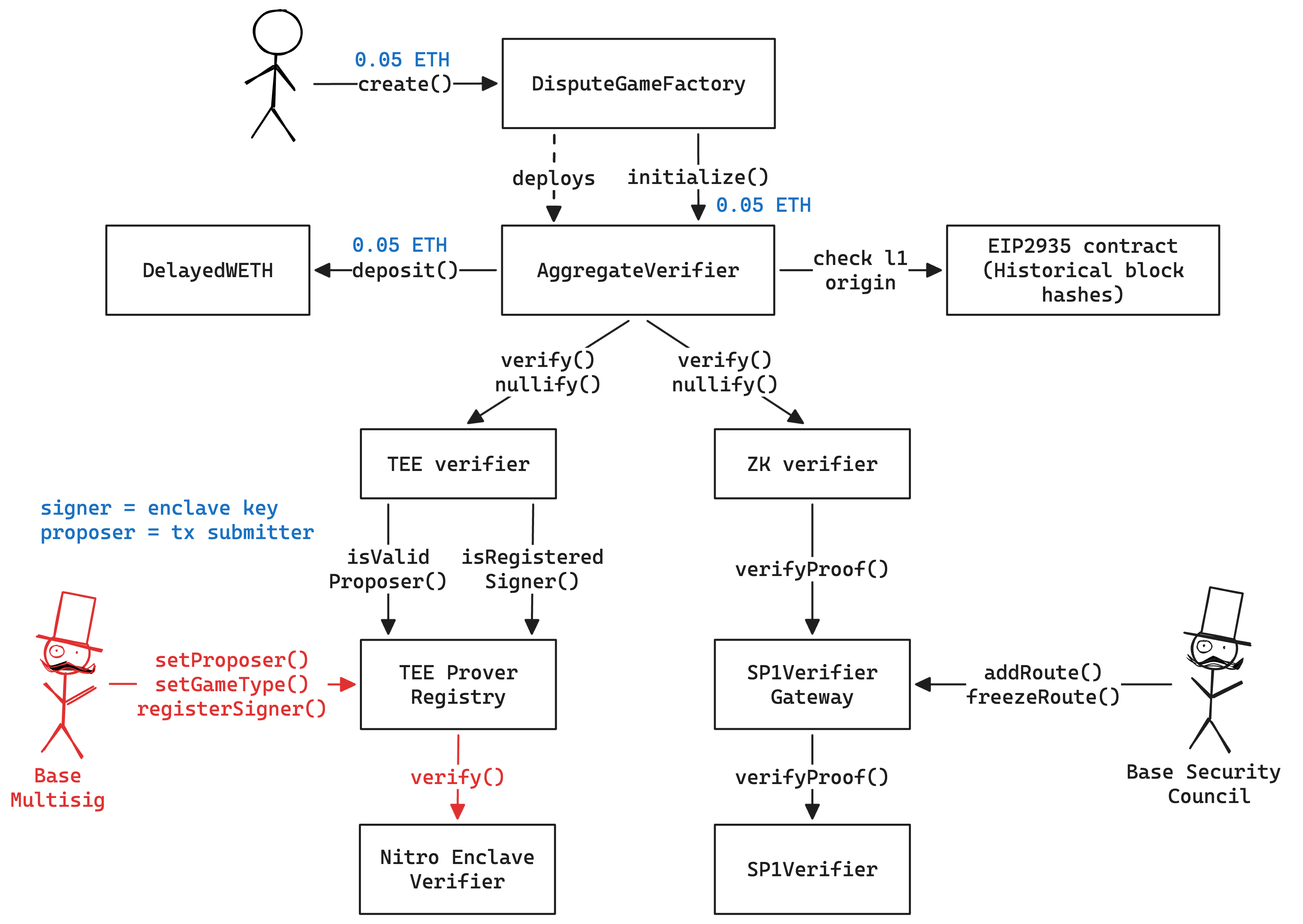
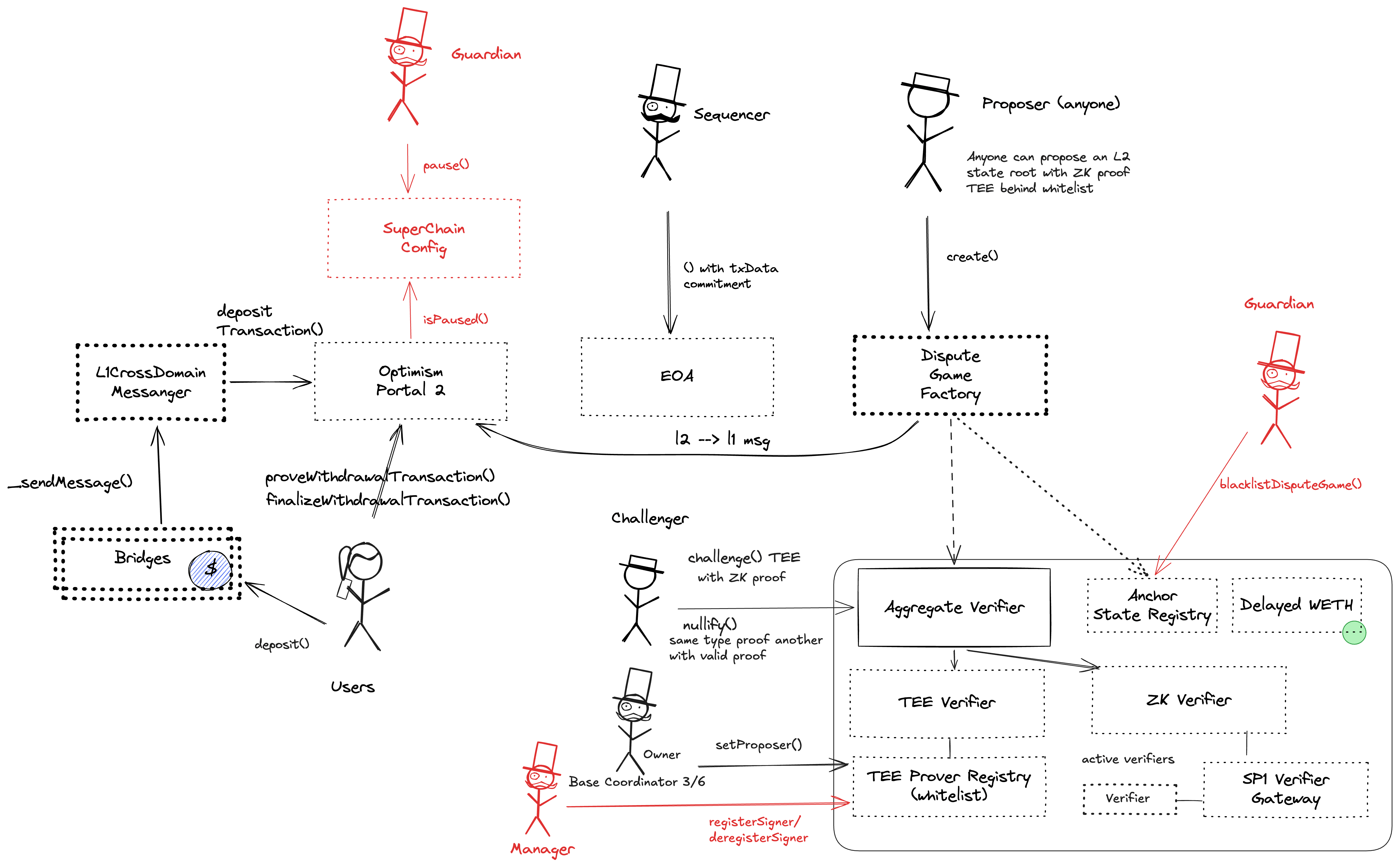
State rootsA cryptographic hash succinctly representing a state using a Merkle tree. are proposed by calling DisputeGameFactory.create with the AggregateVerifier game type, posting a bond of 0.05 ETH. Each proposal must include an initial proof (TEE attestation or ZK proof) over the range of 600 L2Layer 2 (L2) is a category of technical solutions aimed to scale the base layer in a trust minimized way. This category includes solutions like rollups as well as state channels and plasma. Other solutions are able to scale further, but with the introduction of additional trust assumptions, which are therefore not trust minimized. Sometimes the term Layer 2 is used to refer to include these solutions too, like validiums and optimiums, but to distinguish between trust minimized and non trust minimized solutions they are often referred to as "light" L2s, opposed to "strong" L2s like rollups. blocksAn ordered list of transactions and chain-related metadata that gets bundled together and published to the L1/DA layer. Nodes execute the transactions contained within blocks to change the rollup chain’s state. Protocol rules dictate what constitutes a valid block, and invalid blocks are skipped over. split into sub-ranges of 30 blocks. With a single proof, the game resolves after 5d; if both proof arms commit, the window collapses to 1d.
Any party that produces a valid ZK proof of an incorrect intermediate root can call AggregateVerifier.challenge, contradicting a TEE-only proposal. The challenger’s proof is verified onchain via the SP1 verifierAn entity in a ZK-Rollup, often a smart contract, that verifies zero-knowledge proofs submitted by a prover. gateway. If the challenge stands until the resolution window closes, the original proposerIn the context of L2s, the actor that proposes a claimed state root on L1. The term is also used in the context of Ethereum to refer to the actor that proposes a new block.’s bond is awarded to the challenger and the game resolves CHALLENGER_WINS. Soundness contradictions within a single proof arm are caught by AggregateVerifier.nullify, which permanently disables that arm’s verifier contract for all games.

Trusted Setups
Onchain verifier
Used in




Projects used in
Search for projects used in
Onchain verifier | Used in Projects used inSearch for projects used in |
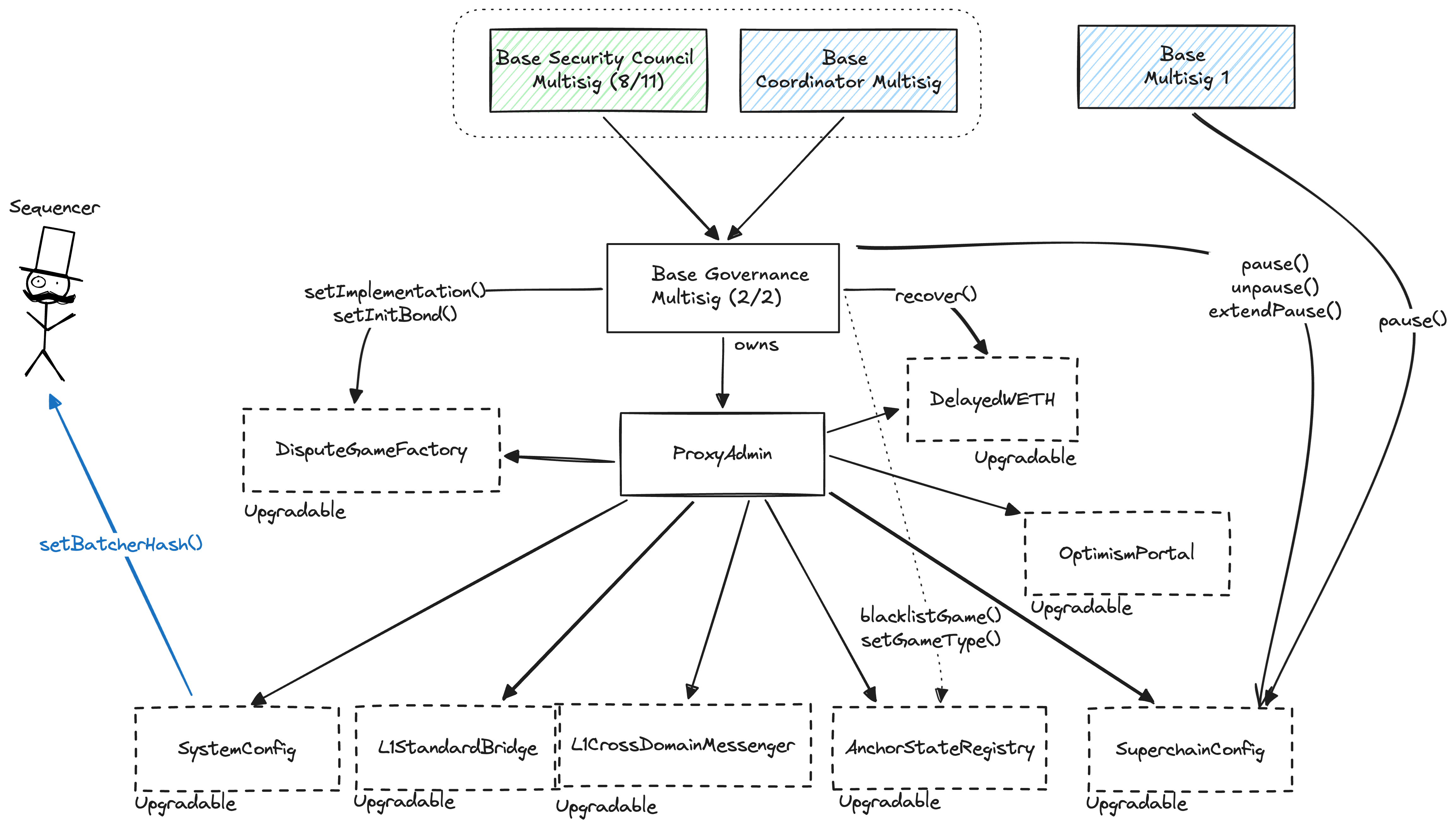
All contracts are upgradable by a ProxyAdmin contract controlled by a nested 2/2 Base Governance Multisig composed of the Base Coordinator Multisig and the Base Security Council. Upgrades require approval from both parties. There is no delay on upgrades. The Guardian role for the SuperchainConfig is assigned to the Base Governance Multisig, which can pause and unpause withdrawals. Base Multisig 1 serves as Incident Responder and can pause withdrawals but cannot unpause or extend pauses. Each pause automatically expires after 3 months if not extended by the Guardian. The single SequencerA party responsible for ordering and executing transactions on the rollup. The sequencer verifies transactions, compresses the data into a block, and submits the data related to it to enable state reconstruction to Ethereum L1 as a single transaction. The data can be either transaction data or state diffs. actor can be modified by Base Multisig 1 via the SystemConfig contract. The Base Governance multisig can also recover dispute bonds in case of bugs that would distribute them incorrectly.
State validation runs through the AggregateVerifier game type (621), which accepts either an AWS Nitro TEE attestation or an SP1 ZK proof. The TEE proverAn entity that generates the cryptographic proof to convince the verifier that the statement is true. In a ZK-Rollup, the prover generates the ZK (validity) proof to submit to the verifier contract. allowlist in the TEEProverRegistry is managed solely by the Base Coordinator Multisig (without Base Security CouncilA Security Council is a sufficiently decentralized set of members that is able to upgrade a system. A properly set up Security Council consists of at least 8 members with a threshold greater than 75%. What 'sufficiently decentralized' means is fundamentally subjective and L2BEAT evaluates each case individually. A Security Council is allowed to instantly upgrade Stage 1 rollups. approval), and a separate Manager EOA can register or deregister enclave signers. The ZK arm routes through a Base-owned SP1 verifierAn entity in a ZK-Rollup, often a smart contract, that verifies zero-knowledge proofs submitted by a prover. gateway; the Base Governance Multisig can add or freeze verifier routes. The Base Governance Multisig can swap the AggregateVerifier implementation, change the respected game type, blacklist individual games, or retire all in-flight games via the AnchorStateRegistry.
Governance profile
Security Council
| Composition | 8/11, nested as one of two signers in the 2/2 |
|---|---|
| Members public | Mapped (10 of 11) — Base publishes Aerodrome (JP), Moonwell (BR), Blackbird (US), ChainSafe (CA), Talent Protocol (PT) and Moshicam (US) as entities, plus Seneca (US), Juan Suarez (US), Toady Hawk (CA), Roberto Bayardo (US) and Yele Bademosi (UK) as individuals. One address is unpublished, as are the people who sign for each entity. Five of the six entities are Base-ecosystem projects and two of the individuals are former Coinbase or Base contributors. |
| Charter | None — the docs page sets out selection criteria, cohort terms and member duties, but no removal procedure, quorum-loss fallback or conflict-of-interest enforcement. Coinbase’s Neutrality Principles cover transaction ordering, user assets and exit rights, and do not bind the Council. |
| Can Coinbase bypass the Council? | Not for upgrades — every |
| Who can override the Council? | Nobody — it administers itself. Seats are changed by the Council Safe calling itself, so 8 of the 11 sitting members decide who joins or leaves. There is no token, DAO or veto body. The 2/2 blocksAn ordered list of transactions and chain-related metadata that gets bundled together and published to the L1/DA layer. Nodes execute the transactions contained within blocks to change the rollup chain’s state. Protocol rules dictate what constitutes a valid block, and invalid blocks are skipped over. both ways: neither side can upgrade alone. Below 8 available signers upgrades stall, and there is no livenessLiveness refers to the ability of a system to respond to requests and to process them in a timely manner. In the context of L2s, it refers to the ability of settling transactions, proofs and state roots to the base layer. module handing control to a fallback. |
Upgrades
| Normal upgrade path | Task published in base/contract-deployments → 8/11 Security CouncilA Security Council is a sufficiently decentralized set of members that is able to upgrade a system. A properly set up Security Council consists of at least 8 members with a threshold greater than 75%. What 'sufficiently decentralized' means is fundamentally subjective and L2BEAT evaluates each case individually. A Security Council is allowed to instantly upgrade Stage 1 rollups. approval → 3/6 Coordinator Multisig approval → execution through the 2/2 |
|---|---|
| Emergency upgrade path | None — the normal path executes as soon as both Safes sign, so there is no lower emergency threshold. The fastest lever is a pause: the 3/12 |
| Exit window | None — nothing separates the second signature from the upgrade taking effect, so users cannot withdraw ahead of an unwanted change. Tasks are published before signing and Base targets six hard forks a year, but neither is enforced onchain. |
Token governance
| Governance token | None — Base has no token, so no token-weighted vote enters the upgrade path. Coinbase has said it is exploring one. |
|---|---|
| Voting venue | None — no DAO, governor contract, Snapshot space or forum vote gates an upgrade. Coordination happens in base/contract-deployments. |
| Proposal rights | Coinbase only — upgrade tasks are Coinbase-authored, and no route exists for a third party to put an upgrade to the Council. |
| Execution model | Two Safes sign, a facilitator executes. No permissionlessAnyone willing should be able to join and leave the network at any time, without causing significant disturbance to the network or being detrimental to the party in question. No single entity should have the power to allowlist or blocklist participants. |
Past upgrades
The metrics include upgrades on the currently used proxy contracts. Historical proxy contracts and changes of such are not included.
Ossification
Contracts our research team classifies as critical form the project's critical perimeter. Its clock starts at the ossification genesis, and every critical change resets it (changes within 24 hours count as one). The ossification score is the share of recorded code-bug exploits whose exploited code was younger than this perimeter is today. Battle-tested exposure is the value secured, summed over that unchanged period.
Discovery updates
2026 October 09, 09:36 UTCHigh severity7changesOptimismPortal2 6.0.0 → 6.0.1: a failed withdrawal call to a 7702-delegated EOA now reverts instead of finalizing, upgraded by the Base Governance Multisig. https://disco.l2beat.com/diff/eth:0xcA5ca23502eFf4254bc11Ac0bEC4Dbb7495Bd06C/eth:0x03863Ab7F64B733cFF85C8fF44a86601C568Ca70
OptimismPortal2 6.0.0 → 6.0.1: a failed withdrawal call to a 7702-delegated EOA now reverts instead of finalizing, upgraded by the Base Governance Multisig. https://disco.l2beat.com/diff/eth:0xcA5ca23502eFf4254bc11Ac0bEC4Dbb7495Bd06C/eth:0x03863Ab7F64B733cFF85C8fF44a86601C568Ca70
| contract OptimismPortal2 (eth:0x49048044D57e1C92A77f79988d21Fa8fAF74E97e) [opstack/OptimismPortal2] { | |
| +++ description: The OptimismPortal contract is the main entry point to deposit funds from L1 to L2. It also allows to prove and finalize withdrawals. It specifies which game type can be used for withdrawals, which currently is the AggregateVerifier. | |
| sourceHashes.1: | |
| - | "0xe19e03ee1eceea55b82f2982dcbf9d11d2a194352be04181edc1b6cfe1e9dcb3" |
| + | "0xa3692169a2d67b0edeeee11f2dd643e4bebd7d1178b87d899f03ff7c580d5dc2" |
| values.$implementation: | |
| - | "eth:0xcA5ca23502eFf4254bc11Ac0bEC4Dbb7495Bd06C" |
| + | "eth:0x03863Ab7F64B733cFF85C8fF44a86601C568Ca70" |
| values.$pastUpgrades.12: | |
| + | ["2026-10-07T17:44:47.000Z","0x12b3bf5bb0a8f921321f9a91303240ce01fde9f99ba9f97234f89d114c077bf6",["eth:0x03863Ab7F64B733cFF85C8fF44a86601C568Ca70"]] |
| values.$upgradeCount: | |
| - | 12 |
| + | 13 |
| values.version: | |
| - | "6.0.0" |
| + | "6.0.1" |
| implementationNames.eth:0xcA5ca23502eFf4254bc11Ac0bEC4Dbb7495Bd06C: | |
| - | "OptimismPortal2" |
| implementationNames.eth:0x03863Ab7F64B733cFF85C8fF44a86601C568Ca70: | |
| + | "OptimismPortal2" |
| } | |
2026 October 02, 14:24 UTCCritical state change61changesBase Cobalt upgrade. Version changes and implementation diffs: - OptimismPortal2 5.2.0 - 6.0.0: https://disco.l2beat.com/diff/eth:0x66d94eE8F529b683ED6013729784e8bb44697A64/eth:0xcA5ca23502eFf4254bc11Ac0bEC4Dbb7495Bd06C - SystemConfig 3.13.2 - 3.14.0: https://disco.l2beat.com/diff/eth:0x0507Aaa21c678976FCdC7e804836ACd6ebc17a44/eth:0x56ca4f4F5Ba9B42d360B48429e8C4a60C5A0795D - DisputeGameFactory 1.4.0 - 1.5.0: https://disco.l2beat.com/diff/eth:0x468C2345D1d409d5b0F2f8bE4aE2082150cC1a0c/eth:0x94eab8f73fd83407D26C006D159923760D483029 - TEEProverRegistry 0.5.0 - 0.6.1: https://disco.l2beat.com/diff/eth:0xeaB9b34BDD26Ad451B381B0934a30fAa6ED5E316/eth:0x1d8728CabC8BC022005dd08D02a749B8a32Af440 - AggregateVerifier 0.1.0 - 0.2.0 (new game type 621 implementation): https://disco.l2beat.com/diff/eth:0xeE303bA054c5F1E14A8EF87f1C7E285af45A1ba2/eth:0xeF9eCeA15265321753047EBF7D54C858D53cB94f OptimismPortal2 and SystemConfig drop ETHLockbox support. DisputeGameFactory deploys games with CREATE2. AggregateVerifier: new TEE image hash, ZK range hash and ZK aggregation hash. Games commit to the upgrade schedule in the new ProtocolVersions contract (admin ProxyAdmin, incident responder Base Multisig 1). TEEProverRegistry: signer attestations are validated by the new NitroValidator, CertManager (owner Base Coordinator Multisig, revoker the TEEProverRegistry manager) and P384Verifier. NitroEnclaveVerifier and the RISC Zero verifier contracts with their TimelockController and Safe are removed.
Base Cobalt upgrade.
Version changes and implementation diffs:
- OptimismPortal2 5.2.0 -> 6.0.0: https://disco.l2beat.com/diff/eth:0x66d94eE8F529b683ED6013729784e8bb44697A64/eth:0xcA5ca23502eFf4254bc11Ac0bEC4Dbb7495Bd06C
- SystemConfig 3.13.2 -> 3.14.0: https://disco.l2beat.com/diff/eth:0x0507Aaa21c678976FCdC7e804836ACd6ebc17a44/eth:0x56ca4f4F5Ba9B42d360B48429e8C4a60C5A0795D
- DisputeGameFactory 1.4.0 -> 1.5.0: https://disco.l2beat.com/diff/eth:0x468C2345D1d409d5b0F2f8bE4aE2082150cC1a0c/eth:0x94eab8f73fd83407D26C006D159923760D483029
- TEEProverRegistry 0.5.0 -> 0.6.1: https://disco.l2beat.com/diff/eth:0xeaB9b34BDD26Ad451B381B0934a30fAa6ED5E316/eth:0x1d8728CabC8BC022005dd08D02a749B8a32Af440
- AggregateVerifier 0.1.0 -> 0.2.0 (new game type 621 implementation): https://disco.l2beat.com/diff/eth:0xeE303bA054c5F1E14A8EF87f1C7E285af45A1ba2/eth:0xeF9eCeA15265321753047EBF7D54C858D53cB94f
OptimismPortal2 and SystemConfig drop ETHLockbox support. DisputeGameFactory deploys games with CREATE2.
AggregateVerifier: new TEE image hash, ZK range hash and ZK aggregation hash. Games commit to the upgrade schedule in the new ProtocolVersions contract (admin ProxyAdmin, incident responder Base Multisig 1).
TEEProverRegistry: signer attestations are validated by the new NitroValidator, CertManager (owner Base Coordinator Multisig, revoker the TEEProverRegistry manager) and P384Verifier. NitroEnclaveVerifier and the RISC Zero verifier contracts with their TimelockController and Safe are removed.
| contract ProxyAdmin (eth:0x0475cBCAebd9CE8AfA5025828d5b98DFb67E059E) [global/ProxyAdmin] { | |
| +++ description: None | |
| directlyReceivedPermissions.10: | |
| + | {"permission":"upgrade","from":"eth:0x7480Afc8D99a5c645c247dB5A1e4a4f440e6e095","role":"admin"} |
| } | |
| - | Status: DELETED |
| contract TimelockController (eth:0x0b144E07A0826182B6b59788c34b32Bfa86Fb711) [global/TimelockController] | |
| +++ description: A timelock with access control. The current minimum delay is 3d. | |
| contract Base Multisig 1 (eth:0x14536667Cd30e52C0b458BaACcB9faDA7046E056) [GnosisSafe] { | |
| +++ description: None | |
| receivedPermissions.1: | |
| + | {"permission":"interact","from":"eth:0x7480Afc8D99a5c645c247dB5A1e4a4f440e6e095","description":"delay the activation of a scheduled upgrade.","role":".incidentResponder"} |
| } | |
| contract TEEProverRegistry (eth:0x1af2A7E537DE2eE795DE5B8BfbB1Ad0DD513A5aA) [base/TEEProverRegistry] { | |
| +++ description: Registry of authorized TEE enclave signers and proposer addresses. Signer registration requires a valid AWS Nitro attestation document. | |
| sourceHashes.1: | |
| - | "0x9831f0365a1629899a27a5e77f1445d6b78de4d90376053079da107921dda3a2" |
| + | "0xede8082a5b614fbd752ea8f214321a92d5c97db36aac1070675b57e45a775d5d" |
| values.$implementation: | |
| - | "eth:0xeaB9b34BDD26Ad451B381B0934a30fAa6ED5E316" |
| + | "eth:0x1d8728CabC8BC022005dd08D02a749B8a32Af440" |
| values.$pastUpgrades.1: | |
| + | ["2026-09-28T20:38:11.000Z","0x356e1dd97cb22e3d6129ec91557b1bec8971f0c2e0b4d6c1fb54e8b014dd659b",["eth:0x1d8728CabC8BC022005dd08D02a749B8a32Af440"]] |
| values.$upgradeCount: | |
| - | 1 |
| + | 2 |
| +++ description: TEE image hash (PCR0) of the AggregateVerifier registered in the DisputeGameFactory for gameType. Derived, not stored in this contract. | |
| values.getExpectedImageHash: | |
| - | "0x58557c709e93357a135041297107aecc4bc6ba616509098a4aa8dbef774d212a" |
| + | "0x45c538bc396fe4a01b3f9ddc999494c3b993480ecac0a917e2f1af230d78b0e0" |
| values.NITRO_VERIFIER: | |
| - | "eth:0x7F3a16E1fe6Fda64c5AC4296E13ECB9F7B44F6fb" |
| values.version: | |
| - | "0.5.0" |
| + | "0.6.1" |
| values.NITRO_VALIDATOR: | |
| + | "eth:0x47C1ab20fac92c789d9e5708D06641c79b03C460" |
| implementationNames.eth:0xeaB9b34BDD26Ad451B381B0934a30fAa6ED5E316: | |
| - | "TEEProverRegistry" |
| implementationNames.eth:0x1d8728CabC8BC022005dd08D02a749B8a32Af440: | |
| + | "TEEProverRegistry" |
| } | |
| - | Status: DELETED |
| contract RiscZeroVerifierEmergencyStop (eth:0x1efDd13f831ceeEa14940806705A53D3211CD698) [risc0/RiscZeroVerifierEmergencyStop] | |
| +++ description: A verifier wrapper for the eth:0xafB31f5b70623CDF4b20Ada3f7230916A5A79df9 that allows pausing (emergency stop) the verifier by its owner. | |
| - | Status: DELETED |
| contract RiscZeroGroth16Verifier (eth:0x20ff7C2Cf391a5F096A2Cc181cb41916680f8E97) [taiko/RiscZeroGroth16Verifier] | |
| +++ description: Verifier contract for RISC Zero Groth16 proofs (version 2.0.0-rc.3). | |
| - | Status: DELETED |
| contract RiscZeroGroth16Verifier (eth:0x2a098988600d87650Fb061FfAff08B97149Fa84D) [taiko/RiscZeroGroth16Verifier] | |
| +++ description: Verifier contract for RISC Zero Groth16 proofs (version 3.0.0). | |
| - | Status: DELETED |
| contract Safe (eth:0x2E5bcc9959dB5F5016F830E47943b07242CB2609) [GnosisSafe] | |
| +++ description: None | |
| contract DisputeGameFactory (eth:0x43edB88C4B80fDD2AdFF2412A7BebF9dF42cB40e) [opstack/DisputeGameFactory_v2] { | |
| +++ description: The dispute game factory allows the creation of dispute games, used to propose state roots and eventually challenge them. This variant exposes per-type reads only; the legacy array views (gameImpls[], initBonds[]) were removed in the new implementation. | |
| sourceHashes.1: | |
| - | "0x780eaf9d8daa77c3325b79e5f3467c1bd8eec57b5d7e84651bdf2d24754d6838" |
| + | "0x580049b41f9d831de51dfb5920cb1d45c4c229d3eb702b5422231a00759af5a1" |
| values.$implementation: | |
| - | "eth:0x468C2345D1d409d5b0F2f8bE4aE2082150cC1a0c" |
| + | "eth:0x94eab8f73fd83407D26C006D159923760D483029" |
| values.$pastUpgrades.6: | |
| + | ["2026-09-28T20:38:11.000Z","0x356e1dd97cb22e3d6129ec91557b1bec8971f0c2e0b4d6c1fb54e8b014dd659b",["eth:0x94eab8f73fd83407D26C006D159923760D483029"]] |
| values.$upgradeCount: | |
| - | 6 |
| + | 7 |
| +++ severity: HIGH | |
| values.game621: | |
| - | "eth:0xeE303bA054c5F1E14A8EF87f1C7E285af45A1ba2" |
| + | "eth:0xeF9eCeA15265321753047EBF7D54C858D53cB94f" |
| values.version: | |
| - | "1.4.0" |
| + | "1.5.0" |
| implementationNames.eth:0x468C2345D1d409d5b0F2f8bE4aE2082150cC1a0c: | |
| - | "DisputeGameFactory" |
| implementationNames.eth:0x94eab8f73fd83407D26C006D159923760D483029: | |
| + | "DisputeGameFactory" |
| } | |
| - | Status: DELETED |
| contract RiscZeroVerifierEmergencyStop (eth:0x44c220f0598345195cE99AD6A57aDfFcb9Ea33e7) [risc0/RiscZeroVerifierEmergencyStop] | |
| +++ description: A verifier wrapper for the eth:0xf70aBAb028Eb6F4100A24B203E113D94E87DE93C that allows pausing (emergency stop) the verifier by its owner. | |
| contract OptimismPortal2 (eth:0x49048044D57e1C92A77f79988d21Fa8fAF74E97e) [opstack/OptimismPortal2] { | |
| +++ description: The OptimismPortal contract is the main entry point to deposit funds from L1 to L2. It also allows to prove and finalize withdrawals. It specifies which game type can be used for withdrawals, which currently is the AggregateVerifier. | |
| sourceHashes.1: | |
| - | "0x247eac30dea3a06b4a7142ac53d0b9ad882952c87406f165ec8721b0d97bd6da" |
| + | "0xe19e03ee1eceea55b82f2982dcbf9d11d2a194352be04181edc1b6cfe1e9dcb3" |
| values.$implementation: | |
| - | "eth:0x66d94eE8F529b683ED6013729784e8bb44697A64" |
| + | "eth:0xcA5ca23502eFf4254bc11Ac0bEC4Dbb7495Bd06C" |
| values.$pastUpgrades.11: | |
| + | ["2026-09-28T20:38:11.000Z","0x356e1dd97cb22e3d6129ec91557b1bec8971f0c2e0b4d6c1fb54e8b014dd659b",["eth:0xcA5ca23502eFf4254bc11Ac0bEC4Dbb7495Bd06C"]] |
| values.$upgradeCount: | |
| - | 11 |
| + | 12 |
| +++ severity: HIGH | |
| values.ethLockbox: | |
| - | "eth:0x0000000000000000000000000000000000000000" |
| values.version: | |
| - | "5.2.0" |
| + | "6.0.0" |
| implementationNames.eth:0x66d94eE8F529b683ED6013729784e8bb44697A64: | |
| - | "OptimismPortal2" |
| implementationNames.eth:0xcA5ca23502eFf4254bc11Ac0bEC4Dbb7495Bd06C: | |
| + | "OptimismPortal2" |
| } | |
| - | Status: DELETED |
| contract RiscZeroSetVerifier (eth:0x5005aBa3DFf7C940fcc1e48DccCAD611a80eEB85) [risc0/RiscZeroSetVerifier] | |
| +++ description: Set verifier contract for RISC Zero proofs (version 0.9.0). It allows verifying a whole set of proofs identified with a Merkle root at once, afterwards each individual proof could be efficiently verified just by checking Merkle inclusion against the verified root. | |
| - | Status: DELETED |
| contract RiscZeroGroth16Verifier (eth:0x54aCE3ED46529B4d4F3770C8Bad5dDC48717B9bF) [taiko/RiscZeroGroth16Verifier] | |
| +++ description: Verifier contract for RISC Zero Groth16 proofs (version 2.0.3). | |
| - | Status: DELETED |
| contract RiscZeroVerifierEmergencyStop (eth:0x68dC2cB4e61774873971c499D9b239ec5Ac540E3) [risc0/RiscZeroVerifierEmergencyStop] | |
| +++ description: A verifier wrapper for the eth:0x20ff7C2Cf391a5F096A2Cc181cb41916680f8E97 that allows pausing (emergency stop) the verifier by its owner. | |
| contract SystemConfig (eth:0x73a79Fab69143498Ed3712e519A88a918e1f4072) [opstack/SystemConfig] { | |
| +++ description: Contains configuration parameters such as the Sequencer address, gas limit on this chain and the unsafe block signer address. | |
| sourceHashes.1: | |
| - | "0x05f19560cc64e41a40dcb3e2efd7011156ab03192fcc0bfadffccd4019c99e8e" |
| + | "0x8ee185d15557b411e4a37287ec10583b4c685af295ff63b63c09edf12c6dbe9a" |
| values.$implementation: | |
| - | "eth:0x0507Aaa21c678976FCdC7e804836ACd6ebc17a44" |
| + | "eth:0x56ca4f4F5Ba9B42d360B48429e8C4a60C5A0795D" |
| values.$pastUpgrades.15: | |
| + | ["2026-09-28T20:38:11.000Z","0x356e1dd97cb22e3d6129ec91557b1bec8971f0c2e0b4d6c1fb54e8b014dd659b",["eth:0x56ca4f4F5Ba9B42d360B48429e8C4a60C5A0795D"]] |
| values.$upgradeCount: | |
| - | 15 |
| + | 16 |
| values.version: | |
| - | "3.13.2" |
| + | "3.14.0" |
| implementationNames.eth:0x0507Aaa21c678976FCdC7e804836ACd6ebc17a44: | |
| - | "SystemConfig" |
| implementationNames.eth:0x56ca4f4F5Ba9B42d360B48429e8C4a60C5A0795D: | |
| + | "SystemConfig" |
| } | |
| contract Base Governance Multisig (eth:0x7bB41C3008B3f03FE483B28b8DB90e19Cf07595c) [GnosisSafe] { | |
| +++ description: None | |
| receivedPermissions.1: | |
| + | {"permission":"interact","from":"eth:0x7480Afc8D99a5c645c247dB5A1e4a4f440e6e095","description":"register upgrades, set their activation timestamps and the minimum protocol version, and appoint the incident responder.","role":".proxyAdminOwner"} |
| receivedPermissions.14: | |
| + | {"permission":"upgrade","from":"eth:0x7480Afc8D99a5c645c247dB5A1e4a4f440e6e095","role":"admin","via":[{"address":"eth:0x0475cBCAebd9CE8AfA5025828d5b98DFb67E059E"}]} |
| } | |
| - | Status: DELETED |
| contract NitroEnclaveVerifier (eth:0x7F3a16E1fe6Fda64c5AC4296E13ECB9F7B44F6fb) [base/NitroEnclaveVerifier] | |
| +++ description: ZK-based verifier of AWS Nitro Enclave attestation documents. Used by TEEProverRegistry to validate new enclave signer registrations against the AWS Nitro PKI. | |
| - | Status: DELETED |
| contract RiscZeroVerifierEmergencyStop (eth:0x844D5f01161E3559d36f23d0Aa9E9620949aF782) [risc0/RiscZeroVerifierEmergencyStop] | |
| +++ description: A verifier wrapper for the eth:0x5005aBa3DFf7C940fcc1e48DccCAD611a80eEB85 that allows pausing (emergency stop) the verifier by its owner. | |
| - | Status: DELETED |
| contract RiscZeroVerifierRouter (eth:0x8EaB2D97Dfce405A1692a21b3ff3A172d593D319) [risc0/RiscZeroVerifierRouter] | |
| +++ description: A router proxy that routes to verifiers based on selectors. The mapping can be changed by a permissioned owner (eth:0x0b144E07A0826182B6b59788c34b32Bfa86Fb711). | |
| contract Base Coordinator Multisig (eth:0x9855054731540A48b28990B63DcF4f33d8AE46A1) [GnosisSafe] { | |
| +++ description: None | |
| receivedPermissions.1: | |
| + | {"permission":"interact","from":"eth:0x7227d8C477CD0A9EC1446A19b1FCf940Ba3Fba17","description":"revoke the root certificate, unrevoke certificates and set the revoker.","role":".owner"} |
| } | |
| - | Status: DELETED |
| contract RiscZeroVerifierEmergencyStop (eth:0x9F9994Eb4Cb5200198FEfb470f8b50301662e696) [risc0/RiscZeroVerifierEmergencyStop] | |
| +++ description: A verifier wrapper for the eth:0x2a098988600d87650Fb061FfAff08B97149Fa84D that allows pausing (emergency stop) the verifier by its owner. | |
| - | Status: DELETED |
| contract RiscZeroGroth16Verifier (eth:0xafB31f5b70623CDF4b20Ada3f7230916A5A79df9) [taiko/RiscZeroGroth16Verifier] | |
| +++ description: Verifier contract for RISC Zero Groth16 proofs (version 2.2.0). | |
| EOA (eth:0xd87488Dbb5b6F47cc6c15Dd95Bb60c83D3031b04) { | |
| +++ description: None | |
| receivedPermissions.1: | |
| + | {"permission":"interact","from":"eth:0x7227d8C477CD0A9EC1446A19b1FCf940Ba3Fba17","description":"revoke non-root certificates.","role":".revoker"} |
| } | |
| - | Status: DELETED |
| contract RiscZeroVerifierEmergencyStop (eth:0xDa8f3de6fBBdb261Ac771B813a578A7aBdA6B2b1) [risc0/RiscZeroVerifierEmergencyStop] | |
| +++ description: A verifier wrapper for the eth:0x54aCE3ED46529B4d4F3770C8Bad5dDC48717B9bF that allows pausing (emergency stop) the verifier by its owner. | |
| - | Status: DELETED |
| contract AggregateVerifier (eth:0xeE303bA054c5F1E14A8EF87f1C7E285af45A1ba2) [opstack/AggregateVerifier] | |
| +++ description: Game type implementation that combines a TEE attestation arm and a ZK proof arm. A single un-nullified proof of either type can resolve a game (PROOF_THRESHOLD = 1). When both arms commit, the finalization window collapses from SLOW_FINALIZATION_DELAY (5d) to FAST_FINALIZATION_DELAY (1d). | |
| - | Status: DELETED |
| contract RiscZeroGroth16Verifier (eth:0xf70aBAb028Eb6F4100A24B203E113D94E87DE93C) [taiko/RiscZeroGroth16VerifierLegacy] | |
| +++ description: Verifier contract for RISC Zero Groth16 proofs. This older implementation exposes control-root and selector constants but does not expose a VERSION getter. | |
| + | Status: CREATED |
| contract NitroValidator (eth:0x47C1ab20fac92c789d9e5708D06641c79b03C460) [base/NitroValidator] | |
| +++ description: Onchain validator of AWS Nitro Enclave attestation documents. | |
| + | Status: CREATED |
| contract CertManager (eth:0x7227d8C477CD0A9EC1446A19b1FCf940Ba3Fba17) [base/CertManager] | |
| +++ description: Verifies and caches AWS Nitro certificate chains against a pinned root certificate. | |
| + | Status: CREATED |
| contract ProtocolVersions (eth:0x7480Afc8D99a5c645c247dB5A1e4a4f440e6e095) [base/ProtocolVersions] | |
| +++ description: Registry of L2 upgrade activation timestamps. Dispute games commit to the upgrades active at their ending L2 block and proofs must match that commitment. | |
| + | Status: CREATED |
| contract P384Verifier (eth:0xe0aa6868e14300355001130C6DC29f2f4467D86c) [base/P384Verifier] | |
| +++ description: Stateless verifier of P-384 ECDSA signatures. | |
| + | Status: CREATED |
| contract AggregateVerifier (eth:0xeF9eCeA15265321753047EBF7D54C858D53cB94f) [opstack/AggregateVerifier] | |
| +++ description: Game type implementation that combines a TEE attestation arm and a ZK proof arm. A single un-nullified proof of either type can resolve a game (PROOF_THRESHOLD = 1). When both arms commit, the finalization window collapses from SLOW_FINALIZATION_DELAY (5d) to FAST_FINALIZATION_DELAY (1d). | |
2026 July 28, 08:08 UTC1changeRefresh config-derived discovery metadata at the main-branch block.
Refresh config-derived discovery metadata at the main-branch block.
New and verified contracts
| + | Status: CREATED |
| contract DelayedWETH (eth:0x2453c1216E49704d84eA98a4daCd95738F2fC8Ec) [opstack/DelayedWETH] | |
| +++ description: Contract designed to hold the bonded ETH for each game. It is designed as a wrapper around WETH to allow an owner to function as a backstop if a game would incorrectly distribute funds. | |
2026 July 28, 08:08 UTCCritical state change8changesRedeployed aggregate verifier with different range and aggregation prog hashes and no code changes: https://disco.l2beat.com/diff/eth:0x1bd8db5139Ba7aC9277684650c15e6E341761919/eth:0xeE303bA054c5F1E14A8EF87f1C7E285af45A1ba2. Both programs are regenreated from sources. Disabled Groth16 SP1 verifier and enabled Plonk v6.1.0 SP1 verifier. It is an already known contract, regenerated from sources.
Redeployed aggregate verifier with different range and aggregation prog hashes and no code changes: https://disco.l2beat.com/diff/eth:0x1bd8db5139Ba7aC9277684650c15e6E341761919/eth:0xeE303bA054c5F1E14A8EF87f1C7E285af45A1ba2. Both programs are regenreated from sources.
Disabled Groth16 SP1 verifier and enabled Plonk v6.1.0 SP1 verifier. It is an already known contract, regenerated from sources.
| - | Status: DELETED |
| contract AggregateVerifier (eth:0x1bd8db5139Ba7aC9277684650c15e6E341761919) [opstack/AggregateVerifier] | |
| +++ description: Game type implementation that combines a TEE attestation arm and a ZK proof arm. A single un-nullified proof of either type can resolve a game (PROOF_THRESHOLD = 1). When both arms commit, the finalization window collapses from SLOW_FINALIZATION_DELAY (5d) to FAST_FINALIZATION_DELAY (1d). | |
| contract DisputeGameFactory (eth:0x43edB88C4B80fDD2AdFF2412A7BebF9dF42cB40e) [opstack/DisputeGameFactory_v2] { | |
| +++ description: The dispute game factory allows the creation of dispute games, used to propose state roots and eventually challenge them. This variant exposes per-type reads only; the legacy array views (gameImpls[], initBonds[]) were removed in the new implementation. | |
| +++ severity: HIGH | |
| values.game621: | |
| - | "eth:0x1bd8db5139Ba7aC9277684650c15e6E341761919" |
| + | "eth:0xeE303bA054c5F1E14A8EF87f1C7E285af45A1ba2" |
| } | |
| - | Status: DELETED |
| contract SP1Verifier (eth:0xb69f2584CBcFf99a58C4e7002E8b89Af54a6f4e2) [succinct/SP1Verifier] | |
| +++ description: Verifier contract for SP1 proofs (v6.1.0). | |
| contract SP1VerifierGateway (eth:0xdc32E228636273285Befa5F001dBB5142517C106) [succinct/SP1VerifierGateway] { | |
| +++ description: This contract is the router for zk proof verification. It stores the mapping between identifiers and the address of onchain verifier contracts, routing each identifier to the corresponding verifier contract. | |
| values.activeVerifiers.0.verifier: | |
| - | "eth:0xb69f2584CBcFf99a58C4e7002E8b89Af54a6f4e2" |
| + | "eth:0xc3c6dDDAc8829b233Dc6536Ec024775a57b0AF2A" |
| values.activeVerifiers.0.selector: | |
| - | "0x4388a21c" |
| + | "0x5a093a2f" |
| +++ description: All verifiers that were ever routed to by this gateway. | |
| values.allVerifiers.1: | |
| + | {"selector":"0x5a093a2f","verifier":"eth:0xc3c6dDDAc8829b233Dc6536Ec024775a57b0AF2A"} |
| } | |
| + | Status: CREATED |
| contract SP1Verifier (eth:0xc3c6dDDAc8829b233Dc6536Ec024775a57b0AF2A) [shared-sp1/SP1Verifier] | |
| +++ description: None | |
| + | Status: CREATED |
| contract AggregateVerifier (eth:0xeE303bA054c5F1E14A8EF87f1C7E285af45A1ba2) [opstack/AggregateVerifier] | |
| +++ description: Game type implementation that combines a TEE attestation arm and a ZK proof arm. A single un-nullified proof of either type can resolve a game (PROOF_THRESHOLD = 1). When both arms commit, the finalization window collapses from SLOW_FINALIZATION_DELAY (5d) to FAST_FINALIZATION_DELAY (1d). | |
2026 July 21, 15:38 UTC2changesTEEProverRegistry: both registered enclave signers rotated.
TEEProverRegistry: both registered enclave signers rotated.
| contract TEEProverRegistry (eth:0x1af2A7E537DE2eE795DE5B8BfbB1Ad0DD513A5aA) [base/TEEProverRegistry] { | |
| +++ description: Registry of authorized TEE enclave signers and proposer addresses used by the TEEVerifier. Owner can add or remove allowlisted proposers via setProposer (onlyOwner) and set the AggregateVerifier game type lookup. Owner and Manager can register or deregister enclave signers via registerSigner / deregisterSigner. Registration requires a Risc0 ZK proof of a valid AWS Nitro attestation document verified by the NITRO_VERIFIER. | |
| +++ severity: LOW | |
| values.getRegisteredSigners.0: | |
| - | "eth:0x3354226FDDD041367AE68F7245Cd5166e11013f3" |
| + | "eth:0x9a73d6848BBe8562CBb6BF1c92B33610B80a98cC" |
| +++ severity: LOW | |
| values.getRegisteredSigners.1: | |
| - | "eth:0xE32f95a9c06159c3cB3DC39f7573215ddAB86E59" |
| + | "eth:0xd7D60ED09A8069DedA10d721bDF2F04F0F80F69d" |
| } | |
Users can force any transaction
Because the state of the system is based on transactions submitted on the underlying host chain and anyone can submit their transactions there it allows the users to circumvent censorship by interacting with the smart contract on the host chain directly.
Transactions are ordered by a centralized sequencer
Base uses a single centralized sequencerA party responsible for ordering and executing transactions on the rollup. The sequencer verifies transactions, compresses the data into a block, and submits the data related to it to enable state reconstruction to Ethereum L1 as a single transaction. The data can be either transaction data or state diffs. for fast confirmations. Users can bypass it with one Ethereum transaction to the OptimismPortal. Base nodes derive the deposited transaction from Ethereum, including it after at most one sequencing window.
| Centralized sequencing spec sheet | |
|---|---|
| Trusted preconfirmation | 2 s L2 block time |
| Trusted ordering | Fee order per Flashblock |
| Sequencer | 5-instance Raft HA |
| Real-time censorship resistance | |
| Forced inclusion | 1 L1 tx: portal deposit |
| Inclusion delay | 3,600 L1 blocks |
| Inclusion mechanics | Address alias |
| Exit delay | 12h inclusion + 20m + 5d state |
| Exit economics | ZK proof required |
Censorship resistance
The centralized sequencerA party responsible for ordering and executing transactions on the rollup. The sequencer verifies transactions, compresses the data into a block, and submits the data related to it to enable state reconstruction to Ethereum L1 as a single transaction. The data can be either transaction data or state diffs. provides no real-time censorship resistance. The Ethereum deposit path provides eventual censorship resistance, assuming the deposit is included on Ethereum.
Forced messaging
If the user experiences censorship from the operatorAn operator is the entity charged with managing a rollup and progressing its state. A rollup operator can be a centralized sequencer, proposer, prover, challenger, pauser of admin that is able to perform upgrades. with regular L2Layer 2 (L2) is a category of technical solutions aimed to scale the base layer in a trust minimized way. This category includes solutions like rollups as well as state channels and plasma. Other solutions are able to scale further, but with the introduction of additional trust assumptions, which are therefore not trust minimized. Sometimes the term Layer 2 is used to refer to include these solutions too, like validiums and optimiums, but to distinguish between trust minimized and non trust minimized solutions they are often referred to as "light" L2s, opposed to "strong" L2s like rollups.->L1Layer 1 (L1) is a blockchain that is self-reliant on its validator set for its security and consensus properties. Ethereum is an example of a layer 1. Blockchains started receiving the moniker of layer 1 once layer 2 became a meaningful area of development. messaging they can submit their messages directly on L1. The system is then obliged to service this request or halt all messages, including forced withdrawals from L1 and regular messages initiated on L2. Once the force operation is submitted and if the request is serviced, the operation follows the flow of a regular message.
EVM compatible smart contracts are supported
OP stack chains are pursuing the EVM EquivalenceA perfect degree of compatibility; where one system or concept is indistinguishable from another in the domain being compared. In the context of rollups, it generally refers to the proximity to the EVM and to Ethereum architecture. model. No changes to smart contracts are required regardless of the language they are written in, i.e. anything deployed on L1Layer 1 (L1) is a blockchain that is self-reliant on its validator set for its security and consensus properties. Ethereum is an example of a layer 1. Blockchains started receiving the moniker of layer 1 once layer 2 became a meaningful area of development. can be deployed on L2Layer 2 (L2) is a category of technical solutions aimed to scale the base layer in a trust minimized way. This category includes solutions like rollups as well as state channels and plasma. Other solutions are able to scale further, but with the introduction of additional trust assumptions, which are therefore not trust minimized. Sometimes the term Layer 2 is used to refer to include these solutions too, like validiums and optimiums, but to distinguish between trust minimized and non trust minimized solutions they are often referred to as "light" L2s, opposed to "strong" L2s like rollups..
Ethereum
Actors:
A Multisig with 2/2 threshold.
- Can upgrade with no delay
- L2CrossDomainMessenger ProxyAdmin
- L2StandardBridge ProxyAdmin
- SequencerFeeVault ProxyAdmin
- OptimismMintableERC20Factory ProxyAdmin
- L1BlockNumber ProxyAdmin
- L2ERC721Bridge ProxyAdmin
- L1Block ProxyAdmin
- L2ToL1MessagePasser ProxyAdmin
- OptimismMintableERC721Factory ProxyAdmin
- ProxyAdmin ProxyAdmin
- BaseFeeVault ProxyAdmin
- L1FeeVault ProxyAdmin
- SchemaRegistry ProxyAdmin
- EAS ProxyAdmin
- OptimismMintableERC20Factory ProxyAdmin
- TEEProverRegistry ProxyAdmin
- DelayedWETH ProxyAdmin
- L1StandardBridge ProxyAdmin
- DisputeGameFactory ProxyAdmin
- OptimismPortal2 ProxyAdmin
- L1ERC721Bridge ProxyAdmin
- DelayedWETH ProxyAdmin
- SystemConfig ProxyAdmin
- ProtocolVersions ProxyAdmin
- L1CrossDomainMessenger ProxyAdmin
- AnchorStateRegistry ProxyAdmin
- SuperchainConfig ProxyAdmin
- DelayedWETH ProxyAdmin
- Can interact with DisputeGameFactory
- set the dispute game implementation and initial bond for any game type
- Can interact with ProtocolVersions
- register upgrades, set their activation timestamps and the minimum protocol version, and appoint the incident responder
- Can interact with AddressManager
- set and change address mappings ProxyAdmin
- Can interact with SuperchainConfig
- Allowed to pause withdrawals. In op stack systems with a proof systemThe infrastructure that allows projects to verify their state transitions. It is composed by onchain verifiers and offchain provers. The main two flavors are optimistic and ZK proof systems, but they can be combined in a hybrid model. In general though, if a system is able to accept state roots optimistically, even if it has a ZK component, it is considered an optimistic proof system., the Guardian can also blacklist dispute games and set the respected game type (permissioned / permissionlessAnyone willing should be able to join and leave the network at any time, without causing significant disturbance to the network or being detrimental to the party in question. No single entity should have the power to allowlist or blocklist participants.)
- Can interact with SP1VerifierGateway
- affect the livenessLiveness refers to the ability of a system to respond to requests and to process them in a timely manner. In the context of L2s, it refers to the ability of settling transactions, proofs and state roots to the base layer. and safety of the gateway - can transfer ownership, add and freeze verifierAn entity in a ZK-Rollup, often a smart contract, that verifies zero-knowledge proofs submitted by a prover. routes
A Multisig with 3/12 threshold.
- Can interact with SystemConfig
- it can update the preconfer address, the batch submitter (SequencerA party responsible for ordering and executing transactions on the rollup. The sequencer verifies transactions, compresses the data into a block, and submits the data related to it to enable state reconstruction to Ethereum L1 as a single transaction. The data can be either transaction data or state diffs.) address and the gasA virtual fuel used to execute smart contracts on a rollup. The EVM (or other VM within the rollup) uses an accounting mechanism to correspond the consumption of gas to the consumption of computing resources, and to limit the consumption of computing resources. configuration of the system
- Can interact with ProtocolVersions
- delay the activation of a scheduled upgrade
- Can interact with SuperchainConfig
- can pause for up to 3mo 1d, but cannot unpause or extend pauses
A Multisig with 3/6 threshold. Member of Base Governance Multisig.
- Can interact with TEEProverRegistry
- add or remove allowlisted proposers, set the game type, and register or deregister TEE enclave signers
- Can interact with CertManager
- revoke the root certificate, unrevoke certificates and set the revoker
A Multisig with 8/11 threshold. Member of Base Governance Multisig.
- Can interact with SystemConfig
- Allowed to commit transactions from the current layer to the host chain
- Can interact with TEEProverRegistry
- register and deregister TEE enclave signers and transfer the manager role
- Can interact with CertManager
- revoke non-root certificates
Base Chain
Actors:
- Can upgrade with no delay
- FeeDisburser
Ethereum
The dispute game factory allows the creation of dispute games, used to propose state rootsA cryptographic hash succinctly representing a state using a Merkle tree. and eventually challenge them. This variant exposes per-type reads only; the legacy array views (gameImpls[], initBonds[]) were removed in the new implementation.
- Roles:
- admin: ProxyAdmin; ultimately Base Governance Multisig
- owner: Base Governance Multisig
The OptimismPortal contract is the main entry point to deposit funds from L1Layer 1 (L1) is a blockchain that is self-reliant on its validator set for its security and consensus properties. Ethereum is an example of a layer 1. Blockchains started receiving the moniker of layer 1 once layer 2 became a meaningful area of development. to L2Layer 2 (L2) is a category of technical solutions aimed to scale the base layer in a trust minimized way. This category includes solutions like rollups as well as state channels and plasma. Other solutions are able to scale further, but with the introduction of additional trust assumptions, which are therefore not trust minimized. Sometimes the term Layer 2 is used to refer to include these solutions too, like validiums and optimiums, but to distinguish between trust minimized and non trust minimized solutions they are often referred to as "light" L2s, opposed to "strong" L2s like rollups.. It also allows to prove and finalize withdrawals. It specifies which game type can be used for withdrawals, which currently is the AggregateVerifier.
- Roles:
- admin: ProxyAdmin; ultimately Base Governance Multisig

Contains configuration parameters such as the SequencerA party responsible for ordering and executing transactions on the rollup. The sequencer verifies transactions, compresses the data into a block, and submits the data related to it to enable state reconstruction to Ethereum L1 as a single transaction. The data can be either transaction data or state diffs. address, gas limitThe maximum amount of gas a transaction or block may consume. on this chain and the unsafe blockAn ordered list of transactions and chain-related metadata that gets bundled together and published to the L1/DA layer. Nodes execute the transactions contained within blocks to change the rollup chain’s state. Protocol rules dictate what constitutes a valid block, and invalid blocks are skipped over. signer address.
- Roles:
- admin: ProxyAdmin; ultimately Base Governance Multisig
- batcherHash: EOA 1
- owner: Base Multisig 1
Base’s own SuperchainConfig, used to manage pause states for the Base chain. The guardian and incident responder roles are immutable and set at construction time. Each pause automatically expires after 3mo 1d.
- Roles:
- admin: ProxyAdmin; ultimately Base Governance Multisig
- guardian: Base Governance Multisig
- incident_responder: Base Multisig 1
The main entry point to deposit ERC20 tokens from host chain to this chain.
- Roles:
- admin: ProxyAdmin; ultimately Base Governance Multisig
All supported tokens in this escrow are included in the value secured calculation.
Used to bridgeA message-passing protocol between two blockchains. At its most basic, a token bridge consists of a smart contract which can escrow funds on one side of the bridge, and instruct the release or minting of corresponding assets on the other side, but bridges could also support arbitrary messages. How these instructions are validated is a critical factor in assessing the trust assumptions of a bridge. ERC-721 tokens from host chain to this chain.
- Roles:
- admin: ProxyAdmin; ultimately Base Governance Multisig
Sends messages from host chain to this chain, and relays messages back onto host chain. In the event that a message sent from host chain to this chain is rejected for exceeding this chain’s epoch gas limitThe maximum amount of gas a transaction or block may consume., it can be resubmitted via this contract’s replay function.
- Roles:
- admin: ProxyAdmin; ultimately Base Governance Multisig
EIP-2935 system contract storing the last 8191 L1Layer 1 (L1) is a blockchain that is self-reliant on its validator set for its security and consensus properties. Ethereum is an example of a layer 1. Blockchains started receiving the moniker of layer 1 once layer 2 became a meaningful area of development. blockhashes. BytecodeGenerally, an instruction set designed for efficient execution by a software interpreter or a virtual machine. Unlike human-readable source code, bytecode is expressed numerically. Within the context of rollups, often related to the concept of compatibility: whether the bytecode of programs on the rollup are capable of being run as-is on Ethereum as well, and vice versa. is canonical to the EIP, deployed at the same address across networks.
- Roles:
- owner: Base Governance Multisig
A helper contract that generates OptimismMintableERC20 contracts on the networkA constellation of nodes (peers) that communicate via a peer-to-peer protocol, for example, in propagating transactions and blocks to other nodes. it’s deployed to. OptimismMintableERC20 is a standard extension of the base ERC20 token contract designed to allow the L1StandardBridge contracts to mint and burn tokens. This makes it possible to use an OptimismMintableERC20 as this chain’s representation of a token on the host chain, or vice-versa.
- Roles:
- admin: ProxyAdmin; ultimately Base Governance Multisig
Registry of authorized TEE enclave signers and proposerIn the context of L2s, the actor that proposes a claimed state root on L1. The term is also used in the context of Ethereum to refer to the actor that proposes a new block. addresses. Signer registration requires a valid AWS Nitro attestation document.
- Roles:
- admin: ProxyAdmin; ultimately Base Governance Multisig
- manager: EOA 3
- owner: Base Coordinator Multisig
The PreimageOracle contract is used to load the required data from L1Layer 1 (L1) is a blockchain that is self-reliant on its validator set for its security and consensus properties. Ethereum is an example of a layer 1. Blockchains started receiving the moniker of layer 1 once layer 2 became a meaningful area of development. for a dispute game.
Stateless verifierAn entity in a ZK-Rollup, often a smart contract, that verifies zero-knowledge proofs submitted by a prover. of TEE proofs. Recovers an ECDSA signature over the journal and checks that the signer is registered in the TEEProverRegistry with the expected enclave image hashA fixed-length fingerprint of variable-size input, produced by a hash function.. Can be permanently nullified.
Contract designed to hold the bonded ETH for each game. It is designed as a wrapper around WETH to allow an owner to function as a backstop if a game would incorrectly distribute funds.
- Roles:
- admin: ProxyAdmin; ultimately Base Governance Multisig
Onchain validatorIn the context of L2s, a Validator is an actor that validates the correctness of state transitions. For optimistic rollups this corresponds to challengers, and for ZK rollups this corresponds to the onchain verifier of AWS Nitro Enclave attestation documents.
Same as FaultDisputeGame, but only two permissioned addresses are designated as proposerIn the context of L2s, the actor that proposes a claimed state root on L1. The term is also used in the context of Ethereum to refer to the actor that proposes a new block. and challenger.
The MIPS contract is used to execute the final step of the dispute game which objectively determines the winner of the dispute.
Contract designed to hold the bonded ETH for each game. It is designed as a wrapper around WETH to allow an owner to function as a backstop if a game would incorrectly distribute funds.
- Roles:
- admin: ProxyAdmin; ultimately Base Governance Multisig
Logic of the dispute game. When a state rootA cryptographic hash succinctly representing a state using a Merkle tree. is proposed, a dispute game contract is deployed. Challengers can use such contracts to challenge the proposed state root.
Verifies and caches AWS Nitro certificate chains against a pinned root certificate.
- Roles:
- owner: Base Coordinator Multisig
- revoker: EOA 3
Registry of L2Layer 2 (L2) is a category of technical solutions aimed to scale the base layer in a trust minimized way. This category includes solutions like rollups as well as state channels and plasma. Other solutions are able to scale further, but with the introduction of additional trust assumptions, which are therefore not trust minimized. Sometimes the term Layer 2 is used to refer to include these solutions too, like validiums and optimiums, but to distinguish between trust minimized and non trust minimized solutions they are often referred to as "light" L2s, opposed to "strong" L2s like rollups. upgrade activation timestamps. Dispute games commit to the upgrades active at their ending L2 blockAn ordered list of transactions and chain-related metadata that gets bundled together and published to the L1/DA layer. Nodes execute the transactions contained within blocks to change the rollup chain’s state. Protocol rules dictate what constitutes a valid block, and invalid blocks are skipped over. and proofs must match that commitment.
- Roles:
- admin: ProxyAdmin; ultimately Base Governance Multisig
- incidentResponder: Base Multisig 1
- proxyAdminOwner: Base Governance Multisig
Simple escrow that accepts tokens and allows to configure permissioned addresses that can access the tokens.
Contains the latest confirmed state rootA cryptographic hash succinctly representing a state using a Merkle tree. that can be used as a starting point in a dispute game. This variant stores respectedGameType, retirementTimestamp, and disputeGameFinalityDelaySeconds locally and drops the legacy *FromGame fields, since the AggregateVerifier model does not expose vm()/weth()/absolutePrestate() on its game implementation.
- Roles:
- admin: ProxyAdmin; ultimately Base Governance Multisig
Escrow for custom external tokens that use the canonical bridgeA message-passing protocol between two blockchains. At its most basic, a token bridge consists of a smart contract which can escrow funds on one side of the bridge, and instruct the release or minting of corresponding assets on the other side, but bridges could also support arbitrary messages. How these instructions are validated is a critical factor in assessing the trust assumptions of a bridge. for messaging but are governed externally.

Custom bridgeA message-passing protocol between two blockchains. At its most basic, a token bridge consists of a smart contract which can escrow funds on one side of the bridge, and instruct the release or minting of corresponding assets on the other side, but bridges could also support arbitrary messages. How these instructions are validated is a critical factor in assessing the trust assumptions of a bridge. for USDS and sUSDS managed by Sky governance.
Thin router that forwards SP1 ZK proof verification to the SP1VerifierGateway. Can be permanently nullified.
VerifierAn entity in a ZK-Rollup, often a smart contract, that verifies zero-knowledge proofs submitted by a prover. contract for SP1 proofs (v6.1.0).
Contract designed to hold the bonded ETH for each game. It is designed as a wrapper around WETH to allow an owner to function as a backstop if a game would incorrectly distribute funds.
- Roles:
- admin: ProxyAdmin; ultimately Base Governance Multisig
This contract is the router for zk proof verification. It stores the mapping between identifiers and the address of onchain verifierAn entity in a ZK-Rollup, often a smart contract, that verifies zero-knowledge proofs submitted by a prover. contracts, routing each identifier to the corresponding verifier contract.
- Roles:
- owner: Base Governance Multisig
Stateless verifierAn entity in a ZK-Rollup, often a smart contract, that verifies zero-knowledge proofs submitted by a prover. of P-384 ECDSA signatures.
Game type implementation that combines a TEE attestation arm and a ZK proof arm. A single un-nullified proof of either type can resolve a game (PROOF_THRESHOLD = 1). When both arms commit, the finalization window collapses from SLOW_FINALIZATION_DELAY (5d) to FAST_FINALIZATION_DELAY (1d).
Base Chain
Contract used to disburse funds from system FeeVault contracts, shares revenue with Optimism and bridges the rest of funds to L1Layer 1 (L1) is a blockchain that is self-reliant on its validator set for its security and consensus properties. Ethereum is an example of a layer 1. Blockchains started receiving the moniker of layer 1 once layer 2 became a meaningful area of development..
- Roles:
- admin: EOA 2
The L2CrossDomainMessenger (L2xDM) contract sends messages from L2Layer 2 (L2) is a category of technical solutions aimed to scale the base layer in a trust minimized way. This category includes solutions like rollups as well as state channels and plasma. Other solutions are able to scale further, but with the introduction of additional trust assumptions, which are therefore not trust minimized. Sometimes the term Layer 2 is used to refer to include these solutions too, like validiums and optimiums, but to distinguish between trust minimized and non trust minimized solutions they are often referred to as "light" L2s, opposed to "strong" L2s like rollups. to L1Layer 1 (L1) is a blockchain that is self-reliant on its validator set for its security and consensus properties. Ethereum is an example of a layer 1. Blockchains started receiving the moniker of layer 1 once layer 2 became a meaningful area of development., and relays messages from L1 onto L2 with a system tx. In the event that a message sent from L2 to L1 is rejected for exceeding the L1 gas limitThe maximum amount of gas a transaction or block may consume., it can be resubmitted via this contract’s replay function.
- Roles:
- admin: ProxyAdmin; ultimately Base Governance Multisig
The L2StandardBridge contract is the main entry point to deposit or withdraw ERC20 tokens from L2Layer 2 (L2) is a category of technical solutions aimed to scale the base layer in a trust minimized way. This category includes solutions like rollups as well as state channels and plasma. Other solutions are able to scale further, but with the introduction of additional trust assumptions, which are therefore not trust minimized. Sometimes the term Layer 2 is used to refer to include these solutions too, like validiums and optimiums, but to distinguish between trust minimized and non trust minimized solutions they are often referred to as "light" L2s, opposed to "strong" L2s like rollups. to L1Layer 1 (L1) is a blockchain that is self-reliant on its validator set for its security and consensus properties. Ethereum is an example of a layer 1. Blockchains started receiving the moniker of layer 1 once layer 2 became a meaningful area of development.. This contract can store any token.
- Roles:
- admin: ProxyAdmin; ultimately Base Governance Multisig
Collects the sequencerA party responsible for ordering and executing transactions on the rollup. The sequencer verifies transactions, compresses the data into a block, and submits the data related to it to enable state reconstruction to Ethereum L1 as a single transaction. The data can be either transaction data or state diffs. fees, which are withdrawable to the FeesCollector on L1Layer 1 (L1) is a blockchain that is self-reliant on its validator set for its security and consensus properties. Ethereum is an example of a layer 1. Blockchains started receiving the moniker of layer 1 once layer 2 became a meaningful area of development..
- Roles:
- admin: ProxyAdmin; ultimately Base Governance Multisig
Factory contract to create bridgeA message-passing protocol between two blockchains. At its most basic, a token bridge consists of a smart contract which can escrow funds on one side of the bridge, and instruct the release or minting of corresponding assets on the other side, but bridges could also support arbitrary messages. How these instructions are validated is a critical factor in assessing the trust assumptions of a bridge. compliant ERC20 IOU token representations of bridged L1Layer 1 (L1) is a blockchain that is self-reliant on its validator set for its security and consensus properties. Ethereum is an example of a layer 1. Blockchains started receiving the moniker of layer 1 once layer 2 became a meaningful area of development. ERC20 tokens.
- Roles:
- admin: ProxyAdmin; ultimately Base Governance Multisig
Simple contract that returns the latest L1Layer 1 (L1) is a blockchain that is self-reliant on its validator set for its security and consensus properties. Ethereum is an example of a layer 1. Blockchains started receiving the moniker of layer 1 once layer 2 became a meaningful area of development. blockAn ordered list of transactions and chain-related metadata that gets bundled together and published to the L1/DA layer. Nodes execute the transactions contained within blocks to change the rollup chain’s state. Protocol rules dictate what constitutes a valid block, and invalid blocks are skipped over. number.
- Roles:
- admin: ProxyAdmin; ultimately Base Governance Multisig
The L2ERC721Bridge contract is the main entry point to deposit or withdraw ERC721 tokens from L2Layer 2 (L2) is a category of technical solutions aimed to scale the base layer in a trust minimized way. This category includes solutions like rollups as well as state channels and plasma. Other solutions are able to scale further, but with the introduction of additional trust assumptions, which are therefore not trust minimized. Sometimes the term Layer 2 is used to refer to include these solutions too, like validiums and optimiums, but to distinguish between trust minimized and non trust minimized solutions they are often referred to as "light" L2s, opposed to "strong" L2s like rollups. to L1Layer 1 (L1) is a blockchain that is self-reliant on its validator set for its security and consensus properties. Ethereum is an example of a layer 1. Blockchains started receiving the moniker of layer 1 once layer 2 became a meaningful area of development.. This contract can store any token.
- Roles:
- admin: ProxyAdmin; ultimately Base Governance Multisig
Simple contract that returns information about the latest L1Layer 1 (L1) is a blockchain that is self-reliant on its validator set for its security and consensus properties. Ethereum is an example of a layer 1. Blockchains started receiving the moniker of layer 1 once layer 2 became a meaningful area of development. blockAn ordered list of transactions and chain-related metadata that gets bundled together and published to the L1/DA layer. Nodes execute the transactions contained within blocks to change the rollup chain’s state. Protocol rules dictate what constitutes a valid block, and invalid blocks are skipped over., which is derived permissionlessly from the L1 chain.
- Roles:
- admin: ProxyAdmin; ultimately Base Governance Multisig
Contract used internally by the L2CrossDomainMessenger to send messages to L1Layer 1 (L1) is a blockchain that is self-reliant on its validator set for its security and consensus properties. Ethereum is an example of a layer 1. Blockchains started receiving the moniker of layer 1 once layer 2 became a meaningful area of development., including withdrawals. It can also be used directly as a low-level interface.
- Roles:
- admin: ProxyAdmin; ultimately Base Governance Multisig
Factory contract to create bridgeA message-passing protocol between two blockchains. At its most basic, a token bridge consists of a smart contract which can escrow funds on one side of the bridge, and instruct the release or minting of corresponding assets on the other side, but bridges could also support arbitrary messages. How these instructions are validated is a critical factor in assessing the trust assumptions of a bridge. compliant ERC721 IOU token representations of bridged L1Layer 1 (L1) is a blockchain that is self-reliant on its validator set for its security and consensus properties. Ethereum is an example of a layer 1. Blockchains started receiving the moniker of layer 1 once layer 2 became a meaningful area of development. ERC721 tokens.
- Roles:
- admin: ProxyAdmin; ultimately Base Governance Multisig
- Roles:
- admin: ProxyAdmin; ultimately Base Governance Multisig
- owner: Base Governance Multisig
Collects EIP-1559 base fees, which are withdrawable to the FeesCollector on L1Layer 1 (L1) is a blockchain that is self-reliant on its validator set for its security and consensus properties. Ethereum is an example of a layer 1. Blockchains started receiving the moniker of layer 1 once layer 2 became a meaningful area of development..
- Roles:
- admin: ProxyAdmin; ultimately Base Governance Multisig
Collects the L1Layer 1 (L1) is a blockchain that is self-reliant on its validator set for its security and consensus properties. Ethereum is an example of a layer 1. Blockchains started receiving the moniker of layer 1 once layer 2 became a meaningful area of development. portion of the L2Layer 2 (L2) is a category of technical solutions aimed to scale the base layer in a trust minimized way. This category includes solutions like rollups as well as state channels and plasma. Other solutions are able to scale further, but with the introduction of additional trust assumptions, which are therefore not trust minimized. Sometimes the term Layer 2 is used to refer to include these solutions too, like validiums and optimiums, but to distinguish between trust minimized and non trust minimized solutions they are often referred to as "light" L2s, opposed to "strong" L2s like rollups. transaction fees, which are withdrawable to the FeesCollector on L1.
- Roles:
- admin: ProxyAdmin; ultimately Base Governance Multisig
Contracts to register schemas for the Ethereum Attestation Service (EAS).
- Roles:
- admin: ProxyAdmin; ultimately Base Governance Multisig
Contract containing the main logic for the Ethereum Attestation Service (EAS).
- Roles:
- admin: ProxyAdmin; ultimately Base Governance Multisig
The current deployment carries some associated risks:
Funds can be stolen if a contract receives a malicious code upgrade. Upgrades must be approved by 2 parties: the Base Coordinator Multisig and the Base Security Council. There is no delay on upgrades.
Base Chain