Search
Search for projects and tokens by name or address
 Celo
CeloCelo
Badges
About
Celo is an Ethereum Optimium based on the OP stack, scaling real-world solutions & leading a thriving new digital economy for all.
- Compromising ≥75% of the Security Council to push a malicious upgrade, or sequencer+DA-committee collusion to withhold data and finalize invalid state roots, should be the only ways (other than bugs) to steal funds or block withdrawals indefinitely.






Badges
About
Celo is an Ethereum Optimium based on the OP stack, scaling real-world solutions & leading a thriving new digital economy for all.








The section shows the operating costs that L2s pay to Ethereum.
This section shows how "live" the project's operators are by displaying how frequently they submit transactions of the selected type. It also highlights anomalies - significant deviations from their typical schedule.
Jello hardfork activates OP Succinct Lite
2025 Dec 10th
Celo implements OP Succinct Lite, introducing ZK proofs for dispute resolution and DA verification.
Celo becomes an Ethereum L2
2025 Mar 26th
Celo migrates from an L1Layer 1 (L1) is a blockchain that is self-reliant on its validator set for its security and consensus properties. Ethereum is an example of a layer 1. Blockchains started receiving the moniker of layer 1 once layer 2 became a meaningful area of development. to an L2Layer 2 (L2) is a category of technical solutions aimed to scale the base layer in a trust minimized way. This category includes solutions like rollups as well as state channels and plasma. Other solutions are able to scale further, but with the introduction of additional trust assumptions, which are therefore not trust minimized. Sometimes the term Layer 2 is used to refer to include these solutions too, like validiums and optimiums, but to distinguish between trust minimized and non trust minimized solutions they are often referred to as "light" L2s, opposed to "strong" L2s like rollups. architecture on Ethereum and EigenDA.
Funds can be stolen if
- a contract receives a malicious code upgrade. There is no delay on code upgrades (CRITICAL),
- the validity proof cryptography is broken or implemented incorrectly,
- no whitelisted challenger disputes an invalid state root before the challenge window expires (CRITICAL),
- the proposer routes proof verification through a malicious or faulty verifier.
Funds can be lost if
Funds can be frozen if
MEV can be extracted if
In the event of a sequencerA party responsible for ordering and executing transactions on the rollup. The sequencer verifies transactions, compresses the data into a block, and submits the data related to it to enable state reconstruction to Ethereum L1 as a single transaction. The data can be either transaction data or state diffs. failure, users can force transactions to be included in the project’s chain by sending them to L1Layer 1 (L1) is a blockchain that is self-reliant on its validator set for its security and consensus properties. Ethereum is an example of a layer 1. Blockchains started receiving the moniker of layer 1 once layer 2 became a meaningful area of development.. There can be up to a 12h delay on this operation.
Fraud proofs allow actors watching the chain to prove that the state is incorrect. Single round proofs (1R) only require a single transaction to resolve. ZK proofs are used to prove the correctness of the state transition. The system currently operates with at least 5 whitelisted challengers external to the team.
Proof construction and state derivation fully rely on data that is posted on EigenDA. The sequencerA party responsible for ordering and executing transactions on the rollup. The sequencer verifies transactions, compresses the data into a block, and submits the data related to it to enable state reconstruction to Ethereum L1 as a single transaction. The data can be either transaction data or state diffs. is publishing data to EigenDA v2. Sequencer transaction data roots are checked against the DACert VerifierAn entity in a ZK-Rollup, often a smart contract, that verifies zero-knowledge proofs submitted by a prover. data roots, signed off by EigenDA operators.
There is no exit windowThe amount of time that users have to exit a system before an unwanted upgrade. It takes into account upgrade delays, forced transaction delays and other time factors. To be considered Stage 1, a rollup needs to have an exit window of at least 7d if upgrades are initiated by a permissioned actor less decentralized than a Security Council. For Stage 2, a rollup needs at least 30d in all cases outside of onchain provable bugs. for users to exit in case of unwanted upgrades as they are initiated by the Security CouncilA Security Council is a sufficiently decentralized set of members that is able to upgrade a system. A properly set up Security Council consists of at least 8 members with a threshold greater than 75%. What 'sufficiently decentralized' means is fundamentally subjective and L2BEAT evaluates each case individually. A Security Council is allowed to instantly upgrade Stage 1 rollups. with instant upgrade power and without proper notice.
Only the whitelisted proposers can publish state rootsA cryptographic hash succinctly representing a state using a Merkle tree. on L1Layer 1 (L1) is a blockchain that is self-reliant on its validator set for its security and consensus properties. Ethereum is an example of a layer 1. Blockchains started receiving the moniker of layer 1 once layer 2 became a meaningful area of development., so in the event of failure the withdrawals are frozen.
Data is posted to EigenDA
Transactions roots are posted onchain and the full data is posted on EigenDA. The sequencerA party responsible for ordering and executing transactions on the rollup. The sequencer verifies transactions, compresses the data into a block, and submits the data related to it to enable state reconstruction to Ethereum L1 as a single transaction. The data can be either transaction data or state diffs. is publishing data to EigenDA v2. The DACert VerifierAn entity in a ZK-Rollup, often a smart contract, that verifies zero-knowledge proofs submitted by a prover. is used to verify attestations from the EigenDA operatorAn operator is the entity charged with managing a rollup and progressing its state. A rollup operator can be a centralized sequencer, proposer, prover, challenger, pauser of admin that is able to perform upgrades. set that the data is indeed available. If EigenDA becomes unavailable, the sequencer falls back to Ethereum.
Funds can be lost if the sequencer posts an unavailable transaction root (CRITICAL).
Funds can be lost if the data is not available on the external provider (CRITICAL).
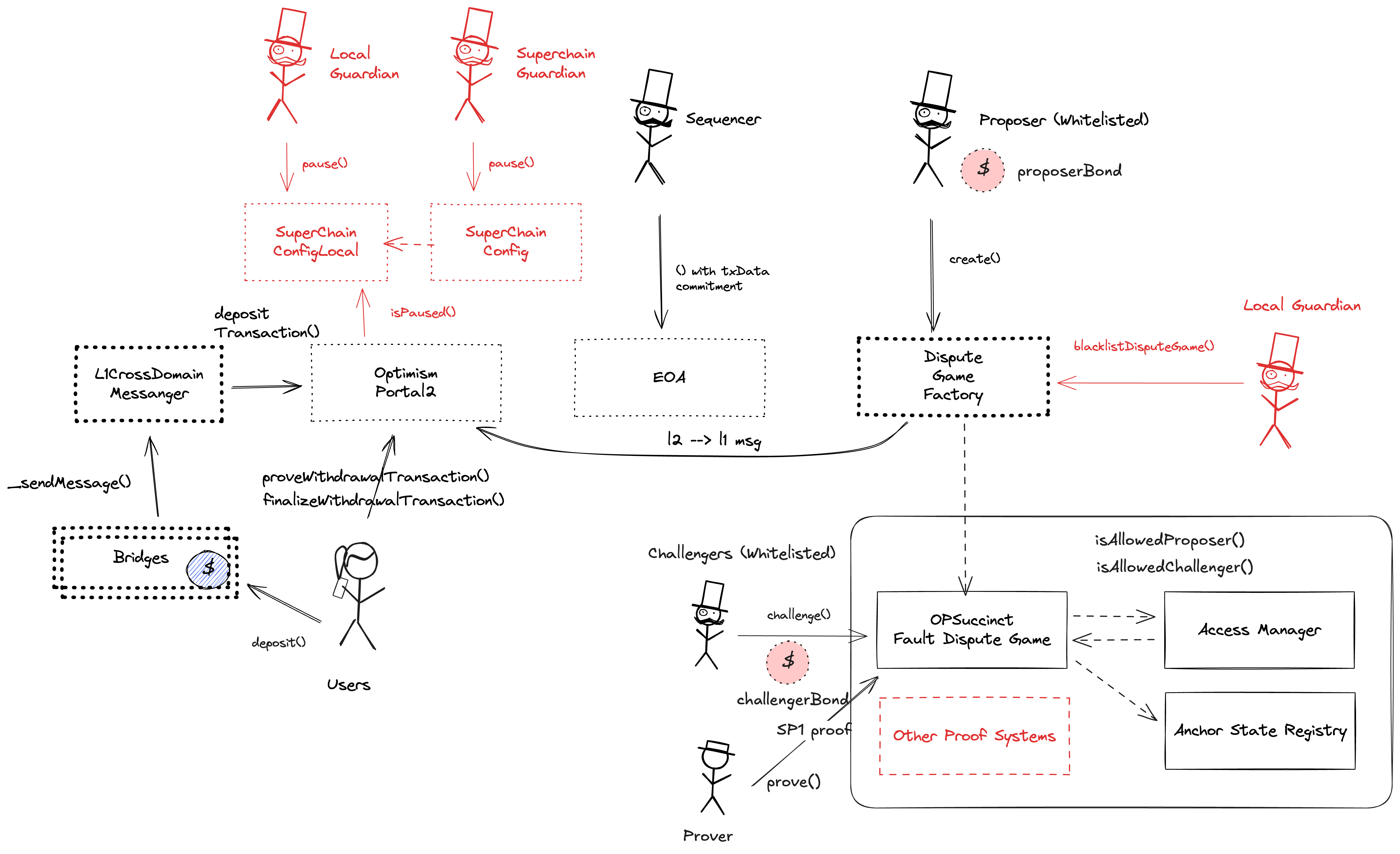
State rootsA cryptographic hash succinctly representing a state using a Merkle tree. are proposed by whitelisted proposers who create dispute games via the DisputeGameFactory by posting a bond of 0.01 ETH. Once created, the game enters a challenge periodIn optimistic rollups, the window of time wherein network participants can assert that some fraud was included in a prior block. Most optimistic rollups currently specify a challenge window of 7 days. By extending the period, there is more time for participants to guard against fraud (invalid state transitions), but also more time until withdrawals gets enabled. of 3d 12h during which whitelisted challengers can dispute the proposal by posting a bond of 0.01 ETH. If challenged, anyone can submit a ZK proof to prove the correct state within the proving period of 1d. After the challenge period passes without a successful challenge, or after a valid proof is submitted, anyone can resolve the game and finalize the state root.
Funds can be stolen if the validity proof cryptography is broken or implemented incorrectly.
Funds can be stolen if no whitelisted challenger disputes an invalid state root before the challenge window expires (CRITICAL).
Funds can be stolen if the proposer routes proof verification through a malicious or faulty verifier.
Funds can be frozen if the permissioned proposer fails to publish state roots to the L1.

Trusted Setups
Onchain verifier
Used in



Projects used in
Search for projects used in
Onchain verifier | Used in Projects used inSearch for projects used in |
Celo’s L1Layer 1 (L1) is a blockchain that is self-reliant on its validator set for its security and consensus properties. Ethereum is an example of a layer 1. Blockchains started receiving the moniker of layer 1 once layer 2 became a meaningful area of development. contracts are upgradable by a ProxyAdmin owned by the 2/2 CeloProxyAdminOwner, a nested Safe whose two signers are the 6/8 Celo Security Council and the 6/8 Celo cLabs Multisig. Both halves must approve, and there is no delay on upgrades. The shared SuperchainConfig is the exception: it remains under the 2/2 SuperchainProxyAdminOwner controlled by the Optimism Foundation and the Optimism Security CouncilA Security Council is a sufficiently decentralized set of members that is able to upgrade a system. A properly set up Security Council consists of at least 8 members with a threshold greater than 75%. What 'sufficiently decentralized' means is fundamentally subjective and L2BEAT evaluates each case individually. A Security Council is allowed to instantly upgrade Stage 1 rollups., outside Celo’s control.
Pause powers sit apart from the upgrade path. The CeloSuperchainConfig guardian, which can pause Celo withdrawals, is the Celo cLabs Multisig acting alone; the shared SuperchainConfig guardian, which can pause the whole Superchain including Celo, resolves to the Optimism Security Council. The Celo Security Council holds no pause power at all. Celo cLabs Multisig also owns SystemConfig and the OP Succinct AccessManager on its own, so it sets the sequencerA party responsible for ordering and executing transactions on the rollup. The sequencer verifies transactions, compresses the data into a block, and submits the data related to it to enable state reconstruction to Ethereum L1 as a single transaction. The data can be either transaction data or state diffs., gasA virtual fuel used to execute smart contracts on a rollup. The EVM (or other VM within the rollup) uses an accounting mechanism to correspond the consumption of gas to the consumption of computing resources, and to limit the consumption of computing resources. configuration and the proposerIn the context of L2s, the actor that proposes a claimed state root on L1. The term is also used in the context of Ethereum to refer to the actor that proposes a new block. and challenger allowlists without Council approval.
Governance profile
Security Council
| Composition | 6/8 community Security CouncilA Security Council is a sufficiently decentralized set of members that is able to upgrade a system. A properly set up Security Council consists of at least 8 members with a threshold greater than 75%. What 'sufficiently decentralized' means is fundamentally subjective and L2BEAT evaluates each case individually. A Security Council is allowed to instantly upgrade Stage 1 rollups., nested as one of two signers in the 2/2 |
|---|---|
| Members public | Named, not mapped — the docs name 8 members (L2Beat, Hyperlane, Valora, Mento, Nitya Subramanian, Kris Kaczor, Tim Moreton, Aaron Boyd) without addresses, and the founding proposal lists 8 signer addresses “in no particular order”, so no member can be tied to a signer. Membership is mostly Celo-ecosystem projects, and cLabs sits on the other half of the 2/2 rather than inside the Council. |
| Charter | No charter — the docs page is explicitly a work in progress restating the founding forum proposal, which deferred term lengths to “a later date” and never defined renewal, removal or rotation. Review feedback on that thread flagged missing emergency protocols, timezone coverage, compensation and reporting cadence; none have since been published. The Council does follow the Optimism multisig security policy. |
| Can bypass DAO? | Entirely — every L1Layer 1 (L1) is a blockchain that is self-reliant on its validator set for its security and consensus properties. Ethereum is an example of a layer 1. Blockchains started receiving the moniker of layer 1 once layer 2 became a meaningful area of development. upgrade runs on the 2/2 |
| DAO can override SC? | No — the Council administers itself. Seats are changed by the Council Safe calling itself, so 6 of the 8 sitting members decide who joins or leaves. CELO governance ratified the inaugural cohort by vote but holds no standing power, because the |
Upgrades
| Normal upgrade path | A task is published in the public celo-superchain-ops repo → 6/8 Security CouncilA Security Council is a sufficiently decentralized set of members that is able to upgrade a system. A properly set up Security Council consists of at least 8 members with a threshold greater than 75%. What 'sufficiently decentralized' means is fundamentally subjective and L2BEAT evaluates each case individually. A Security Council is allowed to instantly upgrade Stage 1 rollups. approval → 6/8 cLabs approval → execution through the 2/2 |
|---|---|
| Emergency upgrade path | No separate path — the normal path executes as soon as both halves have signed, so there is no lower emergency threshold. The fast levers are pauses, and neither belongs to the Security CouncilA Security Council is a sufficiently decentralized set of members that is able to upgrade a system. A properly set up Security Council consists of at least 8 members with a threshold greater than 75%. What 'sufficiently decentralized' means is fundamentally subjective and L2BEAT evaluates each case individually. A Security Council is allowed to instantly upgrade Stage 1 rollups.: the 6/8 |
| Exit window | None — nothing separates the second approval from the upgrade taking effect, so users get no notice and cannot withdraw ahead of an unwanted change. Routine changes run through the same gate: rotating the OP Succinct verification keys is a |
| Proof-system levers | Beyond upgrades, whoever controls the proof systemThe infrastructure that allows projects to verify their state transitions. It is composed by onchain verifiers and offchain provers. The main two flavors are optimistic and ZK proof systems, but they can be combined in a hybrid model. In general though, if a system is able to accept state roots optimistically, even if it has a ZK component, it is considered an optimistic proof system. controls withdrawals. |
Token governance
| Governance token |
|
|---|---|
| Voting venue | The onchain |
| Proposal threshold | 10,000 CELO deposit to queue a proposal. Queued proposals expire after 4 weeks, and only the 3 most-upvoted are promoted to a vote each day. |
| Quorum | Participation must clear a moving baseline — currently ~23% of Locked CELO, scaled by a 0.5 quorum factor to roughly 12%, with a 5% floor. The baseline is an exponential moving average of past turnout, so quorum drifts with participation rather than being fixed. |
| Execution model | 7d referendum → 3d execution window. A 3/14 approver multisig must approve before execution, after which anyone can execute. Scope is the limiting factor: this path governs Celo’s L2Layer 2 (L2) is a category of technical solutions aimed to scale the base layer in a trust minimized way. This category includes solutions like rollups as well as state channels and plasma. Other solutions are able to scale further, but with the introduction of additional trust assumptions, which are therefore not trust minimized. Sometimes the term Layer 2 is used to refer to include these solutions too, like validiums and optimiums, but to distinguish between trust minimized and non trust minimized solutions they are often referred to as "light" L2s, opposed to "strong" L2s like rollups. core contracts and the Community Fund, while every L1Layer 1 (L1) is a blockchain that is self-reliant on its validator set for its security and consensus properties. Ethereum is an example of a layer 1. Blockchains started receiving the moniker of layer 1 once layer 2 became a meaningful area of development. rollupA blockchain that inherits consensus and data availability from another blockchain called L1. Rollups enable trust minimized bridges with the base layer via proof systems, either optimistic or zero-knowledge. A rollup without a bridge, or without considering the bridge, is called a sovereign rollup. contract sits behind the 2/2 |
Past upgrades
The metrics include upgrades on the currently used proxy contracts. Historical proxy contracts and changes of such are not included.
Ossification
Contracts our research team classifies as critical form the project's critical perimeter. Its clock starts at the ossification genesis, and every critical change resets it (changes within 24 hours count as one). The ossification score is the share of recorded code-bug exploits whose exploited code was younger than this perimeter is today. Battle-tested exposure is the value secured, summed over that unchanged period.
Discovery updates
2026 October 21, 13:06 UTC1changeOpFoundationUpgradeSafe: Member rotated.
OpFoundationUpgradeSafe: Member rotated.
| contract OpFoundationUpgradeSafe (eth:0x847B5c174615B1B7fDF770882256e2D3E95b9D92) [GnosisSafe] { | |
| +++ description: None | |
| values.$members.3: | |
| - | "eth:0x7F1D4FE689B73B628285454667B93cfd09409f27" |
| + | "eth:0xa564C83958f7F9fA5a255a540EF5e49445873104" |
| } | |
2026 October 14, 08:20 UTC2changesConfig-only rerun on the same block number. Celo's own EigenDA cert verifier router is now discovered: a proxy under Celo's ProxyAdmin and CeloProxyAdminOwner that routes certificates to EigenDA's canonical verifier until block 25,624,000 and to Celo's own verifier after it. EigenDA's contracts are references to the shared-eigenda module.
Config-only rerun on the same block number. Celo’s own EigenDA cert verifier router is now discovered: a proxy under Celo’s ProxyAdmin and CeloProxyAdminOwner that routes certificates to EigenDA’s canonical verifier until block 25,624,000 and to Celo’s own verifier after it. EigenDA’s contracts are references to the shared-eigenda module.
New and verified contracts
| + | Status: CREATED |
| contract EigenDACertVerifierRouter (eth:0x2ea418AE1852bfC79e18B37E55F278F9c598AA08) [eigenda/EigenDACertVerifierRouter] | |
| +++ description: A router contract for DA Certificate verifiers. Verifier routing depends on the certificate reference block number. | |
| + | Status: CREATED |
| contract EigenDACertVerifier (eth:0xd9C4dA492c60e92e2B53abB5Bea7Aa4b8aA5b181) [eigenda/EigenDACertVerifier] | |
| +++ description: A DA verifier contract for EigenDA V2 certificates. The verifier is used to verify the certificate against operator signatures and stake thresholds. | |
2026 October 07, 14:32 UTC52changesThe L2 predeploy implementations (L2CrossDomainMessenger, L2StandardBridge, L2ToL1MessagePasser, ProxyAdmin) are now verified. Each is templatized with the opstack/Layer2 templates: same logic as the existing shapes, differences are interface-typed calls (ProxyAdmin, L2CrossDomainMessenger), Celo's fee-currency OptimismMintableERC20 import (L2StandardBridge) and unused library functions (L2ToL1MessagePasser, identical bytecode). The L2 ProxyAdmin is renamed to L2ProxyAdmin and its owner, the CeloProxyAdminOwner L2 alias, now receives the predeploy upgrade permissions. The L1 counterpart fields of the L2 messenger and bridge are formatted as Ethereum addresses. this also lists celo on the ossification page!
The L2 predeploy implementations (L2CrossDomainMessenger, L2StandardBridge, L2ToL1MessagePasser, ProxyAdmin) are now verified. Each is templatized with the opstack/Layer2 templates: same logic as the existing shapes, differences are interface-typed calls (ProxyAdmin, L2CrossDomainMessenger), Celo’s fee-currency OptimismMintableERC20 import (L2StandardBridge) and unused library functions (L2ToL1MessagePasser, identical bytecode). The L2 ProxyAdmin is renamed to L2ProxyAdmin and its owner, the CeloProxyAdminOwner L2 alias, now receives the predeploy upgrade permissions. The L1 counterpart fields of the L2 messenger and bridge are formatted as Ethereum addresses.
this also lists celo on the ossification page!
New and verified contracts
| contract L2CrossDomainMessenger (celo:0x4200000000000000000000000000000000000007) [opstack/Layer2/L2CrossDomainMessenger] { | |
| +++ description: The L2CrossDomainMessenger (L2xDM) contract sends messages from L2 to L1, and relays messages from L1 onto L2 with a system tx. In the event that a message sent from L2 to L1 is rejected for exceeding the L1 gas limit, it can be resubmitted via this contract’s replay function. | |
| unverified: | |
| - | true |
| values.l1CrossDomainMessenger: | |
| + | "eth:0x1AC1181fc4e4F877963680587AEAa2C90D7EbB95" |
| values.MESSAGE_VERSION: | |
| + | 1 |
| values.MIN_GAS_CALLDATA_OVERHEAD: | |
| + | 16 |
| values.MIN_GAS_DYNAMIC_OVERHEAD_DENOMINATOR: | |
| + | 63 |
| values.MIN_GAS_DYNAMIC_OVERHEAD_NUMERATOR: | |
| + | 64 |
| values.OTHER_MESSENGER: | |
| + | "eth:0x1AC1181fc4e4F877963680587AEAa2C90D7EbB95" |
| values.otherMessenger: | |
| + | "eth:0x1AC1181fc4e4F877963680587AEAa2C90D7EbB95" |
| +++ severity: MEDIUM | |
| values.paused: | |
| + | false |
| values.RELAY_CALL_OVERHEAD: | |
| + | 40000 |
| values.RELAY_CONSTANT_OVERHEAD: | |
| + | 200000 |
| values.RELAY_GAS_CHECK_BUFFER: | |
| + | 5000 |
| values.RELAY_RESERVED_GAS: | |
| + | 40000 |
| values.version: | |
| + | "2.1.1-beta.4" |
| fieldMeta.paused: | |
| + | {"severity":"MEDIUM"} |
| implementationNames.celo:0xC0d3c0d3c0D3c0D3C0d3C0D3C0D3c0d3c0d30007: | |
| - | "" |
| + | "L2CrossDomainMessenger" |
| template: | |
| + | "opstack/Layer2/L2CrossDomainMessenger" |
| sourceHashes: | |
| + | ["0xdb44b7e73254e0314f233ca790b4d44a2f9e3cebc019945c0ef84b9e3579c77a","0xfb9b6038f92aab239c0d4ae0e732ef9ba91590fee841a84ed2aea05732414997"] |
| description: | |
| + | "The L2CrossDomainMessenger (L2xDM) contract sends messages from L2 to L1, and relays messages from L1 onto L2 with a system tx. In the event that a message sent from L2 to L1 is rejected for exceeding the L1 gas limit, it can be resubmitted via this contract’s replay function." |
| usedTypes: | |
| + | [{"typeCaster":"ChainPrefix","arg":{"prefix":"eth"}}] |
| } | |
| contract L2StandardBridge (celo:0x4200000000000000000000000000000000000010) [opstack/Layer2/L2StandardBridge] { | |
| +++ description: The L2StandardBridge contract is the main entry point to deposit or withdraw ERC20 tokens from L2 to L1. This contract can store any token. | |
| unverified: | |
| - | true |
| values.l1TokenBridge: | |
| + | "eth:0x9C4955b92F34148dbcfDCD82e9c9eCe5CF2badfe" |
| values.messenger: | |
| + | "celo:0x4200000000000000000000000000000000000007" |
| values.MESSENGER: | |
| + | "celo:0x4200000000000000000000000000000000000007" |
| values.OTHER_BRIDGE: | |
| + | "eth:0x9C4955b92F34148dbcfDCD82e9c9eCe5CF2badfe" |
| values.otherBridge: | |
| + | "eth:0x9C4955b92F34148dbcfDCD82e9c9eCe5CF2badfe" |
| +++ severity: MEDIUM | |
| values.paused: | |
| + | false |
| values.version: | |
| + | "1.11.1-beta.3" |
| fieldMeta.paused: | |
| + | {"severity":"MEDIUM"} |
| implementationNames.celo:0xC0d3c0d3c0D3c0d3C0D3c0D3C0d3C0D3C0D30010: | |
| - | "" |
| + | "L2StandardBridge" |
| template: | |
| + | "opstack/Layer2/L2StandardBridge" |
| sourceHashes: | |
| + | ["0xdb44b7e73254e0314f233ca790b4d44a2f9e3cebc019945c0ef84b9e3579c77a","0x1d5e294663c579fbf93ce17a16e1ea24409366a02df03e17d4e64c499376ac68"] |
| description: | |
| + | "The L2StandardBridge contract is the main entry point to deposit or withdraw ERC20 tokens from L2 to L1. This contract can store any token." |
| usedTypes: | |
| + | [{"typeCaster":"ChainPrefix","arg":{"prefix":"eth"}}] |
| } | |
| contract L2ToL1MessagePasser (celo:0x4200000000000000000000000000000000000016) [opstack/Layer2/L2ToL1MessagePasser] { | |
| +++ description: Contract used internally by the L2CrossDomainMessenger to send messages to L1, including withdrawals. It can also be used directly as a low-level interface. | |
| unverified: | |
| - | true |
| values.MESSAGE_VERSION: | |
| + | 1 |
| values.version: | |
| + | "1.1.1-beta.1" |
| implementationNames.celo:0xC0D3C0d3C0d3c0d3C0d3C0D3c0D3c0d3c0D30016: | |
| - | "" |
| + | "L2ToL1MessagePasser" |
| template: | |
| + | "opstack/Layer2/L2ToL1MessagePasser" |
| sourceHashes: | |
| + | ["0xdb44b7e73254e0314f233ca790b4d44a2f9e3cebc019945c0ef84b9e3579c77a","0x139a7bcf87ffc29f97c88feb9de39cb420dd36a61aeddf64c01af03d5b91b4ef"] |
| description: | |
| + | "Contract used internally by the L2CrossDomainMessenger to send messages to L1, including withdrawals. It can also be used directly as a low-level interface." |
| } | |
| contract L2ProxyAdmin (celo:0x4200000000000000000000000000000000000018) [opstack/Layer2/L2ProxyAdmin] { | |
| +++ description: Administration contract for other contract proxies. | |
| name: | |
| - | "ProxyAdmin" |
| + | "L2ProxyAdmin" |
| unverified: | |
| - | true |
| values.addressManager: | |
| + | "celo:0x0000000000000000000000000000000000000000" |
| values.isUpgrading: | |
| + | false |
| fieldMeta.owner.description: | |
| - | "L2 alias of the CeloProxyAdminOwner. It can upgrade the security-critical L2 predeploys." |
| implementationNames.celo:0xC0d3C0D3c0d3C0d3c0d3c0D3C0D3C0d3C0D30018: | |
| - | "" |
| + | "ProxyAdmin" |
| receivedPermissions: | |
| - | [{"permission":"upgrade","from":"celo:0x4200000000000000000000000000000000000007","role":"admin"},{"permission":"upgrade","from":"celo:0x4200000000000000000000000000000000000010","role":"admin"},{"permission":"upgrade","from":"celo:0x4200000000000000000000000000000000000016","role":"admin"},{"permission":"upgrade","from":"celo:0x4200000000000000000000000000000000000018","role":"admin"}] |
| template: | |
| + | "opstack/Layer2/L2ProxyAdmin" |
| sourceHashes: | |
| + | ["0xdb44b7e73254e0314f233ca790b4d44a2f9e3cebc019945c0ef84b9e3579c77a","0x7f6864f2ed905cae4ebf163729df004c7b19520740e00ee1710427ec016e60ce"] |
| description: | |
| + | "Administration contract for other contract proxies." |
| directlyReceivedPermissions: | |
| + | [{"permission":"upgrade","from":"celo:0x4200000000000000000000000000000000000007","role":"admin"},{"permission":"upgrade","from":"celo:0x4200000000000000000000000000000000000010","role":"admin"},{"permission":"upgrade","from":"celo:0x4200000000000000000000000000000000000016","role":"admin"},{"permission":"upgrade","from":"celo:0x4200000000000000000000000000000000000018","role":"admin"}] |
| } | |
2026 October 05, 16:17 UTCHigh severity10changesOP Contracts Upgrade 20 (op-contracts/v8.0.0-rc.3): the shared SuperchainConfig implementation was upgraded v2.4.2 → v2.4.3 on 2026-09-24. Version bump only; no chain-specific contract changed. (diff)
OP Contracts Upgrade 20 (op-contracts/v8.0.0-rc.3): the shared SuperchainConfig implementation was upgraded v2.4.2 → v2.4.3 on 2026-09-24. Version bump only; no chain-specific contract changed. (diff)
| contract SuperchainConfig (eth:0x95703e0982140D16f8ebA6d158FccEde42f04a4C) [opstack/SuperchainConfig_expiry] { | |
| +++ description: Used to manage global configuration values for multiple OP Chains within a single Superchain network. The SuperchainConfig contract manages individual pause states for each chain connected to it, as well as a global pause state for all chains. The guardian role can pause either separately, but each pause expires after 3 months if left untouched. | |
| sourceHashes.1: | |
| - | "0x2cd597b7305a446a1df355e6909cbd75fe38aa045faf4876a8e5496eebc1734f" |
| + | "0xb74ed3aa109bd981b095c02d6e3bda2b2467d40e9d1060b4c89b01de32ebad3a" |
| values.$implementation: | |
| - | "eth:0xE4F9779ab53070a55db24dFAeFf9AF147c6ED550" |
| + | "eth:0x5570b1f2b97B1E35b5C6f9Ee76f6cf02c9917504" |
| values.$pastUpgrades.8: | |
| + | ["2026-09-24T16:51:23.000Z","0x0a0fe86f7b1a3d3d2d0be990e3f8b15628b885363ae527fa9548cb2c2375741a",["eth:0x2476c911E6D4D9411E677D8Faf15a64ac1fDEEe8"]] |
| values.$pastUpgrades.9: | |
| + | ["2026-09-24T16:51:23.000Z","0x0a0fe86f7b1a3d3d2d0be990e3f8b15628b885363ae527fa9548cb2c2375741a",["eth:0x5570b1f2b97B1E35b5C6f9Ee76f6cf02c9917504"]] |
| values.$pastUpgrades.10: | |
| + | ["2026-09-24T16:51:23.000Z","0x0a0fe86f7b1a3d3d2d0be990e3f8b15628b885363ae527fa9548cb2c2375741a",["eth:0x2476c911E6D4D9411E677D8Faf15a64ac1fDEEe8"]] |
| values.$pastUpgrades.11: | |
| + | ["2026-09-24T16:51:23.000Z","0x0a0fe86f7b1a3d3d2d0be990e3f8b15628b885363ae527fa9548cb2c2375741a",["eth:0x5570b1f2b97B1E35b5C6f9Ee76f6cf02c9917504"]] |
| values.$upgradeCount: | |
| - | 8 |
| + | 12 |
| values.version: | |
| - | "2.4.2" |
| + | "2.4.3" |
| implementationNames.eth:0xE4F9779ab53070a55db24dFAeFf9AF147c6ED550: | |
| - | "SuperchainConfig" |
| implementationNames.eth:0x5570b1f2b97B1E35b5C6f9Ee76f6cf02c9917504: | |
| + | "SuperchainConfig" |
| } | |
2026 September 10, 12:46 UTC4changesRefresh config-derived discovery metadata at the main-branch block.
Refresh config-derived discovery metadata at the main-branch block.
New and verified contracts
| + | Status: CREATED |
| contract L2CrossDomainMessenger (celo:0x4200000000000000000000000000000000000007) [N/A] | |
| +++ description: None | |
| + | Status: CREATED |
| contract L2StandardBridge (celo:0x4200000000000000000000000000000000000010) [N/A] | |
| +++ description: None | |
| + | Status: CREATED |
| contract L2ToL1MessagePasser (celo:0x4200000000000000000000000000000000000016) [N/A] | |
| +++ description: None | |
| + | Status: CREATED |
| contract ProxyAdmin (celo:0x4200000000000000000000000000000000000018) [N/A] | |
| +++ description: None | |
The system has a centralized operator
The operatorAn operator is the entity charged with managing a rollup and progressing its state. A rollup operator can be a centralized sequencer, proposer, prover, challenger, pauser of admin that is able to perform upgrades. is the only entity that can propose blocksAn ordered list of transactions and chain-related metadata that gets bundled together and published to the L1/DA layer. Nodes execute the transactions contained within blocks to change the rollup chain’s state. Protocol rules dictate what constitutes a valid block, and invalid blocks are skipped over.. A live and trustworthy operator is vital to the health of the system.
MEV can be extracted if the operator exploits their centralized position and frontruns user transactions.
Users can force any transaction
Because the state of the system is based on transactions submitted on the underlying host chain and anyone can submit their transactions there it allows the users to circumvent censorship by interacting with the smart contract on the host chain directly.
Regular exits
The user initiates the withdrawal by submitting a regular transaction on this chain. When a state rootA cryptographic hash succinctly representing a state using a Merkle tree. containing such transaction is settled, the funds become available for withdrawal on L1Layer 1 (L1) is a blockchain that is self-reliant on its validator set for its security and consensus properties. Ethereum is an example of a layer 1. Blockchains started receiving the moniker of layer 1 once layer 2 became a meaningful area of development. after 3d 12h. Withdrawal inclusion can be proven before state root settlementThe mechanism with which the execution of rollup blocks and the resultant state is verified and possible disputes are resolved. In the context of rollups or other modular blockchains, it often refers to the proof system used--validity (ZK) or fraud proofs, or a combination thereof. Sometimes it will refer to this mechanism along with where the mechanism's outputs are ultimately published and verified, as in Ethereum being a settlement layer by verifying the proofs and allowing for withdrawals., but a 7d period has to pass before it becomes actionable. The process of state root settlement takes a challenge periodIn optimistic rollups, the window of time wherein network participants can assert that some fraud was included in a prior block. Most optimistic rollups currently specify a challenge window of 7 days. By extending the period, there is more time for participants to guard against fraud (invalid state transitions), but also more time until withdrawals gets enabled. of at least 3d 12h to complete. Finally the user submits an L1 transaction to claim the funds. This transaction requires a merkle proof.
Forced messaging
If the user experiences censorship from the operatorAn operator is the entity charged with managing a rollup and progressing its state. A rollup operator can be a centralized sequencer, proposer, prover, challenger, pauser of admin that is able to perform upgrades. with regular L2Layer 2 (L2) is a category of technical solutions aimed to scale the base layer in a trust minimized way. This category includes solutions like rollups as well as state channels and plasma. Other solutions are able to scale further, but with the introduction of additional trust assumptions, which are therefore not trust minimized. Sometimes the term Layer 2 is used to refer to include these solutions too, like validiums and optimiums, but to distinguish between trust minimized and non trust minimized solutions they are often referred to as "light" L2s, opposed to "strong" L2s like rollups.->L1Layer 1 (L1) is a blockchain that is self-reliant on its validator set for its security and consensus properties. Ethereum is an example of a layer 1. Blockchains started receiving the moniker of layer 1 once layer 2 became a meaningful area of development. messaging they can submit their messages directly on L1. The system is then obliged to service this request or halt all messages, including forced withdrawals from L1 and regular messages initiated on L2. Once the force operation is submitted and if the request is serviced, the operation follows the flow of a regular message.
EVM compatible smart contracts are supported
OP stack chains are pursuing the EVM EquivalenceA perfect degree of compatibility; where one system or concept is indistinguishable from another in the domain being compared. In the context of rollups, it generally refers to the proximity to the EVM and to Ethereum architecture. model. No changes to smart contracts are required regardless of the language they are written in, i.e. anything deployed on L1Layer 1 (L1) is a blockchain that is self-reliant on its validator set for its security and consensus properties. Ethereum is an example of a layer 1. Blockchains started receiving the moniker of layer 1 once layer 2 became a meaningful area of development. can be deployed on L2Layer 2 (L2) is a category of technical solutions aimed to scale the base layer in a trust minimized way. This category includes solutions like rollups as well as state channels and plasma. Other solutions are able to scale further, but with the introduction of additional trust assumptions, which are therefore not trust minimized. Sometimes the term Layer 2 is used to refer to include these solutions too, like validiums and optimiums, but to distinguish between trust minimized and non trust minimized solutions they are often referred to as "light" L2s, opposed to "strong" L2s like rollups..
Ethereum
Actors:
A Multisig with 3/6 threshold.
- Can upgrade with 10d delay
- swETH-Strategy TimelockControllerOwning with 10d delay → EigenLayerOwningMultisig → EigenLayerProxyAdmin
- TaskMailbox TimelockControllerOwning with 10d delay → EigenLayerOwningMultisig → EigenLayerProxyAdmin
- AVSDirectory TimelockControllerOwning with 10d delay → EigenLayerOwningMultisig → EigenLayerProxyAdmin
- ankrETH-Strategy TimelockControllerOwning with 10d delay → EigenLayerOwningMultisig → EigenLayerProxyAdmin
- rETH-Strategy TimelockControllerOwning with 10d delay → EigenLayerOwningMultisig → EigenLayerProxyAdmin
- PermissionController TimelockControllerOwning with 10d delay → EigenLayerOwningMultisig → EigenLayerProxyAdmin
- ProtocolRegistry TimelockControllerOwning with 10d delay → EigenLayerOwningMultisig → EigenLayerProxyAdmin
- METH-Strategy TimelockControllerOwning with 10d delay → EigenLayerOwningMultisig → EigenLayerProxyAdmin
- DelegationManager TimelockControllerOwning with 10d delay → EigenLayerOwningMultisig → EigenLayerProxyAdmin
- BN254CertificateVerifier TimelockControllerOwning with 10d delay → EigenLayerOwningMultisig → EigenLayerProxyAdmin
- cbETH-Strategy TimelockControllerOwning with 10d delay → EigenLayerOwningMultisig → EigenLayerProxyAdmin
- KeyRegistrar TimelockControllerOwning with 10d delay → EigenLayerOwningMultisig → EigenLayerProxyAdmin
- OperatorTableUpdater TimelockControllerOwning with 10d delay → EigenLayerOwningMultisig → EigenLayerProxyAdmin
- osETH-Strategy TimelockControllerOwning with 10d delay → EigenLayerOwningMultisig → EigenLayerProxyAdmin
- StrategyFactory TimelockControllerOwning with 10d delay → EigenLayerOwningMultisig → EigenLayerProxyAdmin
- EmissionsController TimelockControllerOwning with 10d delay → EigenLayerOwningMultisig → EigenLayerProxyAdmin
- RewardsCoordinator TimelockControllerOwning with 10d delay → EigenLayerOwningMultisig → EigenLayerProxyAdmin
- wBETH-Strategy TimelockControllerOwning with 10d delay → EigenLayerOwningMultisig → EigenLayerProxyAdmin
- StrategyManager TimelockControllerOwning with 10d delay → EigenLayerOwningMultisig → EigenLayerProxyAdmin
- sfrxETH-Strategy TimelockControllerOwning with 10d delay → EigenLayerOwningMultisig → EigenLayerProxyAdmin
- EigenPodManager TimelockControllerOwning with 10d delay → EigenLayerOwningMultisig → EigenLayerProxyAdmin
- CrossChainRegistry TimelockControllerOwning with 10d delay → EigenLayerOwningMultisig → EigenLayerProxyAdmin
- stETH-Strategy TimelockControllerOwning with 10d delay → EigenLayerOwningMultisig → EigenLayerProxyAdmin
- AllocationManager TimelockControllerOwning with 10d delay → EigenLayerOwningMultisig → EigenLayerProxyAdmin
- ETHx-Strategy TimelockControllerOwning with 10d delay → EigenLayerOwningMultisig → EigenLayerProxyAdmin
- OETH-Strategy TimelockControllerOwning with 10d delay → EigenLayerOwningMultisig → EigenLayerProxyAdmin
- bEIGEN-Strategy TimelockControllerOwning with 10d delay → EigenLayerOwningMultisig → EigenLayerProxyAdmin
- RiverV1-Strategy TimelockControllerOwning with 10d delay → EigenLayerOwningMultisig → EigenLayerProxyAdmin
- ECDSACertificateVerifier TimelockControllerOwning with 10d delay → EigenLayerOwningMultisig → EigenLayerProxyAdmin
- EIGEN token TimelockControllerOwning with 10d delay → EigenLayerOwningMultisig → EigenLayerProxyAdmin
- ReleaseManager TimelockControllerOwning with 10d delay → EigenLayerOwningMultisig → EigenLayerProxyAdmin
- Can upgrade with 24d delay
- bEIGEN token TimelockControllerBeigen with 24d delay → EigenLayerBeigenOwningMultisig → ProxyAdmin
- Can interact with UpgradeableBeacon
- change the beacon implementation with 10d delay TimelockControllerOwning with 10d delay → EigenLayerOwningMultisig
- Can interact with TimelockControllerBeigen
- can cancel scheduled operations
- Can interact with EigenDAServiceManager
- can pause the DA bridgeSystem that verifies that data has been made available. It takes the form of a smart contract verifying a consensus or, if the data is verified directly by either downloading the full data or sampling, of an enshrined bridge. with no delay or with 10d delay PauserRegistry - or TimelockControllerOwning with 10d delay → EigenLayerOwningMultisig → PauserRegistry
- Can interact with TimelockControllerOwning
- can cancel scheduled operations
A Multisig with 3/5 threshold.
- Can upgrade with 10d delay
- swETH-Strategy TimelockControllerOwning with 10d delay → EigenLayerOwningMultisig → EigenLayerProxyAdmin
- TaskMailbox TimelockControllerOwning with 10d delay → EigenLayerOwningMultisig → EigenLayerProxyAdmin
- AVSDirectory TimelockControllerOwning with 10d delay → EigenLayerOwningMultisig → EigenLayerProxyAdmin
- ankrETH-Strategy TimelockControllerOwning with 10d delay → EigenLayerOwningMultisig → EigenLayerProxyAdmin
- rETH-Strategy TimelockControllerOwning with 10d delay → EigenLayerOwningMultisig → EigenLayerProxyAdmin
- PermissionController TimelockControllerOwning with 10d delay → EigenLayerOwningMultisig → EigenLayerProxyAdmin
- ProtocolRegistry TimelockControllerOwning with 10d delay → EigenLayerOwningMultisig → EigenLayerProxyAdmin
- METH-Strategy TimelockControllerOwning with 10d delay → EigenLayerOwningMultisig → EigenLayerProxyAdmin
- DelegationManager TimelockControllerOwning with 10d delay → EigenLayerOwningMultisig → EigenLayerProxyAdmin
- BN254CertificateVerifier TimelockControllerOwning with 10d delay → EigenLayerOwningMultisig → EigenLayerProxyAdmin
- cbETH-Strategy TimelockControllerOwning with 10d delay → EigenLayerOwningMultisig → EigenLayerProxyAdmin
- KeyRegistrar TimelockControllerOwning with 10d delay → EigenLayerOwningMultisig → EigenLayerProxyAdmin
- OperatorTableUpdater TimelockControllerOwning with 10d delay → EigenLayerOwningMultisig → EigenLayerProxyAdmin
- osETH-Strategy TimelockControllerOwning with 10d delay → EigenLayerOwningMultisig → EigenLayerProxyAdmin
- StrategyFactory TimelockControllerOwning with 10d delay → EigenLayerOwningMultisig → EigenLayerProxyAdmin
- EmissionsController TimelockControllerOwning with 10d delay → EigenLayerOwningMultisig → EigenLayerProxyAdmin
- RewardsCoordinator TimelockControllerOwning with 10d delay → EigenLayerOwningMultisig → EigenLayerProxyAdmin
- wBETH-Strategy TimelockControllerOwning with 10d delay → EigenLayerOwningMultisig → EigenLayerProxyAdmin
- StrategyManager TimelockControllerOwning with 10d delay → EigenLayerOwningMultisig → EigenLayerProxyAdmin
- sfrxETH-Strategy TimelockControllerOwning with 10d delay → EigenLayerOwningMultisig → EigenLayerProxyAdmin
- EigenPodManager TimelockControllerOwning with 10d delay → EigenLayerOwningMultisig → EigenLayerProxyAdmin
- CrossChainRegistry TimelockControllerOwning with 10d delay → EigenLayerOwningMultisig → EigenLayerProxyAdmin
- stETH-Strategy TimelockControllerOwning with 10d delay → EigenLayerOwningMultisig → EigenLayerProxyAdmin
- AllocationManager TimelockControllerOwning with 10d delay → EigenLayerOwningMultisig → EigenLayerProxyAdmin
- ETHx-Strategy TimelockControllerOwning with 10d delay → EigenLayerOwningMultisig → EigenLayerProxyAdmin
- OETH-Strategy TimelockControllerOwning with 10d delay → EigenLayerOwningMultisig → EigenLayerProxyAdmin
- bEIGEN-Strategy TimelockControllerOwning with 10d delay → EigenLayerOwningMultisig → EigenLayerProxyAdmin
- RiverV1-Strategy TimelockControllerOwning with 10d delay → EigenLayerOwningMultisig → EigenLayerProxyAdmin
- ECDSACertificateVerifier TimelockControllerOwning with 10d delay → EigenLayerOwningMultisig → EigenLayerProxyAdmin
- EIGEN token TimelockControllerOwning with 10d delay → EigenLayerOwningMultisig → EigenLayerProxyAdmin
- ReleaseManager TimelockControllerOwning with 10d delay → EigenLayerOwningMultisig → EigenLayerProxyAdmin
- Can upgrade with 24d delay
- bEIGEN token TimelockControllerBeigen with 24d delay → EigenLayerBeigenOwningMultisig → ProxyAdmin
- Can interact with UpgradeableBeacon
- change the beacon implementation with 10d delay TimelockControllerOwning with 10d delay → EigenLayerOwningMultisig
- Can interact with TimelockControllerBeigen
- executes scheduled operations after the delay
- Can interact with EigenDAServiceManager
- can pause the DA bridgeSystem that verifies that data has been made available. It takes the form of a smart contract verifying a consensus or, if the data is verified directly by either downloading the full data or sampling, of an enshrined bridge. with 10d delay TimelockControllerOwning with 10d delay → EigenLayerOwningMultisig → PauserRegistry
- Can interact with TimelockControllerOwning
- executes scheduled operations after the delay
A Multisig with 9/13 threshold. Member of EigenLayerOwningMultisig, EigenLayerBeigenOwningMultisig.
- Can upgrade with no delay
- swETH-Strategy EigenLayerOwningMultisig → EigenLayerProxyAdmin
- TaskMailbox EigenLayerOwningMultisig → EigenLayerProxyAdmin
- AVSDirectory EigenLayerOwningMultisig → EigenLayerProxyAdmin
- ankrETH-Strategy EigenLayerOwningMultisig → EigenLayerProxyAdmin
- rETH-Strategy EigenLayerOwningMultisig → EigenLayerProxyAdmin
- PermissionController EigenLayerOwningMultisig → EigenLayerProxyAdmin
- ProtocolRegistry EigenLayerOwningMultisig → EigenLayerProxyAdmin
- METH-Strategy EigenLayerOwningMultisig → EigenLayerProxyAdmin
- DelegationManager EigenLayerOwningMultisig → EigenLayerProxyAdmin
- BN254CertificateVerifier EigenLayerOwningMultisig → EigenLayerProxyAdmin
- cbETH-Strategy EigenLayerOwningMultisig → EigenLayerProxyAdmin
- KeyRegistrar EigenLayerOwningMultisig → EigenLayerProxyAdmin
- OperatorTableUpdater EigenLayerOwningMultisig → EigenLayerProxyAdmin
- osETH-Strategy EigenLayerOwningMultisig → EigenLayerProxyAdmin
- StrategyFactory EigenLayerOwningMultisig → EigenLayerProxyAdmin
- EmissionsController EigenLayerOwningMultisig → EigenLayerProxyAdmin
- RewardsCoordinator EigenLayerOwningMultisig → EigenLayerProxyAdmin
- wBETH-Strategy EigenLayerOwningMultisig → EigenLayerProxyAdmin
- bEIGEN token EigenLayerBeigenOwningMultisig → ProxyAdmin
- StrategyManager EigenLayerOwningMultisig → EigenLayerProxyAdmin
- sfrxETH-Strategy EigenLayerOwningMultisig → EigenLayerProxyAdmin
- EigenPodManager EigenLayerOwningMultisig → EigenLayerProxyAdmin
- CrossChainRegistry EigenLayerOwningMultisig → EigenLayerProxyAdmin
- stETH-Strategy EigenLayerOwningMultisig → EigenLayerProxyAdmin
- AllocationManager EigenLayerOwningMultisig → EigenLayerProxyAdmin
- ETHx-Strategy EigenLayerOwningMultisig → EigenLayerProxyAdmin
- OETH-Strategy EigenLayerOwningMultisig → EigenLayerProxyAdmin
- bEIGEN-Strategy EigenLayerOwningMultisig → EigenLayerProxyAdmin
- RiverV1-Strategy EigenLayerOwningMultisig → EigenLayerProxyAdmin
- ECDSACertificateVerifier EigenLayerOwningMultisig → EigenLayerProxyAdmin
- EIGEN token EigenLayerOwningMultisig → EigenLayerProxyAdmin
- ReleaseManager EigenLayerOwningMultisig → EigenLayerProxyAdmin
- Can interact with UpgradeableBeacon
- change the beacon implementation EigenLayerOwningMultisig
- Can interact with EigenDAServiceManager
- can pause the DA bridgeSystem that verifies that data has been made available. It takes the form of a smart contract verifying a consensus or, if the data is verified directly by either downloading the full data or sampling, of an enshrined bridge. EigenLayerOwningMultisig → PauserRegistry
Participants (13):
0x1791…41160x34C3…B2BC0x72Ff…4f54Safe0xED73…594b0x97b4…48150x65C4…842F0xe377…9D600x8ffC…Cd950xAF4D…F0610xe8F0…707e0x6A66…0b1f0x33E8…1626A Multisig with 2/4 threshold.
- Can upgrade with no delay
- StakeRegistry ProxyAdmin
- BLSApkRegistry ProxyAdmin
- RegistryCoordinator ProxyAdmin
- EjectionManager ProxyAdmin
- SocketRegistry ProxyAdmin
- EigenDADisperserRegistry ProxyAdmin
- EigenDAServiceManager ProxyAdmin
- PaymentVault ProxyAdmin
- IndexRegistry ProxyAdmin
- EigenDARelayRegistry ProxyAdmin
- EigenDAThresholdRegistry ProxyAdmin
- Can interact with RegistryCoordinator
- can add and remove strategies
- Can interact with EigenDAServiceManager
- can transfer ownership of the contract, update the metadata URI, set reward initiator and set batch confirmer
- Can interact with EigenDAThresholdRegistry
- can add blobThe data that a rollup publishes to its L1/data availability (DA) layer. They consist of the L2 transactions that are rolled up, along with some metadata. Blobs are introduced as a new transaction type within Ethereum with EIP-4844, and has rollup scaling specifically in mind. Blobs persist on Ethereum’s Beacon Chain ephemerally. versions with their coding parameters, which define what the cert verifiers accept as a valid blob
A Multisig with 2/2 threshold.
- Can upgrade with no delay
- L2CrossDomainMessenger L2ProxyAdmin
- L2StandardBridge L2ProxyAdmin
- L2ToL1MessagePasser L2ProxyAdmin
- L2ProxyAdmin L2ProxyAdmin
- Celo native asset Token ProxyAdmin
- L1CrossDomainMessenger ProxyAdmin
- CeloSuperchainConfig ProxyAdmin
- EigenDACertVerifierRouter ProxyAdmin
- L1ERC721Bridge ProxyAdmin
- OptimismMintableERC20Factory ProxyAdmin
- SystemConfig ProxyAdmin
- AnchorStateRegistry ProxyAdmin
- DelayedWETH ProxyAdmin
- L1StandardBridge ProxyAdmin
- OptimismPortal2 ProxyAdmin
- DelayedWETH ProxyAdmin
- DisputeGameFactory ProxyAdmin
- Can interact with EigenDACertVerifierRouter
- can add cert verifiers to the router, changing which contract validates DA certificates from a chosen blockAn ordered list of transactions and chain-related metadata that gets bundled together and published to the L1/DA layer. Nodes execute the transactions contained within blocks to change the rollup chain’s state. Protocol rules dictate what constitutes a valid block, and invalid blocks are skipped over. onwards
- Can interact with AddressManager
- set and change address mappings ProxyAdmin
- Can interact with DisputeGameFactory
- set the dispute game implementation and initial bond for any game type
A Multisig with 6/8 threshold. Member of CeloProxyAdminOwner.
- Can interact with SystemConfig
- it can update the preconfer address, the batch submitter (SequencerA party responsible for ordering and executing transactions on the rollup. The sequencer verifies transactions, compresses the data into a block, and submits the data related to it to enable state reconstruction to Ethereum L1 as a single transaction. The data can be either transaction data or state diffs.) address and the gasA virtual fuel used to execute smart contracts on a rollup. The EVM (or other VM within the rollup) uses an accounting mechanism to correspond the consumption of gas to the consumption of computing resources, and to limit the consumption of computing resources. configuration of the system
- Can interact with AccessManager
- Allowed to add or remove proposers and challengers, and transfer ownership of the AccessManager
A Multisig with 5/7 threshold. It uses the following modules: SaferSafes (A Gnosis Safe module combining LivenessModule and TimelockGuard. Provides livenessLiveness refers to the ability of a system to respond to requests and to process them in a timely manner. In the context of L2s, it refers to the ability of settling transactions, proofs and state roots to the base layer. checks where a fallback owner can challenge and take over if Safe owners are unresponsive, plus optional timelock delays for transaction scheduling). Member of SuperchainProxyAdminOwner.
- Can interact with SuperchainConfig
- Allowed to pause withdrawals. In op stack systems with a proof systemThe infrastructure that allows projects to verify their state transitions. It is composed by onchain verifiers and offchain provers. The main two flavors are optimistic and ZK proof systems, but they can be combined in a hybrid model. In general though, if a system is able to accept state roots optimistically, even if it has a ZK component, it is considered an optimistic proof system., the Guardian can also blacklist dispute games and set the respected game type (permissioned / permissionlessAnyone willing should be able to join and leave the network at any time, without causing significant disturbance to the network or being detrimental to the party in question. No single entity should have the power to allowlist or blocklist participants.) LivenessModule if the number of Optimism Security CouncilA Security Council is a sufficiently decentralized set of members that is able to upgrade a system. A properly set up Security Council consists of at least 8 members with a threshold greater than 75%. What 'sufficiently decentralized' means is fundamentally subjective and L2BEAT evaluates each case individually. A Security Council is allowed to instantly upgrade Stage 1 rollups. members falls below 8 → Optimism Security Council → Optimism Guardian Multisig
A Gnosis Safe module combining LivenessModule and TimelockGuard. Provides livenessLiveness refers to the ability of a system to respond to requests and to process them in a timely manner. In the context of L2s, it refers to the ability of settling transactions, proofs and state roots to the base layer. checks where a fallback owner can challenge and take over if Safe owners are unresponsive, plus optional timelock delays for transaction scheduling.
- Can interact with SuperchainConfig
- Allowed to pause withdrawals. In op stack systems with a proof systemThe infrastructure that allows projects to verify their state transitions. It is composed by onchain verifiers and offchain provers. The main two flavors are optimistic and ZK proof systems, but they can be combined in a hybrid model. In general though, if a system is able to accept state roots optimistically, even if it has a ZK component, it is considered an optimistic proof system., the Guardian can also blacklist dispute games and set the respected game type (permissioned / permissionlessAnyone willing should be able to join and leave the network at any time, without causing significant disturbance to the network or being detrimental to the party in question. No single entity should have the power to allowlist or blocklist participants.) OpFoundationUpgradeSafe → LivenessModule if the number of Optimism Security CouncilA Security Council is a sufficiently decentralized set of members that is able to upgrade a system. A properly set up Security Council consists of at least 8 members with a threshold greater than 75%. What 'sufficiently decentralized' means is fundamentally subjective and L2BEAT evaluates each case individually. A Security Council is allowed to instantly upgrade Stage 1 rollups. members falls below 8 → Optimism Security Council → Optimism Guardian Multisig
A Multisig with 10/13 threshold. It uses the following modules: LivenessModule (used to remove members inactive for 3mo 8d while making sure that the threshold remains above 75%. If the number of members falls below 8, the OpFoundationUpgradeSafe takes ownership of the multisig). Member of Optimism Guardian Multisig, SuperchainProxyAdminOwner.
- Can interact with SuperchainConfig
- Allowed to pause withdrawals. In op stack systems with a proof systemThe infrastructure that allows projects to verify their state transitions. It is composed by onchain verifiers and offchain provers. The main two flavors are optimistic and ZK proof systems, but they can be combined in a hybrid model. In general though, if a system is able to accept state roots optimistically, even if it has a ZK component, it is considered an optimistic proof system., the Guardian can also blacklist dispute games and set the respected game type (permissioned / permissionlessAnyone willing should be able to join and leave the network at any time, without causing significant disturbance to the network or being detrimental to the party in question. No single entity should have the power to allowlist or blocklist participants.) Optimism Guardian Multisig
Participants (13):
0xE61F…76aE0x652B…cB5f0x5c1f…7a810x4A73…e61E0x3A53…aa940xEF9A…877c0x6323…c8650xd5b7…aC900x7ed8…9E390xd915…59300x0a87…efE60xbfA0…E0d90xcbC7…7eA6A Multisig with 3/4 threshold.
- Can interact with EigenDAServiceManager
- can create rewards submissions
A Multisig with 3/8 threshold.
- Can interact with EjectionManager
- can eject DA operators from a quorum
Participants (8):
0x9308…a1250x5262…0aDA0x9951…683F0xA383…350A0x44aC…B9040x3C20…63e90xA4f7…dD310x542a…Bd7EA Multisig with 2/8 threshold. Member of EigenLayerPauserMultisig.
- Can interact with EigenDAServiceManager
- can pause the DA bridgeSystem that verifies that data has been made available. It takes the form of a smart contract verifying a consensus or, if the data is verified directly by either downloading the full data or sampling, of an enshrined bridge. EigenLayerPauserMultisig → PauserRegistry
Participants (8):
0xDe64…33700x55b0…44E80x4719…331A0xa9f9…3d280x5CCF…d0600xA756…84450xd757…B5530xe2eB…26D2A Multisig with 2/2 threshold.
- Can upgrade with no delay
- SuperchainConfig SuperchainProxyAdmin
- Can interact with AddressManager
- set and change address mappings SuperchainProxyAdmin
Modular contract to be used together with the LivenessModule. Tracks livenessLiveness refers to the ability of a system to respond to requests and to process them in a timely manner. In the context of L2s, it refers to the ability of settling transactions, proofs and state roots to the base layer. / activity of Safe owners.
- Can interact with LivenessModule
- can remove members of Optimism Security CouncilA Security Council is a sufficiently decentralized set of members that is able to upgrade a system. A properly set up Security Council consists of at least 8 members with a threshold greater than 75%. What 'sufficiently decentralized' means is fundamentally subjective and L2BEAT evaluates each case individually. A Security Council is allowed to instantly upgrade Stage 1 rollups. inactive for 3mo 8d
A Multisig with 2/3 threshold.
- Can interact with SP1VerifierGateway
- affect the livenessLiveness refers to the ability of a system to respond to requests and to process them in a timely manner. In the context of L2s, it refers to the ability of settling transactions, proofs and state roots to the base layer. and safety of the gateway - can transfer ownership, add and freeze verifierAn entity in a ZK-Rollup, often a smart contract, that verifies zero-knowledge proofs submitted by a prover. routes
A Multisig with 1/1 threshold. It uses the following modules: DeputyPauseModule (Allows 0x2fA150379bF32b6d79Eeb4ff9bD280E76049a87c, called the deputy pauser, to act on behalf of the OpFoundationUpgradeSafe if set as its Safe module).
Participants (1):
Optimism Security CouncilA Multisig with 6/8 threshold. Member of CeloProxyAdminOwner.
A Multisig with 1/1 threshold. Member of EigenLayerCommunityMultisig.
Participants (1):
0x5e6a…d3B5A Multisig with 1/1 threshold. Member of Safe.
Participants (1):
0x43cC…701C- Can interact with SystemConfig
- Allowed to commit transactions from the current layer to the host chain
- Can interact with SuperchainConfig
- Allowed to pause withdrawals. In op stack systems with a proof systemThe infrastructure that allows projects to verify their state transitions. It is composed by onchain verifiers and offchain provers. The main two flavors are optimistic and ZK proof systems, but they can be combined in a hybrid model. In general though, if a system is able to accept state roots optimistically, even if it has a ZK component, it is considered an optimistic proof system., the Guardian can also blacklist dispute games and set the respected game type (permissioned / permissionlessAnyone willing should be able to join and leave the network at any time, without causing significant disturbance to the network or being detrimental to the party in question. No single entity should have the power to allowlist or blocklist participants.) DeputyPauseModule though restricted to the SuperchainConfig’s
pause()function → Optimism Guardian Multisig
- Allowed to pause withdrawals. In op stack systems with a proof systemThe infrastructure that allows projects to verify their state transitions. It is composed by onchain verifiers and offchain provers. The main two flavors are optimistic and ZK proof systems, but they can be combined in a hybrid model. In general though, if a system is able to accept state roots optimistically, even if it has a ZK component, it is considered an optimistic proof system., the Guardian can also blacklist dispute games and set the respected game type (permissioned / permissionlessAnyone willing should be able to join and leave the network at any time, without causing significant disturbance to the network or being detrimental to the party in question. No single entity should have the power to allowlist or blocklist participants.) DeputyPauseModule though restricted to the SuperchainConfig’s
- Can interact with EigenDAServiceManager
- can confirm batches to the DA bridgeSystem that verifies that data has been made available. It takes the form of a smart contract verifying a consensus or, if the data is verified directly by either downloading the full data or sampling, of an enshrined bridge.
- Can interact with RegistryCoordinator
- can approve the replacement of churned operators from a quorum
- Can interact with EigenDARelayRegistry
- Can store and serve both unencoded blobsThe data that a rollup publishes to its L1/data availability (DA) layer. They consist of the L2 transactions that are rolled up, along with some metadata. Blobs are introduced as a new transaction type within Ethereum with EIP-4844, and has rollup scaling specifically in mind. Blobs persist on Ethereum’s Beacon Chain ephemerally. as well as encoded chunks
- Can interact with EigenDADisperserRegistry
- Can disperse EigenDA blobsThe data that a rollup publishes to its L1/data availability (DA) layer. They consist of the L2 transactions that are rolled up, along with some metadata. Blobs are introduced as a new transaction type within Ethereum with EIP-4844, and has rollup scaling specifically in mind. Blobs persist on Ethereum’s Beacon Chain ephemerally. to the EigenDA nodeA software client that participates in the network. operators
Member of EigenLayerPauserMultisig.
- Can interact with EigenDAServiceManager
- can pause the DA bridgeSystem that verifies that data has been made available. It takes the form of a smart contract verifying a consensus or, if the data is verified directly by either downloading the full data or sampling, of an enshrined bridge. EigenLayerPauserMultisig → PauserRegistry
- Can interact with AccessManager
- Allowed to post new state rootsA cryptographic hash succinctly representing a state using a Merkle tree. of the current layer to the host chain
- Can interact with AccessManager
- Allowed to challenge or delete state rootsA cryptographic hash succinctly representing a state using a Merkle tree. proposed by a ProposerIn the context of L2s, the actor that proposes a claimed state root on L1. The term is also used in the context of Ethereum to refer to the actor that proposes a new block.
Ethereum
Contains configuration parameters such as the SequencerA party responsible for ordering and executing transactions on the rollup. The sequencer verifies transactions, compresses the data into a block, and submits the data related to it to enable state reconstruction to Ethereum L1 as a single transaction. The data can be either transaction data or state diffs. address, gas limitThe maximum amount of gas a transaction or block may consume. on this chain and the unsafe blockAn ordered list of transactions and chain-related metadata that gets bundled together and published to the L1/DA layer. Nodes execute the transactions contained within blocks to change the rollup chain’s state. Protocol rules dictate what constitutes a valid block, and invalid blocks are skipped over. signer address.
- Roles:
- admin: ProxyAdmin; ultimately CeloProxyAdminOwner
- batcherHash: EOA 1
- owner: Celo cLabs Multisig
The OptimismPortal contract is the main entry point to deposit funds from L1Layer 1 (L1) is a blockchain that is self-reliant on its validator set for its security and consensus properties. Ethereum is an example of a layer 1. Blockchains started receiving the moniker of layer 1 once layer 2 became a meaningful area of development. to L2Layer 2 (L2) is a category of technical solutions aimed to scale the base layer in a trust minimized way. This category includes solutions like rollups as well as state channels and plasma. Other solutions are able to scale further, but with the introduction of additional trust assumptions, which are therefore not trust minimized. Sometimes the term Layer 2 is used to refer to include these solutions too, like validiums and optimiums, but to distinguish between trust minimized and non trust minimized solutions they are often referred to as "light" L2s, opposed to "strong" L2s like rollups.. It also allows to prove and finalize withdrawals. It specifies which game type can be used for withdrawals, which currently is the 42.
- Roles:
- admin: ProxyAdmin; ultimately CeloProxyAdminOwner

The dispute game factory allows the creation of dispute games, used to propose state rootsA cryptographic hash succinctly representing a state using a Merkle tree. and eventually challenge them.
- Roles:
- admin: ProxyAdmin; ultimately CeloProxyAdminOwner
- owner: CeloProxyAdminOwner
Used to manage global configuration values for multiple OP Chains within a single Superchain networkA constellation of nodes (peers) that communicate via a peer-to-peer protocol, for example, in propagating transactions and blocks to other nodes.. The SuperchainConfig contract manages individual pause states for each chain connected to it, as well as a global pause state for all chains. The guardian role can pause either separately, but each pause expires after 3 months if left untouched.
- Roles:
- admin: SuperchainProxyAdmin; ultimately SuperchainProxyAdminOwner
- guardian: Optimism Guardian Multisig; ultimately OpFoundationUpgradeSafe, Optimism EOA 1, Optimism Security CouncilA Security Council is a sufficiently decentralized set of members that is able to upgrade a system. A properly set up Security Council consists of at least 8 members with a threshold greater than 75%. What 'sufficiently decentralized' means is fundamentally subjective and L2BEAT evaluates each case individually. A Security Council is allowed to instantly upgrade Stage 1 rollups., SaferSafes
Keeps track of the total stake of each operatorAn operator is the entity charged with managing a rollup and progressing its state. A rollup operator can be a centralized sequencer, proposer, prover, challenger, pauser of admin that is able to perform upgrades..
- Roles:
- admin: ProxyAdmin; ultimately EigenDAOperationsMultisig
Keeps track of the BLS public keys of each operatorAn operator is the entity charged with managing a rollup and progressing its state. A rollup operator can be a centralized sequencer, proposer, prover, challenger, pauser of admin that is able to perform upgrades. and the quorum aggregated keys.
- Roles:
- admin: ProxyAdmin; ultimately EigenDAOperationsMultisig
Operators register here with an AVS The coordinator has three registries 1) a StakeRegistry that keeps track of operators’ stakes, 2) a BLSApkRegistry that keeps track of operators’ BLS public keys and aggregate BLS public keys for each quorum, 3) an IndexRegistry that keeps track of an ordered list of operators for each quorum.
- Roles:
- admin: ProxyAdmin; ultimately EigenDAOperationsMultisig
- churnApprover: EOA 7
- owner: EigenDAOperationsMultisig
Defines and stores pauser and unpauser roles for EigenDA contracts.
- Roles:
- pausers: EigenLayerOperationsMultisig, EigenLayerOwningMultisig, EigenLayerPauserMultisig
Contract used for ejection of operators from the RegistryCoordinator for violating the Service Legal Agreement (SLA).
- Roles:
- admin: ProxyAdmin; ultimately EigenDAOperationsMultisig
- ejectors: EOA 4, EOA 6, EigenDA Multisig
- Roles:
- admin: ProxyAdmin; ultimately EigenDAOperationsMultisig
Registry for EigenDA disperser info such as disperser key to address mapping.
- Roles:
- admin: ProxyAdmin; ultimately EigenDAOperationsMultisig
- dispersers: EOA 9
BridgeA message-passing protocol between two blockchains. At its most basic, a token bridge consists of a smart contract which can escrow funds on one side of the bridge, and instruct the release or minting of corresponding assets on the other side, but bridges could also support arbitrary messages. How these instructions are validated is a critical factor in assessing the trust assumptions of a bridge. contract that accepts blobThe data that a rollup publishes to its L1/data availability (DA) layer. They consist of the L2 transactions that are rolled up, along with some metadata. Blobs are introduced as a new transaction type within Ethereum with EIP-4844, and has rollup scaling specifically in mind. Blobs persist on Ethereum’s Beacon Chain ephemerally. batches data availabilityThe property of a rollup's data being reachable by any node retrieving the data that were rolled up and executed to reach the proposed state. Data availability (DA), specifically decoupling it from the rollup nodes themselves, is one of the preeminent factors which allows a rollup to scale securely. A rollup is faced with a decision of what to use as a DA layer to guarantee that any node can retrieve this data--permissionlessly under any circumstance. For this reason, using Ethereum for DA currently provides the strongest security guarantees. If data is stored somewhere other than a permissionless L1, then the project is not a rollup, but rather a validium or an optimium. attestations. Batches availability is attested by EigenDA operators signatures and relayed to the service manager contract by the EigenDA disperser.
- Roles:
- admin: ProxyAdmin; ultimately EigenDAOperationsMultisig
- batchConfirmers: EOA 2, EOA 3, EOA 5
- owner: EigenDAOperationsMultisig
- pauserRegistry: PauserRegistry; ultimately EOA 10, EOA 11, EOA 12, EOA 13, EOA 14, EOA 15, EigenLayerCommunityMultisig, EigenLayerOperationsMultisig, EigenLayerOperationsMultisig2, Safe
- rewardsInitiator: EigenLayerRewardsInitiatorMultisig
Entrypoint for making reservations and on demand payments for EigenDA.
- Roles:
- admin: ProxyAdmin; ultimately EigenDAOperationsMultisig
A registry contract that keeps track of an ordered list of operators for each quorum.
- Roles:
- admin: ProxyAdmin; ultimately EigenDAOperationsMultisig
Registry for EigenDA relay keys, maps key to address.
- Roles:
- admin: ProxyAdmin; ultimately EigenDAOperationsMultisig
- relayers: EOA 8
Registry of EigenDA threshold (i.e, adversary and confirmation threshold percentage for a quorum)
- Roles:
- admin: ProxyAdmin; ultimately EigenDAOperationsMultisig
- owner: EigenDAOperationsMultisig
Read-only view contract that exposes query functions for the AllocationManager, allowing external callers to look up operatorAn operator is the entity charged with managing a rollup and progressing its state. A rollup operator can be a centralized sequencer, proposer, prover, challenger, pauser of admin that is able to perform upgrades. stake allocations, magnitudes, operator sets, and slashable/redistributable status.
UpgradeableBeacon managing the single implementation for all strategies deployed via StrategyFactory.
A strategy implementation allowing to deposit a specific token as a restakable asset.
- Roles:
- admin: EigenLayerProxyAdmin; ultimately EigenLayerCommunityMultisig, EigenLayerOperationsMultisig, EigenLayerOperationsMultisig2
Task lifecycle manager where users create tasks with fee payments directed at specific executor operatorAn operator is the entity charged with managing a rollup and progressing its state. A rollup operator can be a centralized sequencer, proposer, prover, challenger, pauser of admin that is able to perform upgrades. sets, and executors submit results verified via BN254 or ECDSA certificate verification, with fee distribution on successful verification and refunds on task expiration.
- Roles:
- admin: EigenLayerProxyAdmin; ultimately EigenLayerCommunityMultisig, EigenLayerOperationsMultisig, EigenLayerOperationsMultisig2
- Roles:
- admin: EigenLayerProxyAdmin; ultimately EigenLayerCommunityMultisig, EigenLayerOperationsMultisig, EigenLayerOperationsMultisig2
A strategy implementation allowing to deposit a specific token as a restakable asset.
- Roles:
- admin: EigenLayerProxyAdmin; ultimately EigenLayerCommunityMultisig, EigenLayerOperationsMultisig, EigenLayerOperationsMultisig2
A strategy implementation allowing to deposit a specific token as a restakable asset.
- Roles:
- admin: EigenLayerProxyAdmin; ultimately EigenLayerCommunityMultisig, EigenLayerOperationsMultisig, EigenLayerOperationsMultisig2
Contract that enables AVSs and operators to delegate the ability to call certain core contract functions to other addresses.
- Roles:
- admin: EigenLayerProxyAdmin; ultimately EigenLayerCommunityMultisig, EigenLayerOperationsMultisig, EigenLayerOperationsMultisig2
Admin-controlled on-chain registry that tracks all EigenLayer protocol contract deployments (addresses, names, configs, and versioning) and provides a pauseAll function to pause every registered pausable contract in the protocol.
- Roles:
- admin: EigenLayerProxyAdmin; ultimately EigenLayerCommunityMultisig, EigenLayerOperationsMultisig, EigenLayerOperationsMultisig2
A strategy implementation allowing to deposit a specific token as a restakable asset.
- Roles:
- admin: EigenLayerProxyAdmin; ultimately EigenLayerCommunityMultisig, EigenLayerOperationsMultisig, EigenLayerOperationsMultisig2
The DelegationManager contract is responsible for registering EigenLayer operators and managing the EigenLayer strategies delegations. The EigenDA StakeRegistry contract reads from the DelegationManager to track the total stake of each EigenDA operatorAn operator is the entity charged with managing a rollup and progressing its state. A rollup operator can be a centralized sequencer, proposer, prover, challenger, pauser of admin that is able to perform upgrades..
- Roles:
- admin: EigenLayerProxyAdmin; ultimately EigenLayerCommunityMultisig, EigenLayerOperationsMultisig, EigenLayerOperationsMultisig2
Verifies BLS (BN254 curve) certificates for EigenLayer operatorAn operator is the entity charged with managing a rollup and progressing its state. A rollup operator can be a centralized sequencer, proposer, prover, challenger, pauser of admin that is able to perform upgrades. sets by computing the aggregate public key of signers, performing pairing-based signature verification, and returning signed-stake weights for quorum threshold validation.
- Roles:
- admin: EigenLayerProxyAdmin; ultimately EigenLayerCommunityMultisig, EigenLayerOperationsMultisig, EigenLayerOperationsMultisig2
A strategy implementation allowing to deposit a specific token as a restakable asset.
- Roles:
- admin: EigenLayerProxyAdmin; ultimately EigenLayerCommunityMultisig, EigenLayerOperationsMultisig, EigenLayerOperationsMultisig2
Manages the registration and deregistration of operatorAn operator is the entity charged with managing a rollup and progressing its state. A rollup operator can be a centralized sequencer, proposer, prover, challenger, pauser of admin that is able to perform upgrades. cryptographic keys (ECDSA or BN254/BLS) for specific operator sets, enforcing signature-based proof of key ownership and global uniqueness of keys across the protocol.
- Roles:
- admin: EigenLayerProxyAdmin; ultimately EigenLayerCommunityMultisig, EigenLayerOperationsMultisig, EigenLayerOperationsMultisig2
Central coordinator for EigenLayer’s operatorAn operator is the entity charged with managing a rollup and progressing its state. A rollup operator can be a centralized sequencer, proposer, prover, challenger, pauser of admin that is able to perform upgrades. table system: accepts BN254-certified global Merkle table roots from a designated generator operator set, then allows Merkle proof submissions to push per-operator-set tables into the certificate verifierAn entity in a ZK-Rollup, often a smart contract, that verifies zero-knowledge proofs submitted by a prover. contracts.
- Roles:
- admin: EigenLayerProxyAdmin; ultimately EigenLayerCommunityMultisig, EigenLayerOperationsMultisig, EigenLayerOperationsMultisig2
A strategy implementation allowing to deposit a specific token as a restakable asset.
- Roles:
- admin: EigenLayerProxyAdmin; ultimately EigenLayerCommunityMultisig, EigenLayerOperationsMultisig, EigenLayerOperationsMultisig2
UpgradeableBeacon managing the single implementation for all strategies deployed via StrategyFactory.
Factory contract for permissionlessAnyone willing should be able to join and leave the network at any time, without causing significant disturbance to the network or being detrimental to the party in question. No single entity should have the power to allowlist or blocklist participants. strategy creation via beacon proxies.
- Roles:
- admin: EigenLayerProxyAdmin; ultimately EigenLayerCommunityMultisig, EigenLayerOperationsMultisig, EigenLayerOperationsMultisig2
A timelock that allows scheduling calls and executing or cancelling them with a delay. Member of EigenLayerBeigenOwningMultisig.
- Roles:
- cancellers: EigenLayerOperationsMultisig
- executors: EigenLayerOperationsMultisig2
- proposers: EigenLayerOperationsMultisig, EigenLayerOperationsMultisig2
A strategy implementation allowing to deposit a specific token as a restakable asset.
- Roles:
- admin: EigenLayerProxyAdmin; ultimately EigenLayerCommunityMultisig, EigenLayerOperationsMultisig, EigenLayerOperationsMultisig2
The token backing EIGEN and used for intersubjective staking.
- Roles:
- admin: ProxyAdmin; ultimately EigenLayerCommunityMultisig, EigenLayerOperationsMultisig, EigenLayerOperationsMultisig2
The StrategyManager contract is responsible for managing the EigenLayer token strategies. Each EigenDA quorum has at least one strategy that defines the operators quorum stake.
- Roles:
- admin: EigenLayerProxyAdmin; ultimately EigenLayerCommunityMultisig, EigenLayerOperationsMultisig, EigenLayerOperationsMultisig2
A strategy implementation allowing to deposit a specific token as a restakable asset.
- Roles:
- admin: EigenLayerProxyAdmin; ultimately EigenLayerCommunityMultisig, EigenLayerOperationsMultisig, EigenLayerOperationsMultisig2
- Roles:
- admin: EigenLayerProxyAdmin; ultimately EigenLayerCommunityMultisig, EigenLayerOperationsMultisig, EigenLayerOperationsMultisig2
Allows AVSs to create generation reservations that configure and schedule the transport of operatorAn operator is the entity charged with managing a rollup and progressing its state. A rollup operator can be a centralized sequencer, proposer, prover, challenger, pauser of admin that is able to perform upgrades. tables (stake weight data) from L1Layer 1 (L1) is a blockchain that is self-reliant on its validator set for its security and consensus properties. Ethereum is an example of a layer 1. Blockchains started receiving the moniker of layer 1 once layer 2 became a meaningful area of development. to whitelisted L2Layer 2 (L2) is a category of technical solutions aimed to scale the base layer in a trust minimized way. This category includes solutions like rollups as well as state channels and plasma. Other solutions are able to scale further, but with the introduction of additional trust assumptions, which are therefore not trust minimized. Sometimes the term Layer 2 is used to refer to include these solutions too, like validiums and optimiums, but to distinguish between trust minimized and non trust minimized solutions they are often referred to as "light" L2s, opposed to "strong" L2s like rollups. chains, managing per-operator-set configs such as staleness periods and operator table calculators.
- Roles:
- admin: EigenLayerProxyAdmin; ultimately EigenLayerCommunityMultisig, EigenLayerOperationsMultisig, EigenLayerOperationsMultisig2
A strategy implementation allowing to deposit a specific token as a restakable asset.
- Roles:
- admin: EigenLayerProxyAdmin; ultimately EigenLayerCommunityMultisig, EigenLayerOperationsMultisig, EigenLayerOperationsMultisig2
Contract used to create OperatorAn operator is the entity charged with managing a rollup and progressing its state. A rollup operator can be a centralized sequencer, proposer, prover, challenger, pauser of admin that is able to perform upgrades. Sets, and used by Operators to register to them. The Allocation Manager tracks allocation of stake to a Operator Set, and enables AVSs to slash that stake.
- Roles:
- admin: EigenLayerProxyAdmin; ultimately EigenLayerCommunityMultisig, EigenLayerOperationsMultisig, EigenLayerOperationsMultisig2
A strategy implementation allowing to deposit a specific token as a restakable asset.
- Roles:
- admin: EigenLayerProxyAdmin; ultimately EigenLayerCommunityMultisig, EigenLayerOperationsMultisig, EigenLayerOperationsMultisig2
A strategy implementation allowing to deposit a specific token as a restakable asset.
- Roles:
- admin: EigenLayerProxyAdmin; ultimately EigenLayerCommunityMultisig, EigenLayerOperationsMultisig, EigenLayerOperationsMultisig2
A strategy implementation allowing to deposit a specific token as a restakable asset.
- Roles:
- admin: EigenLayerProxyAdmin; ultimately EigenLayerCommunityMultisig, EigenLayerOperationsMultisig, EigenLayerOperationsMultisig2
A strategy implementation allowing to deposit a specific token as a restakable asset.
- Roles:
- admin: EigenLayerProxyAdmin; ultimately EigenLayerCommunityMultisig, EigenLayerOperationsMultisig, EigenLayerOperationsMultisig2
Defines and stores pauser and unpauser roles for EigenLayer contracts.
- Roles:
- pausers: EigenLayerOperationsMultisig, EigenLayerOwningMultisig, EigenLayerPauserMultisig, ProtocolRegistry
A timelock that allows scheduling calls and executing or cancelling them with a delay. Member of EigenLayerOwningMultisig.
- Roles:
- cancellers: EigenLayerOperationsMultisig
- executors: EigenLayerOperationsMultisig2
- proposers: EigenLayerOperationsMultisig, EigenLayerOperationsMultisig2
Verifies ECDSA-based certificates for EigenLayer operatorAn operator is the entity charged with managing a rollup and progressing its state. A rollup operator can be a centralized sequencer, proposer, prover, challenger, pauser of admin that is able to perform upgrades. sets by recovering signer addresses from concatenated signatures, confirming each signer is a registered operator, and tallying their stake weights against quorum thresholds.
- Roles:
- admin: EigenLayerProxyAdmin; ultimately EigenLayerCommunityMultisig, EigenLayerOperationsMultisig, EigenLayerOperationsMultisig2
The EIGEN token can be socially forked to slash operators for data withholding attacks (and other intersubjectively attributable faults). EIGEN is a wrapper over a second token, bEIGEN, which will be used solely for intersubjective staking. Forking EIGEN means changing the canonical implementation of the bEIGEN token in the EIGEN token contract.
- Roles:
- admin: EigenLayerProxyAdmin; ultimately EigenLayerCommunityMultisig, EigenLayerOperationsMultisig, EigenLayerOperationsMultisig2
Manages software release lifecycle for EigenLayer operatorAn operator is the entity charged with managing a rollup and progressing its state. A rollup operator can be a centralized sequencer, proposer, prover, challenger, pauser of admin that is able to perform upgrades. sets, allowing AVS owners to publish versioned releases (containing artifact digests, registry URLs, and upgrade-by deadlines) and metadata URIs that operators can query for required software versions.
- Roles:
- admin: EigenLayerProxyAdmin; ultimately EigenLayerCommunityMultisig, EigenLayerOperationsMultisig, EigenLayerOperationsMultisig2
Sends messages from host chain to this chain, and relays messages back onto host chain. In the event that a message sent from host chain to this chain is rejected for exceeding this chain’s epoch gas limitThe maximum amount of gas a transaction or block may consume., it can be resubmitted via this contract’s replay function.
- Roles:
- admin: ProxyAdmin; ultimately CeloProxyAdminOwner
Used to bridgeA message-passing protocol between two blockchains. At its most basic, a token bridge consists of a smart contract which can escrow funds on one side of the bridge, and instruct the release or minting of corresponding assets on the other side, but bridges could also support arbitrary messages. How these instructions are validated is a critical factor in assessing the trust assumptions of a bridge. ERC-721 tokens from host chain to this chain.
- Roles:
- admin: ProxyAdmin; ultimately CeloProxyAdminOwner
The main entry point to deposit ERC20 tokens from host chain to this chain.
- Roles:
- admin: ProxyAdmin; ultimately CeloProxyAdminOwner
All supported tokens in this escrow are included in the value secured calculation.
used to remove members inactive for 3mo 8d while making sure that the threshold remains above 75%. If the number of members falls below 8, the OpFoundationUpgradeSafe takes ownership of the multisig
- Roles:
- fallbackOwner: OpFoundationUpgradeSafe if the number of Optimism Security CouncilA Security Council is a sufficiently decentralized set of members that is able to upgrade a system. A properly set up Security Council consists of at least 8 members with a threshold greater than 75%. What 'sufficiently decentralized' means is fundamentally subjective and L2BEAT evaluates each case individually. A Security Council is allowed to instantly upgrade Stage 1 rollups. members falls below 8
- livenessGuard: LivenessGuard
- Roles:
- admin: ProxyAdmin; ultimately CeloProxyAdminOwner
The PreimageOracle contract is used to load the required data from L1Layer 1 (L1) is a blockchain that is self-reliant on its validator set for its security and consensus properties. Ethereum is an example of a layer 1. Blockchains started receiving the moniker of layer 1 once layer 2 became a meaningful area of development. for a dispute game.
- Roles:
- admin: ProxyAdmin; ultimately CeloProxyAdminOwner
Logic of the dispute game. When a state rootA cryptographic hash succinctly representing a state using a Merkle tree. is proposed, a dispute game contract is deployed. Challengers can use such contracts to challenge the proposed state root.
A router contract for DA Certificate verifiers. VerifierAn entity in a ZK-Rollup, often a smart contract, that verifies zero-knowledge proofs submitted by a prover. routing depends on the certificate reference blockAn ordered list of transactions and chain-related metadata that gets bundled together and published to the L1/DA layer. Nodes execute the transactions contained within blocks to change the rollup chain’s state. Protocol rules dictate what constitutes a valid block, and invalid blocks are skipped over. number.
- Roles:
- admin: ProxyAdmin; ultimately CeloProxyAdminOwner
- owner: CeloProxyAdminOwner
The MIPS contract is used to execute the final step of the dispute game which objectively determines the winner of the dispute.
A helper contract that generates OptimismMintableERC20 contracts on the networkA constellation of nodes (peers) that communicate via a peer-to-peer protocol, for example, in propagating transactions and blocks to other nodes. it’s deployed to. OptimismMintableERC20 is a standard extension of the base ERC20 token contract designed to allow the L1StandardBridge contracts to mint and burn tokens. This makes it possible to use an OptimismMintableERC20 as this chain’s representation of a token on the host chain, or vice-versa.
- Roles:
- admin: ProxyAdmin; ultimately CeloProxyAdminOwner
Allows 0x2fA150379bF32b6d79Eeb4ff9bD280E76049a87c, called the deputy pauser, to act on behalf of the OpFoundationUpgradeSafe if set as its Safe module.
- Roles:
- deputy: Optimism EOA 1 though restricted to the SuperchainConfig’s
pause()function
- deputy: Optimism EOA 1 though restricted to the SuperchainConfig’s
- Roles:
- owner: CeloProxyAdminOwner
Contains the latest confirmed state rootA cryptographic hash succinctly representing a state using a Merkle tree. that can be used as a starting point in a dispute game. It specifies which game type can be used for withdrawals, which currently is the OPSuccinctFaultDisputeGame. Variant for chains using OPSuccinct (SP1) games instead of Cannon, which omits Cannon-specific cross-contract fields (vm, oracle, weth, challengePeriod, absolutePrestate from game).
- Roles:
- admin: ProxyAdmin; ultimately CeloProxyAdminOwner
Contract designed to hold the bonded ETH for each game. It is designed as a wrapper around WETH to allow an owner to function as a backstop if a game would incorrectly distribute funds.
- Roles:
- admin: ProxyAdmin; ultimately CeloProxyAdminOwner
Same as FaultDisputeGame, but only two permissioned addresses are designated as proposerIn the context of L2s, the actor that proposes a claimed state root on L1. The term is also used in the context of Ethereum to refer to the actor that proposes a new block. and challenger.
Contract designed to hold the bonded ETH for each game. It is designed as a wrapper around WETH to allow an owner to function as a backstop if a game would incorrectly distribute funds.
- Roles:
- admin: ProxyAdmin; ultimately CeloProxyAdminOwner
A DA verifierAn entity in a ZK-Rollup, often a smart contract, that verifies zero-knowledge proofs submitted by a prover. contract for EigenDA V2 certificates. The verifier is used to verify the certificate against operatorAn operator is the entity charged with managing a rollup and progressing its state. A rollup operator can be a centralized sequencer, proposer, prover, challenger, pauser of admin that is able to perform upgrades. signatures and stake thresholds.
Contract managing access control for proposers and challengers in OPSuccinct.
- Roles:
- challengers: EOA 17, EOA 18, EOA 19, EOA 20, EOA 22, EOA 23
- owner: Celo cLabs Multisig
- proposers: EOA 16, EOA 21
Logic of the dispute game. When a state rootA cryptographic hash succinctly representing a state using a Merkle tree. is proposed, a dispute game contract is deployed. Challengers can use such contracts to challenge the proposed state root.
A DA verifierAn entity in a ZK-Rollup, often a smart contract, that verifies zero-knowledge proofs submitted by a prover. contract for EigenDA V2 certificates. The verifier is used to verify the certificate against operatorAn operator is the entity charged with managing a rollup and progressing its state. A rollup operator can be a centralized sequencer, proposer, prover, challenger, pauser of admin that is able to perform upgrades. signatures and stake thresholds.
A beacon with an upgradeable implementation currently set as DurationVaultStrategy. Beacon proxy contracts pointing to this beacon will all use its implementation.
- Roles:
- owner: EigenLayerOwningMultisig; ultimately EigenLayerCommunityMultisig, EigenLayerOperationsMultisig, EigenLayerOperationsMultisig2
- Roles:
- admin: EigenLayerProxyAdmin; ultimately EigenLayerCommunityMultisig, EigenLayerOperationsMultisig, EigenLayerOperationsMultisig2
Manages the distribution of rewards (arbitrary tokens, EIGEN) to restakers and commission to operators.
- Roles:
- admin: EigenLayerProxyAdmin; ultimately EigenLayerCommunityMultisig, EigenLayerOperationsMultisig, EigenLayerOperationsMultisig2
This contract is the router for zk proof verification. It stores the mapping between identifiers and the address of onchain verifierAn entity in a ZK-Rollup, often a smart contract, that verifies zero-knowledge proofs submitted by a prover. contracts, routing each identifier to the corresponding verifier contract.
- Roles:
- owner: SP1VerifierGatewayMultisig
VerifierAn entity in a ZK-Rollup, often a smart contract, that verifies zero-knowledge proofs submitted by a prover. contract for SP1 proofs (v6.1.0).
Celo
The L2CrossDomainMessenger (L2xDM) contract sends messages from L2Layer 2 (L2) is a category of technical solutions aimed to scale the base layer in a trust minimized way. This category includes solutions like rollups as well as state channels and plasma. Other solutions are able to scale further, but with the introduction of additional trust assumptions, which are therefore not trust minimized. Sometimes the term Layer 2 is used to refer to include these solutions too, like validiums and optimiums, but to distinguish between trust minimized and non trust minimized solutions they are often referred to as "light" L2s, opposed to "strong" L2s like rollups. to L1Layer 1 (L1) is a blockchain that is self-reliant on its validator set for its security and consensus properties. Ethereum is an example of a layer 1. Blockchains started receiving the moniker of layer 1 once layer 2 became a meaningful area of development., and relays messages from L1 onto L2 with a system tx. In the event that a message sent from L2 to L1 is rejected for exceeding the L1 gas limitThe maximum amount of gas a transaction or block may consume., it can be resubmitted via this contract’s replay function.
- Roles:
- admin: L2ProxyAdmin; ultimately CeloProxyAdminOwner
The L2StandardBridge contract is the main entry point to deposit or withdraw ERC20 tokens from L2Layer 2 (L2) is a category of technical solutions aimed to scale the base layer in a trust minimized way. This category includes solutions like rollups as well as state channels and plasma. Other solutions are able to scale further, but with the introduction of additional trust assumptions, which are therefore not trust minimized. Sometimes the term Layer 2 is used to refer to include these solutions too, like validiums and optimiums, but to distinguish between trust minimized and non trust minimized solutions they are often referred to as "light" L2s, opposed to "strong" L2s like rollups. to L1Layer 1 (L1) is a blockchain that is self-reliant on its validator set for its security and consensus properties. Ethereum is an example of a layer 1. Blockchains started receiving the moniker of layer 1 once layer 2 became a meaningful area of development.. This contract can store any token.
- Roles:
- admin: L2ProxyAdmin; ultimately CeloProxyAdminOwner
Contract used internally by the L2CrossDomainMessenger to send messages to L1Layer 1 (L1) is a blockchain that is self-reliant on its validator set for its security and consensus properties. Ethereum is an example of a layer 1. Blockchains started receiving the moniker of layer 1 once layer 2 became a meaningful area of development., including withdrawals. It can also be used directly as a low-level interface.
- Roles:
- admin: L2ProxyAdmin; ultimately CeloProxyAdminOwner
Administration contract for other contract proxies.
- Roles:
- admin: L2ProxyAdmin; ultimately CeloProxyAdminOwner
- owner: CeloProxyAdminOwner
The current deployment carries some associated risks:
Funds can be stolen if a contract receives a malicious code upgrade. There is no delay on code upgrades (CRITICAL).