Search
Search for projects and tokens by name or address
 Starknet
Starknet
Badges
About
Starknet is a ZK rollup that uses STARK proofs to securely scale Ethereum and Ethereum blobs for data availability. Starknet is also actively engaged in bringing Bitcoin users the same scale, UX, and liquidity through a variety of products and programs.
- Upgrades unrelated to onchain provable bugs provide less than 30d to exit.
- The Security Council's actions are not confined to onchain provable bugs.
Badges
About
Starknet is a ZK rollup that uses STARK proofs to securely scale Ethereum and Ethereum blobs for data availability. Starknet is also actively engaged in bringing Bitcoin users the same scale, UX, and liquidity through a variety of products and programs.
The section shows the operating costs that L2s pay to Ethereum.
This section shows how much data the project publishes to Ethereum over time. It leaves out data posted to other data-availability (DA) layers. The project currently posts data to Ethereum.
This section shows how "live" the project's operators are by displaying how frequently they submit transactions of the selected type. It also highlights anomalies - significant deviations from their typical schedule.
Starknet reverts 18mins of history
2026 Jan 5th
Starknet experienced an outage during which blockAn ordered list of transactions and chain-related metadata that gets bundled together and published to the L1/DA layer. Nodes execute the transactions contained within blocks to change the rollup chain’s state. Protocol rules dictate what constitutes a valid block, and invalid blocks are skipped over. production was halted.
Starknet upgrades its proving system to Stwo
2025 Oct 19th
Starknet switches to the next-generation proverAn entity that generates the cryptographic proof to convince the verifier that the statement is true. In a ZK-Rollup, the prover generates the ZK (validity) proof to submit to the verifier contract. Stwo to prove its STF on Ethereum L1Layer 1 (L1) is a blockchain that is self-reliant on its validator set for its security and consensus properties. Ethereum is an example of a layer 1. Blockchains started receiving the moniker of layer 1 once layer 2 became a meaningful area of development..
Funds can be stolen if
Funds can be frozen if
Users can be censored if
MEV can be extracted if
Users can submit transactions to an L1Layer 1 (L1) is a blockchain that is self-reliant on its validator set for its security and consensus properties. Ethereum is an example of a layer 1. Blockchains started receiving the moniker of layer 1 once layer 2 became a meaningful area of development. map, but can’t force them. When users “complain” that their transaction is stuck on L1 and not picked up by the sequencerA party responsible for ordering and executing transactions on the rollup. The sequencer verifies transactions, compresses the data into a block, and submits the data related to it to enable state reconstruction to Ethereum L1 as a single transaction. The data can be either transaction data or state diffs., the Security CouncilA Security Council is a sufficiently decentralized set of members that is able to upgrade a system. A properly set up Security Council consists of at least 8 members with a threshold greater than 75%. What 'sufficiently decentralized' means is fundamentally subjective and L2BEAT evaluates each case individually. A Security Council is allowed to instantly upgrade Stage 1 rollups. minority can bypass the sequencer by posting a state rootA cryptographic hash succinctly representing a state using a Merkle tree. that includes it.
STARKs are zero knowledge proofs that ensure state correctness.
All of the data (SD = state diffs) needed for proof construction is published onchain.
Non-emergency upgrades are initiated on L1Layer 1 (L1) is a blockchain that is self-reliant on its validator set for its security and consensus properties. Ethereum is an example of a layer 1. Blockchains started receiving the moniker of layer 1 once layer 2 became a meaningful area of development. and go through a 8d delay. In case users are censored, the Security CouncilA Security Council is a sufficiently decentralized set of members that is able to upgrade a system. A properly set up Security Council consists of at least 8 members with a threshold greater than 75%. What 'sufficiently decentralized' means is fundamentally subjective and L2BEAT evaluates each case individually. A Security Council is allowed to instantly upgrade Stage 1 rollups. minority can be alerted to enforce censorship resistance by submitting a new state rootA cryptographic hash succinctly representing a state using a Merkle tree.. This process is assumed to take 1d, leaving users 7d to exit.
There is no window for users to exit in case of an unwanted upgrade since contracts are instantly upgradable.
Only the whitelisted proposerIn the context of L2s, the actor that proposes a claimed state root on L1. The term is also used in the context of Ethereum to refer to the actor that proposes a new block. can update state rootsA cryptographic hash succinctly representing a state using a Merkle tree. on L1Layer 1 (L1) is a blockchain that is self-reliant on its validator set for its security and consensus properties. Ethereum is an example of a layer 1. Blockchains started receiving the moniker of layer 1 once layer 2 became a meaningful area of development., so in the event of failure the withdrawals are frozen. The Security CouncilA Security Council is a sufficiently decentralized set of members that is able to upgrade a system. A properly set up Security Council consists of at least 8 members with a threshold greater than 75%. What 'sufficiently decentralized' means is fundamentally subjective and L2BEAT evaluates each case individually. A Security Council is allowed to instantly upgrade Stage 1 rollups. minority can be alerted to enforce censorship resistance because they are a permissioned OperatorAn operator is the entity charged with managing a rollup and progressing its state. A rollup operator can be a centralized sequencer, proposer, prover, challenger, pauser of admin that is able to perform upgrades..
All data required to reconstruct rollup state is published on chain
State diffs are publish onchain as blobThe data that a rollup publishes to its L1/data availability (DA) layer. They consist of the L2 transactions that are rolled up, along with some metadata. Blobs are introduced as a new transaction type within Ethereum with EIP-4844, and has rollup scaling specifically in mind. Blobs persist on Ethereum’s Beacon Chain ephemerally. or calldata on every state updateA mechanism that allows to update the claimed state of a project. It usually involves verifying a state transition proof, but it can also be done in a trusted manner by a permissioned actor.. The state diffs contain information on every contact whose storage was updated, and additional information on contract deployments. From diffs full system state can be recovered. Contracts’ code is not published on L1Layer 1 (L1) is a blockchain that is self-reliant on its validator set for its security and consensus properties. Ethereum is an example of a layer 1. Blockchains started receiving the moniker of layer 1 once layer 2 became a meaningful area of development., but can be trustlessly verified if available elsewhere.
EthereumThe Juno nodeA software client that participates in the network. software can be used to reconstruct the L2Layer 2 (L2) is a category of technical solutions aimed to scale the base layer in a trust minimized way. This category includes solutions like rollups as well as state channels and plasma. Other solutions are able to scale further, but with the introduction of additional trust assumptions, which are therefore not trust minimized. Sometimes the term Layer 2 is used to refer to include these solutions too, like validiums and optimiums, but to distinguish between trust minimized and non trust minimized solutions they are often referred to as "light" L2s, opposed to "strong" L2s like rollups. state entirely from L1Layer 1 (L1) is a blockchain that is self-reliant on its validator set for its security and consensus properties. Ethereum is an example of a layer 1. Blockchains started receiving the moniker of layer 1 once layer 2 became a meaningful area of development.. The feature has not been released yet, but can be found in this PR.
Starknet uses stateful compression since v0.13.4.
There is no non-empty genesis state.
The data format has been updated with different versions, and the full specification can be found here.
Each update to the system state must be accompanied by a ZK proof that ensures that the new state was derived by correctly applying a series of valid user transactions to the previous state. These proofs are then verified on Ethereum by a smart contract.
The current Starknet OS and aggregator sources are published in the Starknet sequencer repository, and the bootloader sources are published in cairo-lang. The exact 1,166-felt outer bootloader stored onchain has been reproduced from this source revision. However, SHARP also commits to an ordered allowlist of recursive Cairo verifierAn entity in a ZK-Rollup, often a smart contract, that verifies zero-knowledge proofs submitted by a prover. programs whose active preimages and source-to-hashA fixed-length fingerprint of variable-size input, produced by a hash function. mappings have not been published, so the complete proven program is not independently reproducible.
Each update to the system state must be accompanied by a ZK proof that ensures that the new state was derived by correctly applying a series of valid user transactions to the previous state. These proofs are then verified on Ethereum by a smart contract.

Program Hashes
Name | Hash | Repository | Verification | Used in | |||||||||||||||||||||||||||||||||||||||||||||||||||||||||||||||||||||||||||||||||||||||||||||||
|---|---|---|---|---|---|---|---|---|---|---|---|---|---|---|---|---|---|---|---|---|---|---|---|---|---|---|---|---|---|---|---|---|---|---|---|---|---|---|---|---|---|---|---|---|---|---|---|---|---|---|---|---|---|---|---|---|---|---|---|---|---|---|---|---|---|---|---|---|---|---|---|---|---|---|---|---|---|---|---|---|---|---|---|---|---|---|---|---|---|---|---|---|---|---|---|---|---|---|---|
Name | Hash | Repository | Verification | Used in | |||||||||||||||||||||||||||||||||||||||||||||||||||||||||||||||||||||||||||||||||||||||||||||||
|---|---|---|---|---|---|---|---|---|---|---|---|---|---|---|---|---|---|---|---|---|---|---|---|---|---|---|---|---|---|---|---|---|---|---|---|---|---|---|---|---|---|---|---|---|---|---|---|---|---|---|---|---|---|---|---|---|---|---|---|---|---|---|---|---|---|---|---|---|---|---|---|---|---|---|---|---|---|---|---|---|---|---|---|---|---|---|---|---|---|---|---|---|---|---|---|---|---|---|---|
Name | Hash | Repository | Verification | Used in | |||||||||||||||||||||||||||||||||||||||||||||||||||||||||||||||||||||||||||||||||||||||||||||||
|---|---|---|---|---|---|---|---|---|---|---|---|---|---|---|---|---|---|---|---|---|---|---|---|---|---|---|---|---|---|---|---|---|---|---|---|---|---|---|---|---|---|---|---|---|---|---|---|---|---|---|---|---|---|---|---|---|---|---|---|---|---|---|---|---|---|---|---|---|---|---|---|---|---|---|---|---|---|---|---|---|---|---|---|---|---|---|---|---|---|---|---|---|---|---|---|---|---|---|---|
569015...8729 | | ||||||||||||||||||||||||||||||||||||||||||||||||||||||||||||||||||||||||||||||||||||||||||||||||||
105025...1922 | | ||||||||||||||||||||||||||||||||||||||||||||||||||||||||||||||||||||||||||||||||||||||||||||||||||
237362...8225 | | ||||||||||||||||||||||||||||||||||||||||||||||||||||||||||||||||||||||||||||||||||||||||||||||||||
805228...8372 | | ||||||||||||||||||||||||||||||||||||||||||||||||||||||||||||||||||||||||||||||||||||||||||||||||||
342795...2024 |     Projects used inSearch for projects used in | ||||||||||||||||||||||||||||||||||||||||||||||||||||||||||||||||||||||||||||||||||||||||||||||||||
344285...1079 | Projects used inSearch for projects used in | ||||||||||||||||||||||||||||||||||||||||||||||||||||||||||||||||||||||||||||||||||||||||||||||||||
235884...3330 | Projects used inSearch for projects used in | ||||||||||||||||||||||||||||||||||||||||||||||||||||||||||||||||||||||||||||||||||||||||||||||||||
254986...4351 | Projects used inSearch for projects used in | ||||||||||||||||||||||||||||||||||||||||||||||||||||||||||||||||||||||||||||||||||||||||||||||||||
The Starknet OS, virtual Starknet OS, aggregator, outer bootloader, supported-simple-bootloader commitment, and applicative bootloader are reproducible. Every SHARP verifierAn entity in a ZK-Rollup, often a smart contract, that verifies zero-knowledge proofs submitted by a prover. in the currently accepted fact-registry chain also pins a commitment to an ordered allowlist of recursive Cairo verifier programs. The active allowlist preimages and the programs behind them have not been reproduced, so an invalid nested-proof verifier cannot be ruled out independently.
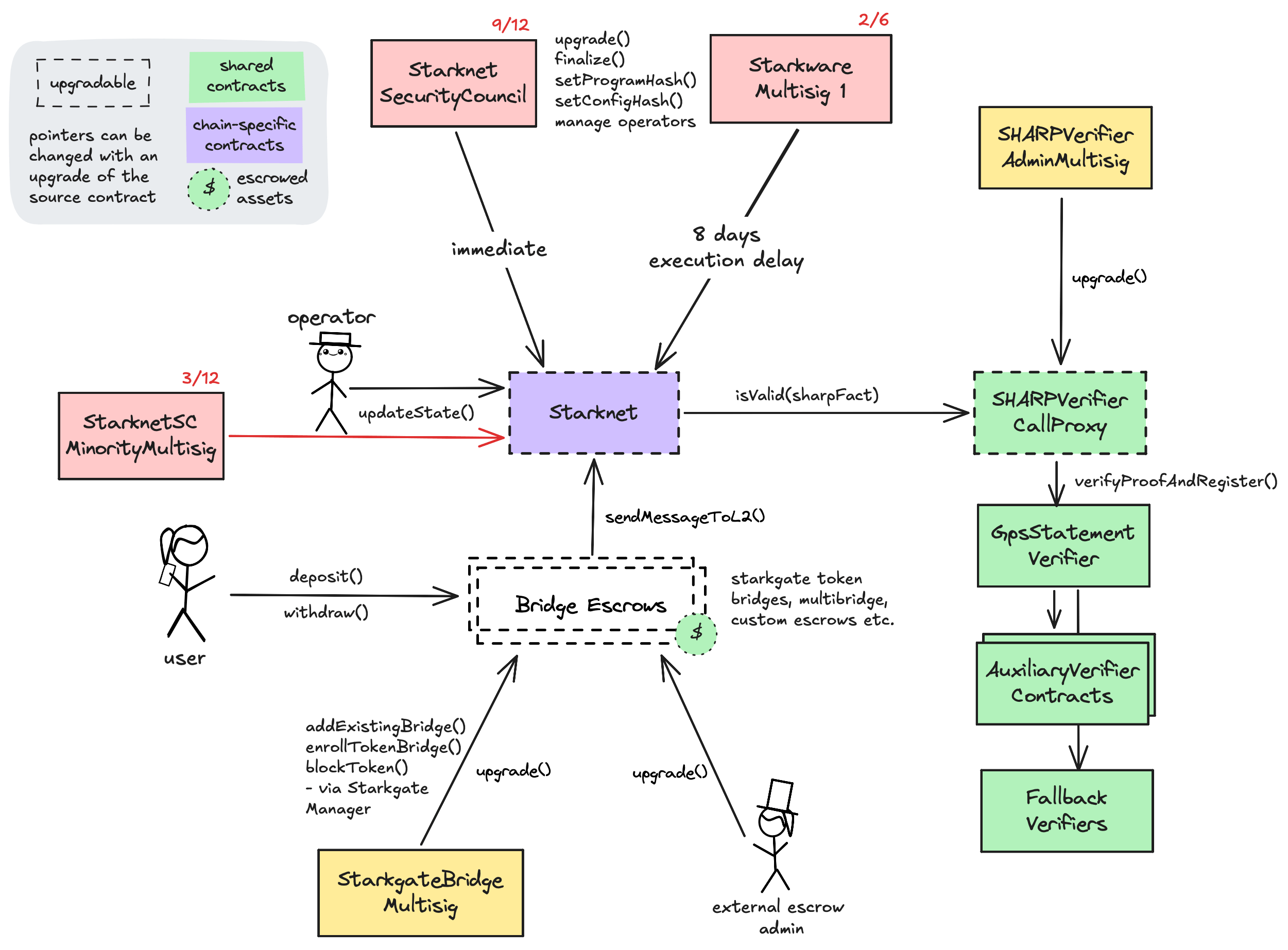
The Starknet zk RollupA blockchain that inherits consensus and data availability from another blockchain called L1. Rollups enable trust minimized bridges with the base layer via proof systems, either optimistic or zero-knowledge. A rollup without a bridge, or without considering the bridge, is called a sovereign rollup. shares its SHARP verifierAn entity in a ZK-Rollup, often a smart contract, that verifies zero-knowledge proofs submitted by a prover. with other StarkEx and SN Stack Layer 2s. Governance of the main Starknet rollup contract and its core bridgeA message-passing protocol between two blockchains. At its most basic, a token bridge consists of a smart contract which can escrow funds on one side of the bridge, and instruct the release or minting of corresponding assets on the other side, but bridges could also support arbitrary messages. How these instructions are validated is a critical factor in assessing the trust assumptions of a bridge. escrows (ETHBridge, STRKBridge) is currently split between two distinct signer groups: the 2/6 Starkware Multisig 1, which forms the normal upgrade path by routing all actions through the DelayedExecutor timelock with a 8d onchain delay, and the 9/12 Security CouncilA Security Council is a sufficiently decentralized set of members that is able to upgrade a system. A properly set up Security Council consists of at least 8 members with a threshold greater than 75%. What 'sufficiently decentralized' means is fundamentally subjective and L2BEAT evaluates each case individually. A Security Council is allowed to instantly upgrade Stage 1 rollups., which can upgrade instantly and is intended for emergencies only. The delay window on the normal path gives the community time to observe queued actions and allows the Security Council to counteract a malicious action with its instant rights. The 2/4 Starkware Multisig 2 governs most other bridge escrows with instant upgradeabilityThe ability for rollup smart contracts and parameters used in a rollup to be updated by holders of an admin key. Upgradeability represents a vector of risk for users, and should be decentralized and combined with time delays for greater security guarantees.. The shared SHARP verifier used for state validation can be changed by the 2/4 SHARP Multisig with and a 8d delay, affecting all rollups like Starknet that are sharing it.
The OperatorAn operator is the entity charged with managing a rollup and progressing its state. A rollup operator can be a centralized sequencer, proposer, prover, challenger, pauser of admin that is able to perform upgrades. role in the Starknet contract is permissioned to update the state of the Starknet rollup by supplying valid (zk) state transition proofs. Since this role is not permissionlessAnyone willing should be able to join and leave the network at any time, without causing significant disturbance to the network or being detrimental to the party in question. No single entity should have the power to allowlist or blocklist participants., Starknet implements a StarknetSCMinorityMultisig with the Operator role, which allows a 3/12 minority of the StarknetSecurityCouncil to enforce censorship resistance by including transactions that are not included by regular Operators.
All bridge escrows allow enabling a withdrawal throttle of 5% of the locked funds per 24h period. Enabling it is permissioned to a Multisig while disabling it in the core bridge escrows (STRKBridge, ETHBridge) can be done by a 3/12 minority of the Security Council.
Governance profile
Security Council
| Composition | 9/12 onchain Safe multisig — 12 members, geographically and organizationally diverse (<50% from one country, <4 from one organization). The Starknet Foundation appoints and can administratively remove members. No fixed term length and no live tokenholder election mechanism. |
|---|---|
| Members public | Not mapped, SNIP-25 and Foundation announcements publish only composition criteria (technical reputation, KYC/AML, diversity limits, conflict-of-interest rules). |
| Charter | SNIP-25 defines duties (security-only mandate), vetting-failure reports, eligibility and the code of conduct. |
| Can bypass DAO? | Yes — 9/12 can approve and execute an emergency upgrade immediately. The same instant rights let it counteract a malicious action queued in the DelayedExecutor during its 8d window. |
| DAO can override SC? | No, the community can only dispute the emergency upgrades after the fact in advisory way. |
Upgrades
| Major upgrade path | Release announcement (≥1 SNIP + specific GitHub commit) → 2-week community deliberation → 1-week final review → 1-week STRK vote on the Governance Hub on L2 → Security CouncilA Security Council is a sufficiently decentralized set of members that is able to upgrade a system. A properly set up Security Council consists of at least 8 members with a threshold greater than 75%. What 'sufficiently decentralized' means is fundamentally subjective and L2BEAT evaluates each case individually. A Security Council is allowed to instantly upgrade Stage 1 rollups. vetting → deployment queued in the DelayedExecutor by the 2/6 Starkware Multisig 1, whose 8d onchain delay covers the procedural ≥7-day freeze → execution. Minimum wall-clock ≈ 5 weeks (8d onchain-enforced if executed via DelayedExecutor). |
|---|---|
| Minor upgrade path | Announcement (SNIP may be submitted in parallel) → 1-week review → 1-week STRK vote on L2Layer 2 (L2) is a category of technical solutions aimed to scale the base layer in a trust minimized way. This category includes solutions like rollups as well as state channels and plasma. Other solutions are able to scale further, but with the introduction of additional trust assumptions, which are therefore not trust minimized. Sometimes the term Layer 2 is used to refer to include these solutions too, like validiums and optimiums, but to distinguish between trust minimized and non trust minimized solutions they are often referred to as "light" L2s, opposed to "strong" L2s like rollups. → deployment queued in the DelayedExecutor, whose 8d onchain delay covers the procedural ≥5-day freeze → execution. No Security CouncilA Security Council is a sufficiently decentralized set of members that is able to upgrade a system. A properly set up Security Council consists of at least 8 members with a threshold greater than 75%. What 'sufficiently decentralized' means is fundamentally subjective and L2BEAT evaluates each case individually. A Security Council is allowed to instantly upgrade Stage 1 rollups. approval required. Minimum wall-clock ≈ 22 days (8d onchain-enforced if executed via DelayedExecutor). |
| Emergency upgrade path | 9/12 Security CouncilA Security Council is a sufficiently decentralized set of members that is able to upgrade a system. A properly set up Security Council consists of at least 8 members with a threshold greater than 75%. What 'sufficiently decentralized' means is fundamentally subjective and L2BEAT evaluates each case individually. A Security Council is allowed to instantly upgrade Stage 1 rollups., instant. |
| Exit window | 8d enforced onchain by the DelayedExecutor on the normal upgrade path (procedurally ≥7 days after the vote for major releases, ≥5 days for minor). 0 for emergency upgrades by the Security CouncilA Security Council is a sufficiently decentralized set of members that is able to upgrade a system. A properly set up Security Council consists of at least 8 members with a threshold greater than 75%. What 'sufficiently decentralized' means is fundamentally subjective and L2BEAT evaluates each case individually. A Security Council is allowed to instantly upgrade Stage 1 rollups.. |
Token governance
| Governance token |
|
|---|---|
| Voting venue | Starknet Governance Hub using Snapshot X — proposals, space configuration and results are recorded and verified on Starknet, with relayed gasless signed votes. |
| Proposal threshold | None, but proposal admission is curated, not triggered permissionlessly by an onchain token threshold. |
| Quorum | No protocol-wide quorum rule published. Historical votes used a simple majority with no minimum quorum. |
| Execution model | Vote as onchain record, permissioned deployment — passed proposals are queued in the DelayedExecutor by the 2/6 Starkware Multisig 1 and execute after 8d. |
Past upgrades
The metrics include upgrades on the currently used proxy contracts. Historical proxy contracts and changes of such are not included.
Ossification
Contracts our research team classifies as critical form the project's critical perimeter. Its clock starts at the ossification genesis, and every critical change resets it (changes within 24 hours count as one). The ossification score is the share of recorded code-bug exploits whose exploited code was younger than this perimeter is today. Battle-tested exposure is the value secured, summed over that unchanged period.
Discovery updates
2026 October 16, 09:50 UTCHigh severity9changesStarknet upgrade: governance can set a minimum fee for L1 - L2 messages, up to the 1 ETH maximum. The setter is not locked by finalize() . The minimum is now 0.00005 ETH. Proof checks and pinned program hashes are unchanged. - https://disco.l2beat.com/diff/eth:0x9961D34D3baE6914635c882e8FE382e14E0F172A/eth:0x73352C6228Ec1DCf737973Db9822bB8e8a465c99
Starknet upgrade: governance can set a minimum fee for L1 -> L2 messages, up to the 1 ETH maximum. The setter is not locked by finalize(). The minimum is now 0.00005 ETH. Proof checks and pinned program hashes are unchanged.
- https://disco.l2beat.com/diff/eth:0x9961D34D3baE6914635c882e8FE382e14E0F172A/eth:0x73352C6228Ec1DCf737973Db9822bB8e8a465c99
| contract Starknet (eth:0xc662c410C0ECf747543f5bA90660f6ABeBD9C8c4) [starknet/Starknet] { | |
| +++ description: Central Starknet rollup contract. For every state update it derives a SHARP fact from the state-transition output and either the Starknet OS or aggregator program hash, checks that fact through the configured SHARP call proxy, and requires the output's OS-config hash to match. It also processes L1 <-> L2 messages and stores the finalized L2 state. | |
| sourceHashes.1: | |
| - | "0xef60960a959a9506c3f6eece9374f7fbcd095a488763801577ae88e427fd3d51" |
| + | "0xa6f25883f5a84ab9a53152a85a18e735a7ebc3fd96b8f56c87862df1245de198" |
| values.$implementation: | |
| - | "eth:0x9961D34D3baE6914635c882e8FE382e14E0F172A" |
| + | "eth:0x73352C6228Ec1DCf737973Db9822bB8e8a465c99" |
| values.$pastUpgrades.11: | |
| + | ["2026-10-14T11:07:35.000Z","0x69e217f115ea6b98822ca30aec1684377f4468232f92b36ddd9069cda5d5ee14",["eth:0x73352C6228Ec1DCf737973Db9822bB8e8a465c99"]] |
| values.$upgradeCount: | |
| - | 11 |
| + | 12 |
| values.identify: | |
| - | "StarkWare_Starknet_2026_11" |
| + | "StarkWare_Starknet_2026_12" |
| values.implementation: | |
| - | "eth:0x9961D34D3baE6914635c882e8FE382e14E0F172A" |
| + | "eth:0x73352C6228Ec1DCf737973Db9822bB8e8a465c99" |
| +++ description: Minimum fee in wei for an L1 -> L2 message. Governance can raise it up to the 1 ETH maximum fee, also after the application configuration is finalized. | |
| +++ severity: MEDIUM | |
| values.getMinL1MsgFee: | |
| + | 50000000000000 |
| implementationNames.eth:0x9961D34D3baE6914635c882e8FE382e14E0F172A: | |
| - | "Starknet" |
| implementationNames.eth:0x73352C6228Ec1DCf737973Db9822bB8e8a465c99: | |
| + | "Starknet" |
| } | |
2026 October 08, 09:46 UTCCritical state change6changesRotated two SC members. Also upgraded Starknet OS and aggregator programs, which were successfully regenerated.
Rotated two SC members. Also upgraded Starknet OS and aggregator programs, which were successfully regenerated.
| contract Starkware Security Council (eth:0x15e8c684FD095d4796A0c0CF678554F4c1C7C361) [GnosisSafe] { | |
| +++ description: None | |
| values.$members.1: | |
| - | "eth:0x5C7DcaECB4D8e49Ea2487c5Cc23C5131Ddb2252F" |
| + | "eth:0x99E84d004E73CC41eFacd382ef6FD34208B0F122" |
| values.$members.2: | |
| - | "eth:0x04D5b12b196a8CADEB2F476F22Ffb1334Ef9F94c" |
| + | "eth:0xb731B63eC22904A17d1cf6fD771eb5BA87f35Fa3" |
| } | |
| contract Starknet (eth:0xc662c410C0ECf747543f5bA90660f6ABeBD9C8c4) [starknet/Starknet] { | |
| +++ description: Central Starknet rollup contract. For every state update it derives a SHARP fact from the state-transition output and either the Starknet OS or aggregator program hash, checks that fact through the configured SHARP call proxy, and requires the output's OS-config hash to match. It also processes L1 <-> L2 messages and stores the finalized L2 state. | |
| +++ description: Previous Starknet aggregator program hashes emitted on each governance update. The current value is exposed separately as `aggregatorProgramHash`. | |
| values.aggregatorProgramHashHistory.7: | |
| + | "1050253032170513549151251823521174837478197699740478552102884446098263561922" |
| +++ description: Starknet OS program hash. In direct mode it is included in the SHARP fact key; in aggregator mode the aggregator's public output must contain this exact OS hash. A malicious OS program could prove arbitrary state transitions. Update the program-hash catalog and liveness tracking whenever this changes. | |
| +++ severity: HIGH | |
| values.programHash: | |
| - | "2006389624453304912912750132846114593020263069652857561377702883656839453432" |
| + | "569015423733809580615518794546253350390163920370934709723320624838312178729" |
| +++ description: Previous Starknet OS program hashes emitted on each governance update. The current value is exposed separately as `programHash`. | |
| values.programHashHistory.15: | |
| + | "2006389624453304912912750132846114593020263069652857561377702883656839453432" |
| +++ description: Human-readable label for the current Starknet OS program hash. | |
| +++ severity: HIGH | |
| values.programHashMapped: | |
| - | "2006389624453304912912750132846114593020263069652857561377702883656839453432" |
| + | "569015423733809580615518794546253350390163920370934709723320624838312178729" |
| } | |
2026 July 10, 10:17 UTCCritical state change6changesUpdated Starknet OS and aggregation ZK programs, new versions verified.
Updated Starknet OS and aggregation ZK programs, new versions verified.
| contract Starknet (eth:0xc662c410C0ECf747543f5bA90660f6ABeBD9C8c4) [starknet/Starknet] { | |
| +++ description: Central rollup contract. Receives (verified) state roots from the Sequencer, allows users to consume L2 -> L1 messages and send L1 -> L2 messages. Critical configuration values for the L2's logic are defined here by various governance roles. | |
| values.aggregatorHashMapped: | |
| - | "2571508110958925737463010241874806654058743535666147712534445437599630018294" |
| + | "1050253032170513549151251823521174837478197699740478552102884446098263561922" |
| values.aggregatorProgramHash: | |
| - | "2571508110958925737463010241874806654058743535666147712534445437599630018294" |
| + | "1050253032170513549151251823521174837478197699740478552102884446098263561922" |
| values.configHash: | |
| - | "3188242426588271529884520804512942022765170489242162533995649881904346336763" |
| + | "2579130946496422157802313572919622021390761807038780433165936715591440018810" |
| +++ description: The L2 programHash which is a hash of the L2 state machine logic. Liveness config MUST be changed in the .ts as soon as this is updated. | |
| +++ severity: HIGH | |
| values.programHash: | |
| - | "2733003247060056328192560178934419513655729851806095615814023997114795707702" |
| + | "2006389624453304912912750132846114593020263069652857561377702883656839453432" |
| values.programHashHistory.14: | |
| + | "2733003247060056328192560178934419513655729851806095615814023997114795707702" |
| values.programHashMapped: | |
| - | "2733003247060056328192560178934419513655729851806095615814023997114795707702" |
| + | "2006389624453304912912750132846114593020263069652857561377702883656839453432" |
| } | |
2026 July 08, 09:36 UTC2changesRotated two ms members.
Rotated two ms members.
| contract Starkware SCMinority Multisig (eth:0xF6b0B3e8f57396CecFD788D60499DB49Ee6AbC6B) [GnosisSafe] { | |
| +++ description: None | |
| values.$members.1: | |
| - | "eth:0x04D5b12b196a8CADEB2F476F22Ffb1334Ef9F94c" |
| + | "eth:0x99E84d004E73CC41eFacd382ef6FD34208B0F122" |
| values.$members.2: | |
| - | "eth:0x5C7DcaECB4D8e49Ea2487c5Cc23C5131Ddb2252F" |
| + | "eth:0xb731B63eC22904A17d1cf6fD771eb5BA87f35Fa3" |
| } | |
2026 July 06, 10:59 UTC4changesRotated two ms members.
Rotated two ms members.
| contract Starkware Security Council (eth:0x15e8c684FD095d4796A0c0CF678554F4c1C7C361) [GnosisSafe] { | |
| +++ description: None | |
| values.$members.3: | |
| - | "eth:0x2914767E232FD7708ab06bA60dB16c36C555751d" |
| + | "eth:0x49C6396070D3310f335AE19169Da6B80ea67B831" |
| values.$members.4: | |
| - | "eth:0xfaECfa5E4180dd55D15396F804Fd00C6dbA233B0" |
| + | "eth:0x16117672EBF77d5DE9a1Af91F8F79b26421b310F" |
| } | |
| contract Starkware SCMinority Multisig (eth:0xF6b0B3e8f57396CecFD788D60499DB49Ee6AbC6B) [GnosisSafe] { | |
| +++ description: None | |
| values.$members.0: | |
| - | "eth:0x2914767E232FD7708ab06bA60dB16c36C555751d" |
| + | "eth:0x49C6396070D3310f335AE19169Da6B80ea67B831" |
| values.$members.4: | |
| - | "eth:0xfaECfa5E4180dd55D15396F804Fd00C6dbA233B0" |
| + | "eth:0x16117672EBF77d5DE9a1Af91F8F79b26421b310F" |
| } | |
The system has a centralized operator
The operatorAn operator is the entity charged with managing a rollup and progressing its state. A rollup operator can be a centralized sequencer, proposer, prover, challenger, pauser of admin that is able to perform upgrades. is the only entity that can propose blocksAn ordered list of transactions and chain-related metadata that gets bundled together and published to the L1/DA layer. Nodes execute the transactions contained within blocks to change the rollup chain’s state. Protocol rules dictate what constitutes a valid block, and invalid blocks are skipped over.. A live and trustworthy operator is vital to the health of the system. Typically, the Operator is the hot wallet of the Starknet service submitting state updates for which proofs have been already submitted and verified.
MEV can be extracted if the operator exploits their centralized position and frontruns user transactions.
Users can't force any transaction
There is no general mechanism to force the sequencerA party responsible for ordering and executing transactions on the rollup. The sequencer verifies transactions, compresses the data into a block, and submits the data related to it to enable state reconstruction to Ethereum L1 as a single transaction. The data can be either transaction data or state diffs. to include the transaction.
Users can be censored if the operator refuses to include their transactions.
Transactions are ordered by centralized sequencers
Starknet v0.14.3 uses 5 equal-weight, permissioned consensusAn agreement on the latest and correct state of a blockchain. Unlike L1 blockchains which coordinate participating nodes with consensus rules, rollups rely on L1s for reaching consensus by checking the state of the rollup smart contract deployed thereon. sequencers controlled by StarkWare. A proposerIn the context of L2s, the actor that proposes a claimed state root on L1. The term is also used in the context of Ethereum to refer to the actor that proposes a new block. is selected in deterministic round-robin order and builds from its own peer-to-peer synchronized mempool. The current deployment uses an honest-majority Tendermint configuration, requiring 3/5 votes to decide a blockAn ordered list of transactions and chain-related metadata that gets bundled together and published to the L1/DA layer. Nodes execute the transactions contained within blocks to change the rollup chain’s state. Protocol rules dictate what constitutes a valid block, and invalid blocks are skipped over.. This provides process-level redundancy, but no independence from StarkWare for ordering or preconfirmations.
State advancement on Ethereum is a separate, also permissioned pipeline. Starknet OS execution tasks are proved and recursively aggregated through StarkWare’s SHARP service, using Stwo for proving tasks and Stone for the roots of the recursive tree. After the resulting proof fact is registered on Ethereum, only the 2 Starknet Operators can update the canonical state: the service OperatorAn operator is the entity charged with managing a rollup and progressing its state. A rollup operator can be a centralized sequencer, proposer, prover, challenger, pauser of admin that is able to perform upgrades. and the Security CouncilA Security Council is a sufficiently decentralized set of members that is able to upgrade a system. A properly set up Security Council consists of at least 8 members with a threshold greater than 75%. What 'sufficiently decentralized' means is fundamentally subjective and L2BEAT evaluates each case individually. A Security Council is allowed to instantly upgrade Stage 1 rollups. minority.
There is no user-callable forced-inclusion function. A censored user can post an L1Layer 1 (L1) is a blockchain that is self-reliant on its validator set for its security and consensus properties. Ethereum is an example of a layer 1. Blockchains started receiving the moniker of layer 1 once layer 2 became a meaningful area of development.-to-L2Layer 2 (L2) is a category of technical solutions aimed to scale the base layer in a trust minimized way. This category includes solutions like rollups as well as state channels and plasma. Other solutions are able to scale further, but with the introduction of additional trust assumptions, which are therefore not trust minimized. Sometimes the term Layer 2 is used to refer to include these solutions too, like validiums and optimiums, but to distinguish between trust minimized and non trust minimized solutions they are often referred to as "light" L2s, opposed to "strong" L2s like rollups. message and ask the Security Council minority to bypass consensus by including it in a valid, proven state updateA mechanism that allows to update the claimed state of a project. It usually involves verifying a state transition proof, but it can also be done in a trusted manner by a permissioned actor., but the contact and response process has no protocol deadline.
| Centralized sequencing spec sheet | |
|---|---|
| Trusted preconfirmation | 1.5s L2 block time |
| Trusted ordering | Higher explicit tips first |
| Sequencer | 5-node Tendermint |
| Real-time censorship resistance | |
| Forced inclusion | Security Council minority |
| Inclusion delay | No protocol deadline |
| Inclusion mechanics | Permissioned inclusion |
| Exit delay | Council response + proving |
| Exit economics | STARK proof + council action |
Censorship resistance
The permissioned sequencerA party responsible for ordering and executing transactions on the rollup. The sequencer verifies transactions, compresses the data into a block, and submits the data related to it to enable state reconstruction to Ethereum L1 as a single transaction. The data can be either transaction data or state diffs. committee provides no real-time censorship resistance. The Security CouncilA Security Council is a sufficiently decentralized set of members that is able to upgrade a system. A properly set up Security Council consists of at least 8 members with a threshold greater than 75%. What 'sufficiently decentralized' means is fundamentally subjective and L2BEAT evaluates each case individually. A Security Council is allowed to instantly upgrade Stage 1 rollups. minority can conditionally bypass consensusAn agreement on the latest and correct state of a blockchain. Unlike L1 blockchains which coordinate participating nodes with consensus rules, rollups rely on L1s for reaching consensus by checking the state of the rollup smart contract deployed thereon. with a valid, proven state updateA mechanism that allows to update the claimed state of a project. It usually involves verifying a state transition proof, but it can also be done in a trusted manner by a permissioned actor., but because users cannot invoke this path and it has no deadline, Starknet provides no deterministic eventual censorship-resistance guarantee.
- Starknet documentation - Transaction lifecycle
- Starknet documentation - SHARP architecture
- Starknet documentation - Current consensus centralization
- Starknet v0.14 - Tendermint and preconfirmations
- Starknet v0.14.3 - More frequent blocks
- Apollo - Mainnet consensus committee configuration
- Apollo - Consensus runtime configuration
- Apollo - L2 block-time target
- Apollo - Deterministic proposer rotation
- Apollo - Mempool fee ordering
- Starknet documentation - L1-L2 messaging
- Starknet - Decentralization roadmap
- Starknet core contract - source code
Regular messaging
The user initiates L2Layer 2 (L2) is a category of technical solutions aimed to scale the base layer in a trust minimized way. This category includes solutions like rollups as well as state channels and plasma. Other solutions are able to scale further, but with the introduction of additional trust assumptions, which are therefore not trust minimized. Sometimes the term Layer 2 is used to refer to include these solutions too, like validiums and optimiums, but to distinguish between trust minimized and non trust minimized solutions they are often referred to as "light" L2s, opposed to "strong" L2s like rollups.->L1Layer 1 (L1) is a blockchain that is self-reliant on its validator set for its security and consensus properties. Ethereum is an example of a layer 1. Blockchains started receiving the moniker of layer 1 once layer 2 became a meaningful area of development. messages by submitting a regular transaction on this chain. When the blockAn ordered list of transactions and chain-related metadata that gets bundled together and published to the L1/DA layer. Nodes execute the transactions contained within blocks to change the rollup chain’s state. Protocol rules dictate what constitutes a valid block, and invalid blocks are skipped over. containing that transaction is settled, the message becomes available for processing on L1. ZK proofs are required to settle blocks. Note that the message request can be censored by the SequencerA party responsible for ordering and executing transactions on the rollup. The sequencer verifies transactions, compresses the data into a block, and submits the data related to it to enable state reconstruction to Ethereum L1 as a single transaction. The data can be either transaction data or state diffs..
Funds can be frozen if the operator censors withdrawal transaction.
Emergency exit
There is no generic escape hatchThe facility for any user of a rollup to exit the system with their assets under any circumstance. Most relevant in rollups with a centralized proposer, wherein users do not have the ability to propose blocks, but can nonetheless exit the rollup by interacting with a smart contract on L1. mechanism as Starknet cannot be forced by users into a frozen state. Note that a freezing mechanism on L2Layer 2 (L2) is a category of technical solutions aimed to scale the base layer in a trust minimized way. This category includes solutions like rollups as well as state channels and plasma. Other solutions are able to scale further, but with the introduction of additional trust assumptions, which are therefore not trust minimized. Sometimes the term Layer 2 is used to refer to include these solutions too, like validiums and optimiums, but to distinguish between trust minimized and non trust minimized solutions they are often referred to as "light" L2s, opposed to "strong" L2s like rollups., to be secure, requires anti-censorship protection.
Ethereum
Actors:
A Multisig with 2/4 threshold.
- Can upgrade with no delay
- StarkgateManager
- StarkgateRegistry
- WBTCBridge
- FXSBridge
- sfrxETHBridge
- FRAXBridge
- MultiBridge
- UNIBridge
- Can upgrade with 3d delay
- USDTBridge - acting directly with 3d delay
- wstETHBridge - acting directly with 3d delay
- rETHBridge - acting directly with 3d delay
- USDCBridge - acting directly with 3d delay
- Can interact with StarkgateManager
- enroll new tokens, deactivate existing ones (for deposits) or blockAn ordered list of transactions and chain-related metadata that gets bundled together and published to the L1/DA layer. Nodes execute the transactions contained within blocks to change the rollup chain’s state. Protocol rules dictate what constitutes a valid block, and invalid blocks are skipped over. tokens from being added to the Multibridge
- manage critical access control roles related to upgrades and set the proxy governor that can upgrade the implementation
- Can interact with StarkgateRegistry
- manage critical access control roles and the role that can upgrade the implementation
- Can interact with WBTCBridge
- disable the withdrawal limit and manage the security agent role that can enable it
- manage critical access control roles related to upgrades and set the proxy governor that can upgrade the implementation
- Can interact with FXSBridge
- disable the withdrawal limit and manage the security agent role that can enable it
- manage critical access control roles related to upgrades and set the proxy governor that can upgrade the implementation
- Can interact with USDTBridge
- disable the withdrawal limit and manage the security agent role that can enable it
- manage critical access control roles related to upgrades and set the proxy governor that can upgrade the implementation
- Can interact with wstETHBridge
- disable the withdrawal limit and manage the security agent role that can enable it
- manage critical access control roles related to upgrades and set the proxy governor that can upgrade the implementation
- Can interact with rETHBridge
- disable the withdrawal limit and manage the security agent role that can enable it
- manage critical access control roles related to upgrades and set the proxy governor that can upgrade the implementation
- Can interact with sfrxETHBridge
- disable the withdrawal limit and manage the security agent role that can enable it
- manage critical access control roles related to upgrades and set the proxy governor that can upgrade the implementation
- Can interact with FRAXBridge
- disable the withdrawal limit and manage the security agent role that can enable it
- manage critical access control roles related to upgrades and set the proxy governor that can upgrade the implementation
- Can interact with LUSDBridge
- disable the withdrawal limit and manage the security agent role that can enable it
- manage critical access control roles related to upgrades and set the proxy governor that can upgrade the implementation
- Can interact with MultiBridge
- disable the withdrawal limit and manage the security agent role that can enable it
- manage critical access control roles related to upgrades and set the proxy governor that can upgrade the implementation
- Can interact with USDCBridge
- disable the withdrawal limit and manage the security agent role that can enable it
- manage critical access control roles related to upgrades and set the proxy governor that can upgrade the implementation
- Can interact with UNIBridge
- disable the withdrawal limit and manage the security agent role that can enable it
- manage critical access control roles related to upgrades and set the proxy governor that can upgrade the implementation
A Multisig with 9/12 threshold.
- Can upgrade with no delay
- ETHBridge
- Starknet
- STRKBridge
- Can interact with ETHBridge
- manage critical access control roles related to upgrades and set the proxy governor that can upgrade the implementation
- Can interact with Starknet
- Permissioned to manage the OperatorAn operator is the entity charged with managing a rollup and progressing its state. A rollup operator can be a centralized sequencer, proposer, prover, challenger, pauser of admin that is able to perform upgrades. role, finalize the application configuration, and change the OS program hashA fixed-length fingerprint of variable-size input, produced by a hash function., aggregator program hash, OS-config hash, fee collector, or message cancellation delay
- Can interact with STRKBridge
- manage critical access control roles related to upgrades and set the proxy governor that can upgrade the implementation
A Multisig with 2/4 threshold.
- Can upgrade with 8d delay
- SHARPVerifierCallProxy - acting directly with 8d delay
- Can interact with SHARPVerifierCallProxy
- Administer the CallProxy’s
GOVERNANCE_ADMINand role-admin hierarchy. This AccessControl role is separate from the outer proxy governor that schedules implementation upgrades - Grant and revoke application roles, including the
APP_GOVERNORrole that controls caller-specific fallback routes - Route fallback calls from specific callers to a still-active registry in the default verifierAn entity in a ZK-Rollup, often a smart contract, that verifies zero-knowledge proofs submitted by a prover.’s reference chain. This principally determines which verifier and bootloader configuration processes their proof submissions; the proxy’s explicit
isValidentry point always queries the default target
- Administer the CallProxy’s
A Multisig with 2/6 threshold.
- Can upgrade with 8d delay
- ETHBridge DelayedExecutor with 8d delay
- Starknet DelayedExecutor with 8d delay
- STRKBridge DelayedExecutor with 8d delay
- Can interact with Starknet
- Permissioned to manage the OperatorAn operator is the entity charged with managing a rollup and progressing its state. A rollup operator can be a centralized sequencer, proposer, prover, challenger, pauser of admin that is able to perform upgrades. role, finalize the application configuration, and change the OS program hashA fixed-length fingerprint of variable-size input, produced by a hash function., aggregator program hash, OS-config hash, fee collector, or message cancellation delay with 8d delay DelayedExecutor with 8d delay
A Multisig with 3/12 threshold.
- Can interact with ETHBridge
- disable the withdrawal limit and manage the security agent role that can enable it
- Can interact with Starknet
- Permissioned to regularly post L2Layer 2 (L2) is a category of technical solutions aimed to scale the base layer in a trust minimized way. This category includes solutions like rollups as well as state channels and plasma. Other solutions are able to scale further, but with the introduction of additional trust assumptions, which are therefore not trust minimized. Sometimes the term Layer 2 is used to refer to include these solutions too, like validiums and optimiums, but to distinguish between trust minimized and non trust minimized solutions they are often referred to as "light" L2s, opposed to "strong" L2s like rollups. state updates and choose an available data-availability entry point. Under the current implementation, every update still needs a fact accepted by SHARP and cannot bypass the pinned program and config hashes
- Can interact with STRKBridge
- disable the withdrawal limit and manage the security agent role that can enable it
Acts as a central contract to manage StarkGate bridgeA message-passing protocol between two blockchains. At its most basic, a token bridge consists of a smart contract which can escrow funds on one side of the bridge, and instruct the release or minting of corresponding assets on the other side, but bridges could also support arbitrary messages. How these instructions are validated is a critical factor in assessing the trust assumptions of a bridge. escrows (add new ones, deactivate existing, change configs) when given the Manager role from the respective escrows.
- Can interact with MultiBridge
- enroll new tokens or deactivate deposits into the escrow (for each token individually)
A Multisig with 3/5 threshold.
Member of Starkware Multisig 4.
- Can interact with WBTCBridge
- enable the withdrawal limit Starkware Multisig 4
- Can interact with ETHBridge
- enable the withdrawal limit Starkware Multisig 4
- Can interact with USDTBridge
- enable the withdrawal limit Starkware Multisig 4
- Can interact with STRKBridge
- enable the withdrawal limit Starkware Multisig 4
- Can interact with MultiBridge
- enable the withdrawal limit Starkware Multisig 4
- Can interact with USDCBridge
- enable the withdrawal limit Starkware Multisig 4
Member of Starkware Multisig 2, Starkware Multisig 4, Starkware Multisig 1, SHARP Multisig.
- Can interact with WBTCBridge
- enable the withdrawal limit Starkware Multisig 4
- Can interact with ETHBridge
- enable the withdrawal limit Starkware Multisig 4
- Can interact with USDTBridge
- enable the withdrawal limit Starkware Multisig 4
- Can interact with STRKBridge
- enable the withdrawal limit Starkware Multisig 4
- Can interact with MultiBridge
- enable the withdrawal limit Starkware Multisig 4
- Can interact with USDCBridge
- enable the withdrawal limit Starkware Multisig 4
- Can interact with Starknet
- Permissioned to regularly post L2Layer 2 (L2) is a category of technical solutions aimed to scale the base layer in a trust minimized way. This category includes solutions like rollups as well as state channels and plasma. Other solutions are able to scale further, but with the introduction of additional trust assumptions, which are therefore not trust minimized. Sometimes the term Layer 2 is used to refer to include these solutions too, like validiums and optimiums, but to distinguish between trust minimized and non trust minimized solutions they are often referred to as "light" L2s, opposed to "strong" L2s like rollups. state updates and choose an available data-availability entry point. Under the current implementation, every update still needs a fact accepted by SHARP and cannot bypass the pinned program and config hashes
- Can interact with ETHBridge
- enable the withdrawal limit
- Can interact with STRKBridge
- enable the withdrawal limit
- Can upgrade with no delay
- SolvBTCBridge
- LUSDBridge
- Can interact with SolvBTCBridge
- disable the withdrawal limit and manage the security agent role that can enable it
- manage critical access control roles related to upgrades and set the proxy governor that can upgrade the implementation
- Can upgrade with no delay
- LBTCBridge
- Can interact with LBTCBridge
- disable the withdrawal limit and manage the security agent role that can enable it
- manage critical access control roles related to upgrades and set the proxy governor that can upgrade the implementation
Ethereum
Central Starknet rollupA blockchain that inherits consensus and data availability from another blockchain called L1. Rollups enable trust minimized bridges with the base layer via proof systems, either optimistic or zero-knowledge. A rollup without a bridge, or without considering the bridge, is called a sovereign rollup. contract. For every state updateA mechanism that allows to update the claimed state of a project. It usually involves verifying a state transition proof, but it can also be done in a trusted manner by a permissioned actor. it derives a SHARP fact from the state-transition output and either the Starknet OS or aggregator program hashA fixed-length fingerprint of variable-size input, produced by a hash function., checks that fact through the configured SHARP call proxy, and requires the output’s OS-config hash to match. It also processes L1Layer 1 (L1) is a blockchain that is self-reliant on its validator set for its security and consensus properties. Ethereum is an example of a layer 1. Blockchains started receiving the moniker of layer 1 once layer 2 became a meaningful area of development. <-> L2Layer 2 (L2) is a category of technical solutions aimed to scale the base layer in a trust minimized way. This category includes solutions like rollups as well as state channels and plasma. Other solutions are able to scale further, but with the introduction of additional trust assumptions, which are therefore not trust minimized. Sometimes the term Layer 2 is used to refer to include these solutions too, like validiums and optimiums, but to distinguish between trust minimized and non trust minimized solutions they are often referred to as "light" L2s, opposed to "strong" L2s like rollups. messages and stores the finalized L2 state.
- Roles:
- admin: DelayedExecutor, Starkware Security CouncilA Security Council is a sufficiently decentralized set of members that is able to upgrade a system. A properly set up Security Council consists of at least 8 members with a threshold greater than 75%. What 'sufficiently decentralized' means is fundamentally subjective and L2BEAT evaluates each case individually. A Security Council is allowed to instantly upgrade Stage 1 rollups.; ultimately Starkware Multisig 1
- operators: EOA 4, Starkware SCMinority Multisig
Immutable Solidity verifierAn entity in a ZK-Rollup, often a smart contract, that verifies zero-knowledge proofs submitted by a prover. for one Cairo CPU layout. It checks the STARKShort for "scalable transparent argument of knowledge", a STARK is a type of zero-knowledge proof that resolves one of the primary weaknesses of ZK-SNARKs, its reliance on a "trusted setup”. STARKs also come with much simpler cryptographic assumptions, avoiding the need for elliptic curves, pairings, and the knowledge-of-exponent assumption and instead relying purely on hashes and information theory. This means that they are secure even against attackers with quantum computers. proof using layout-specific constraint, OODS, Merkle, FRIA proximity test method that is used to determine whether a set of points is mostly on a polynomial with a degree less than a specified value. It resembles the FFT but the arithmetic complexity of its prover is strictly linear and that of the verifier is strictly logarithmic., and periodic-column helper contracts. The SHARP verifier can select any configured layout by cairoVerifierId.
Immutable Solidity verifierAn entity in a ZK-Rollup, often a smart contract, that verifies zero-knowledge proofs submitted by a prover. for one Cairo CPU layout. It checks the STARKShort for "scalable transparent argument of knowledge", a STARK is a type of zero-knowledge proof that resolves one of the primary weaknesses of ZK-SNARKs, its reliance on a "trusted setup”. STARKs also come with much simpler cryptographic assumptions, avoiding the need for elliptic curves, pairings, and the knowledge-of-exponent assumption and instead relying purely on hashes and information theory. This means that they are secure even against attackers with quantum computers. proof using layout-specific constraint, OODS, Merkle, FRIA proximity test method that is used to determine whether a set of points is mostly on a polynomial with a degree less than a specified value. It resembles the FFT but the arithmetic complexity of its prover is strictly linear and that of the verifier is strictly logarithmic., and periodic-column helper contracts. The SHARP verifier can select any configured layout by cairoVerifierId.
Stores the complete compiled Cairo outer bootloader used as the top-level program of a SHARP proof. The SHARP verifierAn entity in a ZK-Rollup, often a smart contract, that verifies zero-knowledge proofs submitted by a prover. copies these words into public memory, pinning this exact executable onchain independently of the separately committed simple, applicative, and recursive-verifier programs.
Immutable Solidity verifierAn entity in a ZK-Rollup, often a smart contract, that verifies zero-knowledge proofs submitted by a prover. for one Cairo CPU layout. It checks the STARKShort for "scalable transparent argument of knowledge", a STARK is a type of zero-knowledge proof that resolves one of the primary weaknesses of ZK-SNARKs, its reliance on a "trusted setup”. STARKs also come with much simpler cryptographic assumptions, avoiding the need for elliptic curves, pairings, and the knowledge-of-exponent assumption and instead relying purely on hashes and information theory. This means that they are secure even against attackers with quantum computers. proof using layout-specific constraint, OODS, Merkle, FRIA proximity test method that is used to determine whether a set of points is mostly on a polynomial with a degree less than a specified value. It resembles the FFT but the arithmetic complexity of its prover is strictly linear and that of the verifier is strictly logarithmic., and periodic-column helper contracts. The SHARP verifier can select any configured layout by cairoVerifierId.
Immutable Solidity verifierAn entity in a ZK-Rollup, often a smart contract, that verifies zero-knowledge proofs submitted by a prover. for one Cairo CPU layout. It checks the STARKShort for "scalable transparent argument of knowledge", a STARK is a type of zero-knowledge proof that resolves one of the primary weaknesses of ZK-SNARKs, its reliance on a "trusted setup”. STARKs also come with much simpler cryptographic assumptions, avoiding the need for elliptic curves, pairings, and the knowledge-of-exponent assumption and instead relying purely on hashes and information theory. This means that they are secure even against attackers with quantum computers. proof using layout-specific constraint, OODS, Merkle, FRIA proximity test method that is used to determine whether a set of points is mostly on a polynomial with a degree less than a specified value. It resembles the FFT but the arithmetic complexity of its prover is strictly linear and that of the verifier is strictly logarithmic., and periodic-column helper contracts. The SHARP verifier can select any configured layout by cairoVerifierId.
PermissionlessAnyone willing should be able to join and leave the network at any time, without causing significant disturbance to the network or being detrimental to the party in question. No single entity should have the power to allowlist or blocklist participants. commitment calculator and registry used by the Solidity STARKShort for "scalable transparent argument of knowledge", a STARK is a type of zero-knowledge proof that resolves one of the primary weaknesses of ZK-SNARKs, its reliance on a "trusted setup”. STARKs also come with much simpler cryptographic assumptions, avoiding the need for elliptic curves, pairings, and the knowledge-of-exponent assumption and instead relying purely on hashes and information theory. This means that they are secure even against attackers with quantum computers. verifiers. Anyone may submit a public-memory page and interaction elements; the contract computes its hashA fixed-length fingerprint of variable-size input, produced by a hash function. and cumulative product and registers the fact key committing to them, which the CPU verifierAn entity in a ZK-Rollup, often a smart contract, that verifies zero-knowledge proofs submitted by a prover. must bind to the proof. It is part of the proof verifier, not an application-level program registry. A malicious or nonconforming implementation can break public-memory soundness; binding to a different honest registry generally causes a livenessLiveness refers to the ability of a system to respond to requests and to process them in a timely manner. In the context of L2s, it refers to the ability of settling transactions, proofs and state roots to the base layer. failure instead.
Upgradeable call router through which Starknet and other applications access SHARP fact registries. It uses call, not delegatecall, so facts and immutable verifierAn entity in a ZK-Rollup, often a smart contract, that verifies zero-knowledge proofs submitted by a prover. configuration remain at each target registry. The explicit isValid entry point always queries the default target. Other calls handled by the fallback, principally proof submissions, can be routed per caller to a still-active registry in the default target’s reference chain. The default target can be replaced by SHARP Multisig after 8d.
- Roles:
- admin: SHARP Multisig
- appGovernor: SHARP Multisig
- appRoleAdmin: SHARP Multisig
- governanceAdmin: SHARP Multisig
Immutable GPS statement verifierAn entity in a ZK-Rollup, often a smart contract, that verifies zero-knowledge proofs submitted by a prover. shared by Starknet and other StarkWare systems. It verifies a STARKShort for "scalable transparent argument of knowledge", a STARK is a type of zero-knowledge proof that resolves one of the primary weaknesses of ZK-SNARKs, its reliance on a "trusted setup”. STARKs also come with much simpler cryptographic assumptions, avoiding the need for elliptic curves, pairings, and the knowledge-of-exponent assumption and instead relying purely on hashes and information theory. This means that they are secure even against attackers with quantum computers. proof of the exact Cairo bootloader stored onchain, forces the bootloader configuration into public memory, and registers a fact for every bootloader task. A fact is also considered valid when it exists in the time-limited reference fact registry.
Immutable GPS statement verifierAn entity in a ZK-Rollup, often a smart contract, that verifies zero-knowledge proofs submitted by a prover. shared by Starknet and other StarkWare systems. It verifies a STARKShort for "scalable transparent argument of knowledge", a STARK is a type of zero-knowledge proof that resolves one of the primary weaknesses of ZK-SNARKs, its reliance on a "trusted setup”. STARKs also come with much simpler cryptographic assumptions, avoiding the need for elliptic curves, pairings, and the knowledge-of-exponent assumption and instead relying purely on hashes and information theory. This means that they are secure even against attackers with quantum computers. proof of the exact Cairo bootloader stored onchain, forces the bootloader configuration into public memory, and registers a fact for every bootloader task. A fact is also considered valid when it exists in the time-limited reference fact registry.
Immutable Solidity verifierAn entity in a ZK-Rollup, often a smart contract, that verifies zero-knowledge proofs submitted by a prover. for one Cairo CPU layout. It checks the STARKShort for "scalable transparent argument of knowledge", a STARK is a type of zero-knowledge proof that resolves one of the primary weaknesses of ZK-SNARKs, its reliance on a "trusted setup”. STARKs also come with much simpler cryptographic assumptions, avoiding the need for elliptic curves, pairings, and the knowledge-of-exponent assumption and instead relying purely on hashes and information theory. This means that they are secure even against attackers with quantum computers. proof using layout-specific constraint, OODS, Merkle, FRIA proximity test method that is used to determine whether a set of points is mostly on a polynomial with a degree less than a specified value. It resembles the FFT but the arithmetic complexity of its prover is strictly linear and that of the verifier is strictly logarithmic., and periodic-column helper contracts. The SHARP verifier can select any configured layout by cairoVerifierId.
Immutable Solidity verifierAn entity in a ZK-Rollup, often a smart contract, that verifies zero-knowledge proofs submitted by a prover. for one Cairo CPU layout. It checks the STARKShort for "scalable transparent argument of knowledge", a STARK is a type of zero-knowledge proof that resolves one of the primary weaknesses of ZK-SNARKs, its reliance on a "trusted setup”. STARKs also come with much simpler cryptographic assumptions, avoiding the need for elliptic curves, pairings, and the knowledge-of-exponent assumption and instead relying purely on hashes and information theory. This means that they are secure even against attackers with quantum computers. proof using layout-specific constraint, OODS, Merkle, FRIA proximity test method that is used to determine whether a set of points is mostly on a polynomial with a degree less than a specified value. It resembles the FFT but the arithmetic complexity of its prover is strictly linear and that of the verifier is strictly logarithmic., and periodic-column helper contracts. The SHARP verifier can select any configured layout by cairoVerifierId.
Immutable GPS statement verifierAn entity in a ZK-Rollup, often a smart contract, that verifies zero-knowledge proofs submitted by a prover. shared by Starknet and other StarkWare systems. It verifies a STARKShort for "scalable transparent argument of knowledge", a STARK is a type of zero-knowledge proof that resolves one of the primary weaknesses of ZK-SNARKs, its reliance on a "trusted setup”. STARKs also come with much simpler cryptographic assumptions, avoiding the need for elliptic curves, pairings, and the knowledge-of-exponent assumption and instead relying purely on hashes and information theory. This means that they are secure even against attackers with quantum computers. proof of the exact Cairo bootloader stored onchain, forces the bootloader configuration into public memory, and registers a fact for every bootloader task. A fact is also considered valid when it exists in the time-limited reference fact registry.
Immutable Solidity verifierAn entity in a ZK-Rollup, often a smart contract, that verifies zero-knowledge proofs submitted by a prover. for one Cairo CPU layout. It checks the STARKShort for "scalable transparent argument of knowledge", a STARK is a type of zero-knowledge proof that resolves one of the primary weaknesses of ZK-SNARKs, its reliance on a "trusted setup”. STARKs also come with much simpler cryptographic assumptions, avoiding the need for elliptic curves, pairings, and the knowledge-of-exponent assumption and instead relying purely on hashes and information theory. This means that they are secure even against attackers with quantum computers. proof using layout-specific constraint, OODS, Merkle, FRIA proximity test method that is used to determine whether a set of points is mostly on a polynomial with a degree less than a specified value. It resembles the FFT but the arithmetic complexity of its prover is strictly linear and that of the verifier is strictly logarithmic., and periodic-column helper contracts. The SHARP verifier can select any configured layout by cairoVerifierId.
PermissionlessAnyone willing should be able to join and leave the network at any time, without causing significant disturbance to the network or being detrimental to the party in question. No single entity should have the power to allowlist or blocklist participants. commitment calculator and registry used by the Solidity STARKShort for "scalable transparent argument of knowledge", a STARK is a type of zero-knowledge proof that resolves one of the primary weaknesses of ZK-SNARKs, its reliance on a "trusted setup”. STARKs also come with much simpler cryptographic assumptions, avoiding the need for elliptic curves, pairings, and the knowledge-of-exponent assumption and instead relying purely on hashes and information theory. This means that they are secure even against attackers with quantum computers. verifiers. Anyone may submit a public-memory page and interaction elements; the contract computes its hashA fixed-length fingerprint of variable-size input, produced by a hash function. and cumulative product and registers the fact key committing to them, which the CPU verifierAn entity in a ZK-Rollup, often a smart contract, that verifies zero-knowledge proofs submitted by a prover. must bind to the proof. It is part of the proof verifier, not an application-level program registry. A malicious or nonconforming implementation can break public-memory soundness; binding to a different honest registry generally causes a livenessLiveness refers to the ability of a system to respond to requests and to process them in a timely manner. In the context of L2s, it refers to the ability of settling transactions, proofs and state roots to the base layer. failure instead.
Immutable GPS statement verifierAn entity in a ZK-Rollup, often a smart contract, that verifies zero-knowledge proofs submitted by a prover. shared by Starknet and other StarkWare systems. It verifies a STARKShort for "scalable transparent argument of knowledge", a STARK is a type of zero-knowledge proof that resolves one of the primary weaknesses of ZK-SNARKs, its reliance on a "trusted setup”. STARKs also come with much simpler cryptographic assumptions, avoiding the need for elliptic curves, pairings, and the knowledge-of-exponent assumption and instead relying purely on hashes and information theory. This means that they are secure even against attackers with quantum computers. proof of the exact Cairo bootloader stored onchain, forces the bootloader configuration into public memory, and registers a fact for every bootloader task. A fact is also considered valid when it exists in the time-limited reference fact registry.
Immutable Solidity verifierAn entity in a ZK-Rollup, often a smart contract, that verifies zero-knowledge proofs submitted by a prover. for one Cairo CPU layout. It checks the STARKShort for "scalable transparent argument of knowledge", a STARK is a type of zero-knowledge proof that resolves one of the primary weaknesses of ZK-SNARKs, its reliance on a "trusted setup”. STARKs also come with much simpler cryptographic assumptions, avoiding the need for elliptic curves, pairings, and the knowledge-of-exponent assumption and instead relying purely on hashes and information theory. This means that they are secure even against attackers with quantum computers. proof using layout-specific constraint, OODS, Merkle, FRIA proximity test method that is used to determine whether a set of points is mostly on a polynomial with a degree less than a specified value. It resembles the FFT but the arithmetic complexity of its prover is strictly linear and that of the verifier is strictly logarithmic., and periodic-column helper contracts. The SHARP verifier can select any configured layout by cairoVerifierId.
A simple Timelock contract with an immutable delay of 8d. The owner (Starkware Multisig 1) can queue transactions.
- Roles:
- owner: Starkware Multisig 1
Standard Starkware canonical bridgeA message-passing protocol between two blockchains. At its most basic, a token bridge consists of a smart contract which can escrow funds on one side of the bridge, and instruct the release or minting of corresponding assets on the other side, but bridges could also support arbitrary messages. How these instructions are validated is a critical factor in assessing the trust assumptions of a bridge. escrow for ETH. Withdrawals can be throttled to 5% of the locked funds per 24 hours.
- Roles:
- admin: DelayedExecutor, Starkware Security CouncilA Security Council is a sufficiently decentralized set of members that is able to upgrade a system. A properly set up Security Council consists of at least 8 members with a threshold greater than 75%. What 'sufficiently decentralized' means is fundamentally subjective and L2BEAT evaluates each case individually. A Security Council is allowed to instantly upgrade Stage 1 rollups.; ultimately Starkware Multisig 1
- govAdmin: Starkware Security Council
- secAdmin: Starkware SCMinority Multisig
- secAgent: EOA 5, Starkware Multisig 4; ultimately EOA 1, EOA 2, EOA 3
Custom (and immutable) entry point contract and escrow for users depositing LORDS to via StarkGate to the L2Layer 2 (L2) is a category of technical solutions aimed to scale the base layer in a trust minimized way. This category includes solutions like rollups as well as state channels and plasma. Other solutions are able to scale further, but with the introduction of additional trust assumptions, which are therefore not trust minimized. Sometimes the term Layer 2 is used to refer to include these solutions too, like validiums and optimiums, but to distinguish between trust minimized and non trust minimized solutions they are often referred to as "light" L2s, opposed to "strong" L2s like rollups..
A simple registry that maps tokens to their StarkGate escrows. It also keeps a list of tokens that are blocked from being added to StarkGate.
- Roles:
- admin: Starkware Multisig 2
- govAdmin: Starkware Multisig 2
Haltable version of the Starkware Multibridge escrow. Withdrawals can be throttled to 5% of the locked funds per 24 hours for each token individually. Deposits for a particular token can be halted by app governor, halt must be finalized in the second transaction that also sweeps all funds into a clrearing address. There is no logic to resume bridging after the halt.
- Roles:
- admin: Starkware Multisig 2
- govAdmin: Starkware Multisig 2
- secAdmin: Starkware Multisig 2
- secAgent: Starkware Multisig 4; ultimately EOA 1, EOA 2, EOA 3
Standard Starkware bridgeA message-passing protocol between two blockchains. At its most basic, a token bridge consists of a smart contract which can escrow funds on one side of the bridge, and instruct the release or minting of corresponding assets on the other side, but bridges could also support arbitrary messages. How these instructions are validated is a critical factor in assessing the trust assumptions of a bridge. escrow (single token). Withdrawals can be throttled to 5% of the locked funds per 24 hours.
- Roles:
- admin: Starkware Multisig 2
- govAdmin: Starkware Multisig 2
- secAdmin: Starkware Multisig 2

Gateway contract that is the user entrypoint to deposit DAI to a custom escrow to bridgeA message-passing protocol between two blockchains. At its most basic, a token bridge consists of a smart contract which can escrow funds on one side of the bridge, and instruct the release or minting of corresponding assets on the other side, but bridges could also support arbitrary messages. How these instructions are validated is a critical factor in assessing the trust assumptions of a bridge. via StarkGate.
Standard Starkware bridgeA message-passing protocol between two blockchains. At its most basic, a token bridge consists of a smart contract which can escrow funds on one side of the bridge, and instruct the release or minting of corresponding assets on the other side, but bridges could also support arbitrary messages. How these instructions are validated is a critical factor in assessing the trust assumptions of a bridge. escrow (single token). Withdrawals can be throttled to 5% of the locked funds per 24 hours.
- Roles:
- admin: Starkware Multisig 2
- govAdmin: Starkware Multisig 2
- secAdmin: Starkware Multisig 2
- secAgent: Starkware Multisig 4; ultimately EOA 1, EOA 2, EOA 3

Standard Starkware bridgeA message-passing protocol between two blockchains. At its most basic, a token bridge consists of a smart contract which can escrow funds on one side of the bridge, and instruct the release or minting of corresponding assets on the other side, but bridges could also support arbitrary messages. How these instructions are validated is a critical factor in assessing the trust assumptions of a bridge. escrow (single token). Withdrawals can be throttled to 5% of the locked funds per 24 hours.
- Roles:
- admin: Starkware Multisig 2
- govAdmin: Starkware Multisig 2
- secAdmin: Starkware Multisig 2

Standard Starkware bridgeA message-passing protocol between two blockchains. At its most basic, a token bridge consists of a smart contract which can escrow funds on one side of the bridge, and instruct the release or minting of corresponding assets on the other side, but bridges could also support arbitrary messages. How these instructions are validated is a critical factor in assessing the trust assumptions of a bridge. escrow (single token). Withdrawals can be throttled to 5% of the locked funds per 24 hours.
- Roles:
- admin: DelayedExecutor, Starkware Security CouncilA Security Council is a sufficiently decentralized set of members that is able to upgrade a system. A properly set up Security Council consists of at least 8 members with a threshold greater than 75%. What 'sufficiently decentralized' means is fundamentally subjective and L2BEAT evaluates each case individually. A Security Council is allowed to instantly upgrade Stage 1 rollups.; ultimately Starkware Multisig 1
- govAdmin: Starkware Security Council
- secAdmin: Starkware SCMinority Multisig
- secAgent: EOA 5, Starkware Multisig 4; ultimately EOA 1, EOA 2, EOA 3

Standard Starkware bridgeA message-passing protocol between two blockchains. At its most basic, a token bridge consists of a smart contract which can escrow funds on one side of the bridge, and instruct the release or minting of corresponding assets on the other side, but bridges could also support arbitrary messages. How these instructions are validated is a critical factor in assessing the trust assumptions of a bridge. escrow (single token). Withdrawals can be throttled to 5% of the locked funds per 24 hours.
- Roles:
- admin: Starkware Multisig 2
- govAdmin: Starkware Multisig 2
- secAdmin: Starkware Multisig 2
Standard Starkware bridgeA message-passing protocol between two blockchains. At its most basic, a token bridge consists of a smart contract which can escrow funds on one side of the bridge, and instruct the release or minting of corresponding assets on the other side, but bridges could also support arbitrary messages. How these instructions are validated is a critical factor in assessing the trust assumptions of a bridge. escrow (single token). Withdrawals can be throttled to 5% of the locked funds per 24 hours.
- Roles:
- admin: Starkware Multisig 2
- govAdmin: Starkware Multisig 2
- secAdmin: Starkware Multisig 2

Standard Starkware bridgeA message-passing protocol between two blockchains. At its most basic, a token bridge consists of a smart contract which can escrow funds on one side of the bridge, and instruct the release or minting of corresponding assets on the other side, but bridges could also support arbitrary messages. How these instructions are validated is a critical factor in assessing the trust assumptions of a bridge. escrow (single token). Withdrawals can be throttled to 5% of the locked funds per 24 hours.
- Roles:
- admin: Starkware Multisig 2
- govAdmin: Starkware Multisig 2
- secAdmin: Starkware Multisig 2

Starkware Multibridge escrow. Withdrawals can be throttled to 5% of the locked funds per 24 hours for each token individually.
- Roles:
- admin: Starkware Multisig 2
- govAdmin: Starkware Multisig 2
- manager: StarkgateManager
- secAdmin: Starkware Multisig 2
- secAgent: Starkware Multisig 4; ultimately EOA 1, EOA 2, EOA 3


Standard Starkware bridgeA message-passing protocol between two blockchains. At its most basic, a token bridge consists of a smart contract which can escrow funds on one side of the bridge, and instruct the release or minting of corresponding assets on the other side, but bridges could also support arbitrary messages. How these instructions are validated is a critical factor in assessing the trust assumptions of a bridge. escrow (single token). Withdrawals can be throttled to 5% of the locked funds per 24 hours.
- Roles:
- admin: Starkware Multisig 2
- govAdmin: Starkware Multisig 2
- secAdmin: Starkware Multisig 2
- secAgent: Starkware Multisig 4; ultimately EOA 1, EOA 2, EOA 3
Standard Starkware bridgeA message-passing protocol between two blockchains. At its most basic, a token bridge consists of a smart contract which can escrow funds on one side of the bridge, and instruct the release or minting of corresponding assets on the other side, but bridges could also support arbitrary messages. How these instructions are validated is a critical factor in assessing the trust assumptions of a bridge. escrow (single token). Withdrawals can be throttled to 5% of the locked funds per 24 hours.
- Roles:
- admin: Starkware Multisig 2
- govAdmin: Starkware Multisig 2
- secAdmin: Starkware Multisig 2

Simple escrow that accepts tokens and allows to configure permissioned addresses that can access the tokens.
Starkware Multibridge escrow. Withdrawals can be throttled to 5% of the locked funds per 24 hours for each token individually.
- Roles:
- admin: EOA 7
- govAdmin: EOA 7
- secAdmin: EOA 7

Haltable version of the Starkware Multibridge escrow. Withdrawals can be throttled to 5% of the locked funds per 24 hours for each token individually. Deposits for a particular token can be halted by app governor, halt must be finalized in the second transaction that also sweeps all funds into a clrearing address. There is no logic to resume bridging after the halt.
- Roles:
- admin: EOA 6
- govAdmin: EOA 6
- secAdmin: EOA 6

Standard Starkware bridgeA message-passing protocol between two blockchains. At its most basic, a token bridge consists of a smart contract which can escrow funds on one side of the bridge, and instruct the release or minting of corresponding assets on the other side, but bridges could also support arbitrary messages. How these instructions are validated is a critical factor in assessing the trust assumptions of a bridge. escrow (single token). Withdrawals can be throttled to 5% of the locked funds per 24 hours.
- Roles:
- admin: EOA 6
- govAdmin: Starkware Multisig 2
- secAdmin: Starkware Multisig 2
The current deployment carries some associated risks:
Funds can be stolen if a contract receives a malicious code upgrade. There is no delay on code upgrades (CRITICAL).
Program Hashes
Name | Hash | Repository | Verification | Used in | |||||||||||||||||||||||||||||||||||||||||||||||||||||||||||||||||||||||||||||||||||||||||||||||
|---|---|---|---|---|---|---|---|---|---|---|---|---|---|---|---|---|---|---|---|---|---|---|---|---|---|---|---|---|---|---|---|---|---|---|---|---|---|---|---|---|---|---|---|---|---|---|---|---|---|---|---|---|---|---|---|---|---|---|---|---|---|---|---|---|---|---|---|---|---|---|---|---|---|---|---|---|---|---|---|---|---|---|---|---|---|---|---|---|---|---|---|---|---|---|---|---|---|---|---|
Name | Hash | Repository | Verification | Used in | |||||||||||||||||||||||||||||||||||||||||||||||||||||||||||||||||||||||||||||||||||||||||||||||
|---|---|---|---|---|---|---|---|---|---|---|---|---|---|---|---|---|---|---|---|---|---|---|---|---|---|---|---|---|---|---|---|---|---|---|---|---|---|---|---|---|---|---|---|---|---|---|---|---|---|---|---|---|---|---|---|---|---|---|---|---|---|---|---|---|---|---|---|---|---|---|---|---|---|---|---|---|---|---|---|---|---|---|---|---|---|---|---|---|---|---|---|---|---|---|---|---|---|---|---|
Name | Hash | Repository | Verification | Used in | |||||||||||||||||||||||||||||||||||||||||||||||||||||||||||||||||||||||||||||||||||||||||||||||
|---|---|---|---|---|---|---|---|---|---|---|---|---|---|---|---|---|---|---|---|---|---|---|---|---|---|---|---|---|---|---|---|---|---|---|---|---|---|---|---|---|---|---|---|---|---|---|---|---|---|---|---|---|---|---|---|---|---|---|---|---|---|---|---|---|---|---|---|---|---|---|---|---|---|---|---|---|---|---|---|---|---|---|---|---|---|---|---|---|---|---|---|---|---|---|---|---|---|---|---|
569015...8729 | | ||||||||||||||||||||||||||||||||||||||||||||||||||||||||||||||||||||||||||||||||||||||||||||||||||
105025...1922 | | ||||||||||||||||||||||||||||||||||||||||||||||||||||||||||||||||||||||||||||||||||||||||||||||||||
237362...8225 | | ||||||||||||||||||||||||||||||||||||||||||||||||||||||||||||||||||||||||||||||||||||||||||||||||||
805228...8372 | | ||||||||||||||||||||||||||||||||||||||||||||||||||||||||||||||||||||||||||||||||||||||||||||||||||
342795...2024 | Projects used inSearch for projects used in | ||||||||||||||||||||||||||||||||||||||||||||||||||||||||||||||||||||||||||||||||||||||||||||||||||
344285...1079 | Projects used inSearch for projects used in | ||||||||||||||||||||||||||||||||||||||||||||||||||||||||||||||||||||||||||||||||||||||||||||||||||
235884...3330 | Projects used inSearch for projects used in | ||||||||||||||||||||||||||||||||||||||||||||||||||||||||||||||||||||||||||||||||||||||||||||||||||
254986...4351 | Projects used inSearch for projects used in | ||||||||||||||||||||||||||||||||||||||||||||||||||||||||||||||||||||||||||||||||||||||||||||||||||
The Starknet OS, virtual Starknet OS, aggregator, outer bootloader, supported-simple-bootloader commitment, and applicative bootloader are reproducible. Every SHARP verifierAn entity in a ZK-Rollup, often a smart contract, that verifies zero-knowledge proofs submitted by a prover. in the currently accepted fact-registry chain also pins a commitment to an ordered allowlist of recursive Cairo verifier programs. The active allowlist preimages and the programs behind them have not been reproduced, so an invalid nested-proof verifier cannot be ruled out independently.